
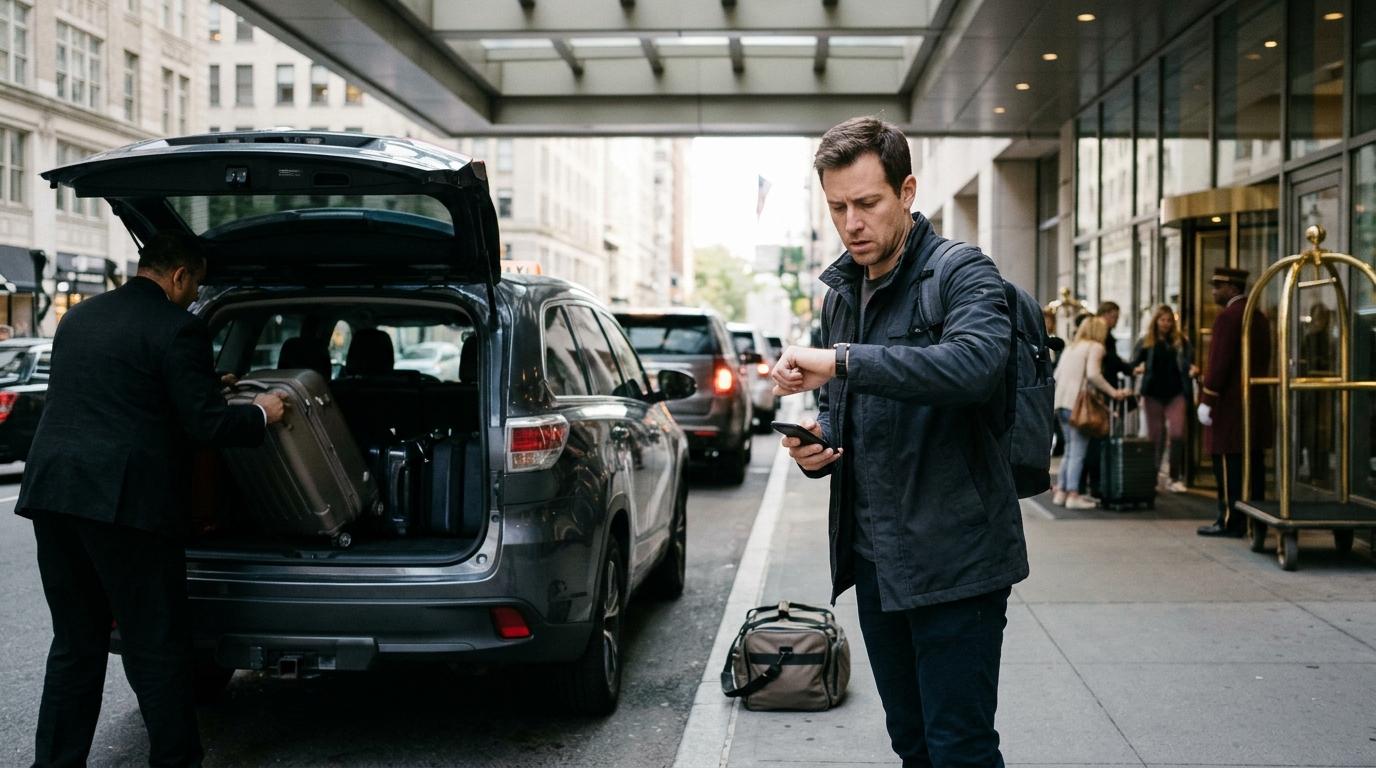
The last morning of a trip has a way of slipping by. You're packing chargers, checking under the bed one last time, settling the bill at the front desk, and suddenly the clock says you should have left fifteen minutes ago. Knowing exactly when to leave hotel for airport takes the guesswork out of that morning. It isn't a single number, though. The right departure time depends on your flight, the airport, the distance from your hotel, the time of day, and how you're getting there. This guide walks you through a simple way to work it out, with real examples you can adapt to your own trip.
Why Leaving From a Hotel Is Different From Leaving Home
When you fly out of your hometown, you know the roads, the traffic patterns, and roughly how long the drive takes. At a hotel, you're working with less information and more moving parts.
You may be in an unfamiliar city where rush hour starts earlier than you'd expect. You have to check out, which can mean a line at the front desk on busy mornings. Your luggage might be stored with the bell desk, or you may be juggling extra bags with souvenirs. If you rented a car, it has to be returned before you get anywhere near the terminal. And if you're relying on the hotel shuttle, you're on its schedule, not yours.
Each of these adds minutes, and travelers tend to underestimate all of them at once. That's why hotel departures need a little more planning than a trip from your own driveway.
Start With Your Airport Arrival Time
Before you can figure out how early to leave the hotel for the airport, you need to know when you want to walk into the terminal. Work backward from there.
Domestic Flights
For domestic flights within the US, most airlines recommend arriving about two hours before departure. At smaller regional airports with short security lines, travelers sometimes cut that closer, but two hours is a reliable target, especially if you're checking a bag or flying during a busy period.
International Flights
For international departures, the common recommendation is three hours. Passport and document checks, longer check-in lines, and earlier bag drop cutoffs all eat into your time.
The Cutoffs That Actually Matter
Recommendations are a buffer. Airline cutoffs are the hard limits. Many US carriers close bag check around 45 minutes before a domestic departure and 60 minutes before an international one, though this varies by airline and airport. Boarding often begins 30 to 50 minutes before takeoff, and gate doors usually close shortly before departure. Miss any of these, and an on-time flight doesn't help you.
Check your airline's specific rules for your route the day before you fly. If you want a deeper look at how much time to allow inside the airport itself, our guide to airport arrival timing breaks it down by flight type and airport size.
A Simple Formula for When to Leave Hotel for Airport
Once you know your target arrival time, the rest is straightforward subtraction:
Flight departure time minus recommended airport arrival time minus realistic travel time minus traffic buffer minus checkout and loading time equals the time you should be in the hotel lobby.
"Realistic travel time" means the drive at the hour you'll actually be on the road, not the estimate a map app shows you the night before at 10 p.m. Check the predicted travel time for your departure hour if your navigation app offers it.
Example: Midday Domestic Flight
Say you have a 1:30 p.m. domestic flight, and the airport is about 40 minutes from your hotel.
-
Aim to arrive at the airport by 11:30 a.m. (two hours before departure).
-
Allow 40 minutes for the drive, plus a 20-minute traffic buffer. That puts you in the car by 10:30 a.m.
-
Give yourself 15 minutes to check out and load your bags. You should be in the lobby by 10:15 a.m.
That timing also fits neatly before a typical 11 a.m. or noon checkout, so you're not paying for a late checkout you don't need.
Example: Early International Flight
Now take a 9:00 a.m. international flight with the airport 30 minutes away.
-
Aim to arrive by 6:00 a.m. (three hours before departure).
-
Early morning roads are usually lighter, so 30 minutes of driving plus a 15-minute buffer means leaving at 5:15 a.m.
-
Be in the lobby by 5:00 a.m.
At that hour, the hotel restaurant probably won't be open, and the front desk may be lightly staffed. Settle your bill the night before or use express checkout if your hotel offers it, and pack a snack for the ride.
Factors That Can Change Your Hotel Departure Time
The formula gives you a starting point. These are the situations where you should add more time.
Rush hour and local traffic. A 30-minute drive at 6 a.m. can take an hour at 8 a.m. in cities like Los Angeles, New York, Atlanta, or Chicago. If your drive overlaps with the morning or evening commute, double-check predicted times and pad your buffer.
Large or busy airports. Big hub airports often have multiple terminals, long walks from the curb to security, and slower drop-off lanes. Know which terminal your airline uses before you leave so your driver goes straight there.
Peak travel days. Holiday weekends, spring break, and Sunday afternoons tend to bring longer security and check-in lines. Adding 30 minutes to your airport arrival time on these days is a smart move.
Rental car returns. Returning a rental usually means a separate facility, a shuttle or train to the terminal, and sometimes a line. Many travelers set aside 30 minutes or more for this step alone.
Traveling with kids, groups, or lots of luggage. Everything takes longer with more people. Strollers, car seats, and extra bags slow down loading, check-in, and security.
No TSA PreCheck or similar programs. If you don't have expedited screening, plan for standard security lines, which can vary widely by time of day.
How Your Ride to the Airport Affects Timing
Your choice of transportation has a bigger effect on your hotel departure time than most people realize. The option you pick decides how much of your schedule you actually control.
Hotel Shuttles
Free hotel shuttles are convenient but run on fixed schedules, often every 30 minutes or every hour. If the timing doesn't line up with your flight, you may have to leave far earlier than necessary. Shuttles can also fill up on busy mornings and may stop at multiple terminals before reaching yours.
Rideshare and Taxis
Rideshare and taxis work well in many cities, but availability isn't guaranteed. Early morning pickups, bad weather, and big events can mean long waits or surge pricing. You also won't know the vehicle size until it arrives, which can be a problem if you have several suitcases or a car seat.
Private Airport Transfers
A pre-booked private transfer removes most of these unknowns. You choose the exact pickup time based on your own calculation, a driver meets you at the hotel, and you go straight to your terminal with no extra stops. You can also pick a vehicle that fits your group and luggage ahead of time, whether that's a sedan for a solo business trip or a van for a family of five.
This matters most on early flights, international departures, and trips where missing the plane would be expensive. With Transpovia, you can book a private airport transfer in advance and lock in a pickup time that matches your plan, so the morning of your flight starts on your schedule instead of an app's availability.
Getting Ready the Night Before
The smoothest departures are mostly settled the evening before. A little prep keeps your morning focused on getting out the door.
Confirm your flight time and terminal, then check in online so you have your boarding pass on your phone. Ask the front desk whether you can settle your bill in advance and how express checkout works. If you have a late flight and an early checkout, arrange to store your luggage with the bell desk so you can enjoy the day without dragging bags around.
Pack everything except what you'll need in the morning, and set your passport, ID, wallet, and phone charger in one spot. If you've booked a private transfer, confirm the pickup time and location, especially at large hotels with more than one entrance.
Running through an airport travel checklist the night before is one of the easiest ways to catch what you'd otherwise forget, like liquids in your carry-on or a missing travel document.
Common Mistakes That Make Travelers Late
Even careful planners slip up in a few predictable ways.
The most common one is trusting a nighttime travel estimate for a morning drive. Another is forgetting that checkout itself takes time, particularly when several guests are leaving at once. Some travelers plan perfectly for the airport but forget the rental car return or the walk from a remote parking area.
There's also the "one more coffee" problem. Small delays stack up. Setting your lobby time as the deadline, rather than your departure time, gives you a clean target to work toward.
Frequently Asked Questions
How early should I leave my hotel for an international flight?
Plan to arrive at the airport about three hours before departure, then subtract your travel time plus a traffic buffer. For a hotel 30 to 45 minutes away, that typically means leaving roughly three and a half to four hours before your flight, depending on the time of day and how busy the roads are.
Is two hours enough time for a domestic flight?
For most domestic flights, arriving two hours early is enough to check bags, clear security, and reach your gate. Add time on holidays, at very large airports, or if you're traveling with children. If you only have a carry-on and expedited security, you may need less, but leaving a cushion is still wise.
What should I do if my flight is after hotel checkout time?
Ask the front desk to store your luggage after checkout so you can spend the day exploring. Some hotels also offer late checkout, sometimes for a fee. Plan to return to the hotel with enough time to collect your bags and meet your ride, then follow the same timing formula from there.
Conclusion
Figuring out when to leave hotel for airport comes down to working backward. Start with when you want to be in the terminal, subtract a realistic drive time for the hour you'll be on the road, add a buffer for traffic, and leave room for checkout and loading bags. Adjust for international flights, busy travel days, rental returns, and larger groups.
The more of that process you control, the calmer your morning will be. Preparing the night before and booking a private airport transfer with a set pickup time takes the biggest variables off the table, so the last day of your trip feels like part of the trip rather than a race.
"We used to leave three hours early and still feel rushed. This time the car was waiting at 5 a.m., the bags went straight in the back, and we had time for breakfast at the gate."
— Melissa, traveling with her husband and two kids from Orlando


