
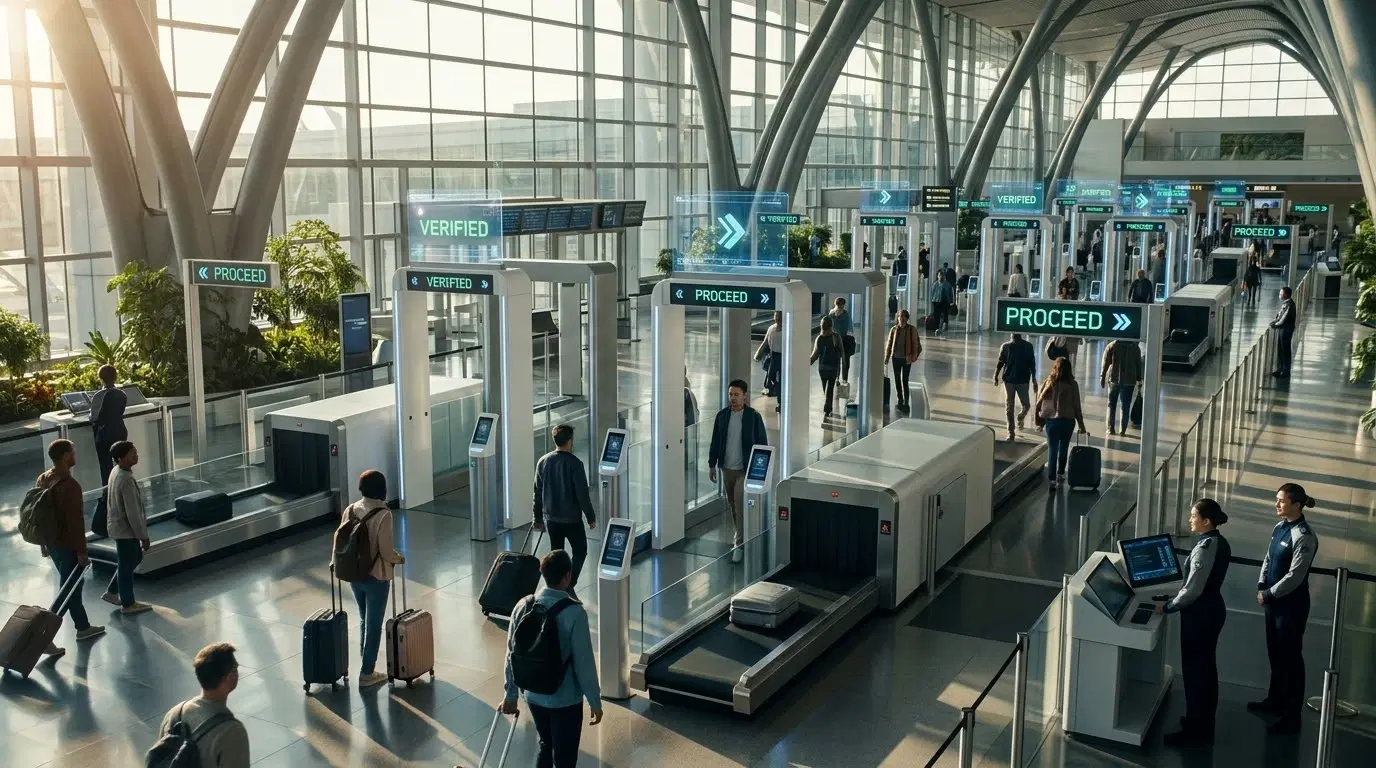
Most delays at the airport don't happen in the air. They happen in the forty feet between the ID podium and the scanner, where one forgotten water bottle or a laptop buried at the bottom of a backpack can hold up an entire line. Learning how to get through airport security faster is less about luck and more about a handful of decisions you make before you ever reach the terminal: what ID you carry, how you pack, what you wear, when you leave home, and how you get to the airport in the first place.
This guide walks through each of those decisions in the order you'll face them, with current TSA rules, practical packing habits, and a few things seasoned travelers do without thinking about it.
Why Airport Security Lines Slow Down
Security checkpoints rarely back up because officers work slowly. They back up because of small, repeated interruptions. A passenger digs through a bag for an ID. Someone else forgets a full-size sunscreen in a side pocket, and the bag gets pulled for a manual search. A family arrives with three carry-ons, a stroller, and no plan for unloading any of it.
Timing also plays a big role. Early-morning departure banks, Friday and Sunday afternoons, and holiday weekends push far more people through the same number of lanes. And when travelers arrive late and anxious, they tend to rush, which leads to the very mistakes that slow everyone down.
The good news is that almost every one of these delays is avoidable.
How to Prepare for Airport Security Before You Leave Home
The fastest trip through the checkpoint starts the night before. A few minutes of preparation at home saves far more time in line.
Check Your ID First
Since May 7, 2025, adults flying within the United States need a REAL ID-compliant driver's license or state ID, or another accepted document such as a U.S. passport, passport card, or trusted traveler card. Compliant licenses usually carry a star in the upper corner.
If you show up without acceptable ID, you aren't automatically turned away, but you should expect delays. Since February 1, 2026, travelers without acceptable identification can use TSA's ConfirmID process for a $45 fee, which verifies identity through additional steps and takes time you probably don't have on travel day. Children under 18 traveling with an adult on domestic flights don't need to show ID at the checkpoint.
Put your ID somewhere you can reach with one hand, like a jacket pocket or the front pouch of your personal item, rather than inside a wallet inside a bag.
Pack Your Carry-On With the Scanner in Mind
The 3-1-1 liquids rule is still in effect: each liquid, gel, aerosol, cream, or paste must be 3.4 ounces (100 milliliters) or less, and all containers must fit in one clear, quart-sized bag per passenger. Items people often forget count as liquids include toothpaste, peanut butter, hummus, lip gloss, gel deodorant, and snow globes.
A few packing habits make a real difference:
-
Keep your liquids bag in an outer pocket or right on top so you can remove it in one motion if asked.
-
Pack laptops and tablets where they slide out easily, not under a layer of clothes.
-
Empty your water bottle before the checkpoint and refill it at a fountain on the other side.
-
Put coins, keys, and your phone into your carry-on before you reach the bins, not while you're standing at them.
If you're not sure about an item, the "What Can I Bring?" search in the MyTSA app gives a quick answer. For everything else you should confirm before a trip, from boarding passes to chargers, keep an airport travel checklist and run through it the night before.
Dress for an Easy Screening
In July 2025, TSA ended its long-standing requirement that most passengers remove their shoes at standard checkpoints. Shoes generally stay on now, though an officer may still ask you to take them off if additional screening is needed, so comfortable slip-ons remain a smart choice.
Belts with large metal buckles, chunky jewelry, and outerwear with lots of zippers or pockets are more likely to trigger a pat-down. Wear simple layers, and plan to place a heavy jacket in a bin rather than walking through the scanner in it.
Time Your Arrival Around the Real Bottleneck
The standard advice is to arrive about two hours before a domestic flight and three hours before an international one. That window exists because security wait times can swing wildly, even at the same airport on the same day.
Before you leave, check the current wait at your departure airport. Many large airports post live checkpoint times on their websites, and the MyTSA app shows crowd-sourced estimates. If you're flying during a holiday rush or an early-morning peak, add extra time rather than trusting a normal day's estimate.
What many travelers overlook is that the clock starts long before the checkpoint. A ride that runs late, a full economy parking lot, a long wait for a parking shuttle, or a confusing drop-off at the wrong terminal can eat 30 minutes before you even reach the ID podium. Arriving rushed is how people end up rushing through bin loading, leaving items in pockets, and setting off alarms. The calmest security experience usually belongs to the traveler who arrived at the right door, on time, with nothing to scramble for.
Book a Private Airport Transfer to Start Your Trip on Schedule
How you get to the airport has a direct effect on how smoothly you clear security. With a pre-booked private airport transfer, your pickup time is set in advance, your driver knows which terminal and airline you're flying, and you're dropped at the departure curb instead of a remote parking lot. There's no waiting for a shuttle, no searching for a rideshare pickup zone, and no circling the garage.
That predictability matters most when the margins are tight. Families can load luggage, car seats, and strollers once instead of juggling them across a parking lot and a train. Business travelers can use the ride to finish emails and walk into the terminal ready to go. And anyone with an early flight can schedule a 4 a.m. pickup the day before instead of hoping a car is available in the dark.
Platforms like Transpovia let you compare and book private airport transfers ahead of time, so the ride to the airport is one less thing to think about on the morning of your flight. When the drive is handled, you arrive with time to spare and the patience to move through the checkpoint methodically, which is exactly what makes it faster.
Trusted Traveler Programs That Speed Up the Checkpoint
If you fly more than a couple of times a year, a trusted traveler program is the single biggest upgrade you can make to your security routine.
TSA PreCheck
TSA PreCheck gives approved travelers access to dedicated screening lanes where you can keep your shoes, belt, and light jacket on and leave your laptop and 3-1-1 liquids bag inside your carry-on. Lines are typically shorter and move more predictably.
Membership lasts five years after a background check and short in-person appointment. The fee varies slightly depending on the enrollment provider. Children 12 and under can use the PreCheck lane with an enrolled parent or guardian, and teens 13 to 17 can join an enrolled parent when they're on the same reservation and their boarding pass shows the PreCheck indicator.
One common mistake: PreCheck only works if your Known Traveler Number is saved in your airline reservation. Add it to your frequent flyer profile so it appears on every booking automatically.
Global Entry
Global Entry speeds up U.S. customs and immigration when you return from abroad, and it includes TSA PreCheck benefits. If you travel internationally even once or twice a year, it often makes more sense than PreCheck alone.
CLEAR
CLEAR is a private, paid service that verifies your identity with biometrics such as fingerprints or an iris scan, letting you skip the line for the ID check. You still go through physical screening afterward. Many frequent flyers pair CLEAR with PreCheck to shorten both stages of the checkpoint.
How to Get Through Airport Security Faster at the Checkpoint
Even with perfect preparation, the last few minutes still matter. Here's how to move through the line efficiently once you're in it.
Have your ID out before the podium. At many airports, officers scan your ID and confirm your flight electronically, but keep your boarding pass ready in your airline app or printed in case it's requested.
Listen to the lane instructions. Screening procedures now vary between lanes. Checkpoints with newer CT scanners often let you keep laptops and liquids in your bag, while older X-ray lanes still require you to take them out. Follow what the officer says for your specific lane rather than what you did on your last trip.
Load bins in a logical order. Put your jacket and loose items in the first bin, any electronics or liquids your lane requires you to remove in the next, then your bags. Push everything forward so the person behind you has room.
Walk through when called and keep moving. Once you clear the scanner, take your bins to the tables past the belt before repacking. Putting your shoes back on or zipping bags at the end of the conveyor is one of the most common reasons the exit side jams up.
Tips for Families, First-Time Flyers, and Travelers Who Need Assistance
Traveling with kids changes the math. Fold strollers before you reach the belt, take children out of carriers, and let older kids carry their own small bags so you're not managing everything at once. Formula, breast milk, and baby food are allowed in reasonable quantities beyond the 3.4-ounce limit, but tell the officer about them at the start of screening so they can be inspected separately.
Medications, both prescription and over-the-counter, are allowed in carry-ons. Medically necessary liquids can exceed 3.4 ounces as long as you declare them. Travelers with disabilities or medical conditions can contact TSA Cares at least 72 hours before their flight to ask about screening procedures and, at some airports, request a passenger support specialist.
If this is your first time at the airport, everything from check-in kiosks to boarding groups can feel unfamiliar. A beginner's guide to your first time at the airport covers the full journey from curb to gate, so the security checkpoint is just one step in a process you already understand.
Small Mistakes That Send Your Bag for a Second Look
A manual bag check can add several minutes to your trip through the checkpoint. These are some of the usual culprits:
-
A forgotten full-size bottle of lotion, shampoo, or sunscreen
-
Food spreads and dips over 3.4 ounces, like peanut butter or salsa
-
Tightly packed electronics and cables that create a dense, unclear image on the scanner
-
Pocketknives, multi-tools, or scissors left in a bag from a previous trip
-
Wrapped gifts, which officers may need to unwrap for inspection
Power banks and spare lithium batteries belong in your carry-on, not your checked bag, so keep them in an easy-to-see spot. A quick sweep of every pocket in your carry-on before each trip catches most of these problems.
Frequently Asked Questions
Do I still have to take my shoes off at TSA?
In most cases, no. TSA stopped requiring most passengers to remove their shoes at standard checkpoints in July 2025. An officer may still ask you to take them off if you need additional screening, so easy-to-remove shoes are still a good idea.
How early should I arrive to get through airport security on time?
Plan to reach the airport about two hours before a domestic flight and three hours before an international one. Check the live wait times for your airport before you leave, and add extra time during holidays, early-morning peaks, or if you're traveling with young children. Pre-booking a private transfer helps you stick to that schedule without depending on parking shuttles or last-minute rides.
Is TSA PreCheck worth it if I only fly a few times a year?
For many travelers, yes. Membership lasts five years, so even two or three round trips a year add up to dozens of faster screenings. If you also travel internationally, Global Entry may be the better value since it includes PreCheck benefits along with expedited customs on your return.
Conclusion
Getting through airport security quickly comes down to removing friction before it reaches the checkpoint. Carry an acceptable ID, pack your liquids and electronics where you can reach them, dress simply, and know which lane rules apply to you. If you fly often, a trusted traveler program will save you more time than any packing trick.
Just as important is how your day starts. When the ride to the airport is planned, on time, and drops you at the right terminal, you walk into the security line calm and organized instead of rushed. That combination of preparation and a reliable private transfer is what turns airport security from the most stressful part of travel into a routine few minutes.
"We used to lose half an hour just getting from long-term parking to the terminal with the kids. Once we started booking a private car for early flights, we got through security with time to grab breakfast before boarding." — a family shared


