
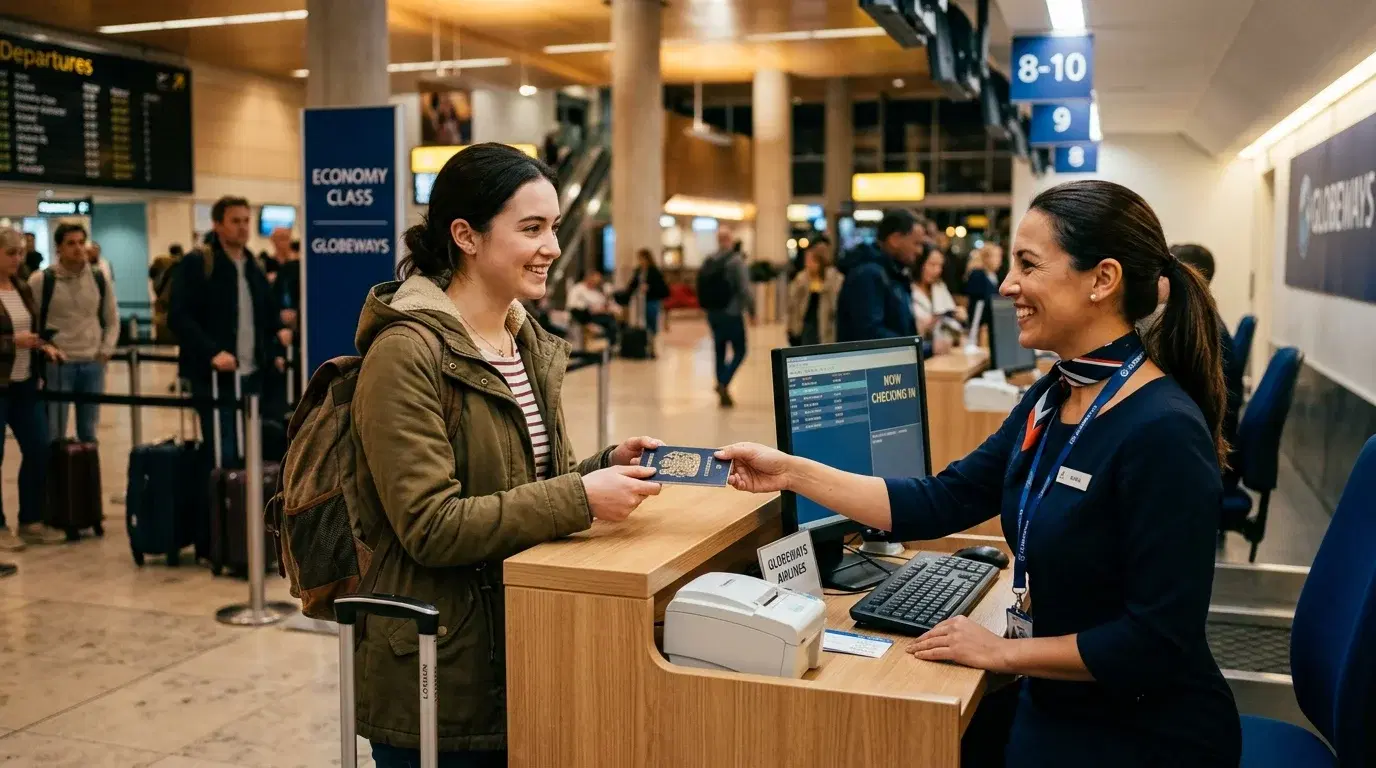
Being at the airport for the first time means moving through a sequence that feels unfamiliar exactly once. Check-in, security, boarding, and what happens after landing each follow a fairly consistent process at most airports, even though the details vary by airline and airport size. Walking through that sequence ahead of time, instead of discovering each step as it happens, turns an unfamiliar process into a predictable one.
Arriving and Checking In
Most airlines open online check-in 24 hours before departure, and completing it before arriving at the airport skips a counter stop entirely for travelers with only carry-on bags. Anyone checking a bag still typically needs to visit a counter or kiosk to attach a bag tag, even with a boarding pass already in hand.
Self-service kiosks handle most of this process at larger airports, printing bag tags and boarding passes in a few taps. A staffed counter is still worth locating for anyone with a question about a name mismatch, an oversized bag, or a booking issue a kiosk cannot resolve.
Going Through Airport Security
Security is the step first-time travelers ask about most, and the sequence is largely the same at every domestic checkpoint. A TSA officer checks a government-issued photo ID and boarding pass, comparing the name and photo before waving the traveler through. From there, bins go onto a conveyor belt, with laptops and other large electronics removed and placed in a bin on their own, along with the compliant quart-sized liquids bag.
The shoes-off requirement ended at TSA checkpoints in July 2025, though identity verification and standard screening otherwise work the way it has for years. Travelers then walk through either a metal detector or a full-body scanner using millimeter wave technology, and a bag or a scan that triggers an alert leads to a secondary inspection, which might include a pat-down or an explosive residue swab. TSA PreCheck skips several of these steps, including the laptop and liquids removal, for enrolled travelers in dedicated lanes.
Finding the Gate and Waiting to Board
Once through security, checking a departure screen or the airline's app for the current gate is worth doing even if a gate number was already printed on a boarding pass, since gates and terminals can change up until boarding. Larger airports sometimes require a train or a significant walk between the security checkpoint and a specific gate area, so building in time for that connection matters at bigger hubs.
Most airlines board passengers in numbered or lettered groups, called in sequence starting with those needing extra time, followed by premium cabins and elite status holders. Economy passengers are typically called from the back of the plane toward the front, which is meant to reduce congestion in the aisle during boarding. Checking a boarding pass for the assigned group ahead of time avoids confusion at the gate when boarding begins.
Boarding the Aircraft
Boarding passes are scanned at the gate before walking down the jet bridge, and a flight attendant typically directs passengers toward their general seating area once on board. Overhead bin space fills up in the order passengers board, so travelers in later groups may need to gate-check a bag if the bins fill before they reach their row.
Gate-checking a bag is free at most airlines and is often faster than working a large carry-on into an already crowded overhead bin, which matters for anyone traveling in one of the later boarding groups. Settling in before the group behind starts boarding, rather than lingering in the aisle, keeps the process moving for everyone.
What Happens After Landing
Getting off the plane, known as deplaning, generally happens row by row starting from the front, though this varies slightly by aircraft and gate setup. From there, signage typically directs arriving passengers toward baggage claim, ground transportation, or connecting gates, depending on the type of trip.
Travelers checking a bag head to baggage claim, where carousels are typically assigned by flight number and displayed on nearby monitors. Reviewing Airport Tips for First-Time Travelers covers what to expect immediately after landing in more detail, including how ground transportation options differ from the ones used on the way to the airport.
Deciding How to Get To and From the Airport
Transportation choices work differently depending on whether it's a first departure or a first arrival. Getting to the airport allows for advance planning, since the departure time and pickup location are both known well ahead of time. Getting away from the airport after landing involves more variables, including baggage claim time and whether a rideshare or taxi queue is busy when the flight lands.
Comparing transportation options before the trip, rather than deciding after arriving at an unfamiliar airport, removes one more unknown from a first flight. Public transit tends to suit travelers with light luggage and flexible timing, while a taxi, rideshare, or scheduled transfer suits anyone arriving late, traveling with a group, or carrying bulky bags.
Frequently Asked Questions
What should a first-time flyer bring to airport security?
A government-issued photo ID or passport, an accessible boarding pass, and a quart-sized bag of compliant liquids kept easy to reach cover most of what's needed at a standard checkpoint.
How do you know which boarding group to line up with?
The assigned boarding group appears on the boarding pass, whether printed or on a mobile app, and gate agents announce each group by number or letter as boarding begins.
Is it normal to feel confused navigating an airport for the first time?
Yes. Airport layouts, signage, and processes vary enough between airports that even experienced travelers occasionally need to check a map or ask staff for directions in an unfamiliar terminal.
What happens if a first-time flyer misses their boarding group?
Boarding late usually still works, since gate agents continue accepting passengers until the door closes, though arriving well before the final boarding call avoids any risk of missing the flight entirely.
Before You Go
Knowing the general sequence, check-in, security, boarding, and arrival, turns a first trip through the airport into a routine one. Confirm transportation on both ends ahead of time, whether that means public transit, a rideshare, or a booked Transpovia transfer, so getting to and from the airport is one less unknown on travel day.


