
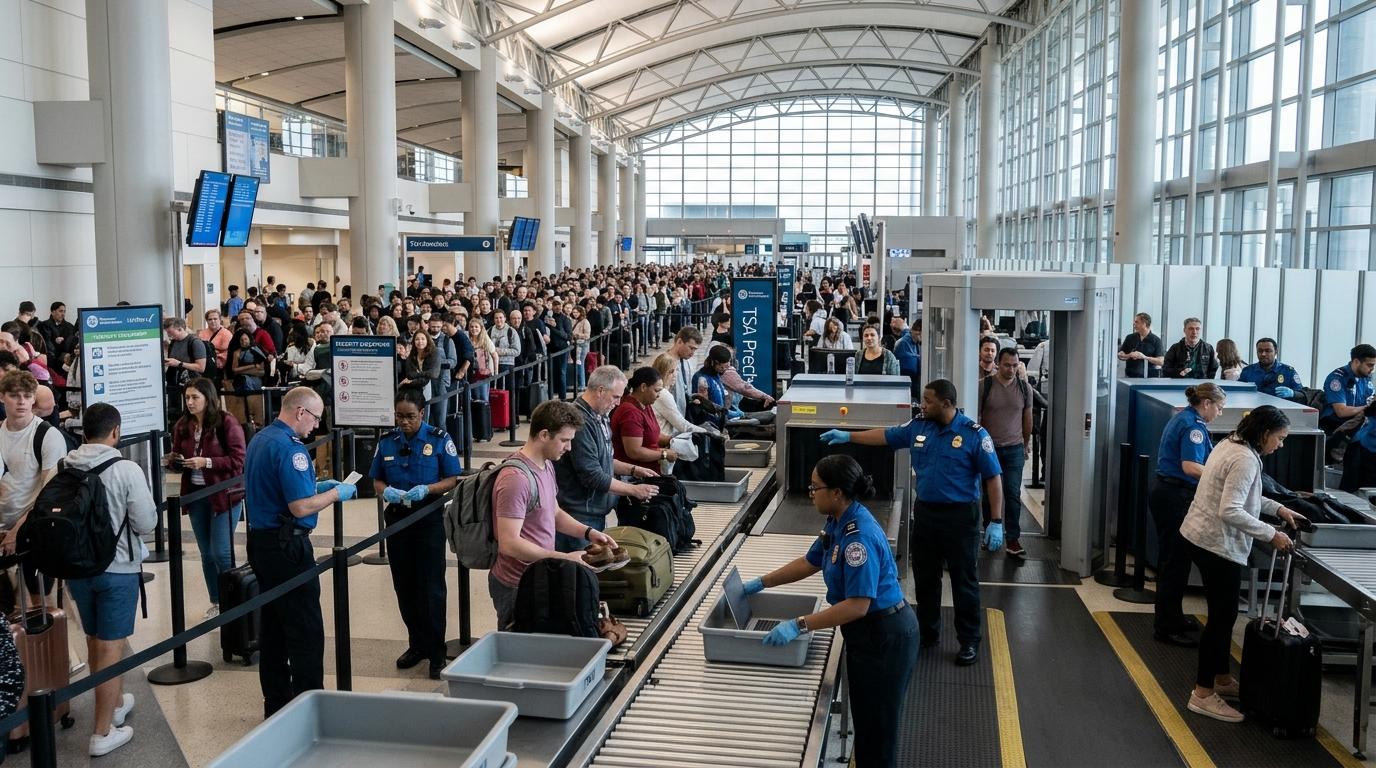
You've printed the boarding pass, packed the carry-on, and now the only real unknown is the line between you and your gate. So, how long does airport security take? On a typical day at a US airport, most travelers in the standard lane get through in 10 to 30 minutes, and TSA PreCheck members usually clear in under 10. That range can stretch well past 45 minutes on a holiday Sunday or a Monday morning at a major hub, though, and that's the part that catches people off guard.
This guide breaks down what an average airport security wait time looks like, what happens at each stage of screening, which factors make TSA wait times jump, and how to plan the rest of your trip so a long line doesn't turn into a missed flight.
How Long Does Airport Security Take on Average?
TSA sets internal performance goals of 30 minutes or less for standard screening and 10 minutes or less for PreCheck lanes. Most of the time, those targets hold. The agency reports that roughly 99% of PreCheck passengers wait less than 10 minutes.
Here's a realistic picture of how long TSA security takes in practice:
|
Situation |
Standard Lane |
TSA PreCheck |
|
Quiet midday or midweek |
5–15 minutes |
Under 5 minutes |
|
Typical weekday |
15–30 minutes |
5–10 minutes |
|
Peak mornings, holidays, busy hubs |
30–60+ minutes |
10–20 minutes |
Keep in mind that the posted wait time measures the queue, not the full screening. After you reach the front, you still need to unload your bags, walk through the scanner, and repack, which adds another 5 to 10 minutes for most people and more for families.
What Happens During Airport Security Screening
Knowing the sequence helps you move faster and estimate how long airport security screening will take once you're actually in it.
Document and ID Check
A TSA officer checks your boarding pass and ID, or at many airports, scans your ID and takes a quick photo instead. This step usually takes under a minute per traveler. Since May 7, 2025, the REAL ID Act has been fully enforced, so your license needs the star marking, or you need a passport or another accepted ID. Travelers who show up without acceptable identification can pay a $45 fee for TSA ConfirmID, which covers a 10-day window, but TSA warns that this process adds delays.
Bag Drop and Bin Loading
This is where most of the time disappears. In standard lanes, you'll typically place your carry-on, personal item, jacket, and belt in bins. Whether you need to remove laptops and your liquids bag depends on the scanner. Newer CT scanners let you leave them inside your bag at many checkpoints, while older X-ray machines still require you to take them out. Officers will tell you which rule applies.
One welcome change: since July 8, 2025, travelers no longer have to take off their shoes at TSA checkpoints, although shoes with a lot of metal can still trigger an alarm.
Body Scanner and Bag Inspection
The body scan itself takes seconds. Delays come from alarms, either on your body or in your bag. A forgotten water bottle, an oversized sunscreen, or a tangle of cables can send your bag to a manual search, which often adds 5 to 15 minutes. The 3-1-1 rule still applies: liquids, gels, and aerosols in containers of 3.4 ounces (100 milliliters) or less, all fitting in one quart-size bag.
What Makes TSA Wait Times Longer
The same airport can have a five-minute line at 1 p.m. and a 50-minute line at 6 a.m. These are the factors that matter most.
Time of Day and Day of the Week
Early mornings, roughly 5 to 9 a.m., are often the busiest window because so many flights depart in the first bank of the day. Late afternoons are another rush at many airports. Mondays, Thursdays, Fridays, and Sunday afternoons tend to be heavier, while Tuesdays and Wednesdays are usually calmer.
Holidays and Peak Travel Seasons
Thanksgiving week, the December holidays, spring break, and summer weekends regularly bring some of the longest airport security wait times of the year. Large events, such as conventions, playoff games, and festivals, can also flood a single airport with departing passengers on the same day.
The Airport and Even the Terminal
Large hubs like Atlanta, Chicago O'Hare, Los Angeles, New York JFK, and Orlando see higher volumes and more variability. Within the same airport, one terminal or checkpoint can run 20 minutes slower than another. If your airport has multiple checkpoints that connect airside, the farther one is sometimes faster.
Who's in Line With You
A line full of business travelers moves differently from one packed with first-time flyers, families with strollers, and large tour groups. Neither is good or bad, but it's a reason the "number of people in line" can be misleading.
How Long Does TSA Take With PreCheck, CLEAR, or Global Entry?
If you fly more than a couple of times a year, a trusted traveler program is the single most reliable way to shorten security.
TSA PreCheck gives you a dedicated lane where you keep on light jackets and belts and usually leave laptops and liquids in your bag. Membership lasts five years and costs less than $100. Children 17 and under traveling with an enrolled parent or guardian on the same reservation can generally use the PreCheck lane too, which makes a real difference for families.
Global Entry includes PreCheck and adds faster customs processing when you return from abroad. It costs a bit more and requires an interview with US Customs and Border Protection, but for international travelers it's often the better value.
CLEAR is a separate paid membership that verifies your identity with biometrics and walks you past the ID line. It doesn't replace screening. CLEAR on its own puts you at the front of the standard lane, while CLEAR combined with PreCheck is usually the fastest option at airports that offer both.
Even PreCheck lines can back up at busy hubs, so these programs reduce the risk rather than eliminate it.
Security for International Flights and Connections
Departing on an international flight from the US doesn't mean a longer TSA screening, but the overall airport process does take longer. Bag drop cutoffs are earlier, document checks at the counter take more time, and international terminals can be crowded during evening departure waves.
For connections, it depends on the route. If you're arriving from abroad into the US and connecting onward, you'll clear customs, recheck your bag, and go through TSA screening again. Allow for that when choosing a connection time. Domestic-to-domestic connections normally keep you airside, so no second screening is needed.
How to Check Airport Security Wait Times Before You Leave
A quick check before you head out the door can save you a stressful morning.
-
Your airport's website or app: Many major airports publish live security wait times by checkpoint.
-
The MyTSA app: It offers crowd-sourced and historical wait estimates, plus quick answers on what you can bring.
-
Your airline's app: Some airlines show checkpoint information alongside flight status.
Treat these numbers as a snapshot. A line that shows 12 minutes when you leave home can double by the time you arrive, especially during the morning rush. That's why it helps to pair live wait times with solid airport arrival timing rather than cutting it close based on a single reading.
Small Mistakes That Slow Down the Line
Most delays at the checkpoint come from preventable issues, not the line itself. These are the most common ones:
-
Bringing an ID that isn't REAL ID compliant, or leaving it in a checked bag
-
Packing full-size liquids in a carry-on
-
Forgetting a water bottle that still has water in it
-
Leaving keys, coins, or a phone in your pockets
-
Packing electronics and cables so tightly that the scanner can't get a clear image
-
Carrying prohibited items such as pocketknives, large tools, or certain sporting goods
Running through an airport travel checklist the night before is the simplest way to avoid a bag search and the extra 10 minutes it costs you.
The Part of Your Airport Timeline You Can Control
Security is the most unpredictable part of the trip, which is exactly why the rest of your timeline should be predictable. Many travelers lose more time before reaching the terminal than they do in the TSA line: circling for parking, waiting for a long-term lot shuttle, dealing with a rideshare cancellation at 4:30 a.m., or hauling luggage from a far-off garage with kids in tow.
A prebooked private airport transfer removes most of those variables. Your driver is arranged ahead of time, you're dropped at the right terminal door, and you walk straight to bag drop instead of starting the day stressed and behind schedule. That buffer matters most on the days when security wait times are hardest to predict, such as holiday weekends, early-morning departures, and trips through large hubs.
Transpovia makes it easy to book a private car to the airport in advance, which is especially useful for families with luggage and car seats, groups traveling together, and business travelers who want to use the ride to catch up on work rather than worry about parking. When the ground transportation is reliable, a 40-minute security line becomes an inconvenience instead of a crisis.
Frequently Asked Questions
How early should I arrive to get through airport security on time?
For domestic flights, most airlines recommend arriving about two hours before departure, and three hours for international flights. Add more time during holidays, early-morning peaks, or at large hubs, and if you need to check bags or are traveling with young children.
How long does TSA take with PreCheck?
Most PreCheck travelers wait less than 10 minutes, and TSA reports that about 99% of PreCheck passengers clear the line in under that time. At busy airports during peak hours, you may occasionally see 10 to 20 minutes.
What is the busiest time for airport security?
Early mornings, generally between 5 and 9 a.m., are often the busiest, along with late afternoons. Mondays, Fridays, Sunday afternoons, and major holiday periods typically bring the longest TSA wait times.
Conclusion
On an ordinary day, airport security takes most travelers somewhere between 10 and 30 minutes in the standard lane and well under 10 with PreCheck. The trouble is that ordinary days aren't guaranteed. Peak mornings, holidays, busy terminals, and a single forgotten water bottle can all push that number higher.
The best approach is to plan for the realistic range, not the best case. Check live wait times before you leave, pack with the screening rules in mind, consider a trusted traveler program if you fly often, and make getting to the airport the easy part of the day with a private transfer booked in advance. Do that, and the security line becomes just one more step on the way to your gate.
"The security line at JFK was almost an hour, but our driver had us at the terminal right on schedule, so we still made it to the gate with time to grab breakfast. That's the first holiday trip where I didn't spend the whole morning stressed."
— Mother of two, flying home for Thanksgiving


