
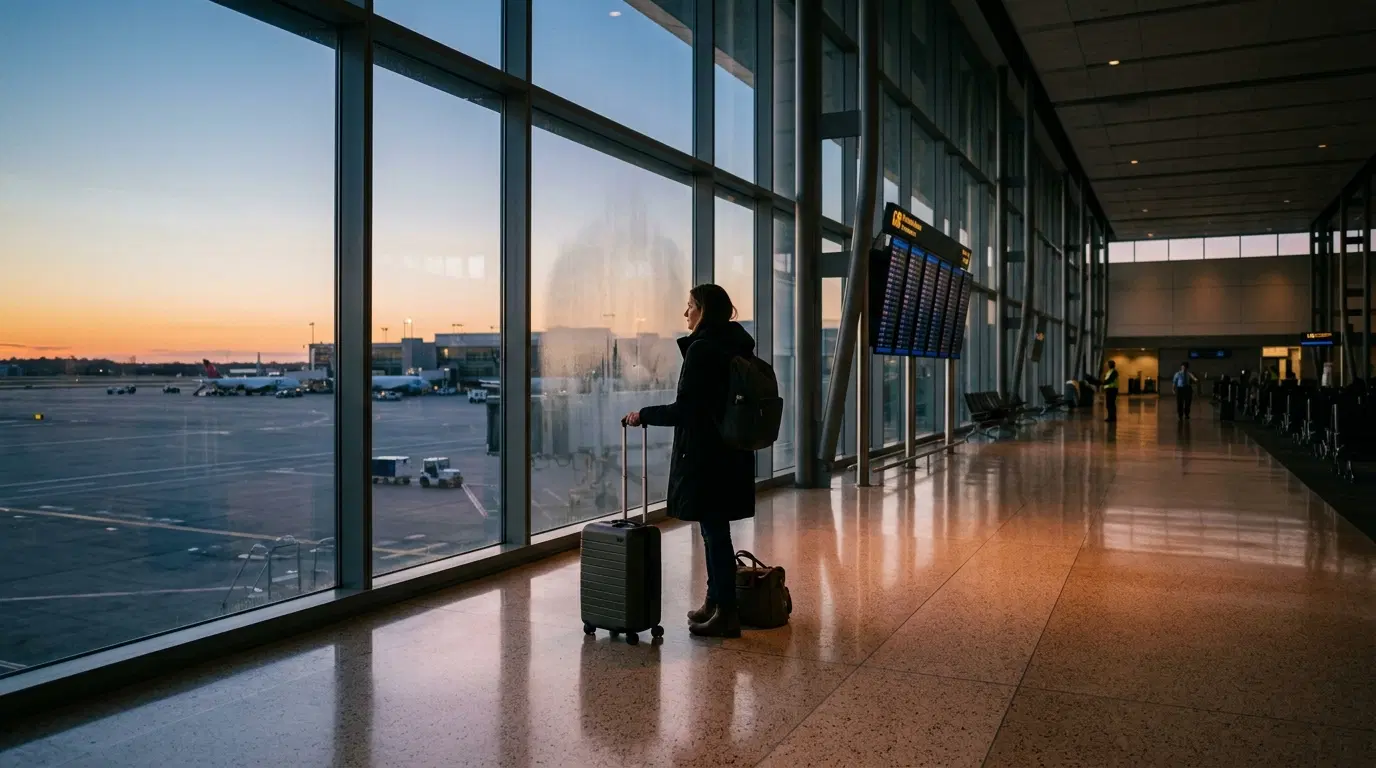
Knowing how early to get to airport check-in can decide whether you start your trip with a coffee at the gate or a sprint past a bag-drop counter that closed two minutes ago. The standard advice is easy to remember: two hours for domestic flights, three for international. But that rule was built for an average traveler on an average day, and very few trips are average.
Your bags, your airport, the hour of your flight, your ID, and even where you're flying to all move the number. This guide breaks the question down flight by flight, shows you how to work backward from the deadlines that actually count, and helps you figure out what time to leave home.
The Quick Answer
If you only need a starting point, use this:
|
Your flight |
Arrive at the terminal |
|
Domestic, carry-on only, already checked in online |
90 minutes to 2 hours |
|
Domestic, checking a bag |
2 hours |
|
Domestic on a holiday or peak travel day |
2.5 to 3 hours |
|
International, checking a bag |
3 hours |
|
International from a major hub at peak times |
3 to 3.5 hours |
|
Departing Europe's Schengen Area as a non-EU traveler |
3 hours or more |
The two-hour domestic and three-hour international guidance comes from the TSA and is echoed by major U.S. airlines. Treat these figures as the floor for a normal day, not a target to shave down. If you want the reasoning behind each window in more depth, our guide to airport arrival timing walks through it step by step.
Work Backward From the Deadlines That Actually Matter
Most travelers think about one time: departure. The airline thinks about three or four, and every one of them lands earlier than the time printed on your ticket.
Check-in and bag drop cutoff. Most major U.S. airlines close check-in and bag drop around 45 minutes before a domestic departure and 60 minutes before an international one. Some airports and routes require more time, so check your airline's page for your specific departure city. Miss this cutoff with a bag in hand, and the agent can refuse to accept it.
Security screening. This is the variable that wrecks plans. A checkpoint can take five minutes at 2 p.m. on a Tuesday and well over an hour on a Sunday evening in July.
Getting to the gate. At a large hub, the walk or train ride from security to a far-off gate can take 15 to 20 minutes on its own.
Boarding door close. Boarding usually begins 30 to 50 minutes before departure, depending on aircraft size, and many airlines close the door 10 to 15 minutes before takeoff. After that, the plane is effectively gone, even if it's still parked at the gate.
Add those pieces together and you'll see why two hours isn't overly cautious. It's simply the sum of the steps plus a modest cushion for things that go wrong.
How Early to Get to Airport Security for Every Type of Flight
Domestic flights with carry-on only
This is the one situation where you can reasonably trim time. If you've checked in on the airline's app, have a mobile boarding pass, and hold TSA PreCheck or CLEAR, 75 to 90 minutes is often enough at a mid-sized airport you know well. Without expedited screening, stick closer to two hours, especially at a large hub.
Domestic flights with checked bags
Two hours remains the usual answer to how early to get to airport for domestic flight departures when you're checking luggage. The bag drop line can take 15 to 30 minutes at a busy hub, and you need to clear it before the cutoff, not just join it before the cutoff.
International flights
For long-haul trips, three hours is the standard answer to how early to get to airport for international flight departures. Agents need to verify passports, visas, and sometimes entry documents for your destination, and international counters often process large groups of travelers checking multiple bags. Wide-body aircraft also begin boarding earlier.
Connecting itineraries and separate tickets
If your trip is on one ticket, the airline handles your bags and protects your connection. If you've booked two separate tickets, you may have to collect your luggage, re-check it, and clear security again. In that case, treat the second flight as a fresh departure and give it the full recommended window.
The first flight of the morning
Early departures have their own logic. Security checkpoints may not open until 4 or 4:30 a.m. at some airports, and showing up long before that just puts you at the front of a crowd waiting for the lights to come on. Check your airport's checkpoint hours, and aim for about 90 minutes to two hours before a 6 a.m. domestic flight.
Holidays, school breaks, and peak travel days
Thanksgiving week, the days around Christmas and New Year's, spring break, and summer Fridays and Sundays all push lines longer. Add 30 to 60 minutes to your usual window. Peak hours within any given day also matter: early mornings and late afternoons tend to be busiest.
Traveling with kids, a group, or special assistance
Families with strollers and car seats, travelers needing wheelchair assistance, and anyone flying with a pet in the cabin should plan for extra time at check-in. Airlines often need to tag strollers, verify pet documents, or arrange assistance, and all of that happens at the counter. In the U.S., the TSA doesn't require ID from travelers under 18 on domestic flights, but the adults in your group still need theirs.
Small regional airports
Smaller airports really can move faster, but they also run fewer flights, often have a single security lane, and may only staff counters around scheduled departures. Ninety minutes is usually comfortable for a domestic flight, but don't assume a tiny airport means you can arrive 30 minutes out.
Leaving Europe as a non-EU traveler
Since April 10, 2026, the EU's Entry/Exit System has been fully operational at Schengen external borders. Non-EU travelers have their passport data and biometrics (fingerprints and a facial image) recorded digitally instead of receiving a passport stamp, and major hubs have reported border queues of up to two hours at peak times. If you're flying home from Paris, Amsterdam, Rome, or another Schengen airport, plan for at least three hours and more in summer.
Check Your ID Before You Check the Clock
Arriving early won't help if your ID stops you at the checkpoint. REAL ID enforcement began on May 7, 2025, so domestic travelers 18 and older need a REAL ID-compliant license (usually marked with a star), a U.S. passport, or another TSA-accepted document.
Since February 1, 2026, travelers without acceptable ID can use the TSA's ConfirmID process for a $45 fee. Verification covers a 10-day travel window, but TSA warns that it can take up to 30 minutes at the airport and the fee doesn't guarantee approval. If that applies to you, pay online at tsa.gov before you leave and add at least 30 extra minutes to your arrival time. Better yet, sort out your REAL ID before your next trip.
ID is just one item worth confirming before you leave. Our airport travel checklist covers documents, bags, apps, and the small things that tend to get forgotten the night before.
How to Work Out Your Leave-Home Time
Every arrival recommendation assumes you're already standing inside the terminal. The ride there is a separate calculation, and it's where many missed flights actually begin.
Here's a simple way to set your departure time:
-
Start with your target arrival time. For a 9:15 a.m. domestic flight from a large hub with one checked bag, that's 7:15 a.m.
-
Subtract realistic travel time. If the drive normally takes 35 minutes but you'll hit morning rush hour, call it 45.
-
Add a cushion for the trip itself. Fifteen to 20 minutes covers a slow pickup, a wrong terminal exit, or a backup on the airport access road.
-
Add time for parking or a rental return. Off-site parking shuttles and rental car returns can easily add 20 to 30 minutes.
In that example, you'd want to be on the road by about 6:10 a.m. If it's the day before Thanksgiving, make it 5:40.
This is also where your choice of ground transportation matters. Rideshare availability can thin out before dawn, public transit may not be running yet for a very early flight, and driving yourself means factoring in parking. A pre-booked private transfer gives you a fixed pickup time planned around your flight, which takes one variable off an already tight morning. Transpovia lets you reserve that ride in advance at airports around the world, which is especially useful for families with luggage or travelers landing in an unfamiliar city.
"I used to leave for the airport whenever my bag was zipped and hope traffic cooperated. For a 6:10 a.m. flight out of O'Hare, I booked a car for 4:15 instead. The driver was already outside when I came down, and I was through security with enough time to actually eat breakfast. That's the whole trick: plan the ride as carefully as the flight."
Illustrative example of a frequent business traveler's experience
Check Conditions on the Day You Fly
Fixed rules can't account for a bad day at the airport, so take two minutes to check before you leave. The MyTSA app shows crowd-sourced checkpoint wait times, and many airports post real-time security waits on their websites or social media accounts.
Airport advisories can change quickly. During the partial federal shutdown in early 2026, TSA staffing shortages led Atlanta's Hartsfield-Jackson to advise travelers to arrive at least four hours early. At the same time, some airports have asked early-morning travelers not to come too early, since a crowd waiting for the checkpoint to open creates the first long line of the day. The lesson is simple: when your departure airport publishes guidance, follow it over any general rule.
Weather, construction around terminals, and major traffic disruptions can also slow the roads into the airport. If any of these are expected, leave earlier.
What to Do If You're Running Late
If you realize you're cutting it close, act before you reach the airport. Check in on the airline's app immediately, since online check-in usually closes at the same time as the counter. If you have a checked bag and you'll miss the cutoff, consider whether you can carry everything on.
At the airport, tell an airline agent your departure time right away. Some airports have staff or dedicated lanes for travelers with imminent departures, but that help is never guaranteed. If you do miss the flight, go straight to the airline's counter or call them. Major U.S. airlines often rebook travelers on a later flight or put them on standby, though policies depend on your fare type.
Frequently Asked Questions
How early should I get to the airport for a 6 a.m. flight?
For a domestic flight, aim for 90 minutes to two hours before departure, and check when your airport's security checkpoint opens. Arriving long before the checkpoint opens won't get you through any faster. For an international flight at 6 a.m., plan on about three hours unless your airline's counter opens later.
Is one hour enough time at the airport?
For most travelers, no. One hour can work for a domestic flight from a small airport if you have no checked bags, a mobile boarding pass, and TSA PreCheck. It's too risky for international flights or any trip with checked luggage, because bag drop typically closes 45 to 60 minutes before departure.
Can you get to the airport too early?
Yes. Airline counters may not be open yet, and you can't check a bag until they are. Some airports have also discouraged very early arrivals for morning flights because they create long lines before checkpoints open. Arriving three or four hours ahead only makes sense when your airport is specifically advising it.
The Bottom Line
Two hours for domestic flights and three for international remains the right baseline, but the smart move is to work backward from your airline's check-in cutoff, then adjust for bags, peak travel days, your airport, and where you're flying. Confirm your ID, check wait times before you leave, and plan the ride to the terminal with the same care as the flight itself. Get those pieces right, and the airport becomes the easy part of the trip.
"We used to argue every single time about when to leave for the airport. Now we book the ride the night before, and the trip starts calm instead of rushed."


