
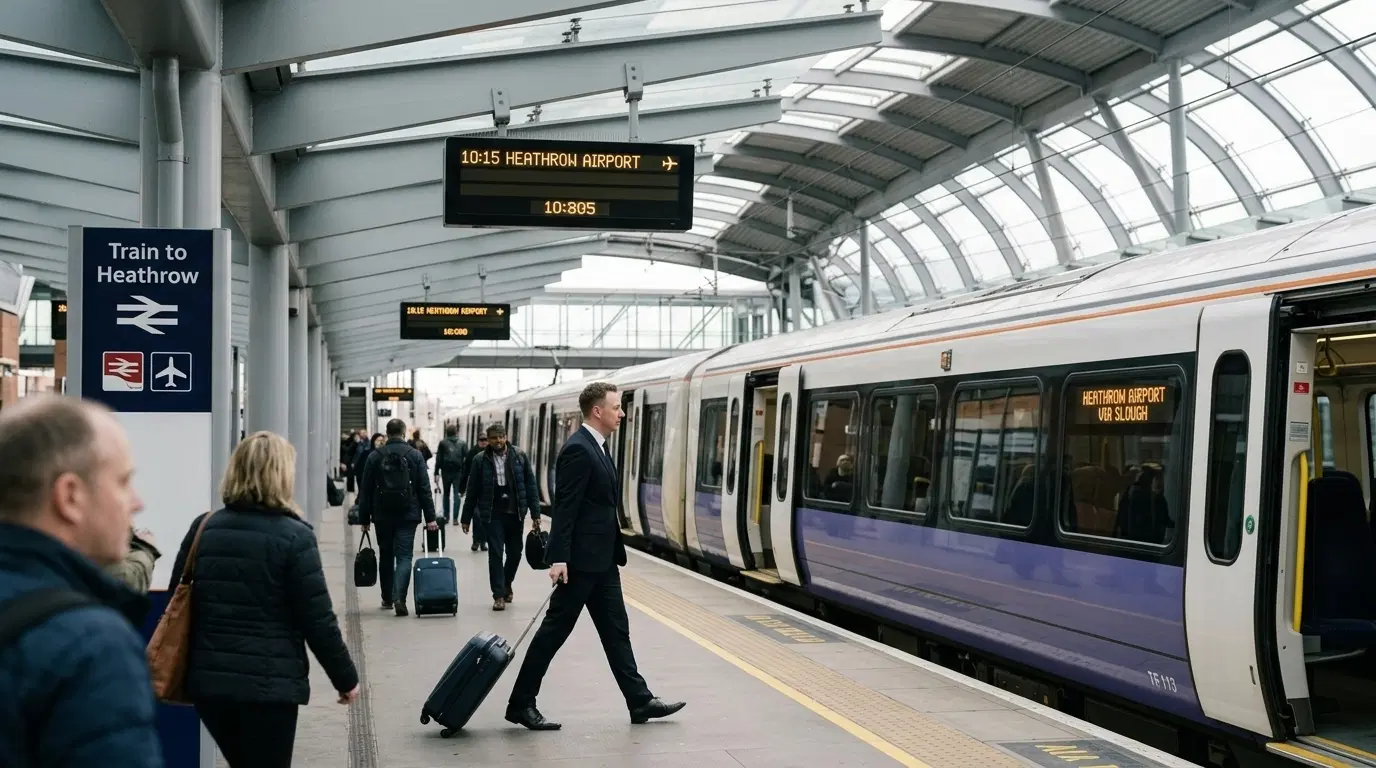
There are three trains to Heathrow. The Heathrow Express is fastest at 15 minutes from Paddington, the Piccadilly line (the Tube) is cheapest, and the Elizabeth Line is the best all-rounder because it links central London to the airport in about half an hour with no change. Which one is right depends on where you start, which terminal you need and how much luggage you carry. This guide compares all three, explains which terminals each serves, and covers what to do when lines are disrupted.
You can pay for the Elizabeth Line and the Tube with a contactless card or phone, and you can add RailAir and National Express coaches if you are coming from outside London. Read the sections that match your journey; you do not need all of them.
There were strikes on the line the morning we flew, so we switched to a pre-booked car. We left on time and never had to check a departure board.
Heathrow trains at a glance
Use this table to compare. Fares and times are typical for October 2026 and vary with time of day and ticket type.
|
Option |
Route |
Time to central London |
Fare (single) |
Frequency |
Terminals served |
|
Elizabeth Line |
Heathrow to Paddington and across central London |
About 30 minutes to Paddington |
About £13 to £16 |
Every 10 to 15 minutes at Terminals 2 and 3 |
2 and 3, 4, 5 |
|
Heathrow Express |
Non-stop to Paddington |
15 minutes |
About £10 (advance) to £26 |
Every 15 minutes |
2 and 3, 5 (change for 4) |
|
Piccadilly line |
Heathrow to central London, many stops |
About 50 to 60 minutes |
About £5.60 to £5.90 |
Every 5 to 10 minutes |
2 and 3, 4, 5 |
|
RailAir and National Express coaches |
Heathrow to Reading, Woking, Guildford, Watford and beyond |
See each route |
Varies |
Varies |
Varies |
In short: take the Express for speed, the Piccadilly line for the lowest fare, and the Elizabeth Line for most journeys in between.
How to choose between the three
Start with your destination. If you are heading to Paddington, Bond Street, Tottenham Court Road or the City, the Elizabeth Line is probably the right answer because it is a through service. If you are going to Paddington itself and speed matters, the Express wins. If you are going to Kings Cross, Piccadilly Circus, South Kensington or other West End stops, the Piccadilly line may be the only direct train.
Then think about luggage. The Express and Elizabeth Line are more comfortable with a suitcase than the Tube. And finally think about time: a late arrival may change the choice, because the Piccadilly line and Elizabeth Line run later than the Express.
Elizabeth Line to Heathrow
The Elizabeth Line is a cross-London railway that links Heathrow and Reading in the west with Essex and south-east London in the east. It serves the airport from Paddington, Bond Street, Tottenham Court Road, Farringdon and Liverpool Street, so you can often board without changing.
Which terminals it serves
Elizabeth Line trains serve Heathrow Terminals 2 and 3, Terminal 4 and Terminal 5. Terminals 2 and 3 have the most frequent service, about six trains an hour, while the Terminal 4 and Terminal 5 branches run less often. That is why the destination on the train matters. Always check the platform display and the front of the train, and look at the TfL journey planner for the current pattern, because services can change.
If you are flying from Terminal 4, the Elizabeth Line is the only train that serves it directly, apart from the Piccadilly line. If you are flying from Terminal 5 and the next Elizabeth Line train goes to Terminal 4, you can change at Terminals 2 and 3 to the Piccadilly line or the Express.
Fares, contactless and journey time
The journey from Paddington to Terminals 2 and 3 takes about 30 minutes. A single from central London costs roughly £13 to £16, depending on the current fare. Pay with a contactless card, phone or Oyster card at the gates; there is no need to buy a ticket. Daily capping applies, so you will not pay more than the cap if you make several journeys on the same day.
If you hold a Travelcard that covers zones 1 to 6, it is valid on this route, which can make the airport journey much cheaper. Always tap in and out with the same card, or you may be charged a maximum fare.
Heathrow Express
The Heathrow Express is a non-stop train that runs between Paddington and Heathrow. It takes 15 minutes to Terminals 2 and 3, around six minutes more to Terminal 5, and trains leave every 15 minutes. It has large luggage racks, free Wi-Fi and plenty of seats, which makes it the most comfortable way to arrive with bags.
Advance fares and carnets
The Express has the widest fare range. A walk-up single can reach about £26, while advance tickets can start at about £10. Carnets (books of tickets) can reduce the price per journey if you travel often. Standard and first-class tickets are sold, and children travel free or at a reduced rate on many tickets.
Book early for the best price. If you arrive at Paddington with no ticket, the Elizabeth Line is nearly as quick and much cheaper. The Express also stops running earlier than the Elizabeth Line, so check the last departure if you are travelling late.
Piccadilly line (Tube)
The Piccadilly line runs from central London to Heathrow, calling at many stops. It serves Terminals 2 and 3, Terminal 4 and Terminal 5, and it is the cheapest rail route at roughly £5.60 to £5.90 a single. It is the only train that goes directly from areas such as Piccadilly Circus, South Kensington, Hammersmith and Kings Cross to Heathrow.
Luggage, steps and journey time
The ride takes about 50 to 60 minutes from the West End and longer from the east. Trains are busy at peak times and have little luggage space, so one suitcase is manageable and several are a struggle. Many central stations have stairs and escalators, so check the step-free map before you set off.
Trains split on the way, so some go to Terminal 5 and some to Terminal 4. The signs on the platform tell you which, and the on-train announcements repeat the destination. If you are staying near Kings Cross, the line runs direct, and the Eurostar connection is covered in more detail in our guide to Kings Cross to Heathrow below.
RailAir links and National Express
If you are coming from outside London, coaches may be easier than trains. RailAir runs from Reading, Woking, Guildford and Watford, with luggage space and direct stops at Heathrow. National Express serves many more cities, and its timetables and fares are on the operator's website. These coaches can be cheaper than the train, but they use the road and can be delayed by traffic.
Trains are still the better choice if you are travelling within London or from a town with a direct rail link, because rail is not affected by motorway traffic. For more detail on coach options, read our coach to Heathrow guide.
Rail or coach from outside London
If you live along the M4 or M25 corridor, the coach may save you a change in London. If you live in the north, the train to London followed by the Elizabeth Line may be more reliable, though you will carry your luggage across the capital. A pre-booked car from the door can beat both when you have a long trip.
Getting to each Heathrow terminal by train
Use this quick guide to reach the right terminal.
|
Terminal |
Elizabeth Line |
Heathrow Express |
Piccadilly line |
|
Terminals 2 and 3 |
Direct |
Direct |
Direct |
|
Terminal 4 |
Direct |
Change at 2 and 3 |
Direct |
|
Terminal 5 |
Direct (less frequent) |
Direct (extra few minutes) |
Direct |
Check your airline's terminal before you travel. If you arrive at the wrong terminal, free transfers link them. Our guide to Heathrow to central London explains the return routes in more detail.
Changing between terminals
Terminals 2 and 3 are linked by walkways, and Terminal 5 has its own station and its own transfer service. If you land at Terminal 3 and your train goes from Terminal 5, allow time for the transfer and do not assume that the nearest station is yours. A quick look at the signs and the departure board before you head to the platform can save a lot of time.
Heathrow train disruption: what to do when lines are closed
Engineering works, signal failures and strikes can close sections of the Piccadilly line, Elizabeth Line or Heathrow Express, often at weekends. Check TfL service updates and the Heathrow website before you leave, and again when you are on your way. Disruption is more common than people expect, and a few minutes of checking can save an hour of confusion.
If one line is closed, switch to another. For example, if the Piccadilly line is suspended, the Elizabeth Line or Heathrow Express usually still runs. If all rail services are down, take a coach or book a car. In a major disruption, allow extra time, because replacement buses and taxis are busy.
Keep a screenshot of your booking and check whether your airline will rebook you if you miss a flight because of rail problems. Most airlines will not move you for free just because the train was late, so build in a safety margin before you leave home.
When a private transfer beats the train
Trains are good value, but a pre-booked car wins in four situations: late arrivals when services thin out, heavy luggage and stairs, groups of three or more who can split the fare, and times when disruption makes rail unreliable. A car meets you at the door, has a fixed price, and can track your flight. See our Heathrow airport transfer page to compare.
The case for a car is strongest at the extremes of the day. Before 6am and after 11pm, trains are infrequent and Tube stations are quiet, and a driver is simply easier. In the middle of the day, a train is usually quick and good value.
Station guides
The best route depends on the station you start from. These guides give step-by-step directions:
-
Paddington to Heathrow: the Heathrow Express and Elizabeth Line starting point.
-
Kings Cross to Heathrow: Piccadilly line direct and Eurostar connections.
-
Liverpool Street to Heathrow: the Elizabeth Line from the City and Stansted Express arrivals.
FAQs
What is the fastest train to Heathrow?
The Heathrow Express, at 15 minutes from Paddington to Terminals 2 and 3.
What is the cheapest train to Heathrow?
The Piccadilly line, at around £5.60 to £5.90 a single, although it takes about an hour from central London.
Does the Elizabeth Line go to Heathrow Terminal 5?
Yes. The Elizabeth Line serves Terminals 2 and 3, Terminal 4 and Terminal 5, though the Terminal 5 branch runs less often. Check the departure board, as the service pattern can change.
Can I use contactless on the trains to Heathrow?
Yes, on the Elizabeth Line and Piccadilly line. The Heathrow Express accepts its own tickets, and many travellers also use contactless, but check the gate rules.
How do I get to Heathrow Airport by Tube?
Take the Piccadilly line towards Heathrow Terminal 5 or Terminal 4, depending on your terminal. Trains split on the way, so check the destination before you board.
What if the trains are cancelled?
Switch to another line, a coach or a pre-booked car. Check TfL and Heathrow updates before you leave and keep a margin for delays.
Is there a night train to Heathrow?
Rail services stop overnight on most days. Night buses and pre-booked cars serve the airport after the last train.
Is the train good with a lot of luggage?
The Heathrow Express and Elizabeth Line have more space than the Tube. For heavy luggage, a pre-booked car is easier.
The Best Train to Heathrow for Your Trip
Take the Heathrow Express if speed and a fixed schedule matter most. Take the Elizabeth Line if you want the best balance of price, speed and stops. Take the Piccadilly line if you are watching every pound and travelling light. And when disruption, luggage or a late arrival makes rail a gamble, Transpovia can arrange a fixed-price car straight to your terminal.


