
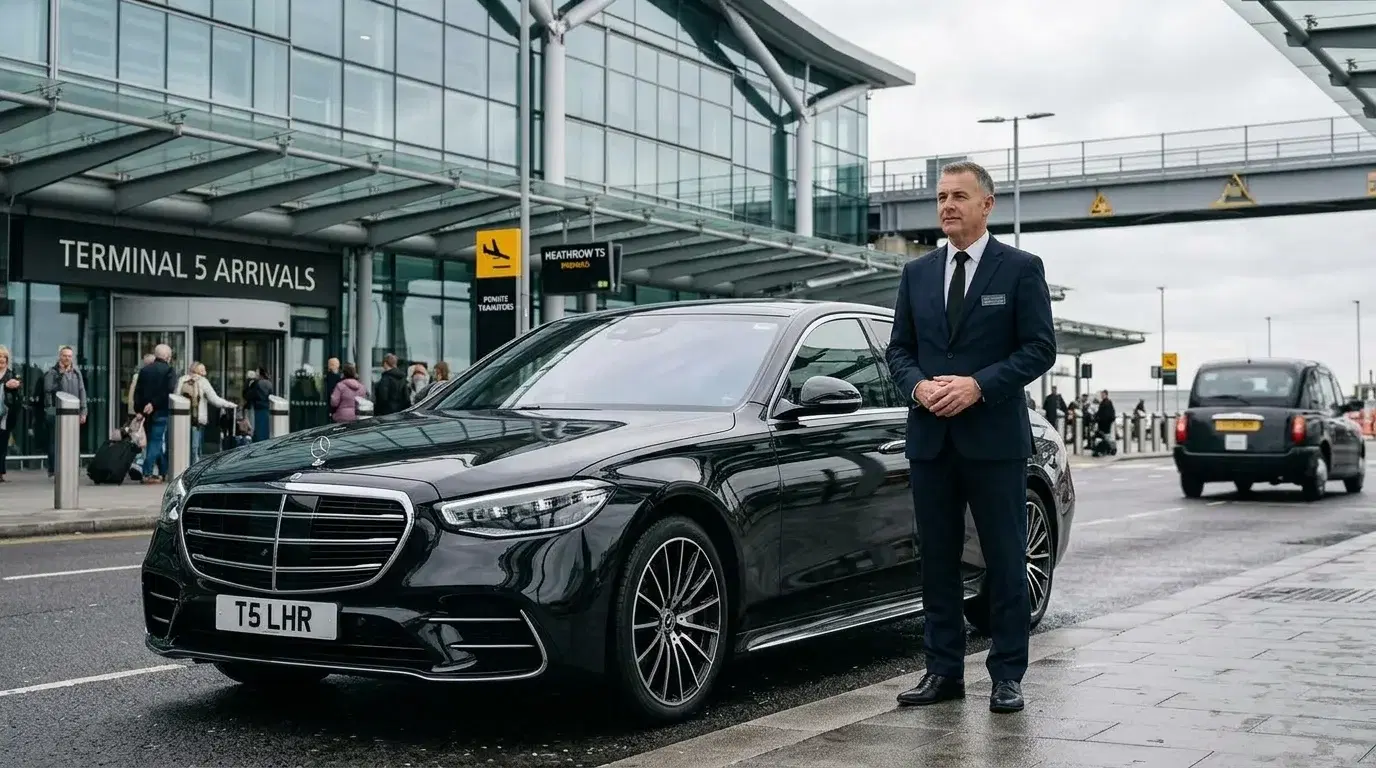
You've cleared passport control, your bag has finally appeared on the belt, and now comes the part most people never plan: getting into the city. Heathrow sits about 15 miles west of the center, and the right Heathrow Airport to Central London transfer depends on where you're staying, how much luggage you're pulling, and what time your plane landed. Someone heading to Paddington at midday faces a completely different problem than a family arriving at 11 p.m. with three suitcases. A few minutes of planning saves a lot of standing around.
Your Options at a Glance
Five realistic routes connect Heathrow with the middle of London: the Elizabeth line, the Heathrow Express, the Piccadilly line, a National Express coach, and road transport (a black cab, a ride-hailing app, or a pre-booked private car). Trains win on speed and price. Road transport wins when you need a door rather than a station.
|
Option |
Time to central London |
Typical one-way cost |
Works best for |
|
Elizabeth line |
About 30 min to Paddington, 35–40 to the West End |
£15.50 flat |
Most visitors staying near a central Elizabeth line stop |
|
Heathrow Express |
15 min to Paddington (about 21 from Terminal 5) |
From £10 booked well ahead, around £25 on the day |
Anyone staying near Paddington or tight on time |
|
Piccadilly line |
50–60 min |
Around £5.90 pay as you go |
Light packers on a budget heading to the West End or King's Cross |
|
National Express coach |
35–65 min to Victoria |
From about £9.50 |
Budget travelers with big bags who'd rather avoid stairs |
|
Black cab or ride-hailing app |
45–75 min |
Roughly £55–£130, depending on meter and demand |
Small groups going door to door |
|
Pre-booked private transfer |
45–75 min |
Fixed price agreed before you fly |
Families, late landings, heavy luggage |
Fares move every March, so check the TfL single fare finder or the operator's own site before you travel.
Start With Your Terminal, Not the Timetable
Your terminal decides which trains you can actually reach without a change. Terminals 2 and 3 share one rail station between the two buildings, Terminal 5 has a station in its basement, and Terminal 4 has its own station directly below arrivals. All three sit in Travelcard Zone 6.
If you land at Terminal 2 or 3, follow the signs for "Trains" through the pedestrian subway. Allow 10 to 15 minutes of walking from Terminal 2 and 5 to 10 from Terminal 3 — that's before you've queued for a ticket. It's flat and lift-served, but it isn't a two-minute hop.
Terminal 4 is the one that catches people out. The Heathrow Express doesn't stop there. You take the free transfer train to Terminals 2 and 3 first, which runs every 15 minutes and takes about four minutes, then change. The Elizabeth line and the Piccadilly line both serve Terminal 4 directly, so for most Terminal 4 arrivals the Elizabeth line is simply the easier choice.
Travel between Heathrow terminals is free on both the Elizabeth line and the Piccadilly line, which is useful if you're meeting someone who landed elsewhere on the airport. Heathrow's own transport and directions pages list current station locations and any building work affecting forecourts and car parks.
Which Train Suits Your Destination
Pick your train by where you're sleeping, not by how fast it looks on paper. The fastest service into Paddington isn't the fastest way to Covent Garden, and the cheapest fare stops being cheap once you add a second ticket at the other end.
The Elizabeth Line: The Default for Most People
Six trains an hour serve Terminals 2 and 3, reaching Paddington in around 27 to 30 minutes. What makes it useful is what happens next: the same train carries on through Bond Street, Tottenham Court Road, Farringdon, Liverpool Street and Canary Wharf. If your hotel sits near any of those, you step off once and pay one fare.
The catch is the price. Since March 2026 the Heathrow fare has been a flat £15.50 to Zone 1, with no off-peak discount — the same figure at 6 a.m. on a Sunday as at 8 a.m. on a Tuesday. The carriages are wide, air-conditioned and easy with a large case, which counts for a lot after a long flight. Paying more for the express and less for the stopping service is a familiar trade-off at big hubs, and the same math shapes a Paris Charles de Gaulle Airport to Central Paris Transfer.
The Heathrow Express: Speed, If Paddington Works for You
Fifteen minutes, non-stop, four departures an hour, from Terminals 2 and 3 into Paddington platforms 6 and 7. Terminal 5 adds about six minutes. Advance singles start around £10 when booked well ahead, while a walk-up ticket on the day is roughly £25.
The honest question is what happens after Paddington. If you're heading to Kensington, Victoria or the City, you'll double back on the Underground and pay again, and the time saved on the fast train quietly disappears. Book it when Paddington is close to your hotel, when you're chasing a meeting, or when you simply can't face a longer trip.
The Piccadilly Line: Cheapest, Slowest, Tightest
Around £5.90 with contactless or Oyster, and it counts toward the £16.30 daily cap for Zones 1 to 6, so a same-day return costs less than two singles. Trains stop at South Kensington, Green Park, Piccadilly Circus, Covent Garden and King's Cross St Pancras, which covers a huge share of London's hotels with no change at all.
The trade-offs are real. The trip takes roughly 50 minutes, you rarely wait more than ten minutes for a train, and services run from about 05:00 to 23:30. The current fleet dates from 1975, with narrow doors, low ceilings and very little luggage space. Arriving into a rush-hour carriage with two suitcases is genuinely unpleasant. TfL is also running a program of part closures on the line through 2026 while it tests a new fleet due to enter service between December 2026 and June 2027, so check the line status before you count on it.
Taxis and Ride-Hailing: Where They Actually Pick You Up
Black cabs and app-based cars collect from completely different places at Heathrow, and confusing the two costs you twenty minutes.
Licensed black cabs queue at signposted ranks just outside arrivals at every terminal. No booking, no app, no walking. The meter runs on distance and time, so central London usually lands somewhere between £75 and £130, with evening, weekend and overnight tariffs pushing the higher end. Heavy traffic on the M4 and A4 pushes it higher still.
Ride-hailing apps work differently. Heathrow's arrival forecourts are reserved for black cabs and drop-offs, so Uber, Bolt and FreeNow drivers wait in a holding area on the airport perimeter and collect from marked rows inside each terminal's car park. Expect a three to six minute covered walk with your bags, plus lift changes. The app shows the exact level and row once you book. Fares can beat a black cab in quiet hours, but arrival waves and bad weather trigger surge pricing at exactly the moment everyone wants a car.
When a Private Transfer Makes Sense
A private transfer solves a specific problem: it removes every decision between the arrivals hall and your hotel door. The driver tracks your flight, waits if immigration is slow, meets you inside with a name board, and the price is agreed before you leave home.
That matters most in a handful of situations:
-
Groups of three or more. Split between four people, a fixed car fare often undercuts four Elizabeth line tickets.
-
Families with young children. Car seats can be requested in advance, which no rank or app guarantees.
-
Heavy or awkward luggage. Ski bags, instruments and three-week suitcases don't belong on a Piccadilly line carriage.
-
Hotels away from a station. Bloomsbury, Marylebone and much of Kensington involve a walk from the nearest stop.
-
Flights that might land late. A fixed booking with flight monitoring doesn't surge because you arrived at midnight.
This is where a service like Transpovia earns its place — a fixed quote, a driver assigned to your flight number, and one clear meeting point instead of a car park hunt.
The same logic applies in reverse, and it's the leg travelers most often forget. Booking your return with Transpovia at the same time as your arrival transfer means you're not comparing prices at 4 a.m. on the morning of a long-haul departure.
Landing Late, Leaving Early, or Traveling Heavy
Rail options thin out fast after midnight. The Elizabeth line's last services leave the airport late evening, and the Piccadilly line closes around 23:30 on most nights. On Friday and Saturday nights the Piccadilly runs a 24-hour Night Tube from Terminals 2, 3 and 5 — but not from Terminal 4.
Outside those windows you have three choices: the N9 night bus toward central London, a coach, or a car. National Express runs to Victoria Coach Station around the clock, up to 77 times a day, from about £9.50, with the fastest daytime runs taking around 35 minutes. Coaches also allow one large suitcase or two medium cases plus hand luggage per passenger, and there are no stairs or escalators involved — a quiet advantage that rarely gets mentioned. Buy online in advance; the machines at the Central Bus Station take cards only.
Very early departures create the opposite squeeze. If your flight leaves before 6 a.m., the first trains won't get you there in time, which leaves road transport as the only realistic option. Late-night and pre-dawn gaps like this affect most European hubs — the same planning applies to a Lisbon Airport to City Center Transfer.
Costs That Don't Show on the Ticket Price
-
A £7 drop-off charge applies at Heathrow's terminal forecourts, which matters if a friend is collecting you or dropping you off later.
-
The Heathrow fare on the Elizabeth line sits outside standard daily capping rules, so it doesn't behave like a normal Tube fare.
-
Advance Heathrow Express tickets are tied to a date and can't be refunded, though they're valid on any train that day.
-
Tap in and out with the same card, and remember that foreign bank cards may add currency conversion fees.
-
Paddington and Victoria are not the end of the road for most travelers. Budget the time and cost of that final leg before you decide which option is cheapest.
Frequently Asked Questions
What's the cheapest way to get from Heathrow to central London?
The Piccadilly line, at roughly £5.90 with contactless or Oyster. It takes 50 to 60 minutes and has limited luggage space, so it suits light packers heading to a station on the line. A National Express coach to Victoria is the next cheapest and handles suitcases far better.
How long does it take to get from Heathrow to central London?
Between 15 minutes and about 75. The Heathrow Express reaches Paddington in 15 minutes, the Elizabeth line takes about 30, the Piccadilly line 50 to 60, and road transport 45 to 75 depending on traffic. Add 20 to 40 minutes at weekday rush hour for anything traveling by road.
Is the Heathrow Express worth the extra cost?
Only if Paddington suits your destination. It's the fastest option by a wide margin, but a Tube connection afterward adds time and a second fare, which usually cancels out the advantage. Booking well in advance brings the price much closer to the Elizabeth line.
Before You Go
Match the option to the day you're actually having. Traveling light in the middle of the afternoon? Take the train. Landing at midnight with a family and four bags? Pay for the door-to-door ride and start the trip properly. Booking with Transpovia before you fly means one less decision waiting for you in the arrivals hall.
"We landed forty minutes late with two tired kids, and the driver was already there waiting. After eleven hours in the air, that was worth every penny."


