
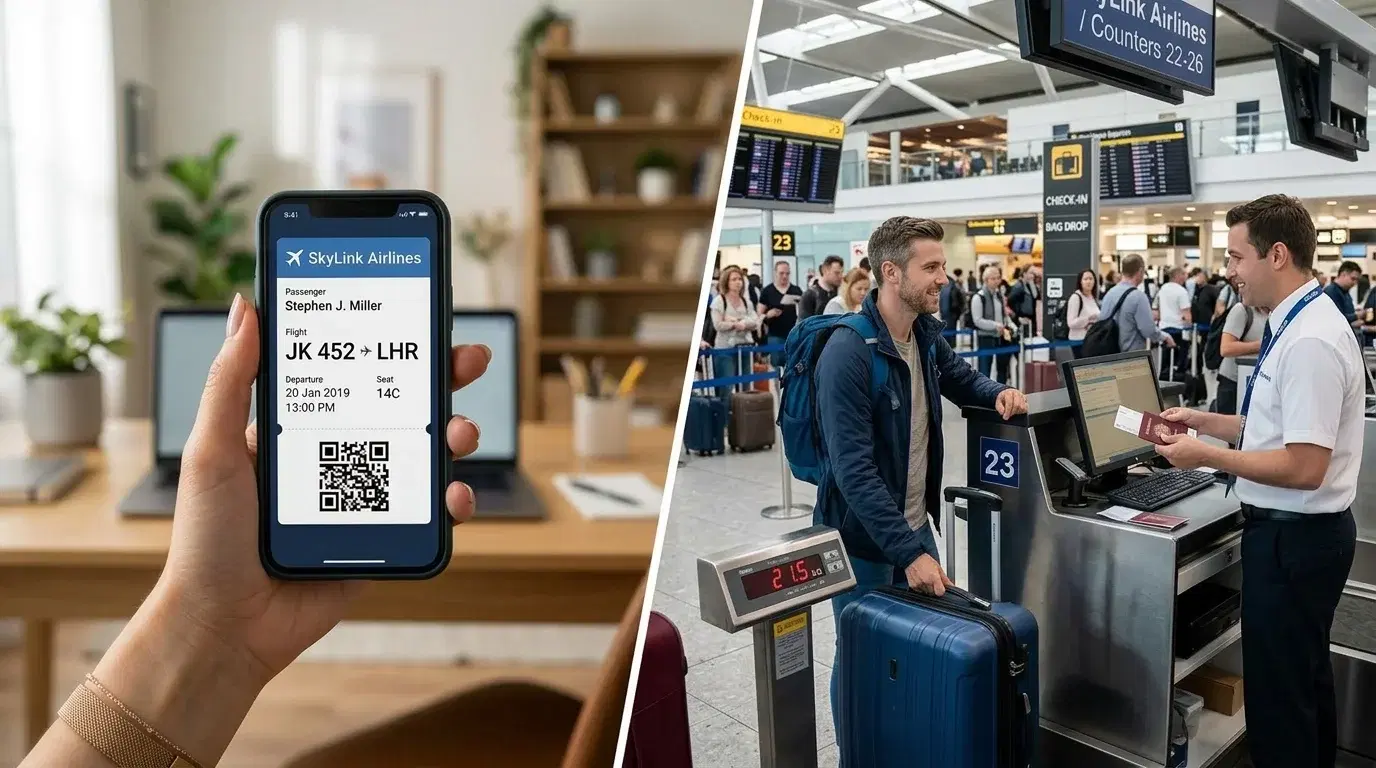
You're standing in a long line at the airline counter, bags at your feet, watching other travelers walk straight past you toward security with phones in hand. That contrast is the heart of the online check in vs airport check in question. Both get you a boarding pass, but they differ in timing, seat selection, luggage handling, and how much of your morning you spend in line. Knowing which to use — and when each one is actually required — can save you time, secure a better seat, and keep a checked bag from missing the plane.
Online Check-In vs. Airport Check-In: The Short Answer
For most travelers carrying only a bag or two into the cabin, online check-in is the faster choice: it opens about 24 hours before departure, locks in your seat, and lets you head straight to security with a mobile boarding pass. Airport check-in makes more sense when you need document verification, are traveling with special items, or want an agent to handle a complicated booking.
|
Feature |
Online check-in |
Airport check-in |
|
When it opens |
~24 hours before (some 48) |
~2–3 hrs domestic, 3–4 hrs international |
|
Boarding pass |
Mobile or home-printed |
Printed at counter or kiosk |
|
Seat selection |
Early pick, best availability |
Whatever's left |
|
Checked bags |
Still dropped at the airport |
Handled at the counter |
|
Best for |
Carry-on, seat control, saving time |
Document checks, special needs, groups |
|
Lines |
Skips the counter |
Full counter or kiosk line |
How Online Check-In Works, and When to Do It
Online check-in usually opens 24 hours before your scheduled departure, though some long-haul carriers, including Emirates, open it 48 hours ahead. You log in through the airline's app or website, confirm your details, choose or confirm your seat, and receive a boarding pass on your phone or as a home printout. For international trips, you'll often enter passport information at this stage so the airline can file the required advance passenger data.
Timing the check-in matters more than people expect. Seats are assigned in the order travelers check in, so logging on right at the 24-hour mark gives you the best shot at an aisle seat, a window, or two seats together for a family. If you wait until the morning of the flight, the good seats are usually gone.
Online check-in also has a closing time — commonly 30 to 60 minutes before a domestic flight and 60 to 90 minutes before an international one — so it isn't something to leave until you reach the curb. Once you have a digital boarding pass and only a carry-on, you can walk past the counters and go directly to security.
A quick note on the pass itself: a mobile boarding pass in the airline's app is convenient, but a phone that dies or won't load the barcode leaves you stuck, so it's worth saving a screenshot or carrying a printed copy as backup. A few carriers on certain international routes still require a paper pass stamped at the counter, another reason to confirm your airline's rules. Knowing exactly when to check in for a flight, and doing it early, is the simplest way to control your seat and your schedule.
How Airport Check-In Works
Airport check-in comes in two forms, and it helps to know the difference. A staffed counter puts a human agent in front of you to verify documents, tag checked bags, and print your boarding pass — the right choice for complicated bookings or international document checks. A self-service kiosk lets you do much of that yourself: check in, select a seat, and print both your boarding pass and your bag tags before heading to a drop-off point.
Counters and kiosks generally open two to three hours before domestic flights and three to four hours before international ones, and they close at the airline's check-in cutoff. For a full walk-through of the airport check in process and your airport check in options, the Airport Check-In Guide breaks down each step in detail.
Airport check-in gives you face-to-face help, which is its main advantage. The trade-off is time: you're committing to whatever line exists when you arrive, and at busy periods that line can be long.
When Airport Check-In Still Makes Sense
Online check-in isn't the answer for every trip. Several situations are handled better, or only, at the airport:
-
International flights with document checks. Many airlines require a passport or visa verification at a counter or dedicated kiosk even after you've checked in online. Some carriers, such as Emirates, ask all passengers to be present at check-in and bag drop regardless.
-
Special items. Pets, oversized sports gear, musical instruments, firearms, or extra bags almost always need an agent to process.
-
Standby, same-day changes, or upgrades. Missed connections, seat changes, and standby lists are managed at the counter or gate, not online.
-
Groups and families. If an online system splits your party across the cabin, an agent can often rearrange seats in person.
-
No smartphone or printer, or a failed online attempt. If the app errors out or you can't produce a boarding pass, the counter sorts it.
One reversal is worth knowing: some low-cost carriers charge a fee to check in at the airport and expect you to do it online in advance. On those airlines, online check-in is effectively mandatory, so read the fare rules before you skip it.
If You're Checking Bags, What Changes
Checking in online does not let you skip the airport when you have a bag to check. You'll still tag the bag and hand it over, and the deadline for doing so is strict. Bag-drop cutoffs commonly fall around 45 to 60 minutes before a domestic flight and 75 to 90 minutes before an international one. Miss that window and your bag may not be loaded — and you could be rebooked.
The upside is that the process is getting faster. Many airports now offer self-service bag drop with automated tagging, where you scan your boarding pass, print a tag, and place the bag on the belt yourself. Some airlines also route travelers who checked in online into a shorter, dedicated bag-drop line that bypasses the full counter. At many large U.S. airports, curbside check-in is another way to hand off bags without the main line, usually for a small per-bag fee plus a tip to the skycap.
Because the bag-drop clock is unforgiving, getting to the terminal on time is part of the equation. A delayed ride can cost you the cutoff even when you've already checked in online, so travelers with checked luggage often pre-book their airport ride. A private airport transfer such as Transpovia's can help you reach the counter with margin to spare before the deadline.
The Deadlines That Decide Everything
Whichever method you choose, three deadlines govern your departure, and they stack in order: the check-in cutoff, the bag-drop cutoff, and the gate-closing time. Being checked in is not the same as being ready to board. Boarding usually begins well before departure, and the gate typically closes 15 to 30 minutes before takeoff — treat that, not the departure time, as your real finish line.
Security sits between check-in and the gate no matter how you got your boarding pass, so the familiar arrival guidance still applies: plan for roughly two hours before a domestic flight and three before an international one, more during holidays and peak periods. Write down your specific airline's cutoffs, since they vary by carrier and airport, and confirm them on the official website before you travel rather than assuming last year's numbers still hold.
Frequently Asked Questions
Is online check-in always better than airport check-in?
Not always. Online check-in is faster for travelers with only a carry-on and helps you secure a seat early. Airport check-in is better, or required, for international document verification, special items like pets or sports gear, standby requests, and group seat changes.
Do you still need to visit the counter if you check in online?
Only if you have a checked bag to drop or need document verification for an international flight. If you're traveling carry-on only with a mobile boarding pass, you can go straight to security.
When should you check in for a flight?
Online check-in typically opens 24 hours before departure, and some long-haul airlines open it 48 hours ahead. Check in as early as you can to get the best seat, and note that check-in closes roughly 30 to 90 minutes before departure depending on the airline and route.
Can you check a bag after checking in online?
Yes. You tag the bag and hand it over at a bag-drop counter or self-service kiosk, as long as you make the airline's bag-drop cutoff — usually about 45 to 90 minutes before departure.
Before You Head to the Airport
Check in online at the 24-hour mark to lock in your seat and boarding pass. If you're carrying on only, walk straight to security. If you're checking bags or flying internationally, still leave time for the counter, the document check, and the bag-drop cutoff. Confirm your airline's exact deadlines, and if timing is tight, a pre-booked transfer like Transpovia's helps you arrive with room to spare.


