
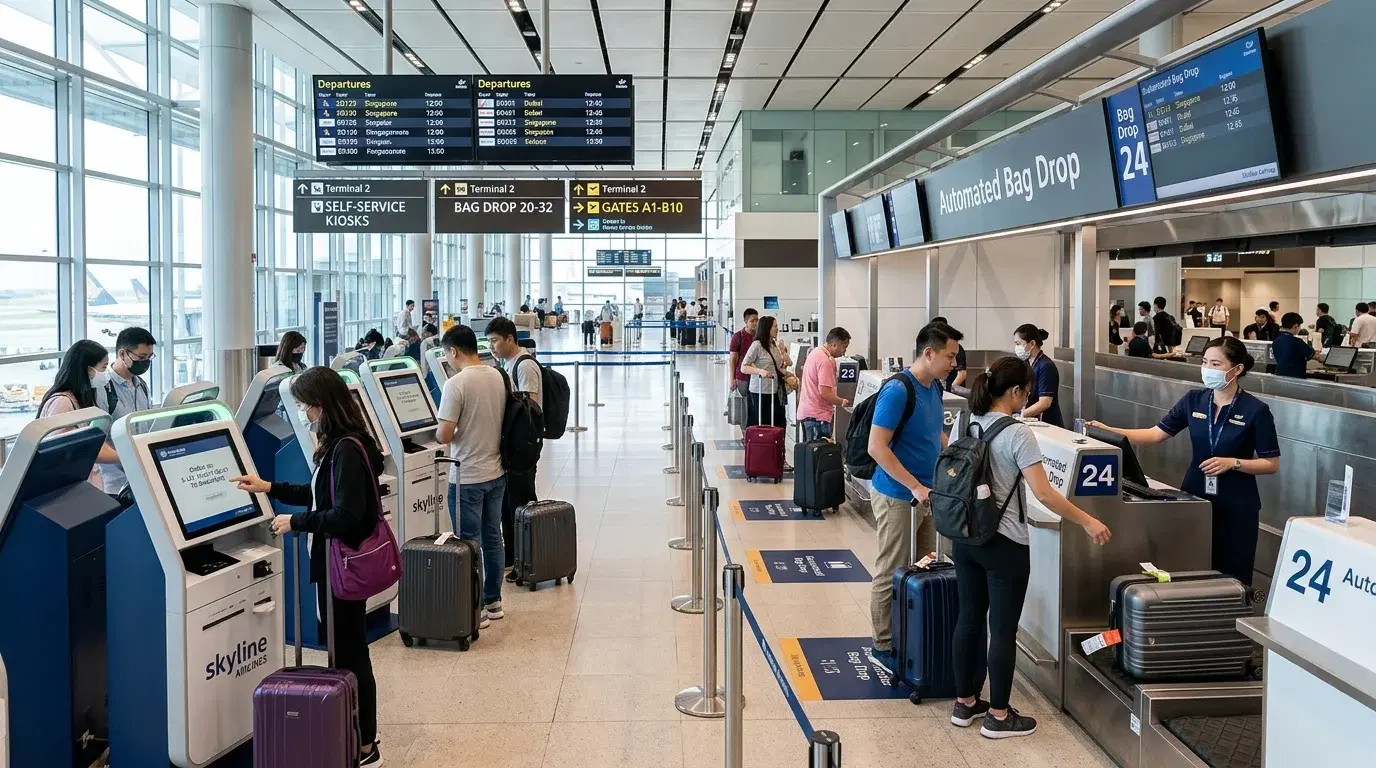
You've booked your flight, packed your bag, and reached the airport, so what happens next? Check-in is the step that confirms you're flying, settles your seat, hands you a boarding pass, and sends any checked luggage on its way. If you've never done it, or only ever flown one airline, the process can feel unclear, especially the deadlines that quietly decide whether you make your flight. Here's how airport check-in works, step by step, from the options you have to the cutoffs you can't afford to miss.
What "checking in" actually means
Checking in tells the airline you intend to fly and are ready to travel. It confirms or assigns your seat, produces your boarding pass, and opens the door to handing over checked bags. You have to check in before every flight, and you can usually do it in one of three ways: online, at a self-service kiosk, or at a staffed counter.
Your boarding pass is the key document that comes out of this step, since it gets you through security and onto the plane. Skip check-in, and the airline can release your seat to someone else. Which route you choose depends on your trip: a carry-on-only domestic traveler can often check in entirely from a phone, while someone checking bags or flying internationally will still use a counter or kiosk at the airport. This Airport Check-In Guide covers how each option works so you can pick the one that fits your flight.
Step 1: Check in online before you reach the airport
The quickest option is online or app check-in, which most airlines open 24 hours before departure, with some international carriers allowing it up to 48 hours ahead. You confirm your details, choose or keep your seat, and download a mobile boarding pass straight to your phone.
Checking in the moment the window opens gives you the best seat selection and early notice of any schedule change. Save your boarding pass to your phone's wallet and take a screenshot as a backup, in case the app won't load or the signal drops at the airport. If you're traveling carry-on only, online check-in means you can walk straight toward security without stopping at a counter. For international trips, you'll usually enter your passport details during this step. One caveat: some low-cost airlines require online check-in and charge a fee to do it at the airport, so read your carrier's rules before you skip it.
Step 2: Check in at an airport kiosk
Self-service kiosks in the departure hall let you check in, print a boarding pass, and often print your own bag tags in a couple of minutes. Scan your passport or enter your booking reference, confirm your flight and seat, and follow the on-screen prompts.
Kiosks are handy when you couldn't check in online or you need a printed boarding pass and luggage tags. After the machine prints your bag tags, you attach them and take your suitcase to the bag-drop counter, which is usually a shorter line than full-service check-in. Airline staff are typically stationed nearby if the kiosk can't process something, such as a passport that won't scan.
Step 3: Check in at the counter and drop your bags
The staffed check-in counter is where you go if you're checking luggage, flying internationally, or traveling with something the machines can't handle, like an infant, a pet, or a request for special assistance. An agent verifies your booking and ID, tags and takes your checked bags, and prints your boarding pass.
Counters generally open about two to three hours before domestic flights and three to four hours before international ones. Have your ID or passport and booking reference ready to speed things along. On international departures, the agent also checks that your passport, and any required visa or entry document, matches your destination's rules, which is one reason international check-in takes longer and is worth arriving earlier for. Weigh your bag beforehand where you can, since overweight luggage brings extra fees. Note that even if you already checked in online, you still visit bag drop to hand over any checked suitcase.
The check-in deadlines you can't miss
Every airline sets cutoff times, and missing one can cost you the flight even when you're already inside the terminal. As a rough guide, bag drop and check-in often close 45 to 60 minutes before domestic departures and 60 minutes or more before international ones, while the boarding gate usually closes 15 to 20 minutes before takeoff.
These deadlines vary widely by airline and airport, and several carriers have tightened them recently. Some close domestic check-in as early as 30 to 45 minutes before departure, and international check-in at major airports can shut 75 to 90 minutes ahead. The important thing to understand is that checking in online doesn't move these deadlines: your bag still has to be accepted, and the gate still closes, on the airline's schedule. Treat the earliest cutoff, usually bag drop, as your true deadline rather than the departure time, and confirm the exact figures on your airline's website before you travel. This is why arriving with a buffer matters; the TSA suggests reaching the airport two hours before a domestic flight and three before an international one. A pre-booked airport transfer through Transpovia can fix your drop-off time, so a slow ride doesn't push you past the bag-drop cutoff.
What happens after you check in
Once you hold your boarding pass and any checked bags are gone, you move to security screening and then to your gate. Your boarding pass and ID clear you through the checkpoint, and the pass shows your gate number and boarding time.
Confirm your gate on the departure boards rather than trusting only the printed pass, since gate assignments change. Boarding starts well before the departure time, so keep an eye on the boarding time and stay within reach of the gate as it approaches. On some international departures, you'll also pass through passport control before reaching the gate, which is another reason to leave extra time. Keep your boarding pass and ID accessible until you're on the plane, as you'll show them again at the gate.
FAQs
Do you still need to check in if you only have carry-on?
Yes. Even with just a carry-on, you must check in to get your boarding pass, which you can usually do online or at a kiosk. What you skip is the bag-drop step, so once you have your pass you can head straight to security.
How early can you check in for a flight?
Most airlines open online check-in 24 hours before departure, and some international carriers allow it up to 48 hours ahead. Airport check-in counters typically open two to three hours before domestic flights and three to four hours before international ones.
What happens if you miss the check-in cutoff?
If you arrive after the check-in or bag-drop deadline, the airline can deny you boarding and release your seat, even though the plane hasn't left. You'd then need to rebook, sometimes for a fee, which is why the cutoff, not the departure time, is the deadline that counts.
Can you check in at the airport for an international flight?
Yes, at the counter, where an agent checks your passport and any visa or entry documents. Allow extra time for these checks, and note that some low-cost carriers charge for airport check-in or require you to check in online first.
Before You Go
Check in online as soon as the window opens, save your boarding pass to your phone, and write down your airline's bag-drop and boarding cutoffs, which matter more than the departure time. Arrive with enough buffer to clear check-in and security without rushing. Booking your ride ahead through Transpovia helps you reach the counter before the deadline rather than after it.


