
Few travel moments feel worse than watching the baggage carousel slow to a stop while your suitcase is still nowhere in sight. The good news is that bags go missing less often than they used to, and many of the reasons they go astray are things you can influence before you ever reach the airport. Learning how to avoid lost luggage mostly comes down to a few habits: choosing smarter connections, labeling your bag properly, tracking it yourself, and paying attention from the check-in counter all the way to baggage claim.
This guide walks through each step, plus what to do if your bag still doesn't show up.
Why Checked Bags Go Missing in the First Place
Most lost luggage isn't actually lost. Industry figures for 2025 show roughly 24 million bags were mishandled worldwide, a rate of about 4.9 bags per 1,000 passengers, and the large majority of those were delayed rather than gone for good. Only a small share, around 4%, were never recovered.
The biggest single trigger is the connection. Transfers accounted for close to four in ten mishandled bags in 2025, because every time a suitcase moves from one plane to another, it has to be scanned, sorted, and driven across the airfield on a tight clock. International trips also carry more risk than domestic ones, largely because they tend to involve more connections, more handlers, and more airports.
Other common culprits are surprisingly ordinary: an old tag that confuses a scanner, a tag torn off on a conveyor belt, a bag pulled aside for a security check, or another traveler grabbing a lookalike suitcase at the carousel. Each of these has a simple fix.
How to Avoid Lost Luggage Before You Leave Home
The work you do while planning and packing does more to prevent lost baggage than anything you can do once the bag disappears down the belt.
Pick Flights That Give Your Bag Time
A nonstop flight is the single best way to keep luggage from getting lost, since your bag only gets loaded and unloaded once. When a nonstop isn't available or affordable, avoid squeezing in the shortest legal connection. Airlines sell itineraries that meet the airport's minimum connection time, but that minimum assumes everything runs on schedule. A 40-minute layover might be enough for you to sprint to the next gate, but your bag has a longer, more complicated route to cover. Giving yourself 90 minutes or more on domestic connections, and extra time for international ones, gives your suitcase a fair chance to make the same flight you do.
It also helps to keep the whole trip on one ticket. If you book two separate tickets on unrelated airlines, your bag may not be checked through, and you could end up collecting and re-checking it yourself mid-journey.
Make Your Bag Easy to Identify
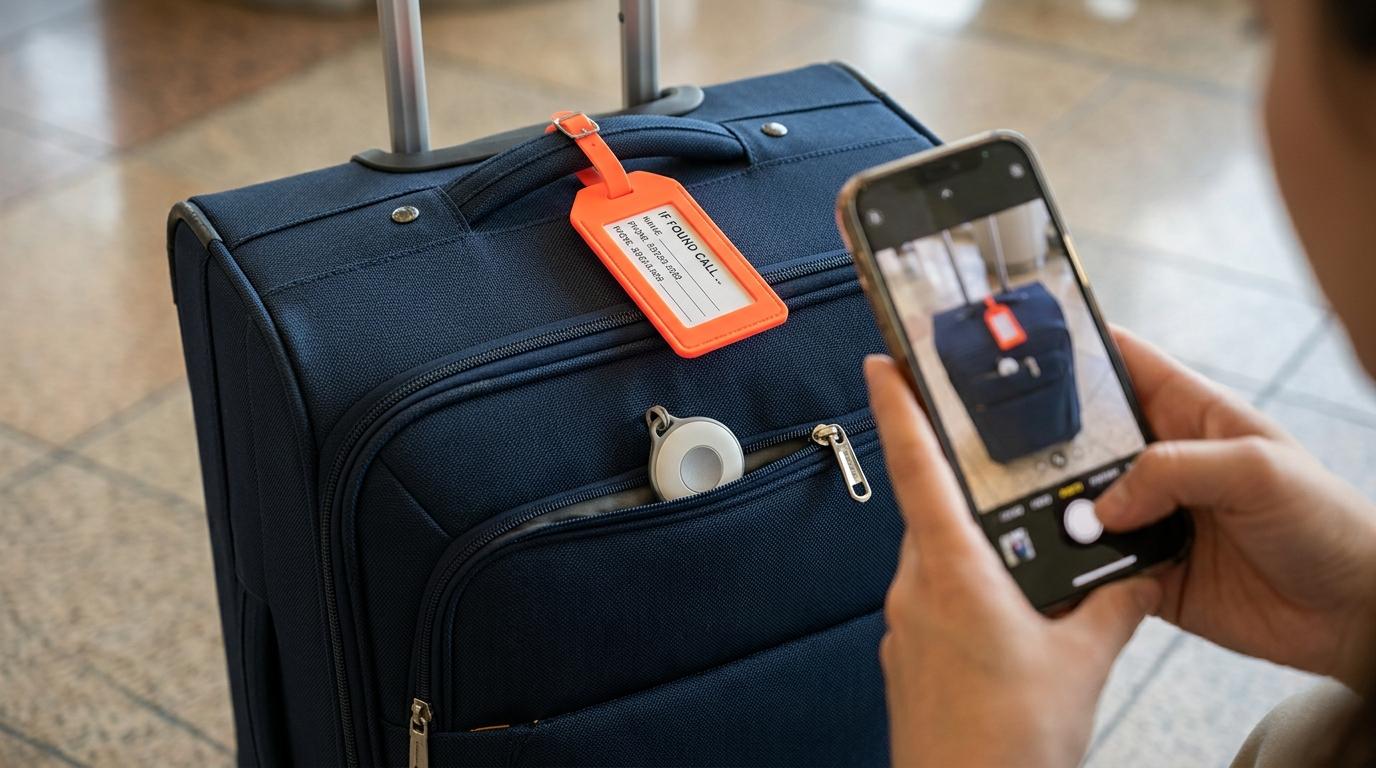
Put your name, phone number, and email on a sturdy luggage tag outside the bag, and put the same details, plus a copy of your itinerary, inside it. If the outside tag rips off, the inside sheet is often how airline staff figure out where the bag belongs. A work address or email is a sensible choice if you'd rather not display your home address.
Then make the bag stand out. A bright strap, a colorful ribbon, or a distinctive cover makes it much less likely that someone else walks off with your black roller bag by mistake, and it helps staff spot it in a storage room full of nearly identical suitcases.
Before every trip, peel off old airline tags and the small barcode stickers that sometimes get stuck to the side of a bag. An outdated barcode can be read by an automated scanner and send your suitcase toward a destination you visited months ago.
Pack So Your Bag Isn't Pulled Aside
Bags flagged during security screening can miss their flight while they're being inspected. Keep spare lithium batteries and power banks in your carry-on, since US rules don't allow them in checked luggage, and double-check that nothing else on the prohibited list made its way into your suitcase. If you lock your bag, use a TSA-recognized lock so screeners can open it without cutting it off.
It's also worth snapping a few photos of your packed bag and its contents. If you ever need to file a claim, those pictures make it far easier to describe the bag and prove what was inside. Going through an airport travel checklist the night before you fly is an easy way to catch these details along with your documents and boarding passes.
Luggage Tracking Tips That Actually Help
A personal Bluetooth tracker, such as an Apple AirTag, a Samsung Galaxy SmartTag, a Tile, or a tracker that works with Google's Find Hub network, has become one of the most useful baggage safety tips around. Tuck it inside the bag rather than clipping it to the outside, where it can snag or get knocked off.
A tracker won't stop a bag from being misrouted, but it changes what happens next. You can see whether your suitcase made it onto your connecting flight before you board, and if it didn't, you can tell the agent exactly where it is. Several airlines and the industry's main bag-tracing system now accept shared tracker locations, so you can send a temporary location link to the airline when you file a report. Recovery tends to move faster when the airline doesn't have to guess.
A few practical habits make trackers more useful:
-
Test the tracker at home and make sure the battery is fresh before a long trip.
-
Remember that location updates depend on nearby phones, so a bag in a quiet storage area may update slowly.
-
Use your airline's app as well. Many major carriers show when your bag was loaded and unloaded, which fills in gaps the tracker can't.
At the Check-In Counter: Small Checks That Prevent Lost Baggage
Arrive early enough to clear the bag-drop deadline comfortably. Many US airlines close bag check around 45 minutes before a domestic departure and 60 minutes before an international one, though the exact cutoff varies by airline and airport. Bags checked at the last minute are more likely to miss the flight.
When the agent prints your tag, look at it before the bag moves away. Confirm that the three-letter code matches your final destination, not just your connection, and that the name is yours. Airport codes can be easy to mix up, and catching a wrong code at the counter takes seconds.
Keep the bag tag receipt the agent hands you, or take a photo of it. That number is how the airline finds your bag in its system. If you use a self-service kiosk, attach the tag exactly as shown, with the adhesive fully sealed and nothing covering the barcode.
If your flight is canceled or you're rebooked, ask the agent directly whether your checked bag has been moved to the new itinerary. Bags don't always follow a passenger automatically after a schedule change.
Keep Your Essentials in Your Carry-On
Even with every precaution, a delay can happen. Pack anything you can't easily replace or can't go a night without in your carry-on: medications, travel documents, house and car keys, chargers, electronics, jewelry, and a change of clothes. If you're traveling with a partner or family, splitting a few outfits across each person's checked bags means nobody is left with nothing if one suitcase is late.
For short trips, the simplest way to avoid lost baggage is to skip checking a bag altogether. A well-packed carry-on stays with you the whole way.
Baggage Claim Habits That Keep Your Bag Yours
Head straight to the carousel after landing rather than stopping for coffee first. Unattended bags sitting on a belt or on the floor are the ones most likely to be picked up by mistake or moved to a back office.
When a bag that looks like yours comes around, check the tag number against your receipt before you leave the area. Two travelers on the same flight with the same model of suitcase is more common than you might think, and the mix-up usually isn't discovered until someone unzips the wrong bag at home.
If your bag is oversized, such as a car seat, stroller, golf bag, or ski equipment, ask where special items are delivered. They often appear at a separate counter instead of on the main carousel.
Plan Your Airport Ride Around Baggage Claim
Waiting at the carousel is often the least predictable part of arriving. Bags can take a few minutes or most of an hour, and if one doesn't show up, filing a report adds more time. That's stressful when a ride is circling outside or a shared shuttle is about to leave without you.
A pre-booked private airport transfer takes some of that pressure off. When you share your flight number at booking, the driver has a clear picture of when you're due to land, and you can message them if baggage claim is running long instead of rushing out and risking leaving a bag behind. It also helps once you've collected everything. With a private car, your luggage goes straight from the curb into one vehicle and comes out at your door, rather than being stacked in a shared shuttle's hold with other passengers' suitcases. Booking through Transpovia lets you choose a vehicle with room for everyone's bags, which matters for families, groups, or anyone traveling with sports gear.
If you haven't used a meet-and-greet service before, the airport pickup guide explains how to find your driver once you're through arrivals.
What to Do If Your Bag Doesn't Show Up
Don't leave the airport. Go to your airline's baggage service desk, usually located near the carousels, and file a report before you exit. Give them your bag tag number, a description of the bag, your contact details, and the address where you'd like it delivered. If you have a tracker inside, share its location. Ask for a file reference number and keep it handy.
Keep receipts for anything you need to buy while you wait, like toiletries or a change of clothes, and ask the airline what interim expenses it covers. On flights subject to US Department of Transportation rules, you're also entitled to a refund of any checked bag fee if your bag isn't delivered within 12 hours of a domestic arrival, or within 15 to 30 hours of an international arrival depending on the flight's length, as long as you've reported it to the airline.
Most delayed bags are delivered within a day or two. If yours doesn't turn up after several days, follow up with the airline about the next steps for a formal claim, and check whether your credit card or travel insurance offers additional baggage coverage.
Frequently Asked Questions
Is it worth putting an AirTag in checked luggage?
For most travelers, yes. A tracker can't prevent a bag from being misrouted, but it shows you where your suitcase is, lets you share its location with the airline, and often speeds up recovery. Place it inside the bag, and make sure the battery is fresh before your trip.
What is the best way to keep luggage from getting lost on a connecting flight?
Book all flights on a single ticket so your bag is checked through, and choose a layover with comfortable extra time instead of the shortest connection available. If you have a tracker, check that your bag reached your connecting flight before boarding, and alert a gate agent if it didn't.
How long do airlines take to find delayed luggage?
Most delayed bags are located and delivered within a day or two, especially when the passenger files a report at the airport and provides the bag tag number. Recovery can take longer on complex international routes, but permanently lost bags are relatively rare.
Conclusion
You can't control every conveyor belt between your departure and arrival, but you can stack the odds in your favor. Choose nonstops or roomy connections, label your bag inside and out, remove old tags, track it yourself, and confirm the tag at the counter. Keep your essentials close, get to the carousel promptly, and know exactly what to do if your bag is late.
A calm arrival also depends on what happens after baggage claim. Planning your ride ahead, with enough space for your luggage and a driver who knows when you've landed, means that even a slow carousel doesn't have to derail the start of your trip.
“We put a tracker in every suitcase and booked a nonstop this time. All five bags came out together, and our driver was already waiting by the exit with room for everything.” — Renee T., flying home to Atlanta with her family


