
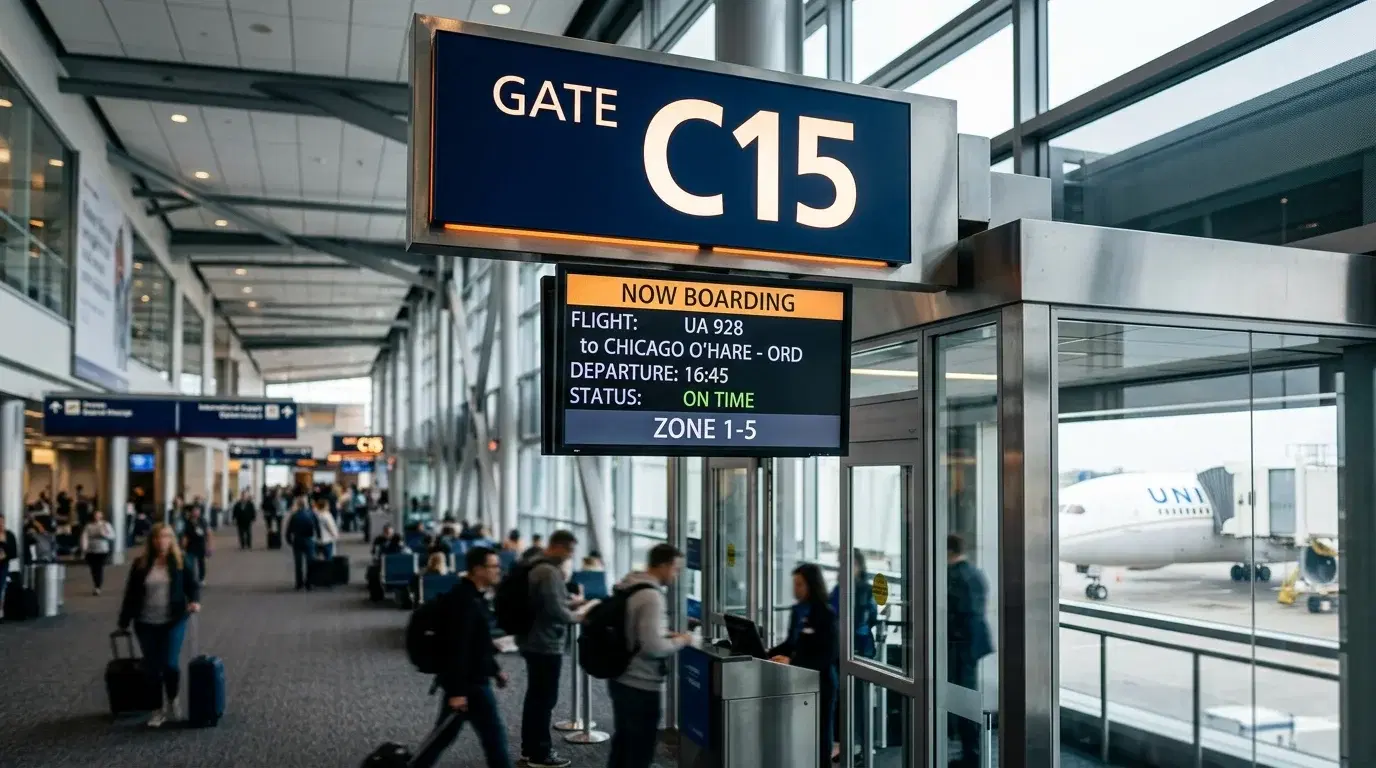
Airport gate numbers follow a logic that makes sense once decoded, even though it can look arbitrary while standing in an unfamiliar concourse. A gate identifier like B12 or C45 combines a concourse letter with a sequential number, and that combination is meant to narrow down location fast. Understanding how gates are structured, why the numbering sometimes skips or doubles up, and what happens when a gate isn't a normal jet bridge at all makes a boarding pass far easier to interpret.
How Gate Numbers Are Structured
Most large airports organize gates around a letter-and-number system tied to a specific concourse or terminal. A gate identifier like B12 typically means Concourse B, Gate 12, with the letter narrowing down the general area and the number pinpointing the specific boarding location within it.
Letters are common at major hub airports partly because they fit multi-building layouts well and hold up through frequent reconfiguration, while also chunking information into something easier to remember, such as "Terminal B, Concourse B, Gate B12," compared to a long numeric range spanning multiple buildings. At large hubs, gates are often grouped within a specific terminal or concourse for a particular airline or alliance, which is meant to reduce the walking distance for travelers connecting between flights on partner airlines.
Why Gate Numbers Sometimes Look Inconsistent
Anyone who has walked a concourse and noticed the numbering jump or double back isn't imagining it. Some concourses number gates so that even numbers sit on one side of the hall and odd numbers on the other, which means walking straight down a corridor can mean passing B1, B3, B5, then B4, B7, and B6 out of what looks like a random order at first glance.
Airports grow over time through construction phases, and that growth sometimes forces in temporary gates, sub-gates, or entirely new numbering patterns that don't match the original layout, which is part of why gate schemes can look inconsistent even within a single concourse. Rather than trying to predict the pattern, following posted signage toward the specific gate number is more reliable than guessing based on the numbers already passed.
Why Your Gate Can Change Right Before Boarding
Gate assignments are not locked in until close to departure, and several operational factors can shift them. Gates can change in the hours before a flight if the incoming aircraft runs late from a previous leg, if a maintenance issue forces an aircraft swap, or if taxiway congestion backs up airport traffic.
Airports typically communicate these changes through gate display screens, public address announcements, and airline apps, which is why checking a live source close to boarding time matters more than trusting a printed boarding pass. Review How to Navigate the Airport From Check-In to the Gate for the fuller walkthrough of finding a gate after a last-minute change, especially when the new gate sits in a different concourse entirely.
Terminal, Concourse, and Gate: Getting the Terms Right
Confusing these three terms is a common source of navigation trouble. A terminal is the larger building or section of the airport, a concourse is a connected hallway or area inside that terminal, and a gate is the exact point where boarding happens.
Terminal changes generally take far longer to navigate than gate changes within the same concourse, so knowing which type of change appeared on a screen affects how much time to allow. A gate change from B12 to B18 usually means a short walk down the same hallway; a terminal change can mean a train, shuttle, or a walk that takes considerably longer.
When a Gate Isn't a Jet Bridge: Remote and Bus Gates
Not every gate number leads to a jet bridge connecting directly to the aircraft. A remote stand serves an aircraft parked further from the terminal, and passengers reach it using ground transportation between the gate area and the aircraft, boarding via stairs instead of a jet bridge.
Airside transfer buses move passengers to a remote stand when jet bridges aren't available, for long-distance transfers within the airport, or for safety reasons, and the same type of bus is also used to move passengers directly between terminals. A gate number assigned to a bus gate still appears on the departure board and boarding pass like any other, so the surprise typically comes only once boarding actually begins and a bus, rather than a jet bridge, is the next step.
Frequently Asked Questions
What does a letter before a gate number mean?
The letter usually identifies the concourse or terminal section, while the number identifies the specific gate within that area, similar to a building and unit number.
Why do gate numbers sometimes skip or repeat with a letter suffix, like 7 and 7A?
This typically happens when a single gate area serves more than one aircraft parking position, or when an airport has added gates over time without renumbering the whole concourse.
How much time should you allow if your gate changes to a different concourse?
More time than a same-concourse change requires, since a different concourse may need a train, shuttle, or a considerably longer walk rather than a short distance down the same hallway.
What should you do if your boarding pass gate turns out to be a bus gate?
Follow the gate agent's instructions at boarding time. Bus gates are a normal part of airport operations at busy hubs, and the boarding process simply includes a short ride to the aircraft instead of a jet bridge.
Before You Go
Gate numbers combine a concourse letter with a sequential number, and checking a live departure screen close to boarding time matters more than memorizing any airport's specific pattern. Confirm ground transportation on arrival, including a pre-booked Transpovia pickup, accounts for which terminal the flight actually lands in.


