
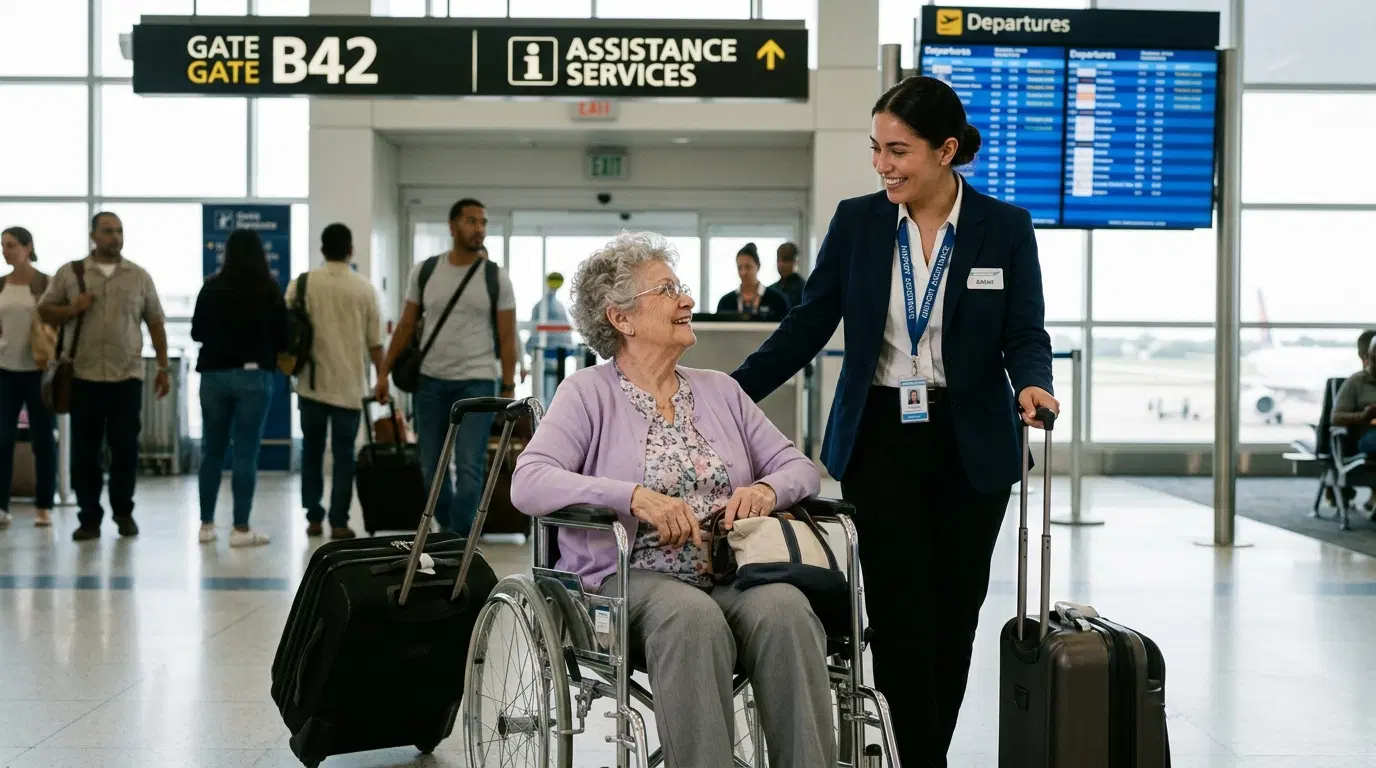
You're arranging a flight for an aging parent, or planning your own trip and worried about long terminal walks, security lines, and getting to the gate on time. Airports are built for speed, and that's hard on anyone with limited mobility, a medical condition, or young kids in tow. The good news is that a lot of help exists — most of it free and most of it needs to be requested in advance. Knowing that airport assistance for seniors is available, and exactly how to arrange it, turns a stressful travel day into a manageable one. Here's how each piece works.
How to Request Airport Assistance for Seniors
Request mobility help through the airline, not the airport or TSA. Under the Air Carrier Access Act, U.S. airlines must provide free assistance to passengers who need it, and many other countries have similar rules. Ask when you book, or call the airline at least 48 hours before departure, and note the request again at check-in.
This senior airport assistance usually covers the whole path through the terminal: a wheelchair or attendant meets the traveler at curbside or check-in, helps through the security line, takes them to the gate, assists with boarding, and — this part gets forgotten — has someone waiting at the arrival gate to help to baggage claim or a connecting flight. If your parent uses their own wheelchair, they can usually ride it to the aircraft door and gate-check it there.
The same forward planning helps families. For households flying with young children, our guide to the Best Travel Tips for Families Flying With Children covers pre-boarding, security, and packing so the airport portion goes smoothly for every age.
Getting Through Security With TSA Cares
For help specifically at the checkpoint, TSA Cares is the program to know. It's a helpline for travelers with disabilities, medical conditions, or other circumstances that make standard screening harder. Call at least 72 hours before your flight at (855) 787-2227 — staffed weekdays 8 a.m. to 11 p.m. ET and weekends and holidays 9 a.m. to 8 p.m. ET — or submit the online form. You can request a Passenger Support Specialist, a TSA officer trained to assist through screening, to meet the traveler at the checkpoint. Requesting one doesn't exempt anyone from screening, but it makes the process calmer and clearer.
A few screening details matter for older travelers:
-
Shoes now stay on. Since July 2025, TSA no longer requires anyone to remove shoes at standard checkpoints, though an alarm or enhanced screening can still prompt a request to take them off.
-
Seated screening is allowed. Passengers 75 and older, and anyone unable to stand, can remain seated in their wheelchair or scooter while an officer checks their hands for explosive residue and inspects the device.
-
Medical items are fine. Hearing aids and cochlear implants can stay on; pacemakers, ports, and other devices are accommodated — just tell the officer before screening begins.
-
Companions can stay together. Travelers with conditions such as dementia, Alzheimer's, or autism don't have to be separated from the person helping them.
One current requirement catches some seniors off guard: as of May 2025, a Real ID-compliant license or an acceptable alternative like a valid passport is needed to board domestic U.S. flights. Check that a parent's ID qualifies well before travel day, since replacing one takes time.
Traveling With Elderly Parents: What to Sort Out First
Handle medications and medical equipment before anything else when traveling with elderly parents. Pack all prescriptions in a carry-on, not a checked bag, in enough supply to cover delays, and keep them in labeled containers with a written list of what each one is. Liquid medications are allowed through security in quantities over the usual limit — declare them to the officer for separate screening.
Medical equipment needs advance clearance. FAA-approved portable oxygen concentrators are generally permitted onboard, but airlines require notice ahead of time, and personal oxygen tanks are often not allowed, so confirm the specific policy with the carrier. The same goes for CPAP machines, which can usually travel as an extra carry-on item.
Seat choice makes the flight itself easier. An aisle seat near the restroom, or a bulkhead row with more legroom, helps a passenger who moves slowly or gets up often. Airlines must provide certain disability-related seating accommodations at no extra charge under the Air Carrier Access Act — ask rather than paying to select seats.
Arranging Reliable Transportation to and From the Airport
The airport itself is only half the trip. Getting an older traveler from home to the terminal, and from the arrival hall to a hotel or house, is often the harder part — curbside drop-off, luggage, and unfamiliar routes all add strain, especially at the end of a long flight. Multiple transfers or a long taxi wait can undo a well-planned day.
Booking door-to-door transport ahead of time removes those friction points. Pre-arranged airport transfers, including options from a service like Transpovia in the cities it covers, mean a vehicle is waiting at a set time, a driver can help with bags, and there's no sorting out routes or ride apps on the spot. For families coordinating travel for a parent or a group, pre-booked private transportation also keeps everyone moving together instead of splitting across taxis.
Timing, Boarding, and Moving Through the Terminal
Give yourself more time than a typical traveler would. Reduced mobility, medication stops, and slower security all add up, and rushing is exactly what you want to avoid. Our guide on How Early Should You Arrive at the Airport breaks down realistic timing, and travelers using assistance should lean toward the longer end of those windows.
Pre-boarding is one of the most useful rights available. Passengers who need extra time or help settling in can board before the general crowd — ask at the gate if it isn't offered. If a traveler uses their own mobility device, gate agents tag it and return it at the jet bridge on arrival rather than sending it to baggage claim, though it's worth confirming this at the gate.
Terminal distances surprise people; connecting gates can sit a long walk or a shuttle ride apart. The wheelchair assistance you requested covers those stretches, including between flights, so use it even if the traveler can manage short distances. One practical note competitors rarely mention: airport wheelchair attendants are frequently contracted staff who work partly on tips, so it's customary to tip for the service.
Common Mistakes That Make Airport Assistance Fall Through
Most problems trace back to a few avoidable errors:
-
Not reconfirming the request. A booking note can get lost — reconfirm airline assistance 24 to 48 hours before, and mention it again at check-in.
-
Assuming TSA provides wheelchairs. Security screening and mobility assistance are separate; the airline supplies the wheelchair, TSA handles the checkpoint.
-
Leaving too little connection time. Assistance and slower movement need buffer; a tight layover can mean a missed flight.
-
Forgetting the arrival end. Arrange help for landing and ground transport, not just departure.
-
Packing medications in checked luggage. If a bag is delayed, so are the pills — always carry them on.
Frequently Asked Questions
Is airport wheelchair assistance free?
Yes. U.S. airlines are required to provide wheelchair and mobility assistance through the airport at no charge under the Air Carrier Access Act, and many countries have equivalent rules. The service itself costs nothing, though the attendants who push wheelchairs are often contracted workers who rely on tips, so tipping for that help is customary and appreciated.
How far in advance should you request senior airport assistance?
Request airline mobility assistance when you book, or at least 48 hours before departure, then confirm it at check-in. For help at the security checkpoint specifically, call TSA Cares at least 72 hours ahead. Earlier is always better, since it gives the airline and airport time to staff the request.
Can someone walk an elderly traveler to the gate without a plane ticket?
Often, yes. Many airlines issue a gate pass, sometimes called an escort or non-traveler pass, that lets a family member accompany a passenger through security to the gate or meet them on arrival. Request it at the airline's check-in counter with photo ID. The escort goes through security screening the same as any passenger.
Do seniors need a Real ID to fly within the United States?
Yes. Since May 2025, adult travelers need a Real ID-compliant driver's license or an acceptable alternative such as a valid passport to board domestic flights. A standard license that isn't Real ID-compliant no longer works on its own, so verify an older traveler's ID well before the trip.
Setting Up an Easier Airport Day
Start by calling the airline to request mobility assistance and confirm seating, then call TSA Cares at least 72 hours out if security is a concern. Arrange door-to-door transport for both ends of the trip, pack medications in a carry-on, and reconfirm every request the day before. Handle those steps in advance, and the traveler arrives supported at every point from the curb to the seat.


