
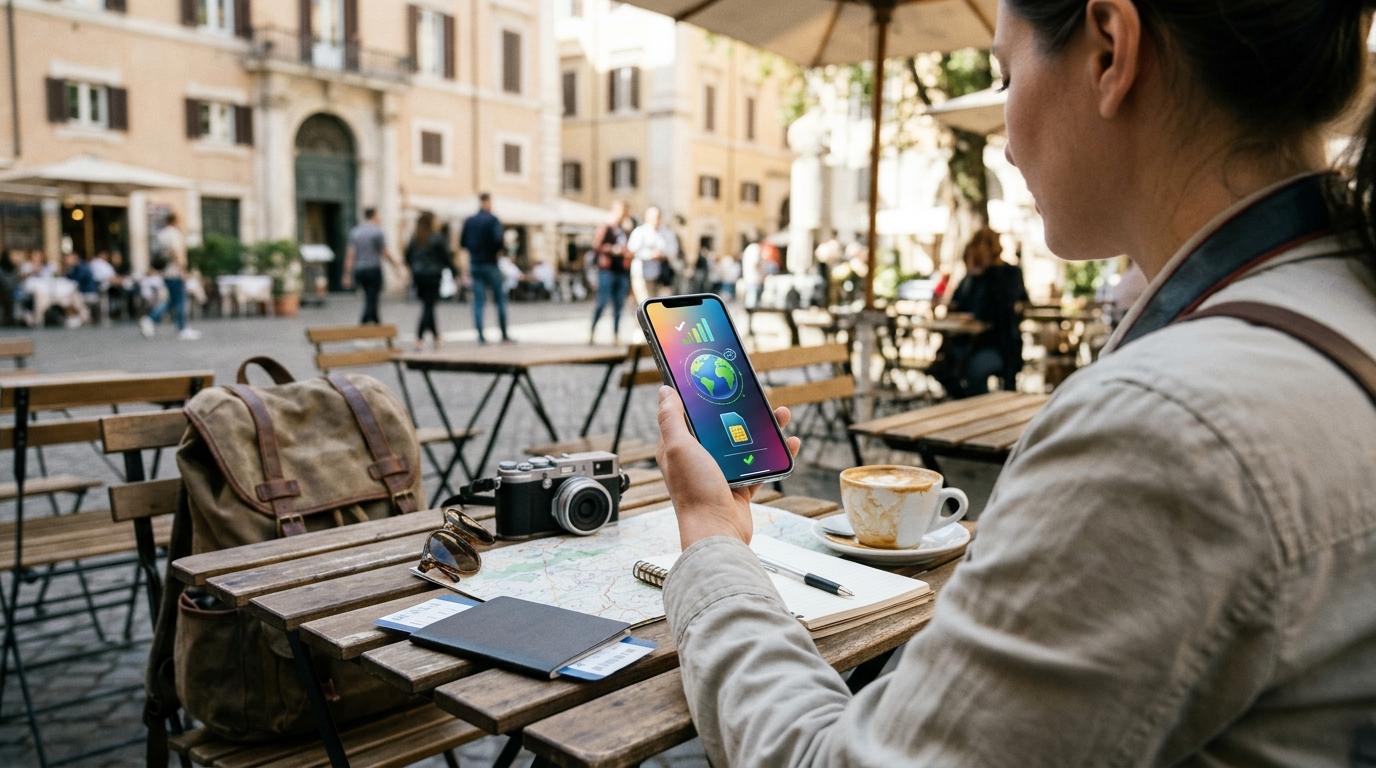
An unlimited data eSIM sounds simple. You pay one price, land in a new country and use your phone without watching a data counter. In practice, every plan comes with rules, and those rules decide if the plan suits your trip or quietly slows you down on day three. This guide explains what unlimited really means, which limits matter most and how to match a plan to a weekend away, a family holiday or a month of remote work.
What an unlimited data eSIM really gives you
An eSIM is a digital SIM profile. You scan a QR code or tap an install button, and your phone adds a second mobile line without any plastic card. An unlimited data eSIM is a travel plan on that line that does not stop when you reach a fixed number of gigabytes. Your data never runs out, and you never face a surprise bill.
That does not mean every megabyte arrives at full speed. Nearly every unlimited travel plan sets a fair use limit. You get a set amount of fast data, then your connection slows down and keeps working. Across the plans we looked at, the daily full speed allowance usually sits somewhere between 2 GB and 5 GB, and a few premium plans offer more. After that, speeds often fall to around 1 or 2 Mbps. Maps, messages and email still work at that pace. Video calls and streaming become painful.
Most people use far less than they expect. A typical traveler burns roughly 0.5 to 1 GB a day on maps, messaging, photos and social apps. If that sounds right for you, a fixed data plan may cost less. If you stream shows on the train, upload videos or share your connection with a laptop, unlimited removes a lot of stress.
You can browse unlimited travel data plans on the Transpovia eSIM page before you fly, and compare the terms of each plan in one place. Read the plan details closely, because the daily allowance, the speed after the limit and the hotspot policy can differ a lot between two plans that both say unlimited on the front.
Who should choose unlimited and who should not
Unlimited plans suit travelers who hate counting. If your phone is your map, translator, ticket wallet, camera and entertainment, a flat plan keeps things calm. Families with several phones benefit too, since nobody has to ask who burned the data. Remote workers who join video calls in cafes will want a plan with a generous daily allowance and clear hotspot rules.
Short trips are the sweet spot. On a stay of three to ten days, the price per day of an unlimited plan stays reasonable, and you skip the math. Long stays are different. After about three weeks in one country, a local prepaid SIM often costs less, though you need a physical shop visit and sometimes a passport scan.
Light users should skip unlimited. If you rely on hotel WiFi, download maps before you leave and only check messages on the street, a small fixed plan of a few gigabytes will do the job at a lower price. Paying for unlimited when you use 300 MB a day means paying for a gym membership just to walk to the shop.
Heavy users need to read the fine print the most. A plan that offers unlimited data and slows to a crawl after 2 GB might feel worse than a 20 GB plan at full speed. The smartest question is not how much data you get. The better question is how much fast data you get each day.
How fair use limits actually work
Fair use rules come in two main shapes, and knowing which one your plan uses will spare you frustration.
Daily allowance plans
On a daily allowance plan, you get a fast data amount every 24 hours. When you pass it, your speed drops and stays low till the next reset. The reset time depends on the provider. Some reset at midnight local time, others count 24 hours after your first use. If your plan resets at an odd hour, you might hit the cap right before a long travel day.
This design rewards steady use. If you spend a quiet day at the hotel and use almost nothing, that unused data usually does not carry over. Heavy days followed by light days work well. Three heavy days in a row do not.
Bundle allowance plans
Some plans give you one large pool of fast data for the whole validity period, for example a pool shared across 15 or 30 days. Once the pool runs out, speed drops for the rest of the plan. These plans suit people who use data in bursts. They also suit travelers who spend a few days offline in remote places and then need a big download.
The risk is simple. If you burn through the pool in the first week, you spend the rest of the trip on a slow line. Look at the pool size and divide it by the number of days. If the daily average looks small, the word unlimited is mostly marketing.
What a slow connection can still do
At 1 to 2 Mbps, you can still send messages, load a map, check a boarding pass, read email and hail a ride. You cannot comfortably stream video, join a group video call or download large files. Knowing that boundary helps you plan. Save heavy downloads for the hotel WiFi, and keep your fast data for moments that need it.
Hotspot and tethering rules
Hotspot rules cause more disappointment than any other detail. Some unlimited plans let you share your connection with a laptop or a second phone with no separate cap. Others limit tethering to a small daily amount, for example a few hundred megabytes, and some block it entirely.
If you plan to work on a laptop, check this line before you pay. Look for the words hotspot, tethering or personal hotspot on the plan page. If the page does not mention it, ask the provider before buying. Travelers who work remotely should also check if the hotspot draws on the same fast data pool the phone uses, since a laptop can consume a daily allowance in an hour.
Families have a simpler solution. A single eSIM with generous hotspot rules can cover two phones, though one phone then becomes the router and its battery drains faster. Many families find it easier to buy one plan per adult and keep the kids on the parents' hotspot only when needed.
Data only or calls and texts too
Most travel eSIMs carry data only. You will not get a local phone number, and you cannot make regular calls or send regular texts on the plan. For many people, that is fine. WhatsApp, FaceTime, iMessage, Signal and similar apps use data and cover most conversations.
Keep your home SIM active in the other slot. Your bank may send a text code to your regular number, and some services still need a text for login. Set the home line for calls and texts, set the eSIM to carry your mobile data and turn off data roaming on the home line. This setup keeps roaming bills away and keeps your number reachable.
If you need a local number, for example to receive restaurant bookings or delivery calls, check for a plan that includes one. These plans cost more and tend to offer fewer countries.
A checklist for comparing unlimited plans
Plan pages look similar at first glance. These points tell good plans apart and expose the ones that disappoint.
-
Country list. Check that every country on your route is named. A plan that covers a region may skip a country you plan to visit.
-
Daily full speed data. This is the number that matters most. Higher is better for heavy users.
-
Speed after the limit. Look for a stated speed in Mbps. If the page hides it, that is a warning sign.
-
Reset rule. Daily plans reset at a set hour. Know which.
-
Hotspot policy. Is tethering allowed, capped or blocked.
-
Validity start. Some plans begin when you install the eSIM, others when you first connect to a network abroad. The second option gives you more freedom.
-
Network quality. Look for 4G or 5G support in your destination.
-
Top up options. Can you extend the plan without a new install.
-
Support and refunds. Live chat in your language and a clear refund rule matter more than a discount code.
A plan that scores well on six of these nine points will usually serve you well. A plan that hides three or more is worth skipping.
Check your phone and install before you fly
Your phone needs to support eSIM and be network unlocked. Most recent iPhones, Samsung Galaxy phones and Google Pixel phones support eSIM, though some models sold in certain countries only support physical SIMs. Look in your phone's settings under mobile data or SIM, or ask your carrier if the phone is locked.
Install the eSIM at home while you have stable WiFi. The process takes a few minutes. You scan the QR code or use the install link, give the line a clear name for example Travel Data, and set it to use mobile data. Do not switch on data roaming for the eSIM before you land, unless the provider says otherwise. Many plans only start counting days when they connect to a supported network.
Keep a screenshot of the QR code and the provider's support contact details in your photos. If something fails at the airport, you can reach them without searching around on a weak signal.
Matching a plan to your trip
Different trips call for different plans. Here are five common patterns.
A city break of three to five days
You need data for maps, ride apps and photos. A short unlimited plan with a daily full speed allowance of a few gigabytes is plenty. Pick the shortest validity that covers your dates.
Two weeks across several countries
Check the country list first. A regional plan that covers every stop will usually beat a patchwork of country plans. If one country on your route sits outside the region, add a small local plan for that stop.
A family holiday
Count phones, not travelers. Teenagers use more data than their parents expect, and a plan with a strict hotspot cap will cause arguments. Consider a plan per adult and shared hotspot for the youngest members.
A business trip
Prioritize speed after the limit, hotspot policy and support. A plan with a stated speed floor and a working hotspot protects your video calls. Keep your home SIM active for authentication codes.
A month or longer
Run the numbers against a local SIM. For a long stay in a single country, local prepaid can win on price. For a slow trip across several countries, a monthly unlimited plan can win on convenience.
Unlimited eSIM versus roaming, local SIMs and airport kiosks
Carrier roaming is easy to switch on and hard to control. Daily roaming passes can work for a short trip, and some home plans include roaming in selected countries. Check your own carrier's rules before you leave, since coverage and fees change by plan.
A local SIM gives you a local number and often strong value on long stays. It also means finding a shop, showing ID and sometimes waiting in line after a long flight.
Airport kiosks sell SIMs and WiFi devices at a convenience premium. They help if you forgot to prepare, though the price per gigabyte tends to be higher.
An eSIM sits between these options. You prepare at home, you skip the shop and you start browsing soon after landing. For most short and medium trips, that mix of speed and control makes it the easiest choice.
Staying connected at the airport and beyond
Connectivity matters most in the first hour after landing. You need to message your host, check your hotel address, open your ticket for the train and confirm your ride. Travelers who arrive with working data tend to move through the airport faster and with less stress.
If you plan to book a private transfer, keep the confirmation email and driver contact details in an offline note too. Many drivers share a live location or a meeting point by message, and a working data connection helps you find them quickly. Transpovia is a ground transportation marketplace that connects travelers with airport transfer and private ride options, and having your data ready makes that handover smoother.
Common mistakes to avoid
A short list of errors causes most disappointments.
-
Buying a plan before checking phone compatibility.
-
Forgetting to choose the eSIM for data, which leaves the phone on home roaming.
-
Leaving data roaming on for the home SIM.
-
Ignoring the speed after the daily limit.
-
Assuming hotspot works without a cap.
-
Installing the eSIM at the airport with no stable WiFi.
-
Choosing a plan that covers a region and skips one country on the route.
-
Deleting the eSIM profile too early. Some profiles can be reused or topped up on the next trip, and a deleted profile is gone for good.
"I landed at midnight, the eSIM was already on, and I messaged my driver before I reached the baggage belt."
FAQs
Is unlimited data on an eSIM really unlimited?
The data does not run out. The speed often drops after a daily or bundle limit. Read the plan page for the fast data amount and the speed after the limit.
How much data do I need for a week abroad?
Many travelers use about 0.5 to 1 GB per day on maps, messaging and social apps. Heavy streaming or hotspot use raises that number a lot. If you use less than a gigabyte a day, a fixed plan may cost less.
Can I use an unlimited eSIM for hotspot sharing?
Some plans allow it with no cap, some cap it at a small daily amount and some block it. The plan page should say which applies. Check before buying if you plan to work on a laptop.
Will I still receive calls and texts on my home number?
Yes, if you keep your home SIM active in the second slot and leave your home line on for calls and texts. Turn off data roaming on the home line to avoid charges.
When does an eSIM plan start counting days?
It depends on the provider. Some start at installation, others at the first connection to a network in the destination. Choose a plan that starts at first connection if you install before you fly.
What happens if my phone does not support eSIM?
You will need a physical SIM, a local prepaid card or a portable WiFi device. Check your phone settings or your carrier before buying.
Is an unlimited eSIM worth it on a short trip?
For trips of three to ten days with heavy phone use, it often is. For light users, a smaller fixed plan is more sensible.
Conclusion
The best unlimited data eSIM is not the one with the loudest promise. It is the plan that names your countries, gives you a healthy amount of fast data every day, states its speed after the limit and treats hotspot use in plain words. Check your phone, install at home, keep your home SIM for calls and codes, and match the plan to the shape of your trip.
Once your data is ready, line up the rest of your arrival. If you want a driver waiting after you land, look at the airport transfer options on Transpovia and book your ride before you fly.


