
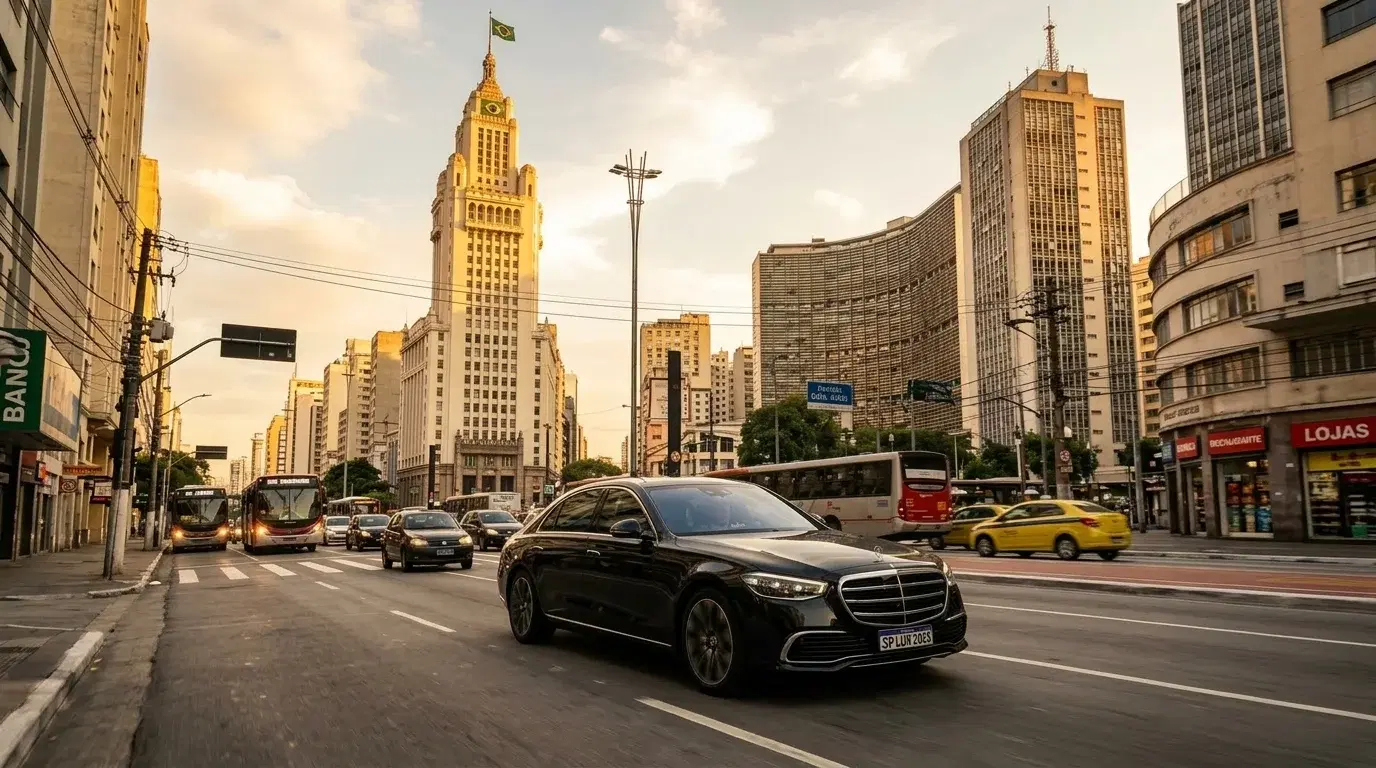
Long-haul flights into São Paulo tend to land at breakfast time, which drops you into the city at the worst possible moment for traffic. Guarulhos sits about 30 kilometers northeast of the center, and the right São Paulo Airport to Downtown São Paulo transfer depends heavily on when you touch down. The same trip can take 40 minutes at midday or nearly two hours in the morning crawl along the Marginal Tietê. Add three terminals, a currency you're not used to and a language barrier, and it pays to know your plan before the wheels hit the ground.
São Paulo Airport to Downtown São Paulo Transfer Options, Compared
Four options genuinely work for the city center: the Expresso Aeroporto train, an executive coach, a taxi or ride-hailing app, or a pre-booked private car. Downtown is one of the few destinations where the train is properly competitive, because it stops in the middle of it.
|
Option |
Time to downtown |
Typical cost |
Works best for |
|
Expresso Aeroporto train |
About 35 min to Luz, plus the terminal connection |
Around R$5 |
Anyone staying near Luz, República or Barra Funda |
|
Executive coach |
40–80 min |
Roughly R$30–R$45 |
Travelers heading to Paulista or the bus terminals |
|
Ride-hailing app |
40–100 min |
Usually below the taxi desk rate |
Door-to-door on a budget, with data |
|
Airport taxi |
40–100 min |
Fixed fare quoted at the desk |
Arriving without a phone plan |
|
Private transfer |
40–100 min |
Fixed price agreed in advance |
Families, groups, early or late flights |
Traffic is the single biggest variable. Weekday peaks run roughly 07:00 to 10:00 and 17:00 to 20:00, and heavy summer rain between December and March makes them worse.
Where You Land and What's Right Outside
Guarulhos has three terminals. Terminal 3 handles most international arrivals, Terminal 2 handles a mix of international and domestic, and Terminal 1 is largely domestic. Free shuttle buses connect all three, so landing in the "wrong" one costs time rather than money.
Once you're through customs, each option has its own spot:
-
Official taxi desks sit inside arrivals, where you pay a fixed fare by destination and receive a voucher.
-
Ride-hailing pickups happen in the parking structures, signposted from arrivals rather than at the curb.
-
Executive coach counters are at Terminal 2 arrivals east, with self-service ticket machines at Terminal 2 arrivals west and Terminal 3 running around the clock.
-
The train station sits outside the airport perimeter, reached by a connection covered in the next section.
Before anything else, confirm you're actually flying into Guarulhos. São Paulo also has Congonhas, close to the south of the city and used for domestic shuttles, and Viracopos in Campinas, roughly 100 kilometers away and popular with budget carriers. A cheap fare into Viracopos can cost you an extra two hours on the ground. Brazil's big cities all spread flights across more than one airport, and the same check is worth doing before a Rio Airport to Copacabana Transfer.
The Train Deserves More Credit Than It Gets
For downtown specifically, the Expresso Aeroporto is the option most guides undersell. It runs hourly from around 05:00 to midnight between Aeroporto-Guarulhos station and Palmeiras-Barra Funda, calling at Guarulhos-CECAP, Brás and Luz, with the exact stop pattern varying slightly by direction. The trip takes roughly 35 minutes and costs about R$5.
That matters because Luz sits in the heart of the old center, within walking distance of parts of República and connected to metro lines 1-Blue and 4-Yellow. No traffic, no surge pricing, no meter. Outside the hourly express, regular Line 13-Jade trains connect at Engenheiro Goulart to Line 12-Safira and onward to Tatuapé and Brás.
The historic weakness was the last stretch. The station sits outside the terminals — about 500 meters from Terminal 1 but two kilometers from Terminal 3 — and the free shuttle bus covering that gap was the slowest part of the whole trip.
That's now changing. An automated people mover, the Aeromóvel, opened to the public in February 2026, running on an elevated track between the station and all three terminals. It's being phased in gradually, so shuttle buses still cover the hours it isn't running. Check what's operating when you land, or look at the official GRU transport pages before you fly. Either way, budget 15 to 20 minutes for that connection on top of the train time.
Executive Coaches to República, Paulista and the Terminals
If you'd rather stay in one seat, the executive coach network run under the EMTU system is the comfortable middle option. Fares run roughly R$30 to R$45 depending on route, and the buses have reclining seats, air conditioning, luggage holds and a restroom.
Three routes matter for most visitors:
-
Line 316 runs to the Avenida Paulista hotel circuit, passing through the República area — the one to take if your hotel is in the center or on Paulista.
-
Line 472 serves the Barra Funda bus terminal via Tietê, useful if you're connecting straight onto a long-distance coach.
-
Line 258 links Guarulhos with Congonhas Airport for domestic connections.
Buy at the counter, at a machine or directly from the driver, and check the timetable before relying on it. Departures generally stop in the early evening, well before the last flights land, which is where this option quietly fails late arrivals.
Taxis Versus Ride-Hailing Apps
Both take you to the door. The difference comes down to certainty against price.
Official airport taxis are booked at desks inside arrivals. The fare is fixed by destination, you pay at the counter, and no money changes hands in the car. It's the simplest choice if you land without mobile data or don't speak Portuguese.
Uber and 99 both operate widely and usually come in noticeably cheaper. The catch is the walk: drivers collect from designated areas in the parking structures rather than at arrivals, and you'll follow signs with your bags. Confirm the plate and driver name in the app before getting in.
Two habits help either way. Have your address written down including the neighborhood, since São Paulo has repeated street names across districts. And expect the driver to use the Ayrton Senna or Dutra highway and then the Marginal Tietê — that's the standard route, not a detour.
When a Private Transfer Makes Sense
A pre-booked car earns its cost when the arrival itself is the difficult part. On this route that comes down to a few specific situations:
-
Early-morning landings. Most long-haul flights arrive between 05:00 and 09:00, straight into the worst traffic of the day, when a driver who knows the alternatives is worth paying for.
-
Groups and families. Four people with luggage don't fit a standard sedan, and car seats need arranging ahead.
-
Business schedules. A driver tracking your flight number removes the queue when a meeting is already on the clock.
-
Late flights. Coaches stop early evening and the train stops around midnight, leaving only cars afterward.
That's the gap a service like Transpovia fills — a fixed price agreed before departure, a driver assigned to your flight, and a single meeting point instead of a walk across a parking garage.
Arranging the return at the same time is worth more here than at most airports. Departure traffic toward Guarulhos is unpredictable, and booking the outbound leg with Transpovia while you plan means you can leave downtown with a genuine buffer rather than a guess.
Traffic, the Rodízio, and Late Landings
One local rule catches visitors out. São Paulo's rodízio restricts cars by the last digit of the license plate inside the Centro Expandido — the expanded downtown area bounded by the Marginais — on weekdays from 07:00 to 10:00 and 17:00 to 20:00. Licensed taxis are exempt. Private cars used for ride-hailing are not.
In practice, that means an app-based ride into downtown during those windows can be harder to get, or your driver may need a route that avoids the restricted area. If you land at 08:00 on a Tuesday and your hotel is in Bela Vista or República, a taxi, a coach or the train sidesteps the problem entirely.
Late arrivals need a different plan. Coach departures wind down in the evening and the last trains run around midnight, so anything after that means a car. The terminals themselves are well-lit and staffed overnight, with cafés and seating, and Guarulhos is a reasonable place to wait if you'd rather not move at 3 a.m. Arriving into a big Latin American capital in the small hours raises the same questions as a Buenos Aires Airport to Palermo Transfer — the answer is usually to arrange the ride before you fly.
Frequently Asked Questions
How much is a taxi from Guarulhos Airport to downtown São Paulo?
Official airport taxis charge a fixed fare set by destination, quoted and paid at a desk inside arrivals before you leave. Ride-hailing apps typically come in below that rate for the same route. Check the app for a live quote, since demand and traffic both move the price considerably.
Is there a train from São Paulo Airport to downtown?
Yes. The Expresso Aeroporto runs hourly between Aeroporto-Guarulhos station and Palmeiras-Barra Funda, stopping at Luz in the city center, for around R$5. The trip takes roughly 35 minutes plus the connection between the station and your terminal, which adds 15 to 20 minutes.
How long does it take to get from Guarulhos to downtown São Paulo?
By road, 40 minutes to well over an hour and a half depending on traffic. Weekday peaks between 07:00 and 10:00 and 17:00 and 20:00 are the slowest. The train takes a more predictable 35 minutes on rails, plus the terminal connection at the airport end.
Before You Land
Match the option to your arrival time, not just your budget. Landing at midday with one bag and a hotel near Luz? Take the train and skip the traffic entirely. Arriving at dawn with family and four suitcases? Have a car waiting and start the trip properly. Booking through Transpovia in advance leaves you nothing to figure out in arrivals.
"Our flight landed at six in the morning, right into rush hour. The driver knew exactly which way to go and we were checking in before nine. That alone saved the day."


