
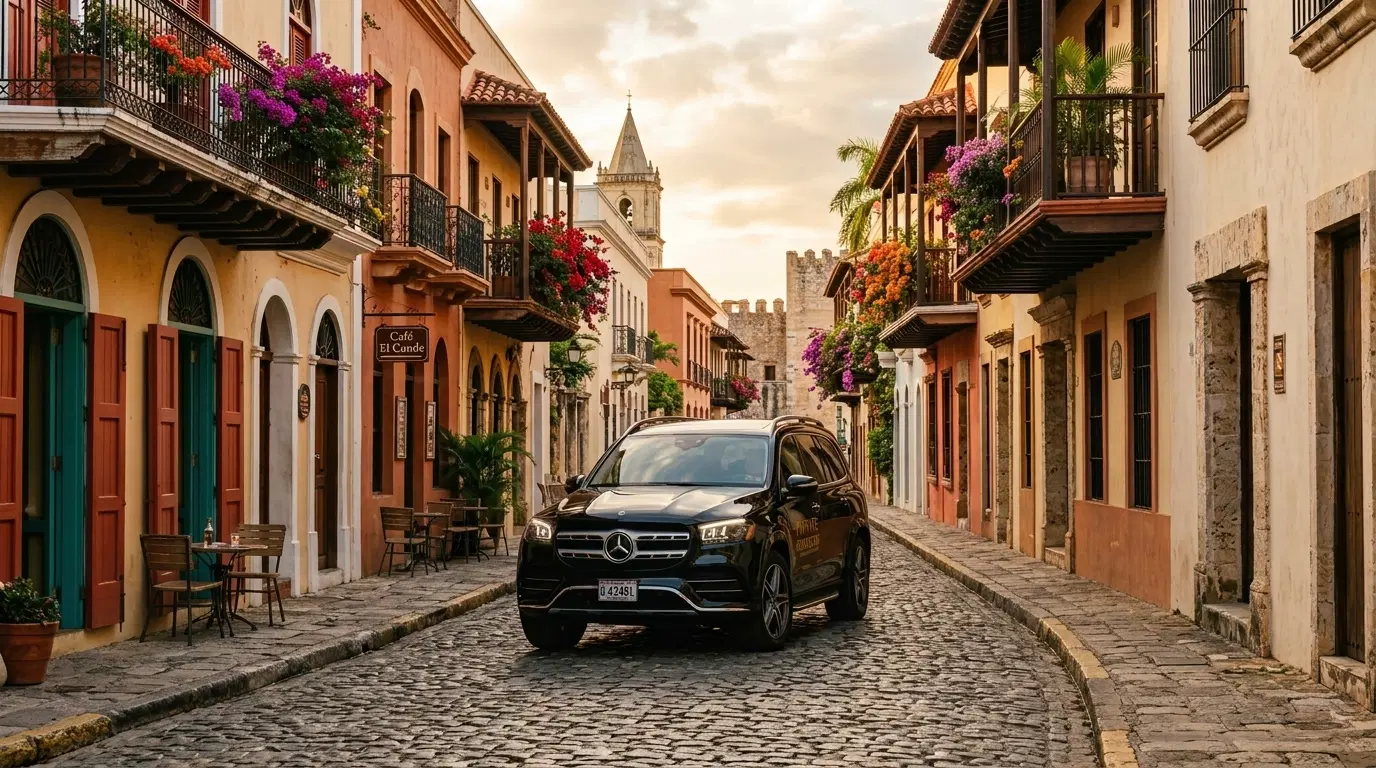
Your flight touches down at Las Américas after hours in the air, and somewhere across the city the cobblestone streets of the Colonial Zone are waiting. Between the two sits nearly 30 kilometers of highway, a river crossing, and the usual questions: how much should the ride cost, will traffic be heavy, and what's easiest with a couple of full suitcases? Choosing the right Santo Domingo airport to Colonial Zone transfer comes down to your priorities — speed, budget, or reaching your hotel door without stress. Sorting it out before you land makes the arrival far calmer than deciding at the curb.
What to Expect When You Land at Las Américas
Las Américas International Airport (SDQ) sits in Punta Caucedo, roughly 27 to 30 kilometers east of the Colonial Zone. That distance matters: unlike some capital-city airports built minutes from downtown, SDQ is a real drive away, and the Ozama River separates you from the historic center on the west bank.
The airport has two passenger terminals, Terminal A (South) and Terminal B (North). Both feed into an arrivals level with baggage claim, currency exchange, car rental desks, and the official taxi service. It's a compact, walkable setup, so you won't wander far to find transport — but you also won't have long to weigh your choices once you exit.
Two small things trip up first-time arrivals. The airport quotes fares in both U.S. dollars and Dominican pesos, so always confirm which currency a price is in. And the on-site exchange counters rarely offer good rates, so change only what you need there and carry a little cash for the ride. For official terminal and flight details, the airport operator Aerodom publishes current information at aerodom.com.
Your Santo Domingo Airport to Colonial Zone Transfer Options at a Glance
Here's the quick version before the detail. An official airport taxi runs a fixed zone fare of roughly US$35 to US$45 and takes about 30 to 45 minutes. Uber and InDrive often show less, around US$20 to US$30, but the price moves with demand and the pickup is handled differently. Public transport is cheap but slow and awkward with bags. A pre-booked private transfer costs a set price and puts a driver at your terminal.
|
Option |
Typical time |
Typical cost |
Best suited to |
|
Official airport taxi |
30–45 min |
~US$35–45 (fixed) |
First-timers, luggage, no hassle |
|
Private transfer (pre-booked) |
30–45 min |
Fixed, arranged ahead |
Late nights, families, groups, guesthouses |
|
Uber / InDrive |
30–45 min |
~US$20–30 (variable) |
Solo travelers comfortable with apps |
|
Public bus / minivan |
60–90 min+ |
A few dollars |
Very light packers on a strict budget |
Fares shift with fuel prices, tolls, and demand, so treat these as a guide and confirm the number before you ride.
Taking the Official Airport Taxi
The official taxi service is the simplest walk-up choice, and it's designed to remove haggling. A single authorized service operates from a counter near the terminal exit, running 24 hours a day with fixed fares set by destination zone. You tell the agent where you're going, the price is quoted from a set board, and you pay a flat rate — no meter, no negotiation at the curb.
Expect somewhere around US$35 to US$45 to the Colonial Zone, depending on your exact address and the time of day. A few practical moves make this smoother:
-
Ask the agent to write your exact hotel or street entrance on the slip. The Colonial Zone is small but dense, and a precise drop-off saves circling.
-
Confirm whether the quote is in dollars or pesos before you agree.
-
Have small bills ready, since drivers don't always carry much change.
This is also the moment to think about the rest of your trip. If your plans include the east coast, a Punta Cana to Santo Domingo Transfer is a much longer intercity ride best arranged in advance rather than sorted on the spot — a different task from this short airport hop.
Using Uber and InDrive
Ride-hailing works in Santo Domingo, and both Uber and InDrive operate around the airport. The apps give you upfront pricing and a tracked driver, and the fare is often lower than the official taxi — frequently in the US$20 to US$30 range for the Colonial Zone. For solo travelers who already live in these apps, it's a reasonable pick.
The catch is the pickup. The official taxi service controls the arrivals curb, so app drivers usually meet passengers at a designated spot, often up on the departures level rather than right outside baggage claim. Watch your app's map, tell the driver your terminal, and check the plate and driver name before getting in.
Two more things worth knowing. Uber doesn't offer a flat airport rate, so the price can rise with demand or tolls, and it may adjust slightly at the end of the trip. And late at night, when many long-haul flights land, driver supply thins out — so the official counter can actually be faster after midnight.
The Ozama River Bridges and Your Real Travel Time
Your travel time depends less on distance than on one thing: the bridges over the Ozama River. The airport connects to the city by the Autopista Las Américas, a wide toll highway that runs smoothly most of the way. The slowdown comes where traffic funnels across the river into the historic center.
During weekday rush hours, that crossing can turn a 30-minute drive into 45 minutes or more. Late at night or early morning, the same trip often runs closer to 25 minutes. If you're arriving during the evening peak, build in a buffer before any dinner reservation or check-in cutoff.
The highway is a toll road, so it helps to confirm whether tolls are included in your fare or added at the end. Official taxi quotes generally cover them; app and private-transfer prices vary, so a quick question up front avoids surprises.
Buses and Budget Routes
Public transport is the cheapest way into the city, but it's the hardest with luggage — and there's no rail link at all. Santo Domingo has a metro, yet it doesn't reach the airport, so that isn't an option from SDQ.
City buses don't enter the terminal. To catch one, you'd walk out to the Autopista Las Américas, a trek of around half an hour on foot, then ride toward the city and likely transfer to reach the Colonial Zone. Shared minivans do leave from in front of the departures area, heading toward Santo Domingo and Boca Chica.
For a few dollars, it's a fair choice if you're traveling very light, aren't in a hurry, and don't mind the walk in Caribbean heat. For most arrivals with suitcases, the time and effort rarely justify the savings.
When a Private Transfer Makes Sense
A private transfer solves a specific problem that this route creates. The Colonial Zone is a UNESCO-listed maze of narrow, one-way cobblestone streets, and some — like the pedestrian Calle El Conde — are closed to cars entirely. That can mean a taxi drops you at the edge of the zone, leaving you to wheel bags over cobblestones to a guesthouse tucked down a side street.
A driver who knows the area can get you as close to the door as the streets allow, which matters most late at night, with children or older relatives, or when a group's luggage won't fit in a standard cab. Booking a private transfer with Transpovia ahead of time also means your flight is monitored and a driver is waiting even if you land behind schedule, at a price fixed before you fly.
It's worth setting up the return the same way. Arranging your ride back to the airport through Transpovia for departure day removes the scramble of finding a taxi during morning traffic, when the Ozama bridges are at their busiest. Travelers who like that certainty tend to use it across the country — much like a Punta Cana Airport to Bávaro Transfer, where a fixed rate and a waiting driver take the guesswork out of arrival.
Frequently Asked Questions
How much is a taxi from Santo Domingo airport to the Colonial Zone?
An official airport taxi charges a fixed zone fare of roughly US$35 to US$45 to the Colonial Zone. The price is quoted at the counter before you ride. Uber and InDrive often show less, around US$20 to US$30, but their fares change with demand and tolls.
How long does it take to get from Las Américas Airport to the Colonial Zone?
Plan for about 30 to 45 minutes. The distance is roughly 27 to 30 kilometers, and travel time depends mostly on traffic at the Ozama River bridges. Late at night the drive can drop to around 25 minutes; weekday rush hours run longer.
Can you take an Uber from Santo Domingo airport?
Yes. Uber and InDrive operate at SDQ, but the official taxi service controls the arrivals curb, so app drivers usually meet you at a designated point, often the departures level. Check the plate and driver name, and note that prices aren't flat-rate.
Is there a bus or metro from the airport to the Colonial Zone?
There's no metro or train link to the airport. City buses run only from the Autopista Las Américas highway, about a 30-minute walk from the terminal, and aren't practical with luggage. Shared minivans leave from the departures area but involve transfers.
Before You Head Out
The easiest arrivals in Santo Domingo are the ones decided before landing. Match the option to your situation — the official counter for a fixed, fuss-free ride, or a private transfer when late hours, cobblestone streets, or family make door-to-door service worth it. Planning your Santo Domingo airport to Colonial Zone transfer in advance, even a simple pre-booked ride with Transpovia, turns a long travel day into a calm start.
"We landed near midnight and dreaded dragging our bags around the old town looking for the hotel. Our driver knew exactly which corner to stop at, and we were checked in within minutes — the smoothest part of the whole trip." — Couple visiting the Colonial Zone


