
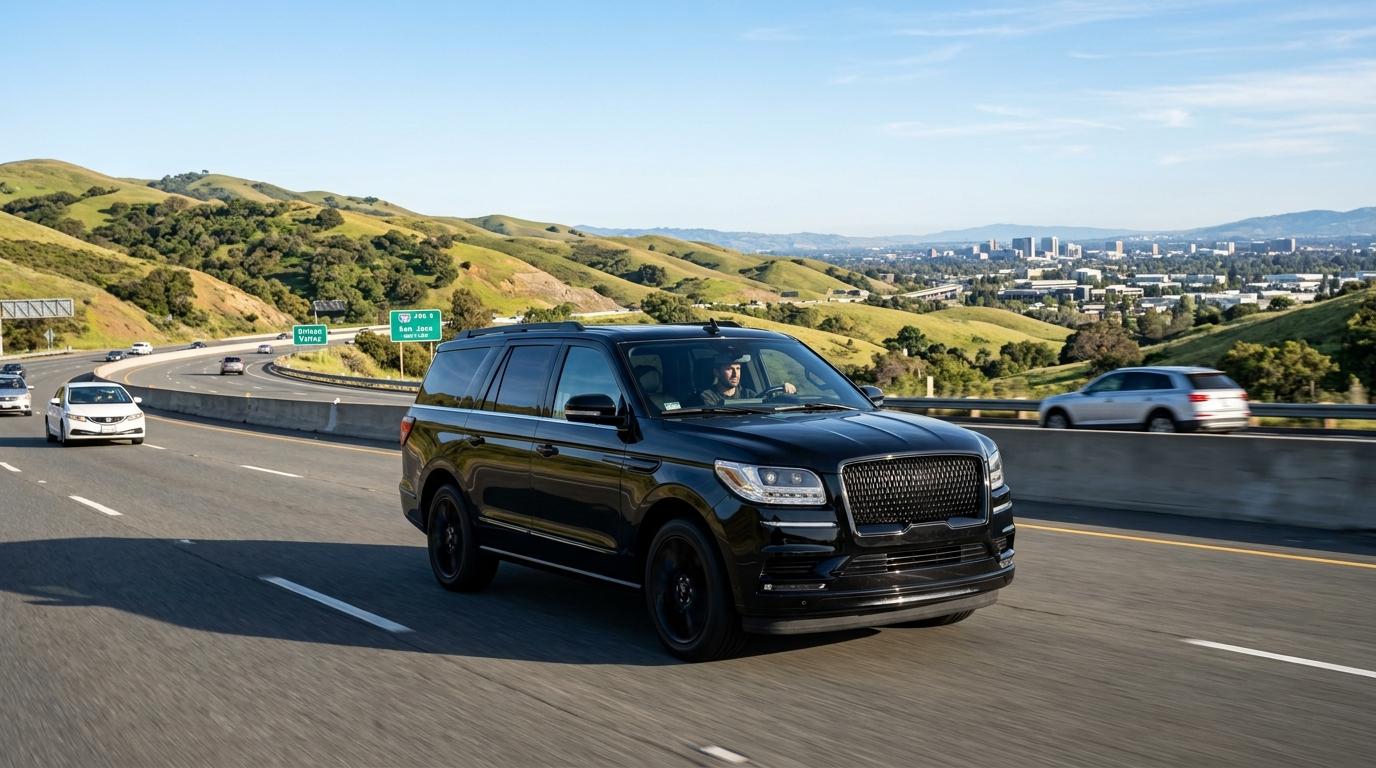
About 50 miles of Peninsula sit between San Francisco and San Jose. A short hop on paper, and a route that regularly humbles people who assume it. Maybe you have a client meeting off North First Street at nine and you're working out whether the train gets you there in time. Maybe you're heading down with a suitcase, a laptop bag, and no patience for a connection at the far end. Highway 101 doesn't care about your calendar. Sorting out your San Francisco to San Jose transfer in advance is what keeps the day on schedule.
How Far Is San Jose From San Francisco?
The drive is roughly 48 to 50 miles on US-101, or about 53 miles if you take I-280 down the western side of the Peninsula. With light traffic, both land around 45 to 60 minutes. During weekday peaks the same trip stretches to 75 minutes, sometimes well past 90.
The two routes behave differently. US-101 is more direct and connects better to downtown San Jose and the airport, but it carries heavier volume and more freight. I-280 runs a little longer through the foothills and is often steadier, though it clogs badly around Daly City in the morning. Direction of travel matters too — this southbound Peninsula run has a completely different rhythm from a San Francisco to Napa Valley transfer. Live conditions are worth checking on 511.org, the Bay Area's official traffic and transit service run by MTC, Caltrans and the CHP.
Comparing Your San Francisco to San Jose Transfer Options
This corridor has more choices than almost any route in California. The right one depends on where in San Jose you're actually headed, and how tightly your day is scheduled.
|
Option |
Typical time |
Approx. cost (one way) |
Best for |
|
Private transfer / car service |
50–90 min |
Fixed, quoted per vehicle |
Groups, luggage, fixed meetings |
|
Caltrain Express |
About 60 min |
$11.50 adult, $1 youth |
Peak-hour trips to downtown San Jose |
|
Caltrain Local |
75–80 min |
$11.50 adult, $1 youth |
Midday and evening trips |
|
BART Green Line |
About 65–75 min |
Roughly $9–$11 |
North San Jose destinations |
|
FlixBus / Greyhound |
1h–1h 40m |
From about $13 |
Lowest cost, if timing lines up |
|
Taxi or rideshare |
50–90 min |
Metered or surge-priced |
Late nights, one or two people |
|
Driving yourself |
45 min–2 hrs |
Fuel and parking, no tolls |
Trips spread across Silicon Valley |
Caltrain
Caltrain runs from 4th & King in San Francisco to San Jose Diridon, and since electrification it's faster and far more frequent than it used to be — more than 100 trains on a typical weekday.
Here's the part most guides skip. Express trains do the run in about an hour but serve only 11 stations and concentrate around commute periods; a Local stops everywhere and takes closer to 77 minutes. Service follows a clockface pattern, so departures repeat at the same minutes each hour — northbound from Diridon, most Expresses leave at :22 and most Locals at :28 and :58.
An adult one-way across all four zones is $11.50 at current rates, and riders aged 5 to 18 pay a flat $1 with a Clipper Youth card, valid across every zone. Caltrain dropped its 55-cent Clipper discount on January 1, 2026, so the price is now the same however you pay. Check the Caltrain fares page before you travel.
BART
BART's Green Line runs from San Francisco to Berryessa/North San José in about 65 minutes for roughly $8 to $11. The catch is where it ends: Berryessa sits in North San Jose, not downtown. Reaching Diridon or the convention center means a VTA connection on top. Green Line service also thins out late evenings and Sundays, so check before you rely on it.
Bus
FlixBus and Greyhound both serve the corridor, boarding curbside near 5th and Townsend and arriving at Diridon, with fares starting around $13. The fastest runs take about an hour. Frequency is the problem — often only two or three departures a day, so the schedule has to happen to suit you.
Taxi and Rideshare
A taxi San Francisco to San Jose or an Uber gives you door-to-door service without booking ahead. On a 50-mile trip, though, the meter climbs fast, and surge pricing bites hardest at exactly the hours you'd want to leave. You won't know the real cost until you arrive.
Private Transfer
A private transfer San Francisco to San Jose picks you up at your address and drops you at the door — no station, no connection, no luggage limits beyond the vehicle. A chauffeur San Francisco to San Jose also handles the part travellers underestimate: reaching a business park in Santa Clara that no train serves. Cost per person is the trade-off, so it works best for two or more people or when the schedule is fixed.
Driving Yourself
Renting makes sense if you're covering multiple Silicon Valley sites. For a single downtown trip it rarely does — you'll pay for parking at both ends and drive the worst stretch of 101 yourself.
Where You're Going in San Jose Changes the Answer
"San Jose" covers a lot of ground, and this is where plans usually go wrong. Diridon Station sits on the western edge of downtown, walkable to the SAP Center and most downtown hotels. That's the one address where Caltrain genuinely wins.
Everywhere else is harder. Levi's Stadium and much of the tech corridor are in Santa Clara and Sunnyvale, several stops short of Diridon. North First Street offices cluster nearer BART's Berryessa terminus. The convention center is a walk or a light rail hop from Diridon. Before you pick a train, check what sits between the platform and your actual destination — that gap is where a 60-minute trip quietly becomes 95.
Route Planning Tips
Southbound traffic builds from about 3 p.m. on weekdays and stays ugly until past 6:30. Mornings are lighter heading south than north, since you're moving against the commute. The clearest windows are before 6:30 a.m. or between 10 a.m. and 2 p.m.
A few things worth planning around:
-
Events reshape the route. Games and concerts at Levi's Stadium or the SAP Center flood 101 and downtown San Jose. Check the calendar before you book.
-
Check the weekend rail schedule. Caltrain runs half-hourly on weekends, but engineering work on the Guadalupe River bridge is closing the Tamien–Diridon segment on selected weekends through September. Diridon itself stays served; confirm your train first.
-
Bay Area transit funding is unsettled. A state loan agreed in early 2026 headed off cuts at Caltrain, BART and Muni through the 2026–27 fiscal year, and a regional measure goes to voters in November. Current schedules are reliable; long-term ones are a fair question.
-
Weekends are genuinely easier on the road. Both freeways move well outside commute hours.
-
Count your luggage honestly. Caltrain has racks, but hauling three large cases up the platform stairs at Diridon isn't the plan you think it is.
When a Private Transfer Makes Sense
The math shifts once you're travelling as a group or working to a fixed time. Three or four people splitting one vehicle often pay less per head than four train fares plus a rideshare at the far end — and arrive at the door instead of the station.
It also makes sense when the destination isn't downtown. Business travellers heading to a Santa Clara office, teams moving together between meetings, older passengers who shouldn't be managing bags across platforms, and anyone landing late all benefit from a driver already waiting. For larger parties, a San Francisco to San Jose shuttle keeps everyone in one vehicle rather than splitting across cars. Booking a car service San Francisco to San Jose through Transpovia removes the connection risk entirely.
Booking Your Transfer
Book ahead during conference season — San Jose fills up around major tech events, and vehicles get scarce. Confirm the exact pickup address, the vehicle size against your real luggage count, and what happens if a flight or meeting runs long.
Build in more buffer than the map suggests. A 55-minute drive that becomes 95 is routine here, not exceptional. If your trip starts with a flight, the same reasoning applies to a San Francisco airport to Downtown San Francisco transfer — short distance, unpredictable clock.
Book With Transpovia
Transpovia provides direct city-to-city San Francisco to San Jose transportation with fixed pricing quoted before you book, so there's no meter and no surge. Booking takes a few minutes, drivers are professional and vetted, and the vehicle is matched to your group and luggage rather than whatever's nearby.
Pickup and drop-off are door to door, with no transfers in between. For groups, business schedules and destinations the trains don't reach, that's usually where Transpovia earns its cost.
Frequently Asked Questions
How long does it take to get from San Francisco to San Jose?
Between about 45 minutes and two hours by road, depending entirely on timing. Caltrain's Express takes roughly an hour; Local trains stop everywhere and take closer to 77 minutes. BART reaches North San Jose in a little over an hour, but that's not downtown.
Is Caltrain or BART better for getting to San Jose?
It depends on your destination. Caltrain goes to Diridon Station on the edge of downtown San Jose, which suits most visitors. BART ends at Berryessa in North San Jose and needs a VTA connection to reach downtown, so it's better if your destination is already up that way.
How much is a taxi from San Francisco to San Jose?
There's no fixed rate. A metered taxi or rideshare over roughly 50 miles varies with traffic and demand, and rises sharply during peak hours or surge pricing. A quoted private transfer is the only option here with a price you know in advance.
Do I need a car in San Jose?
If you're staying downtown, usually not — Diridon, the convention center and the SAP Center are close together. If your plans spread across Santa Clara, Sunnyvale or Cupertino, transit gets slow and a car or booked transfers make more sense.
Before You Go
Work out what matters most: cost, speed, or not having to think about it. Caltrain is excellent value if you're headed downtown and can time an Express. A private transfer wins once luggage, a group or a business-park address enters the picture. Whichever you pick, book it before you travel — the Peninsula rewards planning and punishes improvisation.
"Four of us had a 9 a.m. in Santa Clara and no train goes near the office. One car, one price, everyone arrived together and awake. We stopped debating it after that trip." — Business traveller on the San Francisco to San Jose route


