
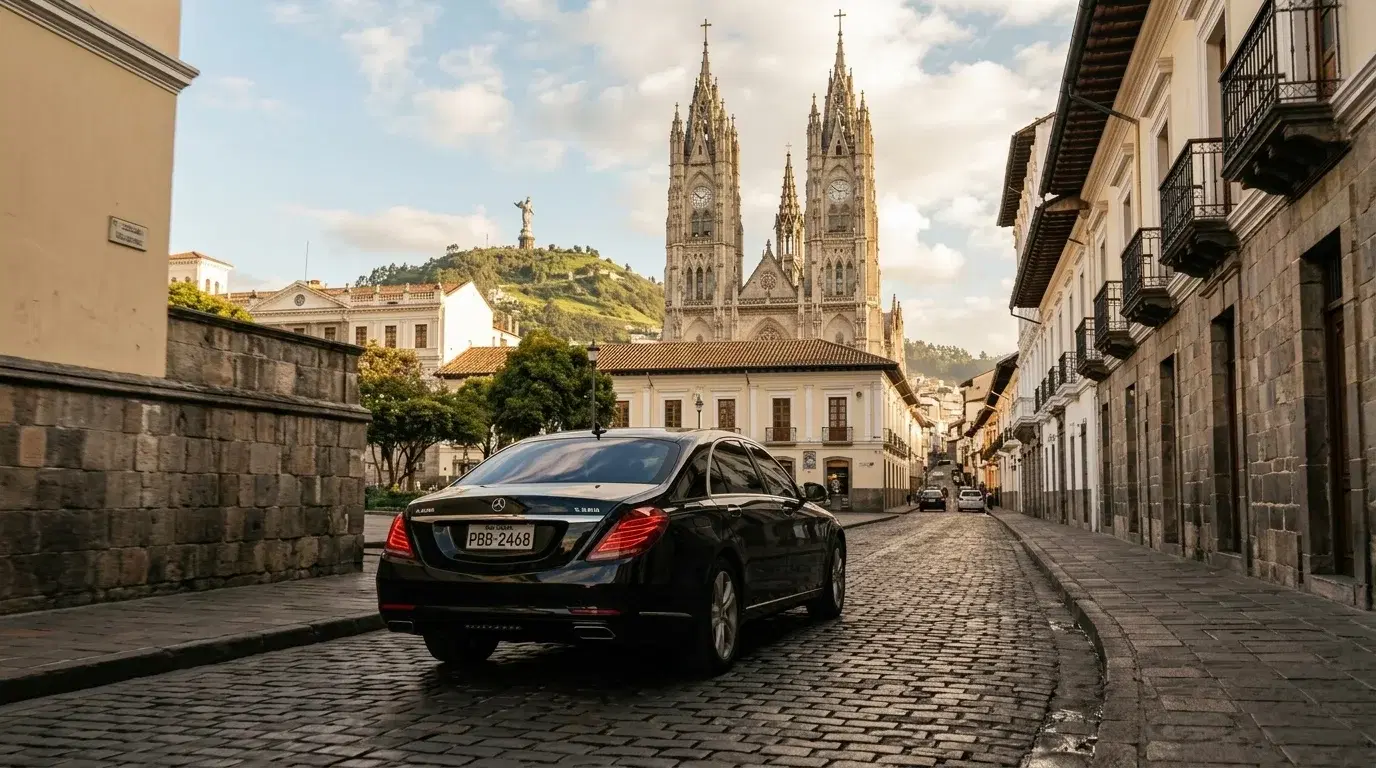
Most flights into Quito land in the evening, and the first thing you notice outside the terminal is how dark and empty everything looks. Mariscal Sucre sits in Tababela, farmland roughly 40 kilometers east of the city, so a Quito Airport to Historic Center transfer isn't a quick hop — it's a 45-minute drive on a highway that climbs steadily toward 2,850 meters. Add tired legs, two suitcases and colonial streets barely wide enough for one car, and the option you pick genuinely matters. Sorting it out before takeoff saves real hassle.
Quito Airport to Historic Center Transfer Options, Compared
There's no train and no direct express bus to the Old Town. You have four realistic choices: an official airport taxi, a ride-hailing app, a public bus connecting to the Metro, or a pre-booked private car. Distance is about 40 kilometers via the Ruta Viva highway, and the drive runs 45 to 60 minutes when traffic behaves.
|
Option |
Time to the Historic Center |
Typical cost |
Works best for |
|
Official airport taxi |
45–60 min off-peak |
Around $26–$30 by day, more overnight |
Arriving without a booking, small groups |
|
Ride-hailing app |
45–70 min |
$15–$25 |
Budget travelers with a working data plan |
|
Public bus + Metro |
90–120 min |
About $2.45 total |
Light packers landing in daylight |
|
Pre-booked private transfer |
45–60 min |
Fixed price agreed in advance |
Families, night landings, heavy luggage |
|
Rental car |
45–60 min |
Rental, fuel and parking |
Onward trips outside Quito |
Traffic is the variable that breaks these numbers. Weekday peaks run roughly 06:00 to 09:30 and 16:00 to 20:00, and a 45-minute drive can stretch past 90 as you funnel into the city through Cumbayá and Tumbaco.
What's Waiting When You Walk Out of Arrivals
The airport has a single terminal with arrivals below and departures above, so there's no terminal-hopping to worry about. Once you clear customs, the official taxi counter is visible almost immediately in the arrivals hall.
That counter matters. You give the staff your destination, they issue a voucher showing the fixed fare for that zone, and you hand it to the driver they assign you. Payment happens at the end of the ride. Two authorized cooperatives work under contract with the airport and run 24 hours a day, 365 days a year. Anyone approaching you inside the terminal offering a ride is not part of that system.
Buses leave from a stop just outside the terminal, past the taxi line — follow the signs for "Transporte Público."
One practical detail that saves frustration: Ecuador uses the US dollar, so most travelers skip currency exchange entirely. Break large notes before you leave the airport, though. Drivers and bus conductors rarely carry change for a $50 or $100 bill.
It's worth knowing this route is unusually long by regional standards. Guayaquil's airport sits inside the city, which makes a Guayaquil Airport to City Center Transfer a ten-minute errand rather than a highway trip. Quito asks more of you.
The $2 Bus and the Metro Connection
Three municipal bus routes serve the airport for $2 each: one to Terminal Río Coca in the north, one to Quitumbe in the south, and one to Carcelén. The northern route has since been extended to El Labrador, a multimodal station on Metro Line 1 — and that changes the math for anyone heading downtown on a budget.
From El Labrador you ride Metro Line 1 south to San Francisco station, which opens directly onto the Historic Center. The Metro fare is $0.45, and the full line takes about 34 minutes end to end. Total cost from the terminal to the Old Town: under $2.50.
Timing is the catch. The El Labrador route runs Monday to Friday from about 04:45 to 22:00, Saturdays from 05:00 to 23:00, and Sundays and holidays from 06:00 to 20:00, with buses every 20 to 25 minutes. Metro trains start at 05:30 on weekdays and 07:00 at weekends, with last services around 23:00.
Budget at least 90 minutes door to door, and be honest about your bags. City buses have no luggage racks, you may stand for part of the ride, and you'll be lifting suitcases on and off twice. It's a reasonable option with a backpack in daylight, and a difficult one with two large cases after dark.
One correction worth carrying with you: the $8 Aeroservicios shuttle to Parque Bicentenario still appears in plenty of guides and forum posts. That service stopped after its contract with the airport operator ended, and no confirmed replacement has launched. Don't build your arrival around it. The airport's own transportation page lists the operators currently running.
Official Taxis Versus Ride-Hailing Apps
The airport taxi costs more and gets you moving faster. Apps cost less and ask more of you.
Taxis win on simplicity. The price is set before you leave, no meter is involved, no phone signal is needed, and the car is already waiting. Overnight rides, roughly 10 p.m. to 6 a.m., typically add a few dollars. Authorized cabs are yellow with orange plates and a visible unit number, and seatbelts are mandatory for every passenger.
Apps win on price. Uber, inDrive, DiDi and Cabify all operate in Quito, and inDrive often returns the lowest quote. The complication is pickup: drivers can't collect from the arrivals curb, so you walk to the designated ride-hailing area and the app guides you there. Cancellations happen, and between 2 and 5 a.m. there are simply fewer drivers online.
The decision usually comes down to group size. Solo in daylight, an app can save you $10. Traveling as three or four, the fixed taxi fare split between you is already inexpensive, and you skip the walk.
Either way, have your hotel address written in Spanish, including cross streets. English is not widely spoken among drivers.
When a Private Transfer Makes Sense
A pre-booked car solves a specific set of problems on this route: no counter queue, no car park hunt, and no uncertainty about who's actually meeting you at 11 p.m. in an airport surrounded by farmland.
It earns its cost in a handful of situations:
-
Late landings. Many long-haul connections from Bogotá, Panama City and Madrid arrive after the last buses have run.
-
Families with small children. Car seats can be arranged in advance, which neither the taxi rank nor an app guarantees.
-
Old Town hotels. Many sit on one-way colonial streets where a driver needs to know exactly which corner works for unloading.
-
Groups and heavy luggage. Four people with cases don't fit comfortably in a standard sedan.
-
No Spanish and no local data plan. Both make the app route harder than it looks.
That's the gap a service like Transpovia fills — a fixed price agreed before you fly, a driver assigned to your flight number, and a single meeting point inside arrivals.
Booking your return at the same time carries more weight here than at most airports. Traffic heading back east is unpredictable, and reserving the departure leg with Transpovia while you're still planning means you're not bargaining on a sidewalk at 4 a.m. before an early international flight.
Late Arrivals, Early Departures, and the Altitude Nobody Plans For
Public transport thins out early. Depending on the route, airport buses finish somewhere between 20:00 and 23:00, and the Metro's last trains run between 22:00 and 23:00. After that, taxis, apps and pre-booked cars are your only options.
Then there's the altitude, which almost no transport guide mentions. The airport sits in a valley at roughly 2,400 meters. The Historic Center sits at about 2,850. You gain that height during the drive, which is why some people feel it the moment they start hauling bags up the stairs of a colonial guesthouse with no elevator.
Give yourself an easy first evening. Drink plenty of water, get adequate rest, and avoid strenuous activities during your first morning after arriving.
Early departures deserve the same caution in reverse. Leaving the Old Town for a morning international flight during weekday rush hour can easily take 90 minutes, so build in the buffer. Pre-arranging a car for a pre-dawn departure is common practice across the region — the same reasoning shapes a Santiago Airport to City Center Transfer.
Getting Into the Old Town Itself
The final kilometer is its own puzzle. Quito's Historic Center is a UNESCO World Heritage site of narrow one-way streets, with pedestrian-only stretches around Plaza Grande and La Ronda and very little space to stop a car. Sending your driver the cross streets rather than just a hotel name makes the drop-off far smoother.
If you're considering a rental car for a city stay, one rule changes the picture. Pico y Placa restricts private cars and motorcycles by the last digit of the plate, Monday to Friday from 06:00 to 09:30 and 16:00 to 20:00, within Quito's urban perimeter. Fines start around $70. Public and commercial transport are exempt; your rental isn't. Rent for trips beyond the city, not for the Old Town.
Frequently Asked Questions
How much is a taxi from Quito Airport to the Historic Center?
Expect roughly $26 to $30 during the day for the official airport taxi, with overnight rides costing a few dollars more. The fare is set by destination zone and printed on a voucher at the counter before you leave, so there's no meter and no negotiation. Pay the driver in cash at the end.
How long does the trip from the airport to the Old Town take?
Between 45 and 60 minutes in normal conditions, covering about 40 kilometers via the Ruta Viva. During weekday rush hours it can reach 90 minutes. Public transport with the bus and Metro combination takes 90 minutes to two hours, including the transfer and waiting time.
Is there a direct bus from Quito Airport to the Historic Center?
No. Municipal buses run to Río Coca, El Labrador, Quitumbe and Carcelén for $2, and from El Labrador you connect to Metro Line 1 and ride to San Francisco station in the Old Town. The former $8 direct shuttle to Parque Bicentenario is no longer operating.
Before You Land
Match the option to your arrival, not to the cheapest number on the page. Traveling light on an afternoon flight? The bus and Metro combination works well. Landing at midnight with family and luggage? Have a car waiting. Arranging it through Transpovia before you fly means the only thing left to do in arrivals is find your name on a board.
"We landed at eleven at night with two kids asleep on our shoulders. Walking out and seeing our driver already there, holding a sign, was the best thing that happened all day."


