
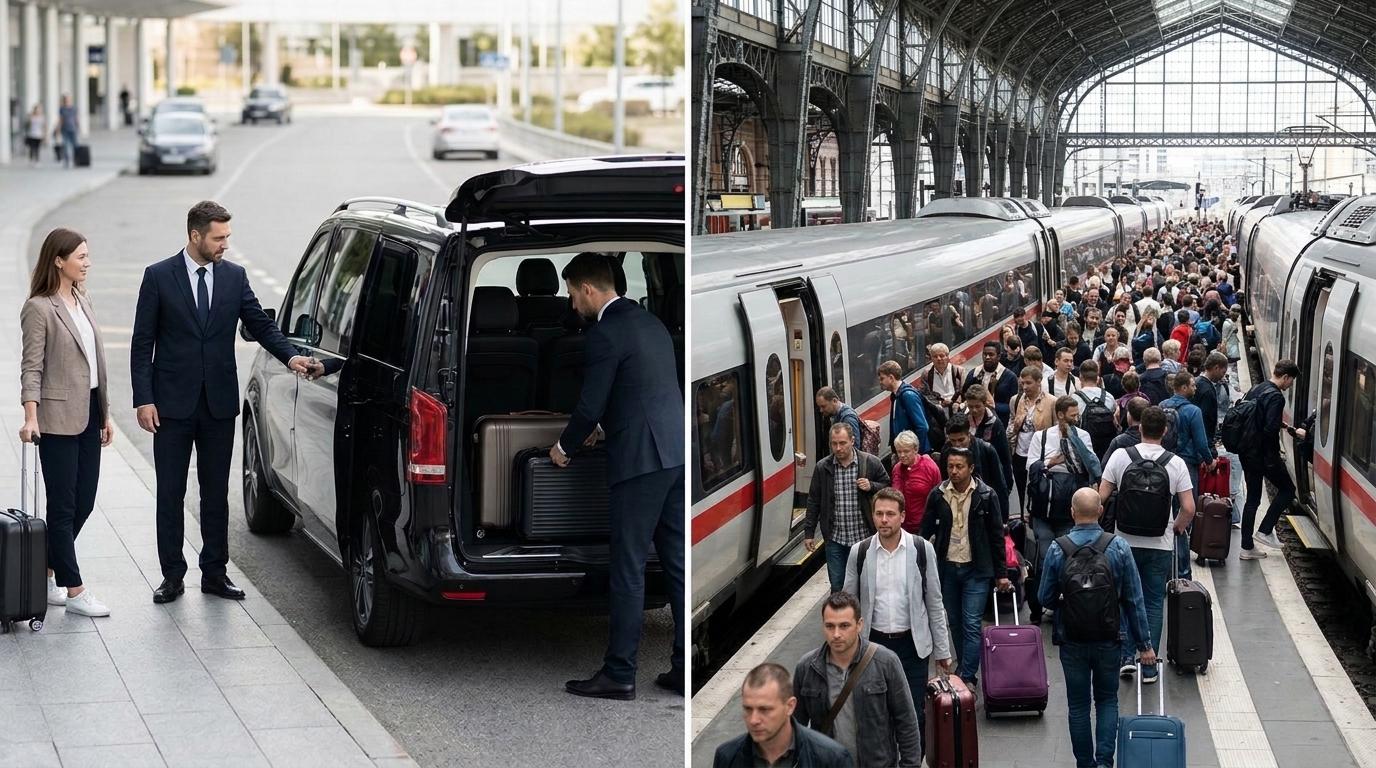
Trains look like the obvious answer when you're planning a trip between two cities. The timetable is clear, the route skips highway traffic, and a single ticket seems easy to compare. But the private transfer vs train question rarely comes down to the timetable alone. What decides it is the whole journey: getting from your hotel to the station, hauling bags through a busy concourse, waiting on the platform, and finding a ride once you arrive.
This guide walks through the factors that actually change the outcome, from real door-to-door time and the true cost for groups to luggage, comfort, and timing. It also covers the trips where the train is still the smarter move, so you can choose based on your route and your travel party instead of habit.
Private Transfer vs Train: Door-to-Door Time Is What Counts
A train schedule tells you how long you'll spend between two stations. It says nothing about the time it takes to reach the first one or to get from the second one to where you're actually sleeping. Those extra legs are where a fast train can quietly lose its edge.
Think about a typical rail day. You leave the hotel early to beat traffic to the station, arrive with a buffer so you don't miss a reserved seat, and find your platform. Cross-border services with passport and security checks ask passengers to show up even earlier. After you arrive, there's often a taxi line, a confusing exit, or a hotel that sits well outside the city center. Add up those pieces and a two-hour train ride can easily turn into a half-day trip.
A private car works differently. The driver picks you up at your hotel lobby or the airport arrivals hall and drops you at your final address. There are no transfers between vehicles, no platform changes, and no need to time your morning around a fixed departure. This matters most when:
-
Your hotel, villa, or meeting is far from the nearest train station
-
You're landing at an airport and heading straight to another city, which by rail usually means airport to station, station to station, then station to hotel
-
Your flight arrives late at night or very early in the morning, when train service is thin or not running
-
You're traveling to a coastal town, ski resort, or countryside area with limited rail access
The train can still win on pure speed when both cities have central stations, high-speed service runs frequently, and your accommodation is a short walk from each end. The point isn't that one is always faster. It's that you should compare the full trip, not just the section printed on the ticket.
Private Transfer vs Train Cost: Do the Math for Your Whole Group
The biggest pricing difference between a private car vs train comes down to how each one charges. Train tickets are priced per seat. A private transfer is priced per vehicle. For one person, that usually favors the train. For a family or a group of friends, the gap can shrink fast or flip entirely.
Here's a simple way to compare the two honestly:
-
Multiply the train fare by the number of travelers, including any children who need a paid seat.
-
Add the cost of getting to the departure station and from the arrival station, whether that's a taxi, rideshare, or public transit for everyone.
-
Check whether your route charges extra for seat reservations or larger bags.
-
Compare that total with a single quote for a vehicle that fits your whole party and your luggage.
Timing affects the numbers too. Many intercity and high-speed rail operators use demand-based pricing, so fares bought close to the travel date or on busy holiday weekends can cost noticeably more than the advertised starting price. A pre-booked transfer locks in the vehicle price when you reserve it.
It also helps to know what a quote covers. With private transfers booked through Transpovia, you see an all-inclusive price for the vehicle before you pay, so you aren't left guessing about add-ons once you arrive. For couples and solo travelers on a tight budget, the train will often stay cheaper. For groups of three or more, especially with luggage, the total is worth calculating before you assume the train is the bargain.
Luggage, Kids, and Comfort Along the Way
Some of the most practical private transfer benefits have nothing to do with price or speed. They show up in the small, tiring moments that rail travel tends to pile on.
Traveling With Luggage
On a train, every bag is your job. You lift suitcases up steps onto the carriage, look for space in overhead racks or the luggage area at the end of the car, and keep an eye on them during stops. Some stations have long walks, stairs, or crowded escalators between the entrance and the platform. With a private transfer, the driver loads the trunk at your door and unloads it at your destination. If you're carrying ski gear, golf clubs, a stroller, or several large suitcases, mention it when you book so the right vehicle shows up.
Families, Older Travelers, and Anyone Who Needs Extra Help
Moving young children through a busy station while juggling tickets and bags is stressful for even the most organized parents. A private car keeps everyone together in one place from start to finish, and you can usually request child seats in advance. Travelers with limited mobility also benefit from a curbside pickup and drop-off instead of navigating platforms, gaps, and station crowds.
Privacy for Work or Rest
Trains can be a decent place to work, but you share the space. Phone calls, video meetings, and confidential conversations are harder in an open carriage. Business travelers often prefer a private vehicle so they can take calls, review documents, or simply rest before a meeting. For anyone recovering from a long-haul flight, a quiet car straight to the hotel is hard to beat.
When the Train Is the Better Choice
A fair train vs private transfer comparison has to admit that rail is excellent for certain trips. The train is often the right call when:
-
You're traveling solo or as a couple, with light bags, and keeping costs low is the priority
-
A high-speed line connects the two city centers and your hotels sit close to both stations
-
Your route crosses a city core known for heavy rush-hour traffic
-
The rail journey itself is part of the experience, such as a scenic line through mountains or along a coast
You also don't have to treat it as all or nothing. Plenty of travelers mix the two. A pre-booked car can handle the hardest leg, such as a late-night airport arrival or the trip from a remote villa to the nearest station, while the train covers the long, straight run between major cities. That way you get the speed of rail without the stress of the first and last mile.
How to Choose and Book an Intercity Transfer With Confidence
When you're stuck on intercity transfer vs train, a few quick questions usually settle it. How many people are traveling, and how many bags are coming along? Is your pickup point or final address near a station? What time do you land or need to leave? And is your budget built around the lowest possible fare or the least amount of hassle?
If a private car comes out ahead, these habits make the booking go smoothly:
-
Book ahead. Reserving early gives you a confirmed price and vehicle, which is especially useful during holidays and peak travel seasons.
-
Share your flight number. If your transfer starts at an airport, this lets the provider follow your arrival time rather than a fixed clock.
-
Match the vehicle to your group. A sedan, minivan, or larger van makes a real difference once suitcases and car seats are counted.
-
Confirm the meeting point and waiting time. Know exactly where the driver will meet you and how long they'll wait if you're held up at baggage claim.
-
Check what the price includes. Look for clear details on tolls, fees, and any charges for extra stops before you pay.
Before you plan around a specific route, browse the transfer destinations available to see which countries and cities are covered. It's an easy way to check your options before you commit to a rail ticket.
Frequently Asked Questions
Is a private transfer cheaper than taking the train?
For a solo traveler, the train is usually cheaper. For families and groups, a private transfer can be competitive or even less expensive, because you pay one price for the vehicle rather than one fare per person. Once you add taxis to and from the stations and last-minute rail fares, the difference often narrows.
Is a private transfer faster than the train between cities?
It depends on the route. High-speed trains between central stations can be faster on paper, but a private transfer often wins on total door-to-door time when your hotel, airport, or destination sits far from a station. It also leaves on your schedule instead of a fixed departure time.
What happens if my flight is delayed before my transfer?
When you include your flight number in the booking, the pickup can be adjusted to your actual arrival time. Transpovia uses real-time flight tracking for airport pickups, so a delayed landing doesn't mean a missed ride or a scramble for another option.
Conclusion
Choosing a train or private transfer is less about which option is better in general and more about which one fits this particular trip. The train shines for light-packing solo travelers on well-connected routes between city centers. A private transfer makes more sense when you're traveling as a group, carrying real luggage, arriving at odd hours, or heading somewhere the rail network doesn't reach easily.
Before you book, compare the full door-to-door journey and the total cost for everyone in your party. When the numbers are close, think about how you want to feel when you arrive. For many travelers, stepping out of a car at the hotel entrance, bags already handled, is what tips the private transfer vs train decision.
"We landed close to midnight with two tired kids and four suitcases. Our driver was waiting right at arrivals, and an hour later we were checked into our hotel in the next city instead of hunting for a train."


