
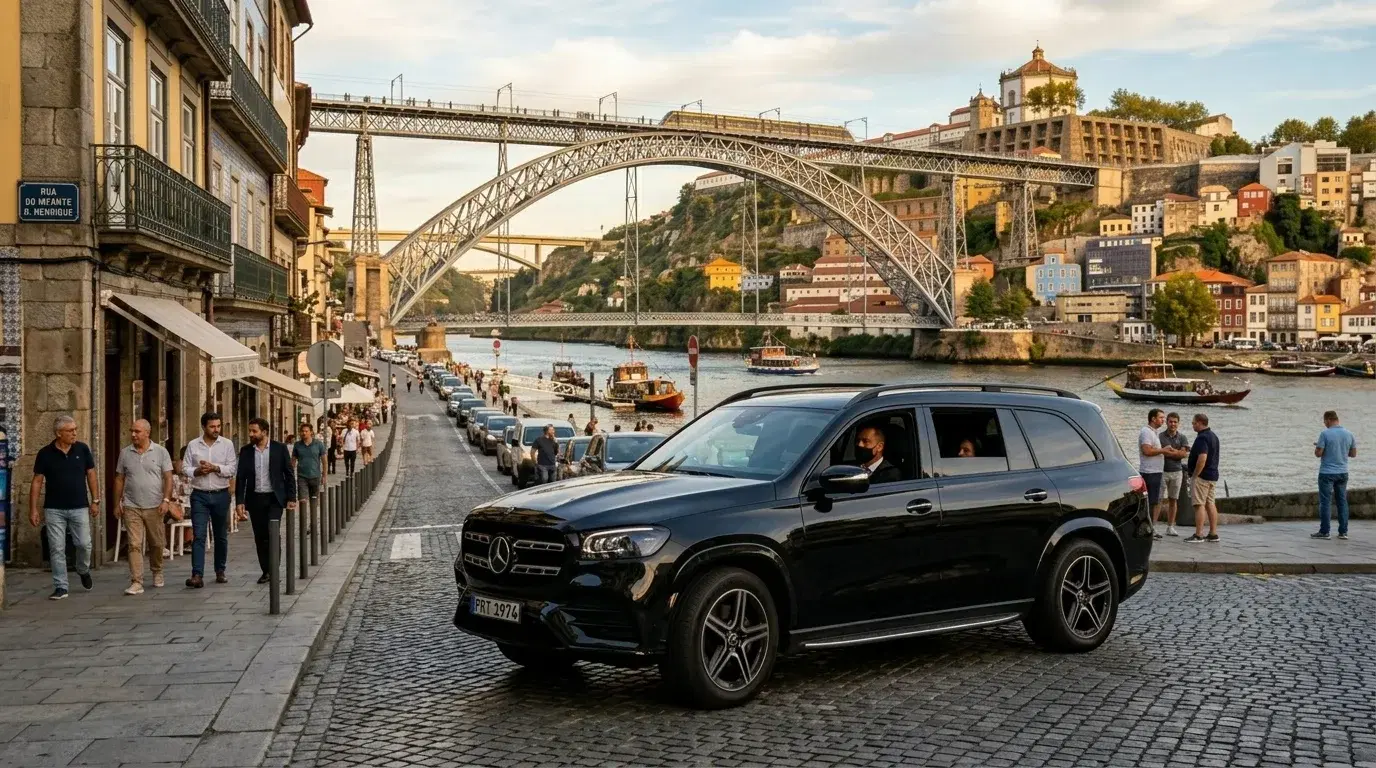
You land at Francisco Sá Carneiro after a short hop from London or a long day connecting through Lisbon, and downtown Porto — the tiled façades, the river, the port cellars — is only about 11 kilometers south. That closeness is a gift, but the arrivals hall still hands you a choice: the direct metro, a taxi at the door, a rideshare, or a driver already waiting. Solo travelers watch the budget, families juggle strollers and bags, and late arrivals worry the trains have stopped. Sorting out your Porto Airport to Downtown Porto transfer before you fly turns that first decision into an easy one.
Getting From Porto Airport to Downtown Porto: Your Options at a Glance
Porto's airport (OPO) sits about 11 km northwest of the center, in Maia, and most options reach downtown in 20 to 35 minutes. You have five realistic ways in: Metro Line E, a taxi, Uber or Bolt, an airport bus, or a pre-booked private transfer. The metro is the standout here — few European airports connect this directly to the city.
|
Option |
Typical cost to downtown |
Time |
Door-to-door? |
Best for |
|
Metro Line E |
~€2.85 first ride (ticket + card) |
25–30 min to Trindade |
No — walk from the station |
Most travelers, budget, beating traffic |
|
Taxi |
~€25–35 |
20–30 min |
Yes |
Groups, heavy luggage, no app |
|
Uber / Bolt |
~€10–22 |
20–30 min |
Pickup at the ride-hailing zone |
Solo or pairs, cashless |
|
Airport / night bus |
~€2.25 |
45–60 min |
No |
Budget, late arrivals, luggage room |
|
Private transfer |
Fixed, from ~€20 |
20–30 min |
Yes |
Families, late arrivals, hilltop hotels |
Portugal uses the euro, and cards work almost everywhere, so there's little cash to sort before you ride.
Taking Metro Line E Into the City
For most travelers, Metro Line E (the violet line) is the best way into Porto. The Aeroporto station sits right outside the terminal, a short walk down from arrivals, and trains run directly to the center in about 25 to 30 minutes. Line E reaches Trindade — the main hub where every other line connects — plus Bolhão and Campanhã.
Here's the part that trips people up. The airport is in fare zone Z4, so you need a Z4 ticket, loaded onto a reusable Andante Azul card that costs €0.60 the first time. That makes your first ride about €2.85. Buy both at the blue machines or the Andante shop in arrivals, choose English, and — this matters — validate the card at the yellow machines before the platform, and again when you change lines.
A few things worth knowing:
-
Buy the correct Z4 ticket. A cheaper Z2 or Z3 won't cover the airport, and inspectors do check — fines start around €50.
-
Keep the Andante card. It works on the metro, STCP buses, and some trains for your whole stay. If you'll ride a few times on arrival day, an Andante Tour pass covers all zones and can be better value.
-
At rush hour, the metro often beats a car. While taxis and Ubers sit on the VCI ring road, Line E runs on its own track and arrives on schedule.
Trains run daily from about 06:00 to 01:00, every 20 to 30 minutes. If you're continuing to the capital later, Campanhã is Porto's main train station — and for anyone combining both cities, a Lisbon to Porto Transfer is a separate cross-country trip worth planning ahead.
Where the Metro Falls Short: The Old Town and Late Nights
The honest limit of the metro is that it doesn't reach deep into the oldest parts of Porto. Ribeira down by the river, the Sé cathedral, and the lanes climbing the hills between them aren't on Line E, so you finish on foot over cobbles and steep gradients. That's fine with a backpack and hard with two suitcases, which is the single biggest reason travelers regret defaulting to the metro.
If your hotel is down in Ribeira, plan for the last stretch: the Funicular dos Guindais links the riverside to the upper city and saves the worst of the climb.
Timing is the other catch. Line E stops running around 01:00. If your flight lands later, the 3M night bus covers the gap — it leaves the airport hourly at half past the hour, roughly 00:30 to 05:30, and ends at Avenida dos Aliados in the center for €2.25. Taxis and rideshares also run 24/7. During the day, standard STCP buses handle luggage more comfortably than a crowded metro, with wider aisles and wheelchair ramps, though they take closer to 50 minutes.
Taxis, Uber, and Bolt
Taxis wait at the rank directly outside arrivals, around the clock, and reach the center in 20 to 30 minutes. Portuguese taxis are metered by law, and a ride downtown usually runs €25 to €35. Make sure the driver starts the meter and that the printed tariff card is visible.
Two extra charges catch people off guard. Night, weekend, and holiday trips use a higher tariff — roughly 20% more than the weekday daytime rate — and there's a small surcharge (around €1.60) for luggage placed in the trunk. If a fare ever looks wrong, you can ask for the Livro de Reclamações, the official complaints book, which usually settles disputes on the spot.
Uber and Bolt both work well in Porto and often cost less — commonly €10 to €22 to the center. The catch is the pickup point: rideshare cars don't collect at the arrivals curb. Follow the signs to the designated ride-hailing pickup area, a short walk from the terminal. Set up the app and mobile data before you land, and remember that demand pricing during major public holidays and peak tourist periods can push fares above a taxi's.
When a Private Transfer Makes the Most Sense
A private transfer is a pre-booked car that meets you inside arrivals with your name on a sign and drives you as close to your door as Porto's streets allow, for a price fixed before you fly. On this route, it solves problems the cheaper options create: no dragging bags up a cobbled hill from a metro stop, no meter anxiety, no walk to a rideshare zone after a long flight.
It earns its cost when:
-
You're arriving late, after the metro has closed, and don't want to work out a night bus with tired kids.
-
You're traveling with family, older relatives, or several suitcases, and want one direct ride.
-
Your hotel sits up in the hills or down in Ribeira, where a driver who knows the one-way lanes saves real effort.
-
Your flight is delayed — a good operator tracks it and waits, so the car is still there.
This is the kind of arrival a service like Transpovia is built for, with a fixed fare and flight tracking so a delay doesn't leave you stranded. Setting up the return the same way is worth doing while you book — arranging the round trip with Transpovia in advance means your departure pickup is confirmed, with time built in for morning traffic back to the airport. If your Portugal trip begins in the capital instead, the same door-to-door thinking applies to a Lisbon Airport to City Center Transfer.
Arriving Smart: Neighborhoods, Payment, and Common Mistakes
Which station or drop-off you aim for depends on where you're staying. Trindade is the interchange for the whole network and handy for the Baixa area around Aliados and Bolhão. São Bento, reached with one transfer, puts you near the top of Ribeira. Campanhã is for onward trains. Knowing your target before you buy a ticket saves a wrong turn with luggage.
A few last details smooth the arrival:
-
Validate every time. Porto's stations are open, with no turnstiles, but riding without a validated, correct-zone ticket risks a fine.
-
Cards are king. The euro is the currency, and contactless payment works on machines, in taxis, and in the apps.
-
Mind the festival calendar. Mind the public holiday and peak travel calendar. Busy periods in late June and the summer season can bring heavier crowds, traffic, and higher rideshare prices.
For current facility and transport details, the official Porto Airport public transport page lists live metro and bus information before you travel.
Frequently Asked Questions
How much is the metro from Porto Airport to the city center?
Your first ride costs about €2.85 — a €2.25 Z4 ticket plus €0.60 for the reusable Andante Azul card. The card then works for the rest of your trip on metro, buses, and some trains. Buy both at the machines or Andante shop in arrivals, and validate before boarding.
How long does it take to get from Porto Airport to downtown?
By metro, about 25 to 30 minutes to Trindade in the center. A taxi or rideshare takes 20 to 30 minutes outside rush hour, though traffic on the ring road can slow that. Buses take closer to 45 to 60 minutes.
Is there Uber at Porto Airport?
Yes, both Uber and Bolt operate and are often cheaper than taxis, around €10 to €22 to the center. They can't pick up at the arrivals curb, though — follow the signs to the ride-hailing pickup area a short walk from the terminal, and have the app ready before you land.
How do I get into Porto if I land after midnight?
The metro stops around 01:00. After that, the 3M night bus leaves the airport hourly at half past the hour until about 05:30, reaching Avenida dos Aliados for €2.25. Taxis and rideshares run all night, and a pre-booked transfer will wait for a late flight.
Before You Go
The right choice comes down to your bags and your timing. The metro is unbeatable value and often the fastest at rush hour, a taxi or app is quickest when you'd rather not think, and a booked car makes the most sense after a late flight or with a hilltop hotel. Planning ahead — Transpovia included — means Porto welcomes you without a stressful start.
"We landed near midnight with our two kids half-asleep, and instead of hunting for a night bus we walked straight to a driver holding our name. We were tucked into our Ribeira apartment before we'd even found the Wi-Fi password." — Family traveling from Porto Airport to Ribeira


