
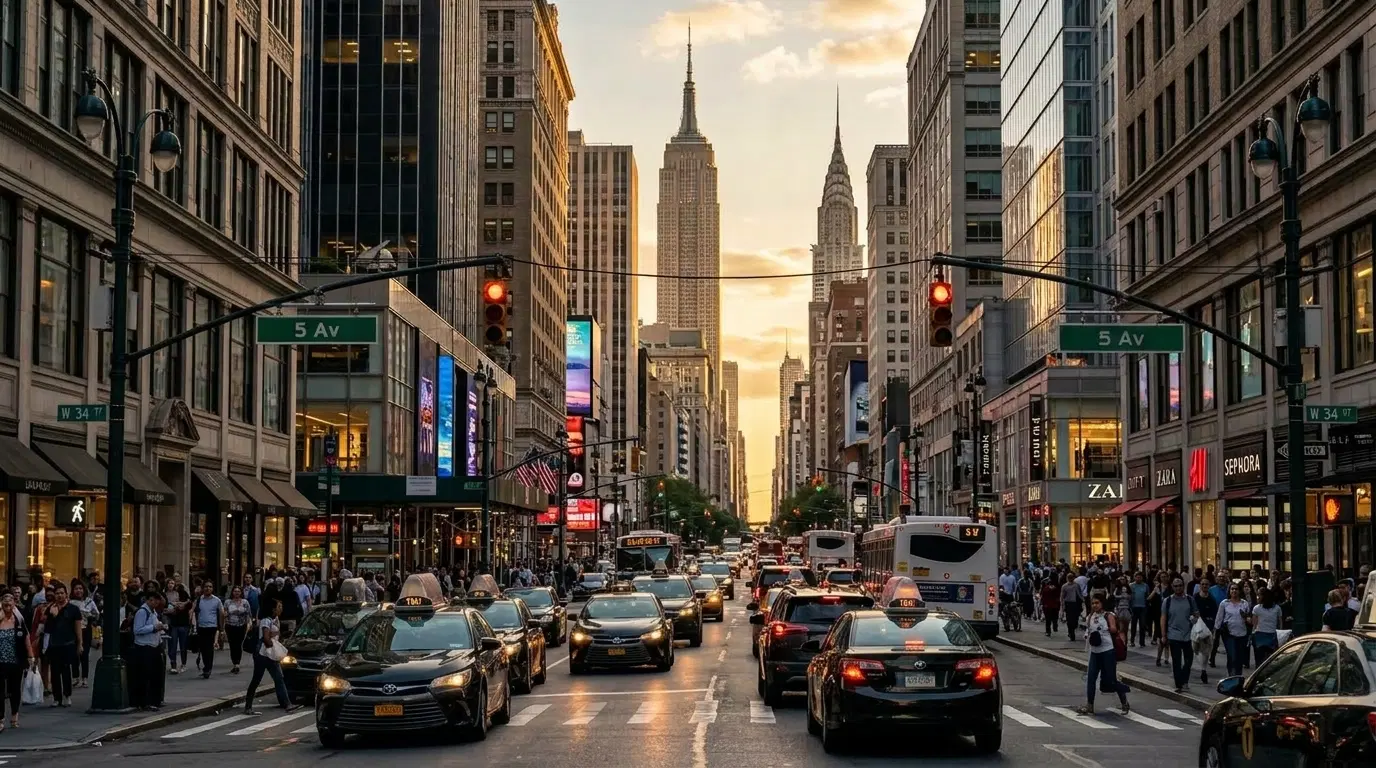
Few cities punish a loose plan as quickly as New York. You have a short list of landmarks, a limited number of days, and a subway map that looks unreadable until someone explains it. The most useful new york travel tips aren't about which museum is best — they're about what sells out, what costs more than it should, and how long things actually take on foot. Sort out your airport transfer, your ticket timing, and your neighborhood before you land, and the rest of the trip mostly takes care of itself.
Sort Out Your Airport Transfer Before You Land
New York has three main airports, and the cheapest route isn't always the smartest one after a long flight. Public transit from JFK costs roughly $12 but takes 60–90 minutes with luggage. A yellow cab from JFK to Manhattan runs on a fixed $70 base fare plus tolls, surcharges, and tip. LaGuardia is the outlier — its transit link is free.
|
Route |
Typical cost |
Best for |
Worth knowing |
|
JFK → AirTrain + subway |
About $11.75 |
Light packers, daytime arrivals |
The $8.75 AirTrain fare is separate; no free transfer to the subway |
|
JFK → AirTrain + LIRR (via Jamaica) |
AirTrain plus rail fare |
Getting to Midtown fast |
Much quicker than the subway; sit near the front of the train |
|
JFK → yellow cab |
$70 base + extras (usually $90–$115 all-in) |
Families, late arrivals, heavy bags |
Flat fare applies to Manhattan only; other boroughs use the meter |
|
LaGuardia → Q70 "LaGuardia Link" bus |
Free, plus $3 subway |
Budget travelers |
Connects to Jackson Heights–Roosevelt Ave and Woodside |
|
Newark → AirTrain + NJ Transit |
Varies by ticket |
Anyone staying near Penn Station |
Check current fares before you travel; they change |
|
Any airport → pre-booked private transfer |
Fixed quoted price |
Groups, early flights, first-timers |
Flight tracking means no scramble if you land late |
One rule matters more than price: only use the official taxi stand or a driver you booked in advance. People approach arriving passengers inside JFK and Newark terminals offering rides — those cars aren't licensed for it, and there's no recourse if something goes wrong.
If you're routing through Europe first, the same principle applies to a Heathrow Airport to Central London Transfer — the value of a pre-booked pickup isn't speed, it's not having to make decisions while jet-lagged. Booking your New York arrival with Transpovia works the same way: a fixed price agreed in advance, and a driver who's watching your flight number rather than the clock.
Subway Fares: The New York Travel Tips That Save You the Most Money
You don't need a pass. Since January 2026, a single subway or local bus ride costs $3.00 no matter how far you go, and the MTA's OMNY system caps your spending automatically: pay for 12 rides in any rolling seven-day period and every additional ride that week is free. The most you'll spend is $35.
Just tap the same contactless bank card or phone every single time. Each payment method has its own separate cap, so if you tap your physical card on Monday and your phone on Tuesday, neither counts toward the other. Couples should also know that two people tapping one card is fine for entry, but only one cap applies.
Transfers between the subway and local buses are free within two hours of your first tap. The AirTrain is not part of this system and never has been.
A few things that trip up first-timers:
-
Some stations have separate entrances for uptown and downtown trains, and no way to cross over inside. Check the sign on the staircase before you go down.
-
Express trains (diamond symbol) skip stops that local trains (circle symbol) serve. Getting on the wrong one can cost you 20 minutes.
-
Weekend track work reroutes lines constantly. Check the MTA site or a live transit app the morning you travel, not the night before.
-
The MetroCard is being retired through 2026, so ignore older advice about buying weekly unlimited cards.
What To Book Ahead, and What You Can Leave to the Day
A small number of New York experiences genuinely sell out months in advance. Most don't. Knowing the difference saves you from over-planning a trip that works better with some flexibility.
Book early: Statue of Liberty crown access sells out three to four months ahead in peak season, with only 500 tickets released per day. Statue City Cruises is the only authorized ferry operator — the National Park Service says so plainly, and tickets bought elsewhere won't get you on the boat. Crown tickets are name-specific, require photo ID, and involve 162 narrow steps with no elevator. Pedestal access is the better call for most people: an elevator, a proper outdoor observation deck, and roughly six to eight weeks of lead time. Budget four to six hours if you want both Liberty and Ellis Islands.
Book a few weeks ahead: 9/11 Memorial Museum tickets, which are released up to six months out. The outdoor memorial plaza itself is free and open daily. If your trip includes a Monday, free evening admission tickets go live on the museum's website at 7 a.m. ET that same morning, first come, first served.
Book the same week: Observation deck slots. Sunset times at the Empire State Building, Top of the Rock, and Summit One Vanderbilt disappear first, but mid-morning and late-evening slots usually stay open.
Leave to the day: Broadway. Some same-day options and discounts are available, especially midweek and in January.
One myth worth correcting: the widely repeated advice that MoMA is free on Friday evenings and the Met is pay-what-you-wish applies to New York State residents only, with ID. Visitors from elsewhere pay full admission. Free-for-everyone options do exist — the Staten Island Ferry, the High Line, Governors Island's ferry-accessible parkland — but they're outdoor spaces, not the marquee museums.
Choosing a Neighborhood To Base Yourself In
Where you sleep shapes your trip more than which attractions you pick, because it decides how much of your day is spent underground.
|
Area |
Suits |
Trade-off |
|
Midtown West / Times Square |
First-timers, central location, short trips |
Crowded, loud, weak restaurant scene |
|
Lower Manhattan (FiDi) |
Statue of Liberty, 9/11 Memorial, better hotel value |
Quiet after office hours |
|
Upper West Side |
Families, Central Park and museum access |
Longer rides to downtown nightlife |
|
Chelsea / West Village |
Walkable dining, galleries, the High Line |
Fewer big hotels, higher rates |
|
Long Island City (Queens) |
Budget-conscious travelers wanting Manhattan views |
One subway stop out, but you'll use it constantly |
|
Downtown Brooklyn / Williamsburg |
Repeat visitors, food and independent shops |
Adds 20–30 minutes to Midtown sightseeing |
Skip the rental car entirely. Parking is expensive, and driving into Manhattan below 60th Street now carries a congestion toll on top of everything else.
Distances Are Longer Than the Map Makes Them Look
Manhattan's grid is deceptive. Twenty numbered street blocks equal about one mile, so walking from 42nd to 62nd Street is a comfortable 20 minutes. Crosstown avenue blocks are two to three times longer — walking from Fifth Avenue to the Hudson River is a real hike, not a stroll.
Plan by cluster, not by wish list. Central Park alone runs two and a half miles from south to north, and the Met sits at its eastern edge, so pairing the two makes sense in a way that pairing the Met with the World Trade Center does not.
Timing matters as much as geography. Major museums fill between 11 a.m. and 3 p.m., and empty out noticeably in the last two hours before closing. Rainy days push everyone indoors at once. Popular outdoor spots — the Brooklyn Bridge walkway, the High Line — are calmest before 9 a.m.
Best Time To Visit New York, and What Each Season Costs
Late September through early November and late April through June offer the best balance of comfortable weather and manageable crowds. January and February are the cheapest months by a wide margin, with hotel rates falling well below summer levels and citywide restaurant and theater promotions running through the winter.
Some dates are worth avoiding or embracing deliberately. Mid-September brings Fashion Week and the UN General Assembly, which means motorcades and unpredictable street closures around Midtown East. The New York City Marathon lands on the first Sunday in November and fills hotels. Thanksgiving week and the stretch from around December 10 to January 2 carry the year's steepest price spikes. Summer is hot and humid, but it's also when waterfront parks, outdoor spaces, and longer daylight hours are at their best.
If you're building a longer trip, New York pairs naturally with New England — Amtrak reaches Boston in around four hours, and a set of practical Boston Travel Tips will save you repeating the same research twice. For current seasonal event listings, the official NYC Tourism site is more reliable than aggregator blogs.
Safety, Scams, and the Small Etiquette Rules
New York is statistically safe for visitors, and the practical risks are mostly financial rather than physical. Costumed characters in Times Square expect payment after a photo. People handing out "free" CDs or bracelets will ask for money once you've taken one. Restaurants near major attractions sometimes add gratuity automatically — read the check before tipping again.
On the subway, stand back from the platform edge, keep your phone in your hand rather than dangling, and choose a busier car late at night. Standard tipping runs 18–20% at restaurants and a few dollars a day for hotel housekeeping.
Two small habits mark you as a considerate visitor: don't stop walking in the middle of a sidewalk, and stand to the right on escalators so people can pass on the left.
Frequently Asked Questions
How many days do you need in New York for a first visit?
Four full days covers the major landmarks, one museum, one Broadway show, and time in two or three neighborhoods without rushing. Three days works if you stay in Manhattan. Five or more lets you add Brooklyn, Queens, or a day trip.
Is the New York subway safe for tourists?
Yes, and it's usually the fastest way to move around. Use it confidently during the day and early evening. Late at night, ride in a car with other passengers and stay near the platform's staffed area while waiting.
Do you need to book New York attractions in advance?
Only a few. Statue of Liberty crown and pedestal access, the 9/11 Memorial Museum, and sunset observation deck slots should be booked ahead. Broadway shows, most museums, and everything outdoors can be handled the same week or the same day.
What's the cheapest way to get from JFK to Manhattan?
The AirTrain connected to the subway, at roughly $11.75 total. It's slow with luggage. The Long Island Rail Road connection costs more but reaches Midtown considerably faster.
Before You Go
Confirm ticket times, hours, and fares on official sites shortly before you travel — New York changes its prices and schedules more often than most cities. Lock in the two things that cause the most stress: your arrival transfer and any timed-entry ticket. Booking your airport pickup with Transpovia removes the first of those from your list entirely, so day one starts with sightseeing instead of queueing.
"We landed at JFK at 10 p.m. with two tired kids and a stroller. Having a driver already waiting meant we were checked in and eating pizza while the taxi line was still wrapped around the terminal." — Family visiting from Manchester


