
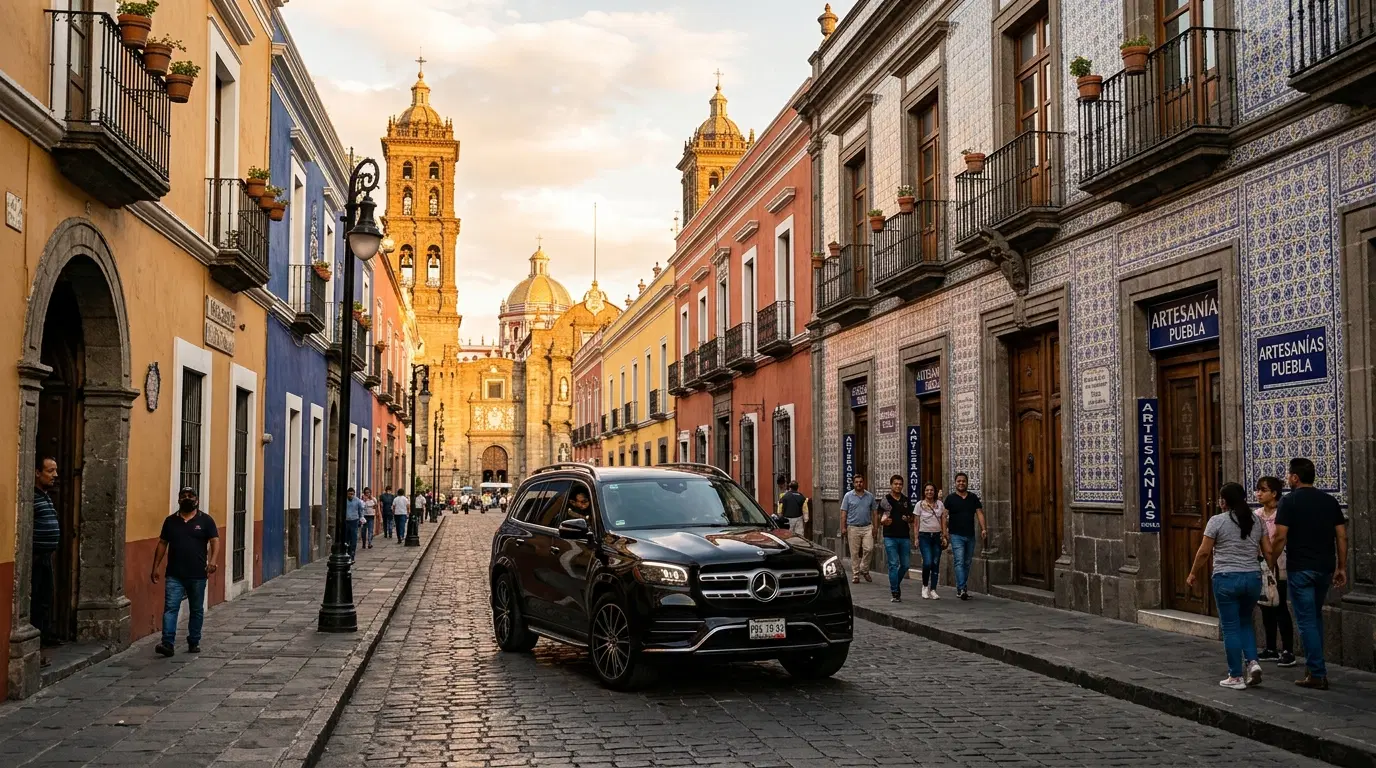
You've got a long weekend set aside for Puebla's mole, Talavera tiles, and colonial streets — or maybe a Monday meeting and a flight that just landed at the capital's airport. Either way, the next question is how to cover the roughly 130 kilometers east without wasting half a day. A Mexico City to Puebla transfer sounds straightforward, and it usually is, but your choice affects your budget, how much luggage you can bring, and whether you spend the trip relaxed or stuck in traffic. Buses, rental cars, and door-to-door rides each suit different travelers. Sorting it out beforehand makes arrival much easier.
How Far Is Puebla, and What's the Route Like?
Puebla sits about 130 kilometers (roughly 80 miles) southeast of Mexico City. Almost everyone takes the MEX-150D, the Autopista México–Puebla, a well-maintained toll road that's been the main link between the two cities for decades. In light traffic the drive runs about 1.5 to 2 hours. Getting out of Mexico City is the slow part — once you clear the eastern edge of the metro area near Chalco, the road opens up.
The route climbs through pine forest around Río Frío, the halfway point, then descends toward the Puebla valley. On clear mornings you'll see the Popocatépetl and Iztaccíhuatl volcanoes off to the right — one of the best stretches of scenery near the capital.
Two practical notes. The 150D is a toll road (cuota), and booths often prefer cash, so keep pesos handy. And if you're driving yourself, factor in that the on-ramps leaving the city can be busy and truck traffic is heavy on this corridor.
Comparing Your Mexico City to Puebla Transfer Options
There's no passenger train on this route, so the real choice is between the bus, driving, and a private ride. Here's how they compare before the detail.
|
Option |
Typical travel time |
Approx. one-way cost |
Luggage & comfort |
Best for |
|
Bus (ADO, AU, ETN) |
~2–2.5 hrs |
~180–320 MXN per person |
Hold storage; reclining seats |
Budget and solo travelers |
|
Driving / rental car |
~1.5–2 hrs |
Gas + tolls (~178–500 MXN) |
Full trunk; total control |
Groups, side trips to Cholula |
|
Private transfer |
~2 hrs |
Flat per-vehicle rate (higher) |
Door-to-door; plenty of space |
Families, business, airport arrivals |
|
Organized day tour |
~2 hrs each way |
~600–1,200 MXN per person |
Guided; fixed schedule |
First-timers wanting context |
Bus
The bus is the default for good reason. Lines like ADO, Autobuses Unidos (AU), and ETN run more than 200 departures a day between the two cities — roughly every 15 to 30 minutes from early morning until late at night. The ride takes a little over two hours, and on most days you don't need to book ahead.
Comfort depends on the class you pick. Standard ADO buses are clean and air-conditioned with reclining seats and a restroom; ADO GL adds more legroom and USB charging for only a little more. Second-class AU buses are cheaper but recline less and often skip the onboard restroom. For a small price difference, first-class is usually the better pick. You can compare classes and schedules directly on ADO's official site.
The trade-off is the ends of the trip: you'll still need to reach the terminal in Mexico City and get from the Puebla station to your hotel.
Driving Yourself
A rental car gives you freedom the bus can't. You set your own schedule and can easily fold in a stop at Cholula and its Great Pyramid, or wander the Puebla countryside afterward. For a group splitting fuel and tolls, it can also work out cheaper per person.
The downsides are city traffic, aggressive lane-changing trucks on the autopista, and parking once you reach Puebla's historic center, where streets are narrow and spaces fill up. Confident drivers comfortable with Mexican highways will be fine; nervous drivers may prefer to let someone else take the wheel.
Private Transfer
A private transfer removes the terminals from the equation entirely. A driver picks you up at your hotel or the airport, handles the tolls, and drops you at your door in Puebla in around two hours. You don't share the vehicle, and the cost is a flat rate for the car rather than a per-person fare — so it often makes sense once you divide it across a family or small group. It's the priciest option for a solo traveler and the most convenient for almost everyone else.
Organized Day Tour
If you'd rather not think about logistics at all and want history along the way, a guided day tour bundles hotel pickup, transport, and often Cholula into one price. It's fixed in schedule and less flexible, but good for first-time visitors who want context rather than independence.
Coming Straight From the Airport
Many travelers reach Puebla without ever entering central Mexico City. Both ADO and Estrella Roja run direct buses from Mexico City International Airport (AICM) — from Terminal 1 and Terminal 2 — straight to Puebla, leaving every 20 to 30 minutes for most of the day. The ride takes around 2.5 hours and skips the city center completely, which is ideal after a long flight.
If you'd rather settle into the capital for a night first — say, in the cafés and tree-lined blocks of Roma Norte — you can handle that first leg with a Mexico City Airport to Roma Norte Transfer and continue to Puebla the next day. For travelers with an early onward flight or a tight connection, arranging a private car straight from the terminal removes the transfer between airport bus gates and your luggage. A service like Transpovia can meet you inside the arrivals area and drive directly to Puebla, so there's no waiting for the next scheduled coach.
Terminals and Getting to Your Hotel
This is the part most guides skip, and it's where trips go sideways. In Mexico City, buses to Puebla mainly leave from TAPO (Terminal de Autobuses de Pasajeros de Oriente) on the east side. It sits directly above Metro San Lázaro on Line 1, which makes it easy to reach — but the terminal is large and signage can be confusing, so give yourself extra time to find your gate.
In Puebla, most buses arrive at CAPU, the main terminal, while some use Terminal Paseo Destino, attached to a shopping mall. Neither is in the historic center. CAPU sits about 4 kilometers from the Zócalo, so budget for a short taxi or ride-hail (roughly 60–120 MXN) to reach your hotel. Knowing which terminal your ticket lists — and how far it is from where you're staying — saves confusion at the end of a long ride.
When a Private Transfer Makes Sense
Public buses cover this route well, so a private transfer isn't about luxury for its own sake. It solves specific problems that the bus can't.
It earns its cost when timing or logistics are awkward: an early departure before you want to deal with the metro, a late arrival when you'd rather not hunt for a taxi at CAPU, or a business schedule that can't absorb a missed connection. It also helps when you're traveling with children, older relatives, or several suitcases — hauling bags through TAPO and again at the Puebla end wears thin fast. Because the ride is door-to-door, a Transpovia car skips both terminals and both taxi rides, dropping you exactly where you're staying.
It's the same reasoning travelers apply to other popular hops around the country — the convenience of a direct ride is why a Cancun to Playa del Carmen Transfer stays busy on the Riviera Maya. For groups, one private vehicle often costs less per head than four separate first-class bus tickets, and everyone stays together the whole way.
Timing, Traffic, and Safety
The route rarely changes, but conditions do. Weekday rush hours around Mexico City — roughly 7 to 10 a.m. and 6 to 8 p.m. — can add 30 to 60 minutes just getting out of the metro area. Leaving mid-morning or early afternoon is smoother.
Holiday periods are the real bottleneck. During Semana Santa (Easter week), long weekends, and the December holidays, both traffic and demand spike; book bus or private transport a few days ahead. In the rainy season, roughly June through September, afternoon downpours can slow the autopista, so an earlier start helps. The 150D itself is one of Mexico's better toll roads and is generally considered safe to travel by day; the main caution is heavy truck traffic and busy interchanges near the cities.
Frequently Asked Questions
How long does the Mexico City to Puebla transfer take?
By car or private transfer, plan on about two hours in normal conditions, a little less with clear roads. Buses take roughly 2 to 2.5 hours depending on traffic leaving the city. City rush hours and holiday weekends can push any option longer.
What's the cheapest way to get from Mexico City to Puebla?
The bus is the most affordable, with first-class fares commonly in the 180–320 MXN range one way and second-class a little less. With departures every 15 to 30 minutes from TAPO, you rarely need to book ahead except around major holidays.
Can I go directly from Mexico City airport to Puebla?
Yes. ADO and Estrella Roja run direct buses from AICM Terminals 1 and 2 to Puebla every 20 to 30 minutes, taking about 2.5 hours and bypassing the city center. A private transfer from the terminal is the door-to-door alternative if you're carrying a lot or connecting on a schedule.
Which terminal do Puebla buses use?
In Mexico City, most leave from TAPO, above Metro San Lázaro. In Puebla, buses arrive at CAPU (the main terminal) or Terminal Paseo Destino — both a short taxi ride from the historic center, so check your ticket for the exact one.
Before You Go
Match the option to your day rather than the other way around: the bus for value and frequency, a rental for flexibility and side trips like Cholula, and a private transfer when timing, luggage, or a group makes door-to-door the sensible call. Carry pesos for tolls, avoid city rush hours, and book ahead around holidays — do that, and you'll reach Puebla relaxed instead of frazzled.
"We landed in Mexico City with our parents and a stack of luggage and didn't want to figure out the metro to the bus station. Getting picked up at the airport and driven straight to our hotel in Puebla made the whole trip feel effortless." — a family traveling from abroad


