
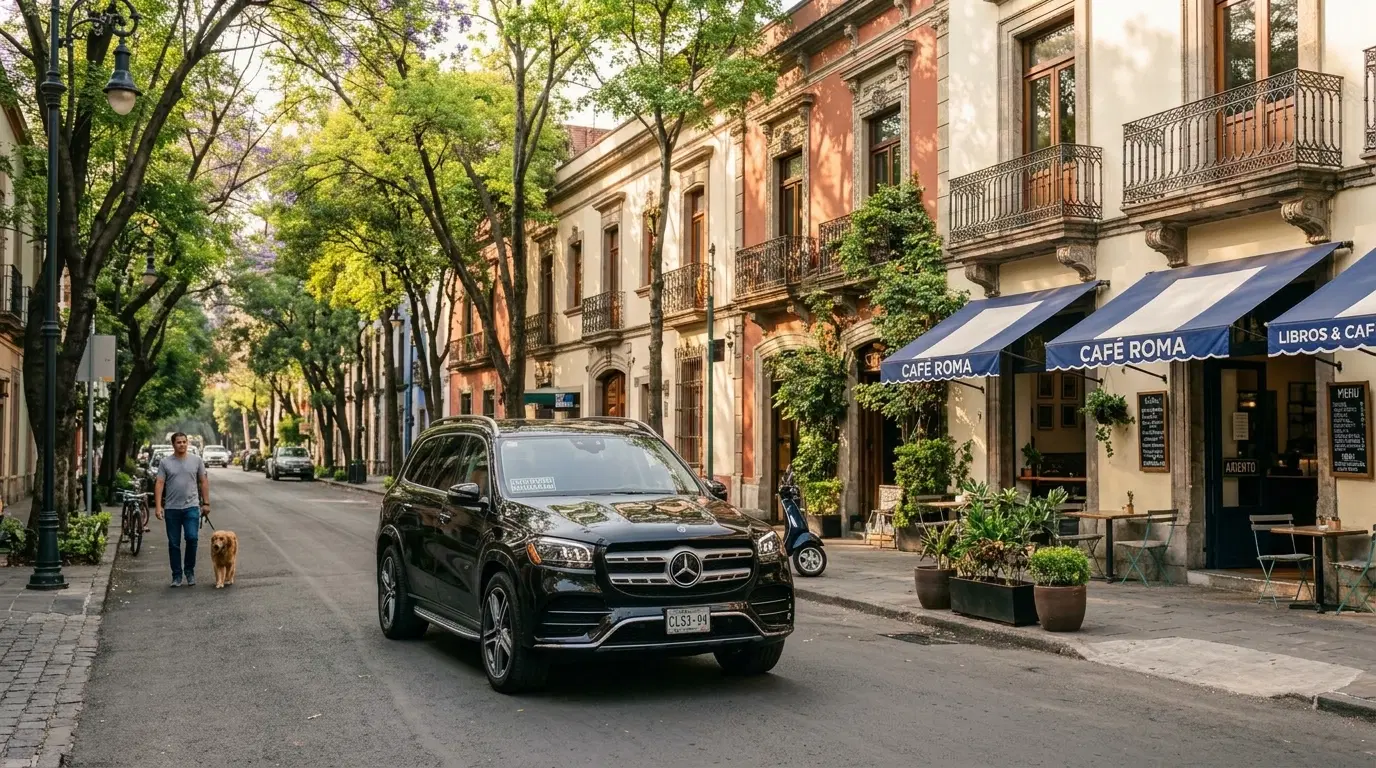
You step off the plane at Benito Juárez, phone nearly dead, and your hotel on a leafy Roma Norte street looks close on the map — just nine miles away. But those miles run through some of Mexico City's heaviest traffic, and the arrivals hall throws taxi booths, rideshare rules, and Metro signs at you all at once. Pick wrong and a short hop turns into ninety minutes. Sorting out your Mexico City Airport to Roma Norte transfer before you land keeps that first afternoon calm. Here's how each option actually holds up.
Mexico City Airport to Roma Norte Transfer Options at a Glance
Four options connect Mexico City International Airport (MEX) with Roma Norte: an authorized airport taxi, a rideshare like Uber or DiDi, the Metro or Metrobús, or a pre-booked private transfer. A taxi or private car covers the roughly 14 km in 20 to 30 minutes off-peak, though rush-hour traffic can push that past an hour. Public transit costs the least but never runs door to door.
Here's how the choices compare:
|
Option |
Approx. cost (one way) |
Time to Roma Norte |
Best for |
|
Authorized taxi (Sitio) |
~300–400 MXN ($17–22) |
20–40 min |
A safe, fixed price at the booth |
|
Uber / DiDi |
~160–250 MXN ($9–14) |
25–45 min |
Lower cost, when pickup rules allow |
|
Metro / Metrobús |
~5–30 MXN (plus a card) |
50–70 min |
Rock-bottom budget, light bags |
|
Private transfer |
Fixed, booked ahead |
20–40 min |
Door-to-door, families, late flights |
MEX is also where many travelers begin longer road trips out of the capital — a Mexico City to Puebla Transfer heads a couple of hours southeast — but Roma Norte is one of the closest neighborhoods to the airport, which keeps this ride short when traffic cooperates.
Using an Authorized Airport Taxi (Sitio)
Authorized airport taxis work on a prepaid, zone-based system. You pay at an official booth inside the terminal before you leave, and the fare to Roma Norte usually runs about 300 to 400 pesos ($17–22 USD). Because the price is set and the driver is registered, this is the safest taxi choice — and the one to use over anyone who approaches you first.
You'll find the booths inside the arrivals area of both terminals. Terminal 2 has ranks at both its domestic (Gate 4) and international (Gate 3) exits. Tell the clerk your neighborhood, pay for the zone, and take your ticket to the marked taxi line outside.
A few practical notes:
-
Bring pesos. Some booths accept cards, but cash is smoother, and paying in pesos avoids a poor dollar exchange rate.
-
Ignore the offers inside the hall. Anyone waving you toward a car before you reach the booth is best skipped. Current authorized-taxi tariffs are posted on the official Mexico City Airport website.
Uber, DiDi, and the Airport Pickup Question
Uber and DiDi are usually cheaper than the taxi booth — often 160 to 250 pesos to Roma Norte — but airport pickups have been a legal tug-of-war for years. Through 2026, the airport has been rolling out designated rideshare pickup zones between Terminals 1 and 2, so check your app for the current meeting point the moment you land.
Here's the background in plain terms. Ride-hailing pickups at MEX have faced on-and-off restrictions and enforcement, including National Guard patrols in early 2026, while operators pointed to court protections and kept running. To settle the standoff before the FIFA World Cup, airport authorities began setting up official pickup areas — a covered, staffed zone roughly an eight-minute walk between the two terminals.
Two things follow from that for you. First, the rules keep shifting, so the instructions your app shows on arrival are the source of truth, not a blog written months earlier. Second, the rideshare meeting point sits farther from the exit than the taxi rank, which means a longer walk with your bags. Using the app to reach the airport for a departure is far less complicated than being collected on arrival.
Metro and Metrobús: the Budget Routes and Their Catch
The Metro and Metrobús are the cheapest way in — a few pesos plus a rechargeable card — but neither reaches Roma Norte directly, and both involve at least one transfer. Metro Line 5 runs from Terminal Aérea station near Terminal 1, while Metrobús Line 4 leaves from stops outside the terminals. They suit light packers who don't mind a connection.
The catch most guides skip is the card. You can't pay cash at a Metro turnstile — you need a rechargeable Movilidad Integrada card, sold for a small fee at station machines, loaded before you ride. The Metro also isn't built for suitcases, gets packed at peak times, and shuts down overnight, roughly midnight to 5 a.m.
Metrobús Line 4 is the friendlier of the two, since the airport buses have space for luggage and head toward the Centro Histórico and Buenavista. Even so, you'll change lines to reach Roma Norte. The one upside worth noting: the Metro is the only option here that traffic can't slow down.
When a Private Transfer Makes Sense
Traffic on this route is genuinely hard to predict. From the app, you can't tell whether you're facing a 25-minute glide or an 80-minute crawl, and MEX's two terminals sit several kilometers apart with no quick free link between them. After a long international flight, sorting out booths, shifting rideshare zones, and Metro cards in Spanish is a lot to take on at once.
A private transfer removes those unknowns. A driver meets you at your terminal with your name on a sign, the price is fixed and paid in advance, and your flight is tracked so a delay doesn't cost you the ride. Companies like Transpovia handle the drive straight to your Roma Norte address, which matters most when you're traveling with kids, several suitcases, an elderly parent, or simply landing at an hour when transit has stopped.
The same pre-booked approach that takes the friction out of a long haul like a Cancun Airport to Tulum Transfer works just as well for a short city run into Roma Norte — the car's already waiting, whatever time you touch down.
Timing Your Ride Around Mexico City Traffic
Traffic, not distance, decides this trip. Off-peak — late evening or early morning — you can reach Roma Norte in 20 to 30 minutes. During weekday rush hours, roughly 7 to 9 a.m. and 5 to 8 p.m., the same 14 km can take 60 to 90 minutes. If you have a flight to catch on the way out, plan around the jam, not the map.
Roads near the airport clog surprisingly early on weekdays, so add about 30 minutes to whatever a rideshare app estimates during peak hours. For a very early departure, the Metro can actually be the more predictable choice if you're traveling light, since it skips the roads entirely. Late-night arrivals are the opposite story: with transit closed, a taxi, rideshare, or private car is your only way in.
Return trips deserve the same thought. Arranging your ride back to the airport when you book your arrival — something a service like Transpovia lets you set as a round trip — means you're not gambling on curbside availability before an early flight.
Frequently Asked Questions
How much is a taxi from Mexico City Airport to Roma Norte?
An authorized airport taxi costs roughly 300 to 400 pesos ($17–22 USD), set by zone and paid at the booth inside the terminal before you leave. Rideshares like Uber or DiDi often run cheaper, around 160 to 250 pesos, when airport pickup rules allow.
Can you take an Uber from Mexico City Airport?
It's complicated. Airport pickups have faced on-and-off bans and enforcement, and through 2026 the airport has been setting up designated rideshare pickup zones between the terminals. Check your app when you land for the current pickup point, and keep the authorized taxi booth as a reliable fallback.
How long does it take to get from MEX to Roma Norte?
About 20 to 30 minutes without traffic, but 60 to 90 minutes during weekday rush hours. Roma Norte sits roughly 14 km from the airport, and congestion — not distance — is what usually decides the time.
Which terminal will I arrive at, and does it matter?
MEX has two terminals, T1 and T2, several kilometers apart with no quick free connection between them. Taxi booths and transit stops serve both, so confirm your terminal before arranging any ride — especially a rideshare pickup that sits between the two.
Before You Land
Match the ride to your bags, your budget, and the clock: transit for the lowest fare on a light-luggage day, an authorized taxi booth for a safe fixed price, or a private car when you're tired, traveling as a group, or landing at an awkward hour. Booking a transfer with Transpovia in advance means a driver is waiting the moment you clear customs — no booth line, no app guesswork.
"After a delayed near-midnight landing, skipping the taxi line and walking straight to a driver who already knew our Roma Norte address made the whole arrival feel effortless." — a couple traveling for a week in Mexico City


