
You've got a weekend in Barcelona and you're starting in Madrid — or maybe it's a Monday meeting in the Catalan capital and you want to arrive sharp and rested. The two cities sit about 500 km apart, and Spain has made covering that distance easy. For most travelers the real question isn't whether to take the train, but which one, how to find a cheap seat, and how to handle luggage and connections at each end. The right Madrid to Barcelona transfer comes down to budget, schedule, and comfort. A little planning saves both time and money.
The Madrid to Barcelona Route at a Glance
Madrid and Barcelona are roughly 505 km apart in a straight line, or about 620 km by road. That gap once meant a long day of driving. Today, a high-speed line links the two city centers in about two and a half hours, which is why the train has become the default choice for nearly everyone.
The trains run from Madrid Puerta de Atocha — recently renamed Atocha–Almudena Grandes, though most people still call it Atocha — to Barcelona Sants, both central stations with metro connections. That center-to-center speed is the train's biggest advantage over flying, which looks faster on paper but rarely is once you add airports.
Many visitors fly into Madrid first. If you're arriving at Barajas and need to reach the city or Atocha before your train, a Madrid Airport to City Center Transfer handles that first leg, so you're not dragging bags through the metro after a long flight.
Comparing Your Madrid to Barcelona Transfer Options
Five ways connect the two cities, but they're far from equal for this particular route.
High-Speed Train
This is the main event. Four brands share the line: Renfe's premium AVE, Renfe's low-cost Avlo, French-owned Ouigo, and private operator iryo. Between them, trains leave every 20 to 40 minutes from around 6am to 9pm — well over 50 departures a day.
The ride takes about 2.5 to 3 hours depending on stops, all at up to 310 km/h. Fares swing widely: low-cost seats booked early can cost under €20, while last-minute premium tickets climb toward €150 or more. You get WiFi, power outlets, a café car, and space to work or relax. For the vast majority of travelers, this is the fastest, easiest option. Book through the official Renfe site or the individual operators.
Flying
A direct flight takes only 1 to 1.5 hours in the air, with Iberia, Vueling, and Air Europa all serving the route. The catch is everything around the flight. Adolfo Suárez Madrid–Barajas and Barcelona–El Prat both sit well outside their city centers, and once you add airport transfers, check-in, and security, total door-to-door time often passes four hours — longer than the train. Flying mainly makes sense when you're connecting to an international flight anyway.
Private Transfer
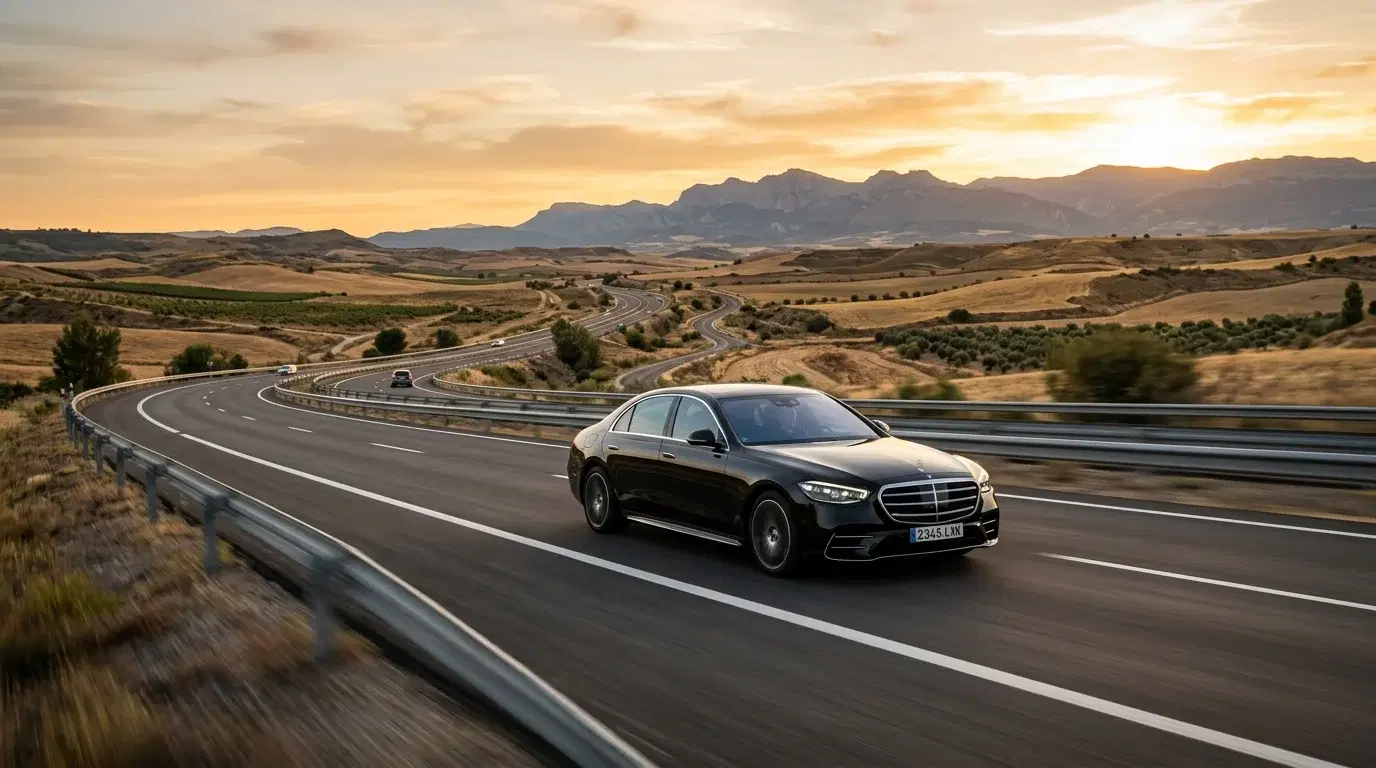
A private car with a driver covers the route door-to-door in about six hours, with no stations or check-in. Over this distance it costs far more than a train seat, so it's a niche choice — but a genuine one for specific needs, covered further below.
Bus
Companies like ALSA and Avanza run coaches from Madrid's Avenida de América to Barcelona Nord. Fares start around €10, making it the cheapest option, but the ride takes 7.5 to 8.5 hours. It suits budget travelers with time to spare.
Driving
The A-2 motorway is the main route, largely toll-free, taking about 6 to 6.5 hours. Renting gives you the freedom to stop in Zaragoza, roughly halfway, or detour toward Lleida. Factor in fuel, tiredness, and city parking at the end.
|
Option |
Travel time |
Approx. cost (one way) |
Best for |
|
High-speed train |
2.5–3 hours |
~€20–€150 |
Almost everyone — fast, central |
|
Flight |
~4+ hours door-to-door |
~€25–€180 |
Connecting to an international flight |
|
Private transfer |
~6 hours |
Higher, per vehicle |
Groups, luggage, door-to-door needs |
|
Bus |
7.5–8.5 hours |
~€10–€30 |
Budget travelers with time |
|
Driving |
~6–6.5 hours |
Fuel + rental |
Stops en route, exploring |
Fares shift with operator, demand, and how early you book.
Choosing Between the Train Operators
Having four operators on one line is a gift — it keeps prices low — but it can be confusing. Here's how they differ.
-
AVE is Renfe's premium service: the most comfortable seats, flexible tickets, and business-class options, at the highest prices.
-
Avlo is Renfe's low-cost brand — the same speed, stripped-back service, and cheap base fares with paid extras.
-
Ouigo runs double-decker trains at rock-bottom prices, but luggage and seating rules are stricter, so read the fine print.
-
iryo sits in the middle: stylish trains, good onboard service, and often competitive fares.
For most leisure travelers, the cheapest early-booked seat on any of them does the job. Business travelers who want flexibility or lounge access lean toward AVE or iryo. If you're traveling light and on a tight budget, Ouigo and Avlo win on price — just check the baggage limits before you book.
Booking Smart and Getting Through the Station
Fares on this route are cheapest when booked early, often two to eight weeks ahead, and rise sharply close to the date. Tickets typically open several months in advance, and flash sales can drop low-cost seats to just a few euros.
A few practical notes make the day smoother:
-
Arrive 20 to 30 minutes early. Spanish high-speed stations have airport-style bag scanning before you reach the platform.
-
Confirm your Madrid station. Most trains leave from Atocha, but some services use Chamartín, so check your ticket rather than assuming.
-
Mind the luggage rules, which vary by operator — the low-cost brands are the strictest.
Both Atocha and Barcelona Sants are large but well signposted, with taxi ranks and metro links right outside.
When a Private Transfer Makes the Most Sense
For a route this long, the train wins for most people — so a private transfer is worth it only in specific situations. It genuinely helps when you're:
-
Traveling as a group or family with several suitcases, where a shared vehicle door-to-door beats hauling bags through two stations.
-
Carrying heavy or bulky luggage the low-cost trains would charge for or restrict.
-
Working to a tight business schedule and want to leave and arrive exactly when you choose.
-
Traveling with reduced mobility or young children, where avoiding crowded platforms matters.
-
Planning to stop en route, such as a few hours in Zaragoza along the way.
Where a service like Transpovia is most useful on this route, though, is the first and last mile — getting from the airport or your hotel to the station, and from the station to your final address. After a 2.5-hour train ride, a waiting driver removes the scramble for a taxi at a busy terminal. If you decide to fly instead, the same applies on arrival: a Barcelona Airport to City Center Transfer turns the slowest part of flying into the easiest. Booking these legs with Transpovia in advance keeps the whole trip connected end to end.
Frequently Asked Questions
What's the fastest way to travel from Madrid to Barcelona?
The high-speed train is fastest in practice, linking the two city centers in about 2.5 hours. A flight is quicker in the air but slower door-to-door once you add airport travel, check-in, and security — usually over four hours total.
How much does the Madrid to Barcelona train cost?
It depends heavily on timing. Low-cost operators like Ouigo and Avlo can offer seats under €20 when booked early, while premium AVE tickets bought last-minute can exceed €150. Booking a few weeks ahead is the surest way to a cheap fare.
Is it better to take the train or fly from Madrid to Barcelona?
For most travelers, the train. It drops you in the center of each city, needs less waiting, and often works out faster once everything is counted. Flying mainly makes sense if you're connecting to a long-haul flight and want to stay airside.
How do I get from Madrid airport to the train station?
Barajas connects to central Madrid and Atocha by metro, cercanías train, and taxi. If you're short on time or carrying luggage, a pre-booked private transfer takes you straight from the terminal to the station without transfers.
Before You Go
For almost everyone, the choice here is simple: take the high-speed train, book a few weeks early for the best fare, and pick the operator that fits your budget and luggage. Arrive at the station with time to clear the bag scan, and sort your airport and station transfers in advance. A Transpovia transfer keeps those first and last miles simple, so the trip stays smooth from door to door.
"We booked the AVE weeks ahead for next to nothing, then had a driver meet us at Sants. Two and a half hours city to city, and we were at our hotel before we'd have finished airport security." — a couple traveling from Madrid


