
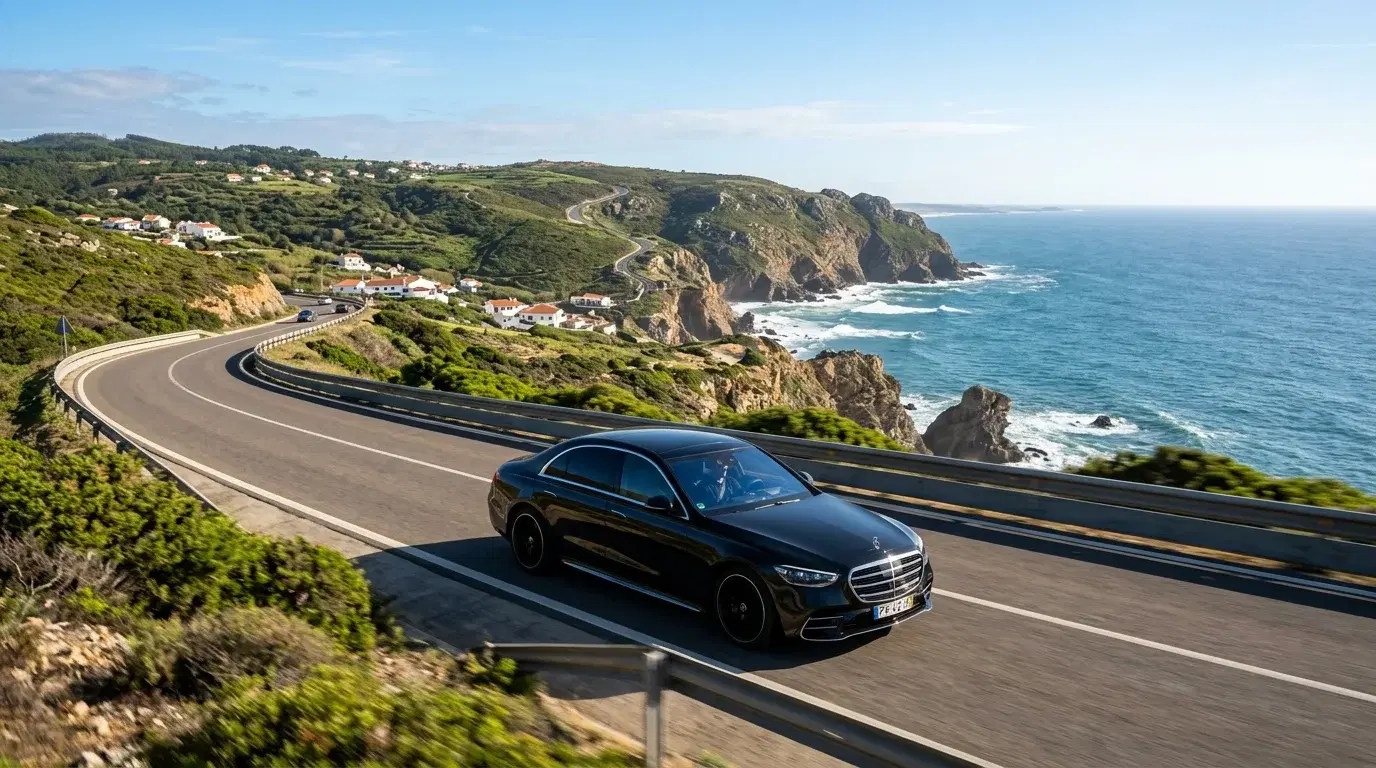
You've got a few days set aside for Porto' riverside tiles, a Monday meeting in the north, or a plan to see two of Portugal's great cities in one trip. The next question is how to cover the 300-odd kilometers between them without wasting a morning. A Lisbon to Porto transfer is an easy trip once you know your options, but the right choice depends on your budget, how much luggage you're carrying, and whether you want speed, scenery, or a door-to-door ride. Trains, coaches, rental cars, and private transfers all work here, and planning ahead makes arrival far smoother.
How Far Is Porto, and How Long Does the Trip Take?
Porto sits about 314 kilometers north of Lisbon by rail, or roughly 300 kilometers by the A1 motorway. The fastest way between the two is the train: the high-speed Alfa Pendular covers the route in about 2 hours 50 minutes, city center to city center. The slightly cheaper Intercidades train takes around 3 hours 10 minutes, while coaches and driving run closer to 3 to 3.5 hours once you add traffic.
There's technically a short flight between the cities, but with check-in, security, and two airport trips, it saves no time and rarely makes sense for a city-to-city hop.
Many travelers reach Lisbon by air first. If you're landing at Humberto Delgado Airport, you might settle into the city with a Lisbon Airport to City Center Transfer before heading north — though it's worth knowing the airport is just a couple of metro stops from Oriente station, one of the main departure points for Porto trains.
Comparing Your Lisbon to Porto Transfer Options
Four options genuinely make sense on this route. Here's how they compare on 2026 figures.
|
Option |
Typical travel time |
Approx. one-way cost |
Comfort & luggage |
Best for |
|
Alfa Pendular train |
~2h50 |
€35.70 (2nd), €49.90 (1st); promo from ~€16 |
Fast, roomy; Wi-Fi, café-bar |
Most travelers, city-to-city |
|
Intercidades train |
~3h10 |
€28.05 (2nd), €41.50 (1st) |
Comfortable; more stops |
Budget-minded rail travelers |
|
Bus (Rede Expressos, FlixBus) |
~3h15–3h30 |
From ~€8–15 (advance) |
A/C, Wi-Fi; hold storage |
Lowest budget, flexible dates |
|
Rental car (A1) |
~3 hrs + traffic |
Tolls ~€22–25 + fuel + drop fee |
Full control; own trunk |
Scenic detours en route |
|
Private transfer |
~3 hrs |
Flat per-vehicle rate (premium) |
Door-to-door; stops on request |
Families, groups, business |
Train
The train is the standout choice for most people. Both services are run by Comboios de Portugal (CP) and link the two city centers directly, with reserved seats, Wi-Fi, power outlets, and a café-bar on board. The Alfa Pendular is the flagship, a tilting train that reaches 220 km/h; the Intercidades is a little slower and cheaper with a few more stops. Fares depend on how early you book — advance CP promo tickets can drop to around €16, while last-minute prices sit at the standard rate. You can check times and buy directly from CP. With 15 or more departures a day, the train fits almost any schedule.
Bus
Rede Expressos is Portugal's main intercity coach line, running more than 20 daily trips, with FlixBus often undercutting on price. Coaches are air-conditioned and comfortable, and advance fares can start under €10, making the bus the cheapest way to go. The trade-offs: it's a bit slower at 3h15 to 3h30, the cheapest seats sell out first, and the Lisbon bus terminals sit farther from the center than the train stations, so factor in extra local transit at each end.
Rental Car
Driving the A1 gives you freedom to stop in Coimbra, Aveiro, or Óbidos along the way. But for a straight trip between the two downtowns, it's the weakest default. You'll pay tolls of roughly €22–25 plus fuel and often a one-way drop fee, then face tight parking in Porto's old streets. If you rent, ask for a Via Verde device so you can pass tolls without stopping. Driving earns its keep only when the scenery is the point.
Private Transfer
A private transfer takes you door to door in around three hours, with space for luggage and the option to break the trip with a stop or two. It's the priciest choice for a solo traveler and the most convenient for families, groups, or anyone who'd rather not change stations at either end.
Which Station You Use Matters
This is the detail that trips up first-timers. In Lisbon, Porto trains leave from two main stations: Santa Apolónia, near the historic center, and Oriente (Gare do Oriente), in the modern Parque das Nações district close to the airport and on the metro's red line. Both are served by the same trains, so pick whichever is closer to your hotel. Coaches instead use Sete Rios (Rede Expressos, on the blue metro line) or Oriente (FlixBus), which is worth confirming on your ticket.
At the Porto end, long-distance trains arrive at Campanhã, on the edge of the center rather than in it. From there, a quick urban train or metro ride carries you to São Bento, the beautiful central station, in about five minutes. Building that final hop into your plan saves confusion when you step off the train with bags.
When a Private Transfer Makes Sense
The train covers this route so well that a private transfer isn't about luxury for its own sake. It solves specific problems the train can't.
It earns its cost when timing or logistics are awkward: an early business start before convenient departures, a late arrival when you'd rather not change stations with luggage, or a group for whom several train tickets add up to more than one vehicle. It also helps travelers with children, older relatives, or lots of bags, since you skip the station transfers entirely. And because the route is yours, a Transpovia transfer can pause in Coimbra or Aveiro on the way — something the Alfa Pendular, with its brief platform stops, can't offer. That same door-to-door ease applies when you land in the north, too, where a Porto Airport to Downtown Porto Transfer handles the first leg for flyers. For groups especially, one Transpovia car often works out simpler and more comfortable than coordinating tickets and connections for everyone.
Seasonal Timing, Booking, and Scenic Detours
The route runs year-round, but a few habits make it smoother. Popular train departures — Friday afternoons, Sunday evenings, and summer mornings — sell out, so book ahead when your dates are fixed. Advance booking also unlocks the cheapest fares on both trains and buses; wait until the day and you'll pay the top price on either.
If scenery matters more than speed, the drive lets you stitch together the walled town of Óbidos, the university city of Coimbra, and the canals of Aveiro, turning a transit leg into part of the trip. A private transfer with planned stops offers the same freedom without the parking hassle. Weather is rarely a barrier here, though winter rain can slow the A1, so leaving earlier in the day is wise in the wetter months. Booking a Transpovia pickup in advance during the busy summer season helps you avoid competing for a last-minute ride.
Frequently Asked Questions
How long is the train from Lisbon to Porto?
The Alfa Pendular takes about 2 hours 50 minutes, and the Intercidades around 3 hours 10 minutes. Both run city center to city center, which usually makes the train faster overall than the bus or a car once you count traffic and terminal transfers.
Is the train or bus better from Lisbon to Porto?
The train is faster, more comfortable, and drops you closer to the center. The bus is cheaper, especially on advance fares, but takes a bit longer and uses terminals farther out. If price is your priority, take the coach; for most travelers, the train wins.
How much does the Lisbon to Porto train cost?
Second-class fares in 2026 are about €28.05 on the Intercidades and €35.70 on the Alfa Pendular, with first class higher. Booking early through CP can bring promo fares down to around €16, so it pays to reserve ahead.
How do I get from Lisbon Airport to Porto?
The simplest rail route is to reach Oriente station, just a short metro or taxi ride from the airport, and take an Alfa Pendular or Intercidades train north. If you'd rather not change modes with luggage, a private transfer can take you from the terminal all the way to Porto.
Before You Go
Match the option to your trip rather than the other way around: the Alfa Pendular for a fast, comfortable ride between centers, the bus if price beats everything, a rental only if you plan to detour, and a private transfer when timing, luggage, or a group makes door-to-door the sensible call. Book ahead for the best fares, confirm your station, and you'll reach Porto relaxed instead of rushed.
"We traveled up from Lisbon with our parents and more luggage than the train seats could handle, and stopping in Aveiro on the way turned a simple transfer into the best afternoon of the trip." — a family exploring northern Portugal


