
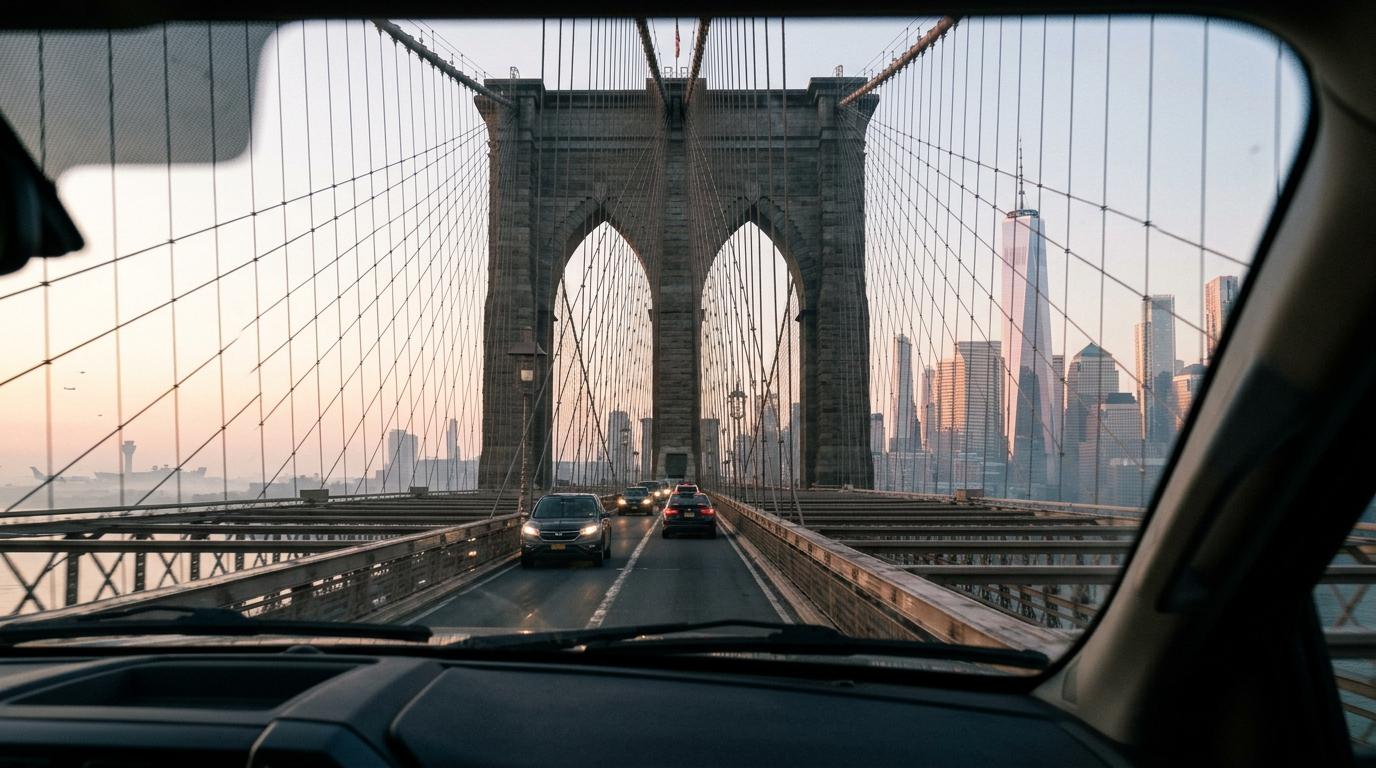
Lower Manhattan sits roughly 16 to 18 miles from JFK, yet the trip is never a simple straight line. Between the Van Wyck Expressway, the Belt Parkway, river crossings and tolls, the same ride can take about 40 minutes at a quiet hour and a good deal longer once traffic builds. Public transit costs far less, but it asks you to change trains while managing your bags.
This guide covers every realistic way to get from JFK to Lower Manhattan, what each option costs in 2026, and which route suits which neighborhood. It treats the Financial District, the World Trade Center area and SoHo separately, because the smartest choice for a hotel near Wall Street is not always the smartest one for a loft near Spring Street. There is also a section for the return trip from the World Trade Center to the airport.
What "Lower Manhattan" Actually Covers
Locals use the term loosely, and it matters for your route. Lower Manhattan is the southern tip of the island, and it includes several areas that feel very different on the ground:
-
Financial District (FiDi): Wall Street, the New York Stock Exchange, Stone Street and the South Street Seaport.
-
World Trade Center area: the 9/11 Memorial, One World Trade Center, the Oculus and Brookfield Place.
-
Battery Park City and Battery Park: residential towers along the Hudson and the ferries to the Statue of Liberty.
-
Tribeca and Civic Center: quieter streets, courthouses, loft hotels and City Hall.
-
Chinatown and the Lower East Side: to the northeast, with the best subway links toward Brooklyn.
-
SoHo: north of Canal Street, often grouped with downtown for visitors.
Why does this matter? Because the subway lines fan out differently. The A train drops you at Fulton Street or Chambers Street. The E train ends at the World Trade Center. The J and Z trains run toward Canal Street and Broad Street. A driver, meanwhile, may choose a route through Brooklyn or one that crosses the East River bridges, depending on where your hotel's front door actually is.
How Far and How Long Is the Trip?
The driving distance from JFK to Lower Manhattan is typically in the 16 to 18 mile range. In light traffic, a car can complete it in around 40 minutes. At rush hour, on a Friday afternoon, or during a major event, you should plan for well over an hour. Most reliable estimates for a typical daytime ride land between 45 and 75 minutes.
Two things shape that range. First, JFK sits at the far edge of Queens, so every route must cross dense neighborhoods before reaching the island. Second, the entry points into Lower Manhattan are limited. Drivers usually pick between the Hugh L. Carey Tunnel, which comes up near Battery Park, and the free East River bridges such as the Brooklyn Bridge and Manhattan Bridge. A tunnel closure or a bridge backup can change the plan on the day.
Time of day matters more than distance. Weekday mornings and the late afternoon peak add the most delay, and the congestion zone below 60th Street is busiest when everyone else is also heading downtown. That unpredictability is why many travelers arrange a JFK airport transfer in advance instead of deciding at the curb.
Your Main Options at a Glance
Before the details, here is how the common choices compare for a trip to Lower Manhattan. Times are typical ranges rather than promises, and fares change, so confirm the current figure before you travel.
|
Option |
Typical time |
What you pay |
Best for |
|
Pre-booked private car |
45–75 min |
Fixed quote agreed before pickup |
Families, luggage, late arrivals |
|
Yellow taxi |
45–75 min |
$70 flat fare plus tolls, tip and fees |
Travelers who want no booking |
|
Uber or Lyft |
45–75 min |
Varies with demand |
Solo travelers off-peak |
|
AirTrain + A train |
About 60–75 min |
About $11.75 total |
Light packers, tight budgets |
|
AirTrain + E, J or Z |
About 60–80 min |
About $11.75 total |
WTC, Chinatown, SoHo edges |
|
AirTrain + LIRR + subway |
55–75 min |
AirTrain plus 5.25–7.25 plus subway |
Trips with a Brooklyn or Penn Station link |
If comfort and certainty matter most after a long flight, a pre-arranged ride removes the two biggest sources of stress: finding the right pickup area and guessing the final price.
Private Car From JFK to Lower Manhattan
A private transfer is the simplest way to move a family, a group or anyone carrying more than a carry-on. A driver is arranged ahead of time, the price is agreed before you travel, and you are taken to your actual address rather than the nearest subway entrance.
We landed after a long flight with two kids and four bags, and having a driver waiting made the first hour in New York feel easy.
A few details are worth checking when you book a ride into Lower Manhattan:
-
Whether tolls and the congestion charge are included. Drivers who enter Manhattan below 60th Street pay the Congestion Relief Zone toll, which is $9 at peak times for a passenger vehicle with E-ZPass and lower overnight. Tunnel tolls are separate, although a partial credit can apply when crossing through certain tunnels.
-
Flight monitoring. Ask whether the provider tracks your arrival, so a delay does not leave you with a missed pickup.
-
Waiting time. International arrivals often take longer than expected because of passport control and baggage claim, so a clear waiting policy helps.
-
Drop-off logistics. Some blocks around Wall Street and the stock exchange have restricted vehicle access, and SoHo's narrow one-way streets can add minutes. Give the driver your exact address and entrance.
Since Transpovia works as a marketplace, you can compare transportation providers for the airport in one place instead of contacting each company separately. That is the main advantage of booking in advance: you see your options and your total before you land.
Taking a Yellow Taxi to Lower Manhattan
Official yellow taxis wait outside each JFK terminal, and the ride from JFK to Manhattan runs on a flat fare. According to the airport's own guidance, the flat rate is $70, plus tolls, tip and additional fees that vary by time of day and destination. If you make more than one stop in Manhattan, the flat fare covers only the first.
Do the math before you assume the price. Add a 15 to 20 percent tip, a tunnel or bridge toll if the driver uses one, the congestion surcharge, and any peak-hour charge on weekday afternoons, and many riders end up paying noticeably more than $70. One fare covers everyone in the cab, so a group of three or four can split it.
Use only the official taxi line. Anyone approaching you inside the terminal offering a ride is not part of the system, and you have no guarantee about price or safety.
Uber and Lyft
Ride-hailing apps work from designated pickup areas at JFK rather than the curb outside baggage claim, and each terminal signs these differently. Fares move with demand, so a quiet Tuesday afternoon can cost much less than a Friday evening when prices spike. Ride-hailing passengers also pay a per-trip congestion surcharge for rides into the Congestion Relief Zone, which is $1.50 for Uber and Lyft.
The honest comparison: ride-hailing can beat a taxi off-peak, and it can lose badly at rush hour. If your schedule is fixed, a locked quote is easier to plan around than a price you only see once you are standing outside the terminal.
AirTrain and Subway: The Cheapest Way Downtown
The budget route from JFK to Lower Manhattan combines the AirTrain and the subway. There is no direct subway to JFK, so you take the AirTrain from your terminal to one of two stations: Howard Beach or Jamaica. Riding the AirTrain between terminals is free. You pay when you enter or exit at Howard Beach or Jamaica, which is about $8.75 in 2026. The subway base fare is $3.00, so the combined cost comes to roughly $11.75 per person, paid by tap with a card or phone through OMNY.
The A train via Howard Beach
For most trips to the Financial District, this is the natural route. Take the AirTrain to Howard Beach–JFK Airport, transfer to a Manhattan-bound A train, and ride to Fulton Street or Chambers Street. Expect about an hour in total, sometimes closer to 75 minutes after waiting and walking.
One practical warning: not every A train serves Howard Beach. Trains heading to Lefferts Boulevard do not stop at the airport station, so read the destination sign before you board.
The E, J and Z trains via Jamaica
From Jamaica, the AirTrain connects to the Sutphin Boulevard–Archer Avenue–JFK Airport subway station. The E train runs to the World Trade Center, which makes it a good fit for the WTC campus, Battery Park City and Tribeca. The J and Z trains continue toward Canal Street and Broad Street, handy for Chinatown, the Lower East Side and parts of the Financial District.
The honest trade-off is luggage. The subway has stairs, narrow turnstiles and crowded cars at commute hours, and not every station has an elevator. If you travel light, it works well. If you carry two large suitcases, you will feel every step.
If your plans include Midtown after the first night, our guide to JFK to Manhattan compares the E train, the LIRR and road options for the rest of the island.
LIRR Plus Subway: A Useful Hybrid
The Long Island Rail Road is the fastest public link out of Jamaica. A train to Penn Station takes roughly 20 minutes from Jamaica, and an off-peak ticket to Manhattan is $5.25 in 2026, rising to $7.25 at peak hours. Add the AirTrain fare, and you pay somewhat more than the subway route, but you save time.
For Lower Manhattan, there is a catch: LIRR does not stop downtown. From Penn Station you would need a 1, 2 or 3 train south toward Chambers Street or Wall Street, which adds a transfer. An alternative many visitors overlook is the LIRR to Atlantic Terminal in Brooklyn, where the subway lines serving Wall Street and Bowling Green are within reach. Service patterns change, so check the live map on the day.
This hybrid makes the most sense if your accommodation is near a station on one of those lines and you can handle one extra change.
Choosing a Route by Destination
The right option depends on where in Lower Manhattan you are sleeping or meeting someone.
JFK to World Trade Center
The E train from Jamaica ends at the World Trade Center, so it needs no transfer after the AirTrain. The A train via Howard Beach reaches the Chambers Street area, a short walk from the memorial and the Oculus. By car, drivers can reach the area near Vesey Street and West Street, although construction and security barriers sometimes shift the exact drop-off point.
JFK to the Financial District
This is where the A train to Fulton Street is strongest, since you arrive close to Wall Street, Pearl Street and the Seaport. For hotels near Broad Street or Bowling Green, the 4 or 5 line from Brooklyn can be an alternative. A car is simpler if you are staying on a narrow block such as Stone Street, but ask your driver about the nearest legal stopping point.
JFK to SoHo
SoHo is where public transit gets awkward. Neither the A nor E drops you in the middle of it. The E train to Spring Street serves the western side, and the J and Z to Canal Street cover the eastern edge, but you will likely walk several blocks over cobblestones with luggage. A door-to-door car ride avoids that, and it is usually the most comfortable choice for a boutique hotel on Greene or Mercer Street.
JFK to downtown more generally
If you only know your lodging is "downtown," confirm the exact address and the nearest cross streets before choosing. Two hotels a ten-minute walk apart can need different subway lines, and a driver needs a precise entrance more than a neighborhood name.
Going the Other Way: WTC to JFK
The return trip deserves more planning than the arrival, because a missed flight costs far more than a slow arrival. The trip from the World Trade Center to JFK can be done by car or by subway and AirTrain.
By road, leave extra margin on weekday afternoons, when the Belt Parkway and Van Wyck are slowest. For an international flight, many travelers allow around three hours before departure, and more during holiday periods. Book a pickup time that reflects traffic, not the distance on a map.
By subway, take the A train toward the Rockaways from Fulton Street or Chambers Street and transfer to the AirTrain at Howard Beach, or ride the E to Jamaica and switch to the AirTrain there. You pay the AirTrain fare when you enter at Howard Beach or Jamaica, then ride free between terminals. For WTC to JFK airport, the subway is predictable because it does not depend on road traffic, but it needs more effort with luggage.
Check your terminal before you leave. JFK is in the middle of a large redevelopment, and terminal assignments can change, so confirm yours with your airline rather than relying on an old booking.
Timing, Luggage and Arrival Tips
A few habits make the trip smoother regardless of how you travel:
-
Add buffer for arrivals. Immigration and baggage claim can take a long time at JFK on busy days, so do not schedule a pickup based on the landing time alone.
-
Avoid the peak windows. Weekday rush hour is hardest on road routes. If you land at 5:30 p.m., the subway may beat a car.
-
Share the address, not just the neighborhood. Lower Manhattan's streets are short, irregular and often one way.
-
Check hotel check-in times. Landing early does not mean a room is ready, so ask about luggage storage if you arrive in the morning.
-
Plan the whole trip, not only this leg. Some visitors combine a stay in the city with time with relatives on the island, and the guide on JFK to Long Island is useful if part of your trip continues east.
Late-night arrivals deserve their own thought. The AirTrain and subway run around the clock, but trains are less frequent and the journey takes longer. For a very late landing after a long flight, many people prefer a driver to a station platform.
Which Option Fits Which Traveler?
There is no single best answer, only a better fit.
-
A couple with two suitcases, arriving at midday: a private car or taxi saves effort, and the time difference from the subway may be modest.
-
A solo traveler with a backpack and a flexible day: AirTrain and the A train is hard to beat for cost.
-
A business traveler heading to a meeting near Wall Street: a fixed pickup time and a driver who knows where to stop is worth paying for.
-
A family with children and a stroller: avoid stairs and transfers. A car is far easier.
-
Anyone landing very late: prioritize safety and simplicity over savings.
FAQs
How far is JFK from Lower Manhattan?
It is roughly 16 to 18 miles by road. In light traffic that can take around 40 minutes, but a typical daytime ride is closer to 45 to 75 minutes, and rush hour can extend it further.
What is the cheapest way from JFK to the Financial District?
The AirTrain to Howard Beach and the A train to Fulton Street is generally the cheapest, at roughly $11.75 per person in 2026, based on the AirTrain fare and the $3.00 subway fare. It takes about an hour or more.
How much is a taxi from JFK to Lower Manhattan?
The airport lists a $70 flat fare for rides between JFK and Manhattan, plus tolls, tip and additional fees. Your final cost will be higher than $70 once those are added.
Is there a direct train from JFK to the World Trade Center?
There is no single direct train. The usual route is the AirTrain to Jamaica and then the E train, which ends at the World Trade Center.
Does the congestion charge apply to a ride to Lower Manhattan?
Yes. Passenger vehicles entering Manhattan below 60th Street pay the Congestion Relief Zone toll, and taxis and ride-hailing trips carry a smaller per-trip surcharge. Ask whether a private quote includes it.
What is the best way from the World Trade Center back to JFK?
For certainty, a pre-booked pickup with extra time for traffic. For budget travel, the A train to Howard Beach or the E train to Jamaica, each followed by the AirTrain.
Can I reach SoHo easily from JFK by subway?
It is possible, but not simple. The E train to Spring Street or the J and Z to Canal Street get you close, followed by a walk. A car goes door to door.
Conclusion: Pick the Route That Matches Your Day
The best way from JFK to Lower Manhattan depends on three things: how much luggage you have, what time you land and how precisely you need to reach your door. The AirTrain and subway win on price. A taxi wins on convenience for walk-up travelers. A pre-booked car wins on predictability, particularly for families, late arrivals and anyone with a schedule to keep.
Whichever you choose, confirm the exact address, leave margin for immigration and traffic, and check current fares before you go. If you would rather have the ride settled before you land, you can compare and book a private airport transfer through Transpovia and walk out of the terminal knowing what comes next.


