
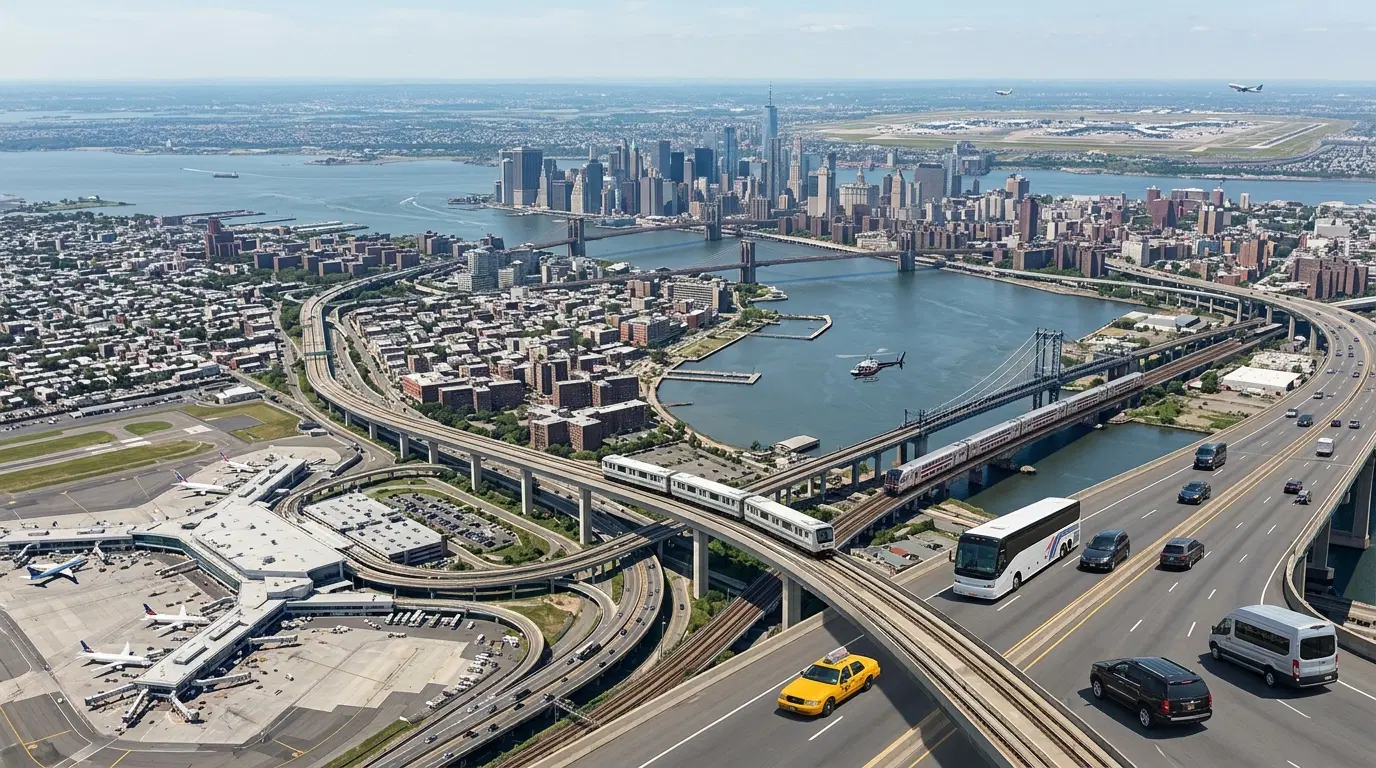
There is no direct train, subway line or free shuttle from JFK to EWR. One airport is in Queens, the other is in New Jersey, and the 25 to 30 miles between them cross some of the most congested roads in the country. Whichever way you go, you are choosing between a single car ride that costs real money and a multi-leg rail trip that costs less but demands patience, stairs and a good sense of timing.
This guide walks through every realistic way to get from JFK to Newark Liberty, with honest notes on how long each option takes, what it tends to cost, and who it suits. It also covers the reverse trip, because the best route from EWR to JFK is not always the mirror image of the one you took the other way.
The Short Answer
If you have luggage, a tight connection or more than one traveler, a car is the sensible choice. A pre-booked private transfer gives you a fixed pickup point and a driver watching your flight. A yellow taxi or rideshare works too, but the price is less predictable.
If you are traveling light, have several hours to spare and want the lowest fare, the rail route works: AirTrain JFK to Jamaica Station, the Long Island Rail Road to Penn Station, NJ Transit to Newark Airport station, then the Newark AirTrain to your terminal. Expect roughly an hour and a quarter at the very best, and closer to two hours once you count walking and waiting.
Distances and times vary with traffic. A drive in light conditions can take about 45 minutes, but a weekday rush hour, a Friday afternoon or a closed lane can double it.
Four Questions to Answer Before You Pick a Route
Most advice on this trip skips the part that actually decides the right answer. Before comparing prices, settle these.
How much time is there before your next flight? A connection with four or five hours of slack gives you room to take a slower, cheaper route. A connection with two hours does not. If something goes wrong on a train transfer, the delay compounds, because each leg runs on its own timetable.
Are your flights on one ticket or two? On a single ticket, the airline is responsible for getting you through if the first flight lands late. On separate tickets, you are on your own. You will generally collect your bags, clear any entry formalities if you arrived from abroad, leave the building, travel across the region and check in again. Build in a much larger buffer than the travel time alone suggests.
What are you carrying? Two carry-ons are manageable on the AirTrain and a commuter train. Two large suitcases, a stroller and a toddler are a different journey. Penn Station in particular involves long corridors, escalators and the occasional flight of stairs.
How many people are traveling? Rail fares are charged per person. A car is charged per vehicle. For a family of four, the cost gap between train and private car narrows quickly.
Option 1: Private Transfer From JFK to EWR
A pre-booked private transfer is the most direct route between the two airports. If you are landing at Kennedy, a JFK airport transfer booked through Transpovia, a marketplace for ground transportation, lets you compare vehicles and set Newark as the destination before you travel. A driver meets you at a designated point, loads your bags and takes you straight to your Newark terminal without a single change. You know the vehicle type before you land, and you are not queuing at a taxi stand or hoping a rideshare driver accepts your trip.
For airport-to-airport trips, this tends to suit anyone with a tight connection, a larger group, or a lot of luggage. It also helps if you are arriving after a long overnight flight and do not want to figure out Penn Station with a suitcase in each hand. Many bookings include flight tracking, so a late arrival does not leave you without a ride.
Quotes for this kind of trip commonly land above $100 depending on the vehicle, time of day and traffic, though the number varies enough that you should compare current quotes rather than trust a figure from a blog post. Check what the price includes. Tolls, waiting time and gratuity are sometimes bundled and sometimes added on top.
When you book any private car, give the driver your airline and arrival terminal. JFK's terminals are in the middle of a long rebuild, so airline-to-terminal assignments can change. Confirming where you will be picked up saves you a phone call from the curb.
Option 2: Yellow Taxi From JFK to Newark
Yellow taxis wait outside every JFK terminal. The flat fare most visitors have heard about applies only to trips between JFK and Manhattan. A trip to Newark Airport is metered, and it carries a separate Newark surcharge set by the city's Taxi and Limousine Commission, which is currently $20. On top of the meter and surcharge, you pay all tolls in both directions, because drivers are allowed to pass their return tolls on to the passenger. Tips are extra.
What that means in practice: a taxi from JFK to EWR has no fixed price, and a bad traffic day makes the meter run faster. The fare is usually steeper than the same distance in a standard ride because of that surcharge and the tolls.
A taxi is a good fit when you have no booking, no phone signal, or no interest in an app. It is a worse fit when your connection is tight and you cannot afford an unpredictable bill. Ask the driver to confirm the destination terminal before you leave the curb, and keep the receipt, which lists the total including tolls.
Option 3: Rideshare From JFK to Newark Airport
Uber and Lyft both serve JFK and Newark. Pickups at JFK happen in designated zones rather than at the curb, and the walk or shuttle ride to that zone can add several minutes on a busy day. Follow the signs for app-based rides in your terminal.
Prices change with demand. A quiet mid-morning ride and a Friday evening ride across the same route can look nothing alike. Surge pricing on the roads around Kennedy is normal, and the final price can move between the moment you look and the moment you request.
Rideshare makes the most sense for solo travelers or couples with light luggage who want a car without booking days ahead. It makes less sense when the vehicle has to fit four people and four suitcases. If you request a larger vehicle, check that it is available before you plan around it.
Option 4: The Train Route From JFK to EWR
This is the cheapest way to get between the airports, and the one that most surprises first-time visitors by how many steps it needs. There is no direct line. The standard route has five legs:
-
AirTrain JFK to Jamaica Station. Inside JFK, the AirTrain is free. You pay when you tap in or out at Jamaica or Howard Beach, using OMNY or a MetroCard. The fare is a little over $8, and it has changed in recent years, so check the current price at the station.
-
Long Island Rail Road from Jamaica to New York Penn Station. The ride takes around 20 minutes. Fares are lower off-peak and higher at rush hour, usually somewhere between about $5 and $8.
-
Walk across Penn Station to the NJ Transit area. The LIRR and NJ Transit use different parts of the station. This is the part people underestimate, particularly with bags.
-
NJ Transit to Newark Airport station. Buy a ticket to Newark Liberty International Airport. The trip takes around half an hour. The price is roughly $17, and that fare includes the AirTrain ride from the rail station to your terminal.
-
Newark AirTrain to Terminal A, B or C.
Total cost per person is roughly $30 to $35 depending on time of day, and the trip commonly takes between about an hour and a quarter and two hours.
One common mistake: ask for New York Penn Station, not Newark Penn Station, when you change in Manhattan, and make sure your ticket is for Newark Liberty International Airport, not Newark Penn. The names are close enough that the machine menus catch people out. The airport is on the Northeast Corridor line, and some trains on that line do not stop there, so check the departure board for the airport.
A Subway Variation
Another way to reach Penn Station is to take the AirTrain to Howard Beach or Sutphin Boulevard–Archer Avenue and then ride the subway. This can cost a little less than the LIRR, but it is slower, has more stairs, and puts you on a crowded train with luggage. Most travelers who care about their bags prefer the LIRR for this part.
When the Train Is Worth It
The rail route works best when you are alone, traveling light, have a long layover and want to save money. It makes much less sense late at night, when service is thinner, or when anything could delay you. Because you are chaining four transit systems, a late LIRR train can cause you to miss the next NJ Transit departure, and trains to the airport do not run as often as people expect.
Option 5: Shared Shuttles and Express Buses
Shared vans have historically run between New York's airports, with scheduled departures and a fare per seat. Operators, schedules and prices change, so verify that a service is running on your travel date before you build a plan around it. A shared ride can be a good middle ground on cost, but it usually involves other pickups and a longer trip than a direct car.
Buses are the other option. The Newark Airport Express bus runs between Newark Airport and Manhattan stops such as Port Authority, Bryant Park and Grand Central. To use it from JFK, you would first need to reach Manhattan, which makes it two trips rather than one. It can work if you are already staying overnight in the city. It is rarely the best choice as a pure airport-to-airport option.
JFK to EWR Compared at a Glance
|
Option |
Typical time |
Cost level |
Best for |
|
Private transfer |
45 to 90 minutes |
Higher, fixed in advance |
Tight connections, groups, heavy bags |
|
Yellow taxi |
45 to 90 minutes |
Higher, metered plus surcharge and tolls |
No booking, walk-up convenience |
|
Rideshare |
45 to 90 minutes |
Varies with demand |
Solo travelers, light luggage |
|
AirTrain, LIRR, NJ Transit |
About 1 hr 15 min to 2 hr |
Lowest |
Light travelers with plenty of time |
|
Shared shuttle |
Often 1.5 hr or more |
Mid-range |
Flexible schedules, if running |
Times assume ordinary traffic and do not include the walk to your pickup point.
"Our flight into Kennedy was late, and the car was still waiting at the pickup point. We were at Newark with time to spare and the kids hadn't even noticed the change of airport."
EWR to JFK: Going the Other Way
The reverse trip follows the same logic, with a few differences worth knowing.
By car, the process is the same, but Newark has its own pickup rules. Rideshare and car service pickups are in designated areas, so follow the signs from your terminal. A pre-booked car with a name sign or phone contact is simpler than hunting for a rideshare driver in a busy zone. If you arrive in New Jersey and need a ride to Kennedy, the page for a Newark airport transfer lets you check vehicle options and book the trip in advance.
By train, the sequence flips. Take the AirTrain from your Newark terminal to the airport rail station, then a NJ Transit train to New York Penn Station. Buy a ticket to Penn Station, and the AirTrain portion is included. From Penn, you have two choices to reach Kennedy: the E train toward Jamaica to Sutphin Boulevard–Archer Avenue, or the LIRR to Jamaica, in both cases followed by the AirTrain to your JFK terminal. The subway is simpler to find in Penn Station. The LIRR is faster and more comfortable but harder to navigate.
A smaller point that matters: AirTrain Newark requires you to leave the secure zone and re-enter at the rail station when you take the train, which adds time at the start of the trip.
Practical Tips for a Smooth Transfer
Leave more room than you think. Public transit schedules, bridge and tunnel traffic and airport security lines are all variables. The more of them you stack, the larger your margin should be. For separate tickets, a generous gap of several hours between landing and your next departure is sensible.
Avoid the heaviest traffic windows. Weekday mornings and late afternoons, plus Friday and Sunday evenings, are the most likely to produce slow roads around both airports. If you can choose your flights, a midday or late-evening connection is calmer.
Keep your phone charged and your documents handy. Digital tickets, booking confirmations and driver contact details are all on your phone. A dead battery at Penn Station is worse than a delayed train.
Know your terminals. Write down your arrival terminal at JFK and your departure terminal at Newark before you leave. Terminal changes happen, and the signage at both airports takes a moment to read when you are tired.
Tip appropriately. US tipping norms apply to taxis and car services. Check whether gratuity is already included in a private booking so you do not pay twice.
Check current fares before you travel. Rail fares, taxi surcharges and tolls change from time to time. The figures in this guide are meant to help you compare options, not to replace a current quote.
If You Are Heading Into Manhattan Instead
Some travelers searching for a trip between these airports actually need to reach Manhattan first, perhaps for a night in the city between flights. In that case, treat Penn Station as the hub. The rail route from Newark to Penn is quick, and the guide to Newark to Manhattan covers the options on that side of the river in detail.
If you are spending a night in the city, it is usually simpler to take a car from your arrival airport to your hotel, rest, and then take a second ride to the other airport in the morning. That route is not cheaper than going straight, but it avoids hauling bags across Penn Station twice.
FAQs
Is there a direct train from JFK to EWR?
No. There is no direct train, subway line or free shuttle between the two airports. The rail route uses the AirTrain at JFK, the Long Island Rail Road, NJ Transit and the AirTrain at Newark.
How long does it take to get from JFK to Newark Airport?
By car it takes about 45 minutes in light traffic and can stretch to 90 minutes or more at busy times. By rail it usually takes between about an hour and a quarter and two hours, including transfers and walking time.
What is the cheapest way to get from JFK to EWR?
The train route is the least expensive, at roughly $30 to $35 per person depending on the time of day. For several travelers sharing a car, the per-person difference gets smaller.
How much does a taxi from JFK to Newark cost?
The fare is metered, with a surcharge for Newark set by the city, plus tolls and tip. There is no flat fare for this route, so the total depends on traffic. Ask the driver for an estimate before you set off.
Can I get from JFK to Newark Airport without a car?
Yes, by using the AirTrain JFK, the LIRR and NJ Transit, as described above. It is workable if you are traveling light and have time. It is not ideal late at night or with heavy luggage.
Do I need to collect my bags between flights?
If you booked both flights on one ticket, your bags are normally checked through to the final destination, but confirm this with your airline. If you have two separate tickets, you will usually have to collect your bags and check in again.
How early should I arrive at Newark for my flight?
Follow your airline's guidance for check-in and security. When you are traveling between airports on the same day, add extra time for traffic or train delays so you are not racing the clock.
Is a private transfer better than a rideshare for this trip?
It depends on what matters to you. A pre-booked private transfer gives you a known vehicle and pickup and is less affected by sudden demand changes. A rideshare can be cheaper at quiet times but is less predictable when roads are busy.
Choosing the Right Way Between Kennedy and Newark
The best option comes down to your connection time, your luggage and your budget. The train is the lowest-cost route and works for light travelers with plenty of slack. A car, whether private, taxi or rideshare, is what most people end up preferring when there is a flight to catch.
If you would rather settle the question ahead of time, you can compare vehicles and book a private ride between the airports through Transpovia. Knowing who is picking you up and where makes the rest of the journey a lot less stressful.


