
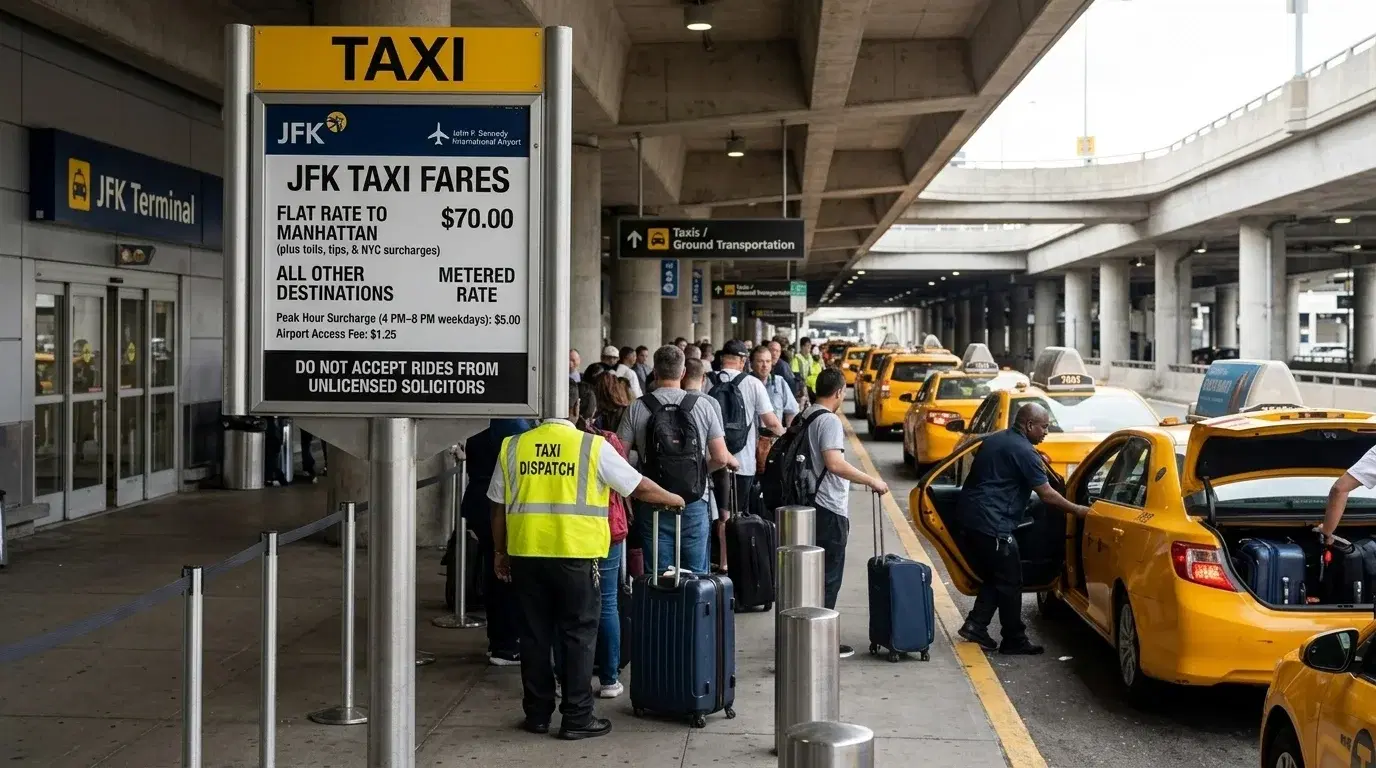
A taxi from JFK to Manhattan costs a flat $70 before extras, and most riders end up paying somewhere around $90 to $100 once surcharges, tolls and a tip are added. That gap between the posted price and the final total is where most of the confusion about the JFK taxi fare comes from.
This guide breaks the fare down line by line, explains which trips get the flat rate and which are metered, shows you where to join the cab line at the airport, and covers the alternatives worth knowing about if a yellow cab isn't the right fit for your trip.
The Short Answer: What a Cab to JFK Costs
New York's Taxi & Limousine Commission (TLC) sets one flat fare for yellow cabs between JFK and Manhattan: $70. It applies in either direction, so a yellow taxi to JFK from a Manhattan hotel and a cab from the terminal into the city start from the same number.
The $70 is not the whole bill, though. TLC adds a few small charges on top, and tolls and tip are separate. Here is how the pieces stack up for a typical Midtown or Lower Manhattan trip:
|
Item |
Amount |
|
Flat fare |
$70.00 |
|
MTA state surcharge |
$0.50 |
|
Improvement surcharge |
$1.00 |
|
State congestion surcharge (trips that start, end or pass through Manhattan south of 96th Street) |
$2.50 |
|
MTA congestion pricing toll (south of and including 60th Street) |
$0.75 |
|
Rush hour surcharge (4 p.m. to 8 p.m. on weekdays, not legal holidays) |
$5.00 |
|
Airport access fee (TLC lists this for taxi pickups at JFK) |
$2.00 |
|
Bridge and tunnel tolls |
Varies by route |
|
Tip |
Up to you |
Add the fixed items and a typical off-peak ride to Midtown comes to roughly $75 to $77 before tolls and tip. With a tip of 15 to 20 percent, the number lands near $90, and a weekday rush hour trip pushes it closer to $100. That range is my own arithmetic from TLC's published components, so treat it as a planning figure. Your meter receipt is the final word.
Where to Get a Cab at JFK
Getting a taxi at JFK Airport is simple once you know the routine. Every terminal has an official taxi stand outside the arrivals area, staffed by a dispatcher who assigns the cabs.
Step by step from baggage claim
-
Collect your bags and follow the "Ground Transportation" or "Taxi" signs to the curb.
-
Join the line at the taxi stand. The line usually moves quickly, though it can stretch during the evening international banks.
-
Tell the dispatcher where you're headed. They'll send you to the next available yellow cab, and in many cases hand you a slip with the cab number on it.
-
Check the screen in the back seat. On a trip between JFK and Manhattan, it should read "Rate #2 – JFK Airport."
-
Keep the receipt. It shows the flat fare, surcharges and tolls separately, which helps if you ever need to question a charge.
Who to ignore
People who approach you inside the terminal offering a "taxi" or "car" are not part of the official system. Licensed yellow cabs wait in the line outside, and the dispatcher is the only person you need to speak to. Taxi-hailing apps also can't be used to summon a yellow cab at the airport, because the Port Authority doesn't allow e-hail pickups there. Rideshare cars use their own designated pickup areas, and those vary by terminal, so check your app before walking out.
If you'd rather skip the line altogether, a pre-booked JFK airport transfer lets a driver meet you at a set point with the price agreed ahead of time. That's a different product from a street cab, and later sections explain when it's worth the switch.
How the Flat Rate Works
The flat fare to JFK is easy to misread, so it helps to spell out exactly what it covers.
It's the same in both directions
Some older articles say the flat rate applies only when you leave the airport. TLC's current fare page says the $70 applies to trips between Manhattan and JFK in either direction. If you're heading out to the airport, you can hail a cab on the street or ask a doorman to whistle one down, and the flat rate should apply when the destination is JFK.
The meter still shows a flat fare
Because the trip is a fixed price, sitting in traffic won't raise the base fare. A ride that takes 45 minutes on a good day and 90 on a bad one costs the same $70. The extras still apply, and that's why the flat fare feels like a promise that keeps changing: surcharges, tolls and tip get layered on afterward.
What the flat rate does not cover
The flat fare is for Manhattan. A cab between JFK and Brooklyn, Queens, the Bronx or Staten Island runs on the meter, and the final price depends on distance, traffic and time. For those trips, ask the dispatcher for a rough estimate before you leave the curb, then watch the meter.
Night and rush hour
The $1 overnight surcharge that applies to metered rides from 8 p.m. to 6 a.m. isn't part of TLC's JFK flat-fare list. The $5 rush hour surcharge is. If your flight lands at 5 p.m. on a Tuesday, expect it on the receipt.
Tolls, Tips and Payment
Tolls are the least predictable part of any cab fare to JFK. Drivers use E-ZPass at bridges and tunnels, and TLC says the discounted E-ZPass toll is added to the passenger fare at the end of the trip. The amount depends on the crossing the driver takes into Manhattan. You can usually ask the driver which route they plan to use, but in practice most people just agree to whichever route the driver says is fastest at that moment.
Tipping is not included. Most New York riders tip 15 to 20 percent of the fare, and the card reader in the back seat will offer preset options. Cash works too.
We landed at 11 p.m. with two kids and four bags and I didn't want to figure out anything. The dispatcher pointed us to a cab, the driver knew the way, and the total at the end was close to what I'd budgeted.
TLC states there is no extra charge for additional passengers, luggage or paying by credit card. Taxis accept cards, and the receipt prints with a breakdown if you ask.
Yellow Cab, Rideshare or Pre-Booked Car: How They Compare
The best choice depends on your priorities. Here is how the three most common ways to get a ride from JFK stack up.
Yellow taxi
The appeal is predictability. The base is fixed by regulation, you don't need a phone signal or an app, and the cab picks you up right at the terminal. The downsides are the line during busy arrival waves and the fact that the final total includes small extras that aren't obvious until you read the receipt.
Rideshare
Uber and Lyft don't offer the same flat rate between JFK and Manhattan. Prices follow demand, which means a quiet Tuesday afternoon can cost less than a taxi while a rainy Friday evening can cost far more. The pickup point is farther from the exit in some terminals, and you need data service to request the car.
Pre-booked private car
A private transfer is the better fit when you're arriving late, traveling with children, carrying more than a couple of bags or meeting people at the terminal. The driver tracks your flight, the price is agreed at booking, and there's no queue. You pay for that certainty, so it makes more sense for planned trips than for spur-of-the-moment ones.
If you're weighing every option for the full jfk to manhattan trip, including train, rideshare and private car, the main trade-off is always speed against budget against convenience, and that trade-off looks different for a solo traveler than for a family of five.
Cheaper Ways Into the City
Not everyone needs a door-to-door ride. The AirTrain connects all JFK terminals to Jamaica and Howard Beach stations. As of 2026 the AirTrain fare is $8.75, and connecting to the subway adds $3.00, so the trip comes to about $11.75 per person. Using the Long Island Rail Road from Jamaica instead costs more but is faster, and the combined fare with AirTrain runs roughly $14 to $16 depending on whether you travel off-peak or at rush hour.
For one traveler with a single carry-on, that's a big saving over the taxi. For two adults and two large suitcases, the gap shrinks quickly, because the train fare is charged per person while the taxi fare is per cab. A group of three or four traveling with luggage often finds that the extra effort of changing trains isn't worth the money saved.
Beyond Manhattan: Brooklyn, Queens and Long Island
If your destination is not in Manhattan, the flat rate no longer applies and the meter takes over. The meter starts at $3.00, then adds 70 cents for each fifth of a mile when traveling above 12 mph, or per 60 seconds in slow or stopped traffic. Surcharges apply on top, and there's no extra charge for luggage.
Trips outside the city limits follow separate rules. For Nassau and Westchester counties, the meter doubles once the cab crosses the city line. For points farther out, the driver may decline the job, and if they accept, the fare is a negotiated flat rate agreed before you leave. A ride from JFK to Long Island can therefore be unpredictable at a taxi stand, which is why many travelers prefer to fix the price in advance. If that's your plan, it's worth reading about the jfk to long island options before you land so you know what to expect.
Taking a Cab From Manhattan to JFK
The return trip deserves its own planning, because the stakes are higher: a missed flight costs far more than a cab fare.
Start with timing. Traffic toward the airport is heaviest on weekday afternoons and on Sunday evenings, and a single accident on the approach roads can add a long delay. Leave earlier than the map suggests, and treat the 45-minute figure as a best case rather than a promise. International travelers who need to check bags and clear security well ahead of departure should build in a bigger cushion than domestic ones.
Next, decide how you'll get the cab. On the street, a yellow cab with its roof light on is available. Hotels often have a doorman who will flag one down. You can also use a licensed taxi e-hail app. TLC lists Curb, Arro and Myle as participating providers, and each sets its own rates and shows a price before you confirm. Some apps offer a binding quote, but they're still allowed to send a metered taxi instead, so read the confirmation screen to see which kind of trip you're getting.
Finally, know what happens at the other end. The $2 airport access fee TLC lists applies to pickups at JFK, not drop-offs, so it shouldn't appear when you're being dropped at your terminal. Tell the driver your airline, not just the terminal number, if you're unsure. Drivers usually know which terminal each carrier uses, and a quick confirmation saves a long walk with your bags.
A simple way to budget: plan on the flat fare, the small surcharges, a tip of 15 to 20 percent and one bridge or tunnel toll, then round up. If the meter receipt comes in lower, you're ahead. If a driver quotes you a number that sounds higher than the flat fare for a Manhattan address, politely point to the rate screen and ask them to confirm "Rate #2."
Practical Tips for a Smoother Ride
A few small habits make the difference between an easy arrival and a stressful one.
Have the address ready. Save your hotel or home address in your phone's notes app so you can show it to the driver if there's a language barrier or a noisy curb.
Know your group size. Standard yellow cabs are built for smaller parties. If you're a family of five, or you have more luggage than fits in a typical trunk, tell the dispatcher so they can assign a larger vehicle, and be prepared for a slightly longer wait.
Ask about accessibility early. TLC runs a service for finding accessible rides, and travelers who need a wheelchair-accessible vehicle should mention it to the dispatcher as soon as they reach the front of the line.
Pay attention at drop-off. Check that the fare on the screen matches what the receipt shows, and take a photo of the receipt. If something looks wrong, the TLC accepts complaints through 311.
Plan around rush hour. Weekday late afternoons bring both the $5 surcharge and heavier traffic on the way in. If you have flexibility, the hour before and after the 4 to 8 p.m. window is calmer.
FAQs
How much is a taxi from JFK to Manhattan?
The base is a $70 flat fare. Surcharges, tolls and tip raise the total, and most riders pay roughly $90 to $100 depending on the time of day and route.
Is the JFK taxi flat rate the same going to the airport?
Yes. TLC's fare page lists the $70 flat fare for trips between Manhattan and JFK in either direction.
Does the flat rate include tolls and tip?
No. Tolls are added at the end of the ride, and tipping is separate.
Is there a flat rate for Brooklyn, Queens or the Bronx?
No. JFK trips to other parts of New York City are metered, so the cost depends on distance and traffic.
Can I pay by credit card in a yellow cab?
Yes. TLC says there's no extra charge for paying by card. You can also tip on the payment screen or in cash.
How long does it take to get to Manhattan by cab?
In light traffic, allow around 45 minutes. At rush hour or during bad weather it can take an hour or more, though the fare is the same.
Are extra bags or passengers more expensive?
No. TLC states there is no additional charge for extra passengers or luggage.
Is a taxi cheaper than Uber from JFK?
It depends on demand. Rideshare prices move up and down, so compare a live quote with a taxi estimate of about $90 to $100 all-in.
Before You Get in the Cab
The yellow cab remains a solid option for anyone who wants a no-app, no-reservation way into the city, and the flat $70 makes planning easier as long as you also budget for surcharges, tolls and tip. Know which stand to use, confirm the rate on the screen and keep the receipt.
If you'd rather have the ride sorted before you land, Transpovia is a ground transportation marketplace where you can compare and book private airport transfers and rides for your arrival or departure.


