
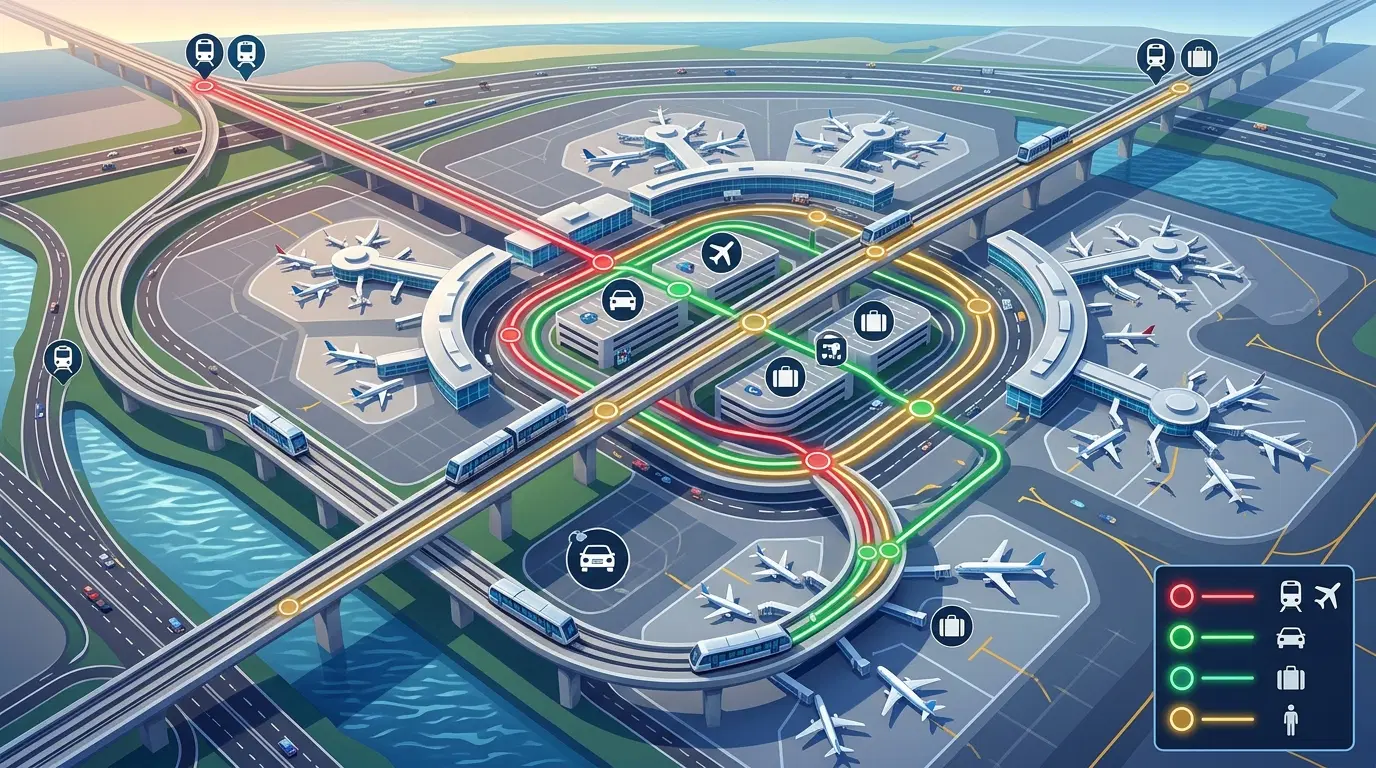
The JFK AirTrain map looks simple until you're on a platform with two suitcases and a screen announcing three different destinations. The system itself is straightforward: one driverless network, three routes, nine stations, and two stops where you leave the airport for the subway or the Long Island Rail Road. What trips people up is the detail. Which route stops where, which stations sit inside the free zone, and why a map from a few years ago shows a station that no longer exists.
This guide reads the map for you, stop by stop, and flags what construction has changed. If you searched for an "airtran map" or a "JFK tram map," you're in the right place. It's the same train.
The JFK AirTrain Map at a Glance
AirTrain is an elevated, automated light-rail system of about eight miles that links JFK's terminals with parking lots, the rental car center, hotel shuttle stops and New York's public transit. It runs around the clock. If you remember one thing about the map, make it this: it's really two zones stitched together. Inside the airport, the train is free. The two outer stations, Jamaica and Howard Beach, are where you pay, because that's where you connect to the subway and the LIRR.
The nine stations on the current JFK airport AirTrain map are five terminal stops (Terminals 1, 4, 5, 7 and 8), Federal Circle, Lefferts Boulevard, Howard Beach and Jamaica. The Terminal 2 station closed in 2022 and won't return, which is why older maps show ten stops. Fares and payment get a full breakdown in our JFK airtrain guide, so this article stays focused on reading the map itself.
The Three AirTrain Lines
The map shows three routes, and they use the same tracks around the terminal ring.
-
Jamaica route (red): runs from Jamaica Station to the terminals and back.
-
Howard Beach route (green): runs from Howard Beach Station to the terminals and back.
-
Terminal loop (gold): circles the terminals only, never leaving the airport.
The first two are your connections to the city. The third is the shuttle for moving between terminals, parking and the other airport stops. The loop generally runs in the opposite direction around the ring from the other two, so a missed terminal is rarely a problem. Stay on and ride around, or switch trains at the next stop.
The practical rule is to ignore the colors and read the destination screen on the platform. Trains don't always head the same way from the same platform, and the screen tells you whether the next one goes to Jamaica, to Howard Beach or just around the terminals. Between terminals, the ride takes under ten minutes.
I stared at the map for a full minute before I realized the loop just goes around the terminals. After that I only watched the screen, and it was easy.
Station by Station: The Nine Stops
The terminal stops
Each terminal station is numbered, and JFK's signs follow the terminal number, not the airline. Terminals 1, 4, 5, 7 and 8 each have a stop, usually with a walkway or elevator into the terminal building. Some walks are longer than you'd expect with luggage, so check which exit your airline's check-in is closest to before you leave the platform. All trains and stations are accessible, with elevators and escalators and wheelchair spaces on board.
Federal Circle
Federal Circle is the stop for the rental car center and the hotel shuttle pickup area. Riding there from the terminals is free. If your hotel runs an airport shuttle, this is usually where you board it. It is a transport stop, not a terminal, so you won't find check-in here.
Lefferts Boulevard
Lefferts Boulevard also sits inside the free zone. The Port Authority opened a free drop-off and pick-up lot here to ease congestion at the terminal curbs, a short free AirTrain ride from the terminals. If a friend is collecting you, compare that lot with a Kiss & Fly drop off before you agree on a plan. The best choice depends on your terminal and the time of day. A few New York City bus routes also stop at Lefferts.
One naming trap here: the A train terminal "Ozone Park–Lefferts Boulevard" is a different station and does not serve the airport.
Howard Beach
Howard Beach connects to the A subway line, which suits parts of Brooklyn, Lower Manhattan and the Rockaways. Check the destination sign on the subway: for the airport, you want an A train heading to Far Rockaway, not every A train stops at Howard Beach. This is a paid stop, so you'll tap in or out here.
Jamaica
Jamaica is the bigger hub. From here you can take the E, J and Z subway lines or the Long Island Rail Road, which reaches Penn Station or Grand Central Madison in roughly twenty minutes. The station is large, with several levels, so allow extra time for the walk if you have bags.
What Construction Has Changed on the Map
JFK is in the middle of a large rebuild, and terminal changes show up on the map. The old Terminal 2 station is gone. The Terminal 1 stop has been affected by construction work in recent years, and how it's served has changed more than once, so check the current AirTrain map on JFK's website or the platform screens before you rely on it.
Two newer pieces matter for 2026. Terminal 6 has opened its first gates next to Terminal 5, so Terminal 5 is the AirTrain stop you use for flights there. The New Terminal One has been pushed back again and is now expected in the first quarter of 2027, so Terminal 1 keeps operating in the meantime. Airlines also move between terminals as new gates open, which means your terminal can differ from last year's. Check your ticket, not an old guide.
Fares, Hours and Payment
The one-way fare is $8.75 when you enter or exit at Jamaica or Howard Beach. Everything inside the airport is free: between terminals, to Federal Circle, to Lefferts Boulevard. You can pay with a contactless card, a phone wallet or an OMNY card. If you ride often, fares are capped at $43.50 within a rolling 30-day period. Remember that the AirTrain fare is separate from your subway or LIRR ticket.
The service runs 24 hours, which helps with red-eye arrivals when other options thin out.
When Another Option Makes More Sense
The AirTrain is hard to beat for a solo traveler with a carry-on. With two kids, three suitcases and a transfer at Jamaica, the math changes. You're carrying bags up and down levels, buying a second ticket and hoping the right train is waiting. Late at night, or when you're heading somewhere that isn't near a subway line, a pre-booked JFK airport transfer from Transpovia puts you in a private vehicle at the terminal instead. Many travelers use the train for the trip in and a ride for the trip out, or the reverse.
FAQs
Is the JFK AirTrain free?
Riding between terminals and to places inside the airport is free. You pay $8.75 when entering or leaving through Jamaica or Howard Beach.
How many stations are on the JFK AirTrain map?
Nine: five terminal stops, Federal Circle, Lefferts Boulevard, Howard Beach and Jamaica.
Does the AirTrain go to Manhattan?
No. It connects to the subway and the LIRR at Jamaica and Howard Beach, and you transfer to reach Manhattan.
How long does it take to go between terminals?
Under ten minutes, according to JFK.
Does the AirTrain run all night?
Yes, it operates 24 hours a day, though frequency varies. Check the platform screen for the next train.
Which AirTrain stop connects to the A subway line?
Howard Beach. Make sure the A train you board is headed to Far Rockaway.
Conclusion
The JFK AirTrain map is easy once you know its logic: free inside the airport, paid at Jamaica and Howard Beach, and a destination screen that tells you everything the colors don't. Check which terminal your airline uses now, since construction keeps shifting things, and give yourself extra time at Jamaica. If the train feels like too much with your luggage or schedule, Transpovia lets you compare and book private airport rides ahead of time.


