
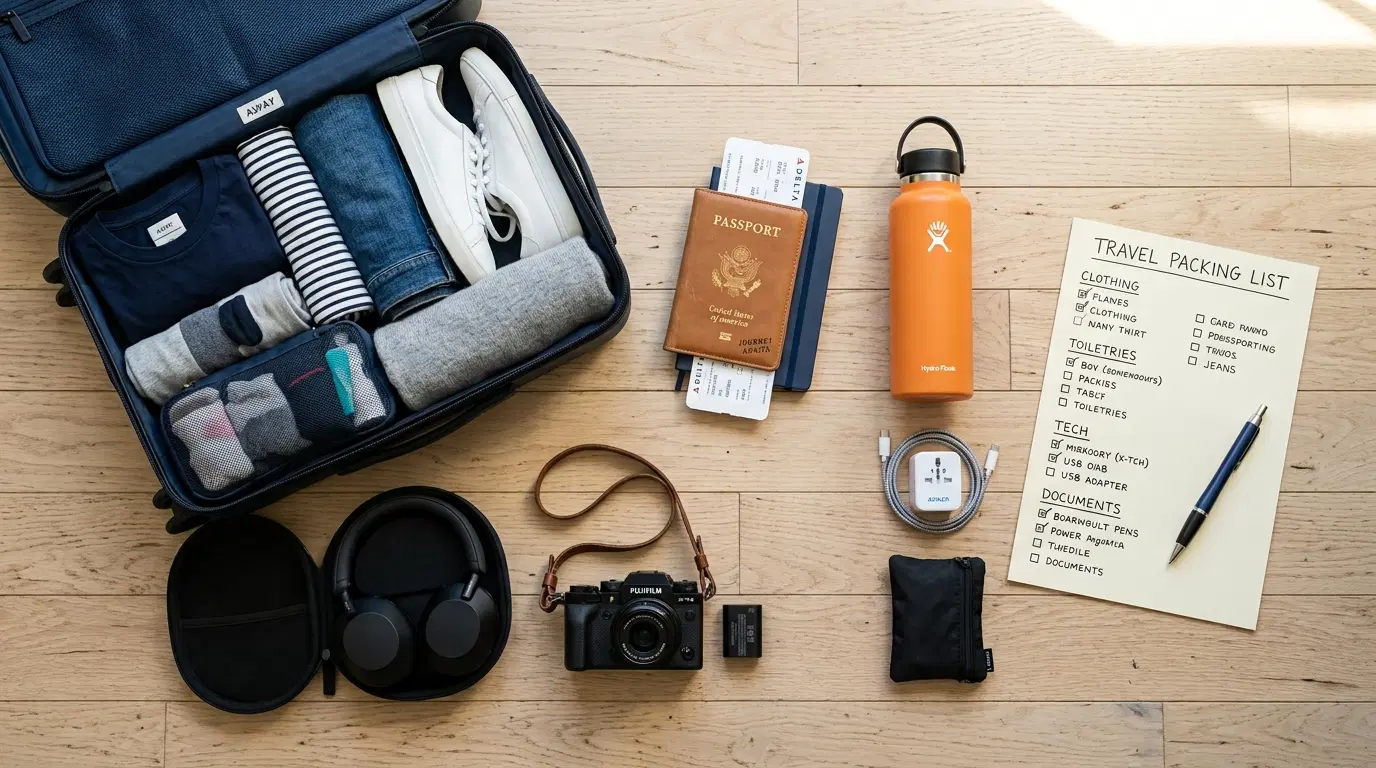
Days before an international trip, you're standing over an open suitcase wondering if you've packed too much, too little, or forgotten the one thing that actually matters. Overpack and you'll haul a heavy bag through unfamiliar airports; underpack and you'll buy a forgotten charger at airport prices. A good international travel packing list solves both by separating what's essential from what just fills space. This guide covers documents, carry-on must-haves, clothing, electronics, and health items, so you land prepared instead of patching gaps after you arrive.
Build Your International Travel Packing List Around Documents First
The most important items on any international travel packing list aren't clothes, they're documents. Start with your passport and check its expiration date the moment a trip is on the calendar. The U.S. State Department warns that some countries won't admit you if your passport expires within six months of your trip, so confirm you have at least six months of validity beyond your return date. This rule varies by destination, with some countries requiring only three months, so check the entry requirements for where you're going.
From there, work through the rest of your paperwork. Confirm whether you need a visa or an electronic travel authorization, and that you have enough blank passport pages for entry stamps. Make copies of your passport, cards, and insurance, storing a digital set and a paper set separately from the originals. Load the digital side too, since offline maps, a translation app, and a currency converter earn their space the moment your data drops, and the [Best Travel Apps Every International Traveler Should Download] cover the ones worth having before you fly.
The Carry-On Essentials You Can't Afford to Lose
Anything you can't easily replace belongs in your carry-on, not a checked bag that might arrive a day late. That means your passport, medications, a change of clothes, your phone and chargers, and any valuables. Checked luggage gets delayed often enough that your trip shouldn't depend on it.
Liquids in your carry-on still follow the TSA's 3-1-1 rule in 2026: containers of 3.4 ounces or less, all fitting in one quart-sized bag, one bag per passenger. Newer computed tomography scanners at some airports let you leave that bag inside your carry-on, but the size limit itself hasn't changed, so follow the signs at your checkpoint. Medications and baby formula are exempt and may exceed the limit; declare them for separate screening, and keep medicines in their original labeled containers. A quick carry-on checklist covers the irreplaceables:
-
Passport, visa, and printed copies of key bookings
-
Medications in original containers, plus a small first-aid kit
-
Phone, charger, power bank, and a universal adapter
-
One change of clothes and travel-size toiletries under 3.4 ounces
-
Two payment cards and some local cash, with a backup stored separately
-
Headphones or earplugs and an eye mask for the flight
Clothing: Pack for a Week, Not a Month
Most overpacking happens in the clothing pile, and the fix is a capsule approach. Choose neutral colors that mix and match, build around layers you can add or remove as the weather shifts, and add one dressier outfit for a nice dinner or an evening out. A week's worth of clothes covers almost any trip length once you plan to do laundry partway through.
Match what you pack to the destination, not a generic list. Check the climate and season for your travel dates, since packing for summer in one hemisphere means winter in another. Cultural norms matter too: many religious sites and some countries expect covered shoulders and knees, so bring at least one modest outfit if that applies where you're headed. Roll clothes or use packing cubes to save space, break in walking shoes before you go, and skip the "just in case" items you could buy cheaply on arrival.
Power, Plugs, and Staying Connected
Electronics trip up travelers because two separate issues get confused: plug shape and voltage. Outlets come in different shapes around the world, and the electrical supply differs too, with the United States running about 120 volts while much of Europe, Asia, and Africa runs closer to 230 volts. A plug adapter changes the shape to fit the socket; a voltage converter changes the actual power. They are not the same tool.
Most phone and laptop chargers are dual-voltage, meaning they handle the full range, so they only need an adapter. Check the fine print on the charger for "100–240V" to confirm. Single-voltage devices like some hair dryers and styling tools can fail or be damaged abroad without a converter, which is why many travelers simply leave them home and use what the hotel provides. Pack a universal adapter, a power bank for long transit days, and sort your data before you go, since an eSIM or a local SIM card is usually far cheaper than international roaming.
Health, Money, and Safety Items
Health and money items are easy to underpack and hard to replace abroad. Bring enough of any prescription medication for the whole trip plus a few extra days, in original labeled containers, and carry a copy of the prescription. Check whether any of your medications are restricted at your destination, since some common drugs are controlled elsewhere. Add a small kit with a pain reliever, anything for motion sickness or stomach upset, bandages, and your personal basics.
For money, carry two payment cards from different networks in case one is declined or lost, plus a little local currency for arrival transport and tips. Store a backup card apart from your wallet so a theft doesn't leave you stranded, and tell your bank your travel dates to avoid a frozen account. On the safety side, the State Department suggests U.S. travelers enroll in the Smart Traveler Enrollment Program (STEP), which sends alerts and helps consular staff reach you in an emergency, and keep those document copies stored separately from the originals.
Pack Light Enough to Move on Your Own
Traveling carry-on only is the single biggest upgrade for an international trip. You skip checked-bag fees, have nothing to lose in transit, and move quickly through tight connections. Airline size and weight limits vary, and international carriers are often stricter than domestic ones, so check the rules for your specific flight rather than assuming.
A few habits keep the bag manageable. Wear your bulkiest items, like a coat and boots, on the plane, leave room for things you'll bring back, and use a luggage scale at home to avoid overweight charges at the counter. Packing light is also one of the simplest ways to spend less without giving up comfort, and there's more on striking that balance in [How to Travel on a Budget Without Losing Comfort]. If you do travel heavy or land after a long flight, arranging your airport transfer in advance means a driver meets you and handles the bags at the curb instead of you wrestling luggage onto a train while jet-lagged; services such as Transpovia coordinate that door-to-door pickup in the destinations they serve.
FAQs
What should you not forget when packing for international travel?
The items people most often forget are the hardest to replace: a passport with at least six months of validity, prescription medications in labeled containers, a universal power adapter, and copies of your key documents stored separately from the originals. Sort these first, before clothes, since a forgotten shirt is easy to buy abroad and a document problem can stop the trip.
Can you bring liquids in your carry-on on international flights?
Leaving from a U.S. airport, the TSA's 3-1-1 rule applies: liquids in containers of 3.4 ounces or less inside one quart-sized bag. Medications and baby formula can exceed that if declared. Keep in mind that airports abroad set their own limits for your return flight, so don't assume the same rules apply in both directions.
How many outfits should you pack for a two-week trip?
Around a week's worth of mix-and-match clothing usually covers a two-week trip if you plan to do laundry once midway. Building outfits from neutral, layerable pieces lets you re-wear items in different combinations, which cuts the pile roughly in half compared to packing a fresh outfit for every day.
Do you need a voltage converter or just a plug adapter?
For most travelers, a plug adapter is enough, because phones, laptops, and camera chargers are almost always dual-voltage and only need the shape changed to fit the socket. A voltage converter is only necessary for single-voltage devices, like certain hair tools, which can be damaged by the higher voltage common outside North America.
Before You Zip the Bag
Lay everything out, then confirm the four items that actually derail trips: passport validity, medications, adapters, and document copies. Pack those first, build your clothes around a week of mix-and-match pieces, and weigh the bag before you leave. Handle the essentials early, and packing becomes a short checklist instead of a night-before scramble.


