
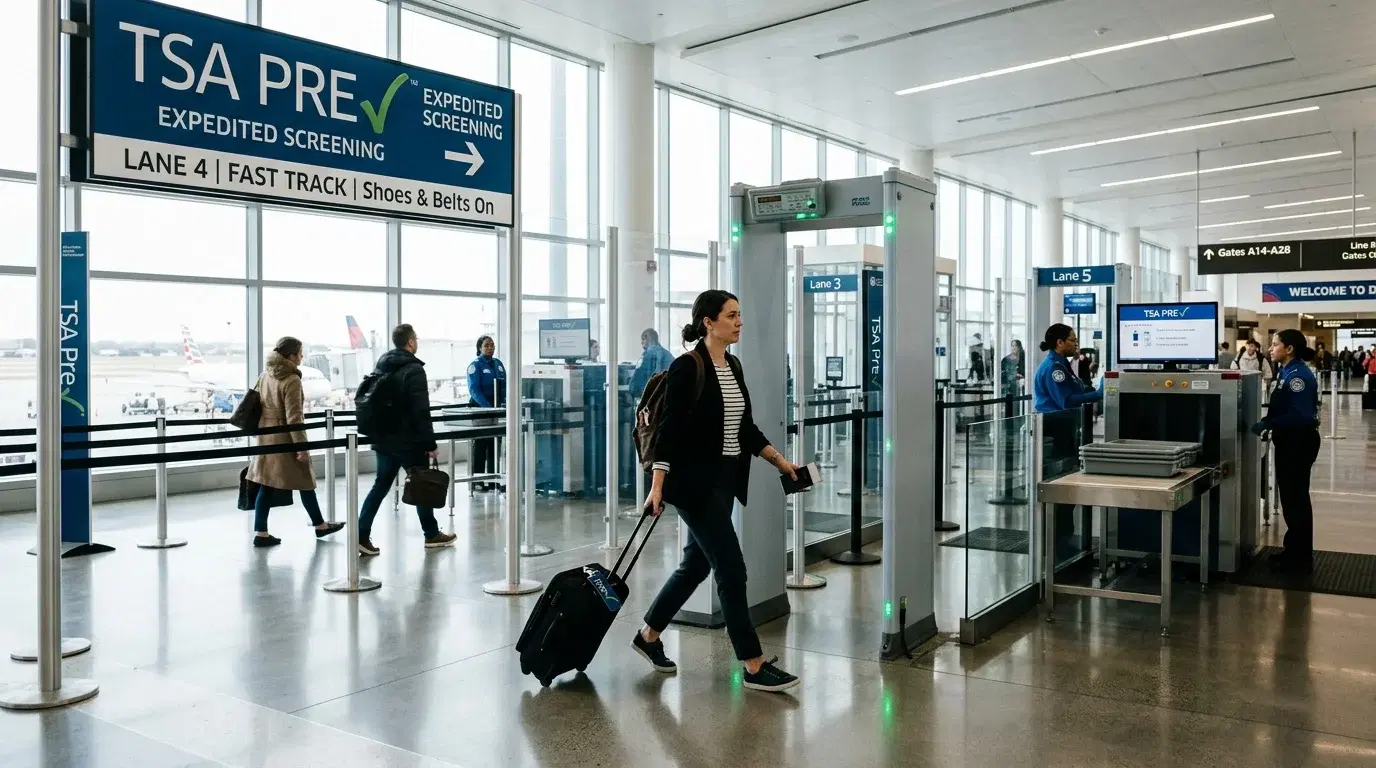
How to save time at the airport is less about rushing through the terminal and more about the choices made before ever arriving there. Enrollment programs, how bags are packed, and which tools get used to check status all shape whether a trip through the airport takes 40 minutes or two hours. The biggest time savings tend to come from decisions made days or weeks ahead, not from moving faster once inside.
Enroll in a Trusted Traveler Program
Security and customs screening are where most airport time disappears, and expedited programs address both. TSA PreCheck lets roughly 99% of enrolled passengers clear security in under 10 minutes during normal operations, a meaningful difference from a standard lane that can run considerably longer during peak periods.
For international travelers, Global Entry addresses the customs side of that equation. Global Entry is a CBP Trusted Traveler Program that gives pre-approved, low-risk travelers expedited clearance when arriving in the United States, and it includes TSA PreCheck benefits. At the kiosk, a Global Entry member's actual processing typically takes as little as 45 seconds, compared to a standard immigration line that can run much longer during a busy arrival bank.
The catch is lead time. Most Global Entry applications are reviewed within about two weeks, though some take up to 12 months depending on background check complexity, and a scheduled interview appointment can add further delay in some regions, since some states have no local enrollment center and require traveling out of state, with wait times near 100 days at nearby processing centers. Applying well before an international trip, rather than close to departure, is the only way this option pays off.
Skip Checked Bags When Possible
Baggage claim and bag drop both add time that travelling with only a carry-on removes entirely. Traveling with a well-packed carry-on avoids the check-in lanes some airports require for dropping off checked bags, which can take considerably longer at crowded hubs.
Carry-on-only travel also protects against a different kind of delay: a missed connection no longer risks a bag arriving separately, since everything stays with the traveler through any rebooking. For trips where checked baggage is unavoidable, checking in online and printing or downloading tags in advance, when the airline offers it, still shaves time off the counter process compared to starting from scratch at the airport.
Use Mobile Boarding Passes and Airline Apps
A downloaded boarding pass removes a stop at the counter or kiosk entirely for travelers who have already checked in online. Pairing that with an airline's app for real-time gate and delay notifications catches changes as they happen, rather than relying on terminal signage that updates less frequently.
Checking flight status through the app before leaving for the airport, and again before heading to the gate, avoids wasted time walking to a gate that has already changed. Review How to Save Time at the Airport for the fuller pre-departure checklist this section supports, from check-in timing to document prep.
Time Security and Customs Around Historical Patterns
Security wait times are not constant throughout the day, and checking historical patterns before choosing a departure time can save real minutes. Several major airports publish terminal-level TSA wait data on their own websites, which tends to be more detailed than the TSA's national app since it breaks estimates down by checkpoint rather than showing one figure for the whole airport.
Choosing a flight time that avoids an airport's known peak windows, when schedule flexibility allows, can save more time than any single trick performed once inside the terminal. This matters most at larger hub airports, where the gap between a slow midday peak and a quieter early-morning or late-evening slot can be substantial.
Navigate the Terminal With a Plan
Knowing gate location, walking distance, and any inter-terminal transfer requirements before arriving prevents backtracking once inside. Airport apps and terminal maps, available through most airport authority websites, show which security checkpoint serves a specific airline and gate area, which matters at airports with multiple checkpoints that do not all connect to the same terminals.
Confirming which terminal an airline uses before leaving for the airport avoids a wasted walk or shuttle ride to the wrong building, particularly relevant at airports where terminal assignments can differ by flight or by codeshare partner.
Common Mistakes That Waste Time at the Airport
Applying for a trusted traveler program too close to a trip is one of the most common missteps, since processing and interview scheduling can take weeks to months. Packing liquids loosely instead of in a compliant, accessible bag is another frequent cause of delay at the checkpoint, regardless of which security lane is used.
Relying on a single source for wait times or flight status, rather than checking both an airline's app and the airport's own published data, can also mean acting on outdated information. Finally, skipping a terminal map for an unfamiliar airport often costs more time in backtracking than checking it in advance would have taken.
Frequently Asked Questions
Is TSA PreCheck or Global Entry a better time-saver?
Global Entry includes TSA PreCheck benefits and adds expedited customs clearance for international arrivals, making it the stronger option for anyone flying internationally. TSA PreCheck alone covers domestic security lines at a lower cost and shorter approval wait for travelers who do not need customs benefits.
How far in advance should you apply for Global Entry to save time on an upcoming trip?
Processing can take anywhere from a couple of weeks to several months, and interview scheduling can add further delay depending on region, so applying as early as possible, ideally months before an international trip, gives the best chance of approval in time.
Does traveling with only a carry-on always save time?
Usually, yes, since it skips bag drop and baggage claim entirely. The trade-off is stricter adherence to size and liquid limits, and some connecting itineraries with tight layovers benefit even more from not waiting on checked luggage.
Are airport wait-time apps accurate enough to plan around?
They provide a useful estimate based on real-time and historical data, but conditions can shift quickly with staffing or passenger volume, so treating the numbers as a guide rather than a guarantee is the safer approach.
Before You Go
Saving time at the airport starts with decisions made well before departure: enrolling in a trusted traveler program early, packing to skip checked bags when possible, and checking both flight status and wait times from a reliable source. Pairing those habits with a reliable ride, whether a pre-booked Transpovia transfer or another option, keeps the time saved from disappearing in transit.


