
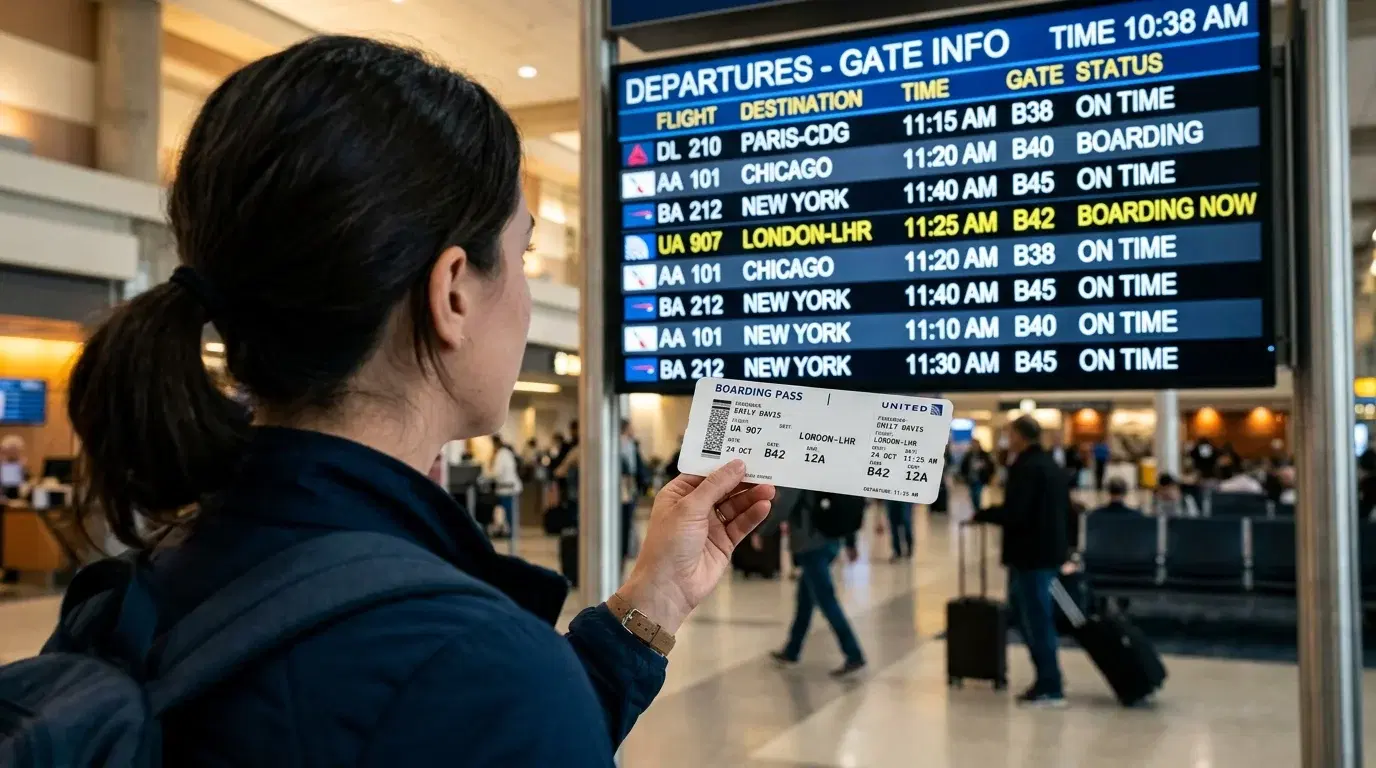
How to read an airport departure board comes down to knowing which pieces of information matter and which status words demand immediate action. A board packed with flight numbers, times, and destinations can look overwhelming at first glance, but it follows a consistent format at almost every airport. Understanding that format, and especially the difference between routine status updates and the ones that mean move now, keeps a departure on track.
What a Departure Board Actually Displays
Every departure board is powered by a flight information display system, commonly called a FIDS, and each line follows a predictable layout. Each line indicates a flight number alongside the airline's IATA or ICAO designator, the destination city, and any intermediate stops, and can include the logos or codes of partner airlines sharing that same flight.
Alongside the flight number, a departure board typically lists scheduled departure time, current gate assignment, and status. Since large airports often run separate display systems for each terminal or major airline, checking the correct board for a specific terminal matters, since not every board in the building shows every flight.
Understanding Flight Status Terms
Status terms on a departure board carry different levels of urgency, and knowing the difference matters more than any other single piece of information on the board. "On Time" and "Delayed" are informational, giving a read on the schedule without requiring immediate action. "Boarding" means the process has started, while "Final Call" is a different signal entirely.
A final call is the last of several regular announcements that it's time to board, meant to prompt an orderly but timely move to the gate. "Gate Closed" that follows is not a warning; it typically means the door has already shut. Boarding gates generally close 15 to 20 minutes before scheduled takeoff regardless of whether every passenger has arrived, and once closed, passengers are usually not permitted to board. Treating "Final Call" as the moment to move, not "Gate Closed," is the difference between making a flight and missing it.
Codeshare Flights and Multiple Numbers on One Line
A single line on a departure board sometimes lists more than one flight number, which confuses travelers checking a booking confirmation against the board. Codeshare and interlining arrangements mean a flight can appear under multiple airline designators, such as one flight showing both an originating carrier's number and a partner airline's number for the same aircraft.
Checking a boarding pass or confirmation email for the exact flight number booked, rather than assuming the first airline name on the board is the correct one, avoids confusion when a flight is marketed by one airline but operated by another. This matters most on international routes and at airports served by multiple alliance partners.
Departure Boards vs. Airline Apps: Which to Trust
Physical departure boards and airline apps do not always update at the same speed. An airline's own app typically reflects a gate change or delay as soon as it's logged in the airline's system, while a terminal-wide board may take a few minutes longer to refresh.
Cross-checking both sources before walking toward a gate, particularly after a status shows anything other than "On Time," reduces the chance of acting on outdated information. Review How to Navigate a Large Airport for how to move quickly between terminals if a departure board reveals a gate change that puts a flight in a different building entirely.
Reading an Arrival Board Instead of a Departure Board
Arrival boards follow a similar layout but serve a different purpose, and mixing the two up is an easy mistake in an unfamiliar airport. A departure board lists flights leaving that airport, along with gate and boarding status, while an arrival board lists incoming flights, their expected or actual landing time, and often the baggage claim carousel assignment.
Anyone picking someone up, rather than departing themselves, needs the arrival board specifically, not the departure listings near the check-in counters. Confirming which board is which before scanning for a specific flight saves a confusing few minutes in a busy terminal.
Common Mistakes Reading a Departure Board
Assuming "Delayed" means there's no rush is one of the more common mistakes, since a delayed flight can still move up its boarding time or gate with little notice. Treating "Final Call" as optional is a related error, particularly for travelers who assume there's more buffer than the term actually allows.
Reading the wrong board entirely, whether an arrival board instead of departure, or a different terminal's board altogether, is another frequent source of confusion at larger airports. Finally, trusting a physical board over a more current airline app, rather than checking both, can mean missing a change that already appeared on a phone but hasn't reached the terminal screen yet.
Frequently Asked Questions
What does "Final Call" actually mean on a departure board?
It means the boarding process is ending and the gate will close shortly. It's the signal to head to the gate immediately rather than a routine update.
Why does a flight sometimes show two different flight numbers on the same board?
This usually reflects a codeshare arrangement, where more than one airline sells tickets for the same physical flight under its own flight number.
Is it safe to rely only on the departure board, or should you also check the airline app?
Checking both is safer. Airline apps often reflect changes faster than a shared terminal board, especially for last-minute gate changes.
How is an arrival board different from a departure board?
An arrival board shows incoming flights with landing times and baggage claim information, while a departure board shows outbound flights with gate and boarding status.
Before You Go
Reading a departure board comes down to catching the status words that actually require action, "Final Call" most of all, and cross-checking gate information against an airline's app when anything changes. Confirm ground transportation, including any pre-booked Transpovia pickup, matches the current flight time before heading to arrivals.


