
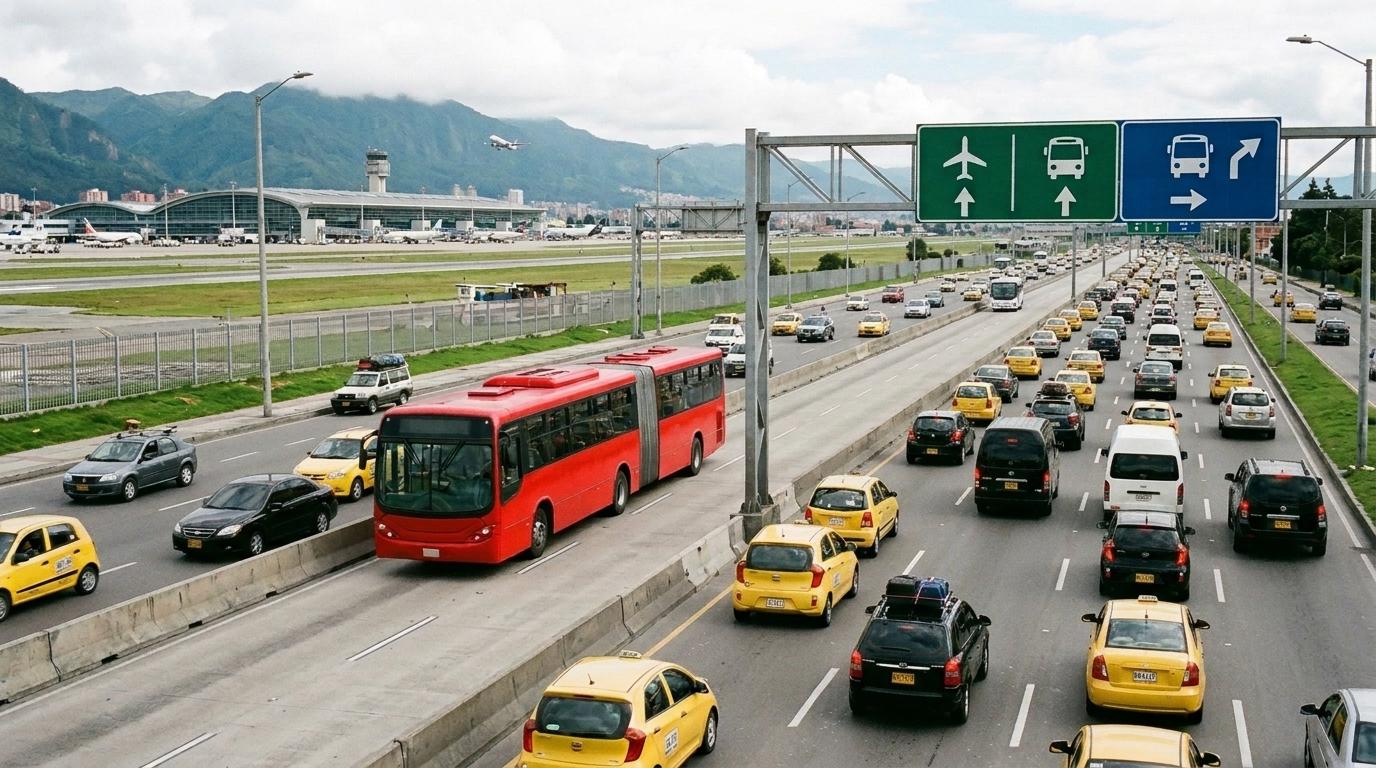
If you are wondering how to get to Bogota airport, you have five workable choices. TransMilenio with a free feeder bus costs the least. SITP buses use the same card and reach more neighborhoods. Official yellow taxis wait outside the terminal. Uber and other apps work once you agree on a meeting point in the app. A private transfer booked in advance costs more and removes most of the guesswork. The right pick depends on your luggage, the hour you land and how well you know the city. This guide walks through each option, points out where travelers usually slip, and helps you choose before you reach the curb.
The Five Ways to Reach El Dorado at a Glance
El Dorado sits about 15 km west of the city center, along Avenida El Dorado, which locals also call Calle 26. That distance looks small on a map. Traffic changes it. A ride can take around half an hour on a quiet morning and well over an hour in the late afternoon rush, and that makes the time you travel equally important with the option you pick.
Here is how the choices compare in plain terms.
-
TransMilenio. The lowest cost, though it needs a TuLlave card, a feeder bus and a transfer. It suits light luggage and daytime arrivals.
-
SITP zonal buses. Cheap and local, though slower, because the buses share lanes with cars.
-
Official airport taxi. Metered and regulated, with a printed fare ticket before you board.
-
Uber and other apps. Convenient if you have mobile data and a few minutes to find your driver.
-
Private transfer. A fixed plan with a driver you book ahead, which helps after a long flight or a late landing.
Travelers who want the plan settled before they land can check Bogotá El Dorado Airport Transportation – private transfer for ride options on this route. Everyone else can keep reading, because the cheaper choices work well once you know the small details.
Check Your Terminal First
El Dorado has two terminals. Terminal 1 handles most international and domestic flights. Terminal 2, called Puente Aéreo for years, serves a few domestic carriers and sits in a separate building a short ride away. A free shuttle links the two, and the airport says it runs every day between roughly four in the morning and midnight.
Look at your booking before you choose a drop-off point. A wrong terminal can cost you twenty minutes and a rushed walk with bags in your hands. Most visitors on international flights will use Terminal 1, and the rest of this guide assumes that.
TransMilenio to El Dorado Airport
TransMilenio is the red bus rapid transit network that crosses Bogotá on dedicated lanes. It is the cheapest way to reach the airport, and also the one that asks the most of you. No trunk line ends inside the terminal, which means the trip always includes a connection. You have two ways to make it.
The Free Feeder to Portal El Dorado
Feeder route 16-14 Aeropuerto links the terminal with Portal El Dorado, the large TransMilenio station for the airport zone. Local reports put the ride at about seven minutes. Airport and city sources call the feeder free for passengers, though you should confirm that at the stop, because fare rules can change. At the portal you board the trunk route that matches your destination. Express services leave Portal El Dorado for many parts of the city, and the letter of each route changes over time, which means you should check the TransMilenio app or the map inside the station before you commit.
The K86 and M86 Dual Route
A dual bus named K86 and M86 stops at the airport and runs along the Avenida El Dorado corridor toward Hacienda Santa Bárbara. City guidance shows its stops labeled for airport satellite bus service near entrances 1 and 8 of Terminal 1. Its schedule starts before dawn and ends around ten at night, with shorter hours on Sundays and holidays. Schedules shift, which is why you should read the posted hours at the stop.
The TuLlave Card
Turnstiles do not take cash. You need a TuLlave card loaded with credit. The airport has a card point near entrance 4 of Terminal 1, and the city recommends buying the card there before you move to the station. Load enough for the trip and for any extra rides in the following days. Lines at portals can get long, and fixing a card problem at a turnstile with a suitcase behind you is no fun.
Who Should Use TransMilenio
Choose it if you travel light, arrive during the day and have a few spare minutes. Skip it if you carry large bags, land at night or arrive at rush hour. Buses fill quickly, and boarding with a big suitcase can be hard. A simple rule works well here. If you can lift your luggage with one hand and still hold a rail with the other, TransMilenio is reasonable.
Reaching La Candelaria by TransMilenio
Many visitors head to La Candelaria, the historic center with colonial streets, museums and small hostels. After the K86 ride, travelers often step off near Universidades station and walk or take a short taxi to their hotel. If you plan to stay in that area, the Bogotá Airport to La Candelaria transfer guide lays out the choices in more detail, including timing and cost.
SITP Buses
SITP is the zonal bus system. Its buses do not run on dedicated lanes, and they stop more often than TransMilenio. Several zonal routes serve the airport area, and local news reports name P500, H317, 12 and 577 among them. They share roads with cars, which makes them slower when traffic builds. They also accept the TuLlave card.
Most visitors never need SITP. It makes sense if you live in the city, know your route and want the lowest cost. Use a live map app, confirm the route number at the stop and ask the driver if you feel unsure. Your first night in Bogotá is not the best moment to learn a bus network by trial and error.
Bogota Airport Taxi or Uber
Taxis and apps are the popular choice for visitors, and both are easy to find outside Terminal 1. They are also where most arrival problems begin, which is why the details matter.
Official Airport Taxis
Taxi Imperial holds the official concession at El Dorado. Its yellow taxis use a meter, and the rates follow the schedule the city sets each year. For 2026, published city rates add a surcharge of 8,000 pesos on trips to or out of the airport, plus a higher charge at night, on Sundays and on holidays. Check the current table before you travel, because rates move every January.
Since August 2024, Taxi Imperial has used a system of advance pricing. Staff at the official point enter your destination on a tablet and hand you a printed ticket with the fare before you get in the car. Keep the ticket. It is your proof of the agreed price if a driver asks for more at the end.
Use only the official queue. Local news has reported overcharging cases, including drivers who demanded far more than the fare should be, and the offenders are often people who approach travelers in the arrivals hall. Walk past anyone who offers a ride before you reach the line. For a closer look at pickup points and what to expect at the curb, read about Taxi and Uber at El Dorado Airport.
Uber and Other Apps
Uber works at El Dorado, and Cabify and DiDi also operate there. The app shows a price before you confirm, which many travelers appreciate. Drivers cannot always stop right at the terminal doors, and no single marked zone exists inside the building. Message your driver, share the exact door or level and watch the app for updates. Travelers often meet drivers at the departures level.
Plan for a few extra minutes. A driver may ask you to walk to a different spot, and a cancelled ride happens often when the pickup point is unclear. Mobile data matters here. Buy a local SIM or an eSIM before you land, or use airport Wi-Fi to order the ride while you wait for your bags.
App prices rise when many people request rides at once, which tends to happen after a large flight lands. If the fare looks high, wait ten minutes and check again, or compare it with the taxi ticket.
Private Transfer
A private transfer is a car or van booked before you travel. The driver knows your flight, the price is set in advance and you do not need to find a queue. It costs more than TransMilenio and often more than a taxi, though many travelers accept that after a long flight.
Transpovia is a ground transportation marketplace, and it lets you compare airport transfer and private ride options before you fly. A transfer makes the most sense in four cases. You land at night. You travel with children. You carry more bags than two hands can manage. Or you have a hotel booked and want the first hour in the city to be simple.
"We landed at midnight with two kids and three bags. Having a driver confirmed before the flight made the whole arrival feel easy."
Compare private options by vehicle size and luggage space, not only price. A sedan for two people is fine. A family of five with checked bags needs a van. If you travel in a group, one larger vehicle often costs less per person than two taxis.
Arriving Late at Night
Late arrivals change the math. TransMilenio and SITP run on posted hours, and the feeder and dual routes stop for the night. Even when a bus is still running, a dark portal station is a poor place to work out a transfer with luggage in tow.
Official taxis and booked rides make more sense after dark. Taxi rates also include a night and holiday surcharge, which means the printed ticket will show a slightly higher number than a daytime fare. If you use an app, send your driver a message with the exact door before you leave the terminal.
Tell your hotel about your arrival time too. A front desk that expects you at one in the morning will keep the door ready, and a driver or taxi can drop you right at the entrance.
Small Habits That Make Arrival Easier
A few simple steps save time, whichever ride you take.
Keep your phone charged and your boarding pass handy, since a driver or taxi attendant may ask for your flight details. Carry a small amount of Colombian pesos for tips, snacks or a toll, because card machines are not everywhere. Keep your passport and wallet in a front pocket or a bag you hold, not in a backpack that sits behind you on a crowded bus.
Pick your ride before you leave the baggage hall. Moving toward the exit with no plan makes you an easy target for people offering unofficial rides. A traveler who walks with a clear destination, a printed ticket or a message on the phone gets far fewer approaches.
Going to the Airport When You Are Leaving Bogotá
The same options work in the other direction, though the stakes are higher because you have a flight to catch. Most travelers aim to arrive two to three hours before departure, and a long international flight deserves the longer margin.
Traffic on Calle 26 and Avenida Boyacá can slow down fast, especially in the late afternoon and when it rains. Heavy rain slows roads around the airport, which is a good reason to leave earlier on wet days. If you take a taxi or app, order it before you pack the last bag, not after.
TransMilenio works well for the trip out if your hotel is near a trunk station and your luggage is light. Take the trunk route to Portal El Dorado, then catch the 16-14 feeder or use the K86 and M86 service. Leave extra time for the transfer, and keep your TuLlave card loaded.
For early flights, check the schedule of every public option, because buses start at different hours. A private transfer or an app ride booked the night before removes that risk. Whichever option you use, confirm your terminal before you leave the hotel.
Which Option Fits Which Traveler
A solo traveler with a backpack and a daytime arrival can use TransMilenio and save money. A couple with two suitcases usually does better with a taxi out of the official queue, since the printed fare removes any doubt. A family with young children, or anyone landing after midnight, gets the most out of a private transfer, because nothing needs negotiating and nobody needs finding in the dark.
A business traveler heading to Chapinero, Usaquén or the financial district often chooses an app ride or a private car. These areas sit north of the airport, and the route along Calle 26 and Carrera Séptima can be slow at peak hours. Visitors staying in La Candelaria can use any option, though narrow streets near the hotel sometimes mean the last stretch happens on foot.
Budget matters too. If you travel with two or three people, the gap between a taxi and TransMilenio shrinks once you count each person. Do the math for your own group before you decide.
FAQs
Is there a direct TransMilenio line to Bogota airport?
No trunk line enters the terminal. You connect through the free 16-14 feeder at Portal El Dorado or use the K86 and M86 dual route, which stops at the airport and runs along the Avenida El Dorado corridor.
How long does it take to reach the city center?
It depends on traffic. A taxi or app ride can take around half an hour in light traffic and well over an hour at rush hour. TransMilenio usually takes about an hour including the connection, and it can run longer during peak times.
Can I use Uber at El Dorado Airport?
Yes. Order the ride in the app, message your driver and agree on the exact meeting point. Expect to wait a few minutes and keep your phone charged.
Are airport taxis worth it?
They can be, if you use the official queue and take the printed fare ticket before you board. Avoid anyone who approaches you inside the terminal.
What is the best option late at night?
A private transfer or an official taxi works best. TransMilenio services have limited hours, and a late arrival with luggage makes public buses a poor choice.
Do I need a TuLlave card for SITP and TransMilenio?
Yes. Neither system takes cash at the turnstile or the bus reader, which means you should buy a card before you head to the station.
Choose the Ride That Fits Your Arrival
The cheapest route is not always the best one. TransMilenio saves money, taxis give a regulated fare, apps bring convenience and a private transfer takes the stress out of a long travel day. Pick the one that matches your luggage, your arrival time and your energy level.
Whatever you choose, confirm your terminal, load your phone and leave time for traffic. If you want a driver confirmed before you land, book your airport transfer with Transpovia and keep the public options for backup.


