
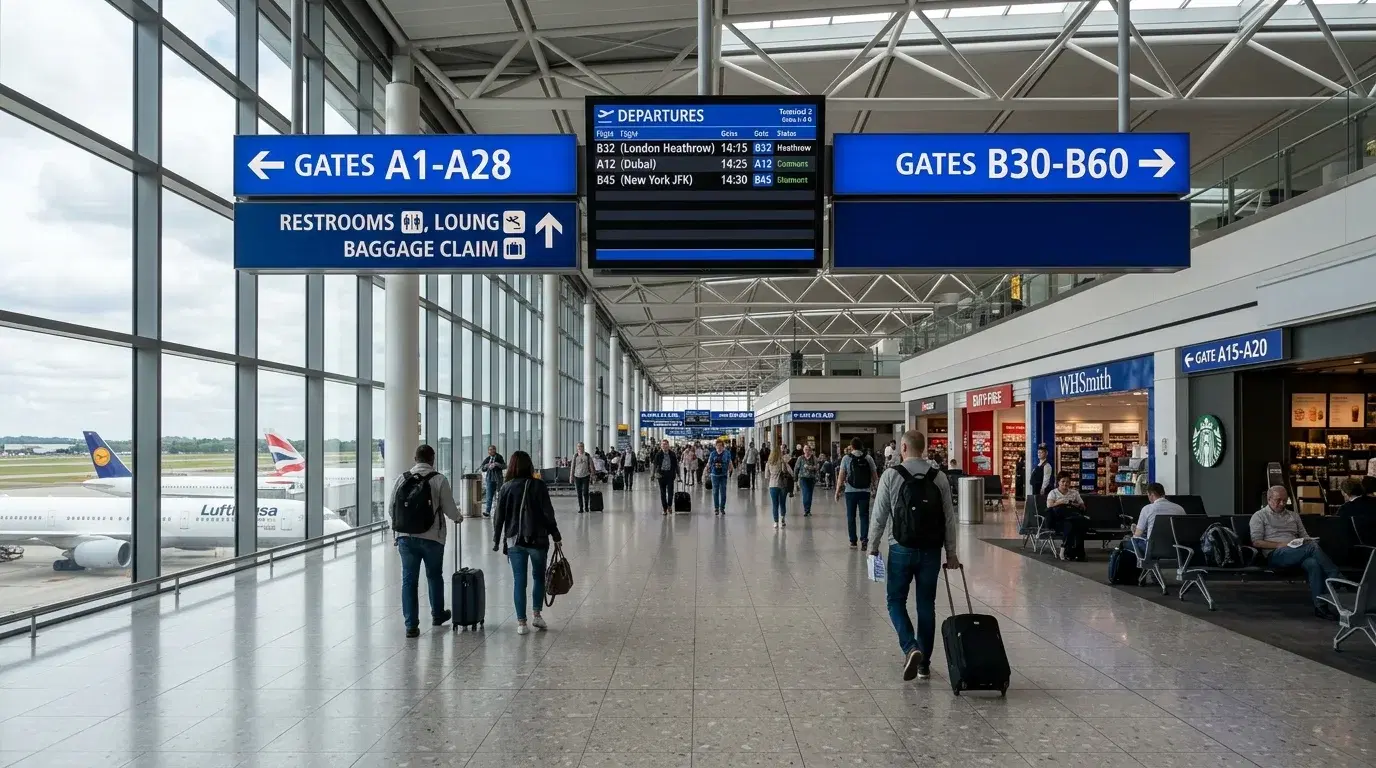
You clear security into a wide concourse, people moving in every direction, and your boarding pass says Gate B47 — but nothing around you says where B47 actually is. At a large airport with multiple concourses and a train between terminals, finding your gate is a real task, not an afterthought. The good news: airports use a consistent labeling system, and a few habits keep a distant gate or a last-minute change from turning into a sprint. Here's how to find your gate at the airport with less guesswork.
Start by Reading the Gate Code
Your gate is a letter-number combination — like B47, A3, or C12 — and each part tells you something. The letter identifies the concourse or terminal, a specific wing of the airport, while the number is the individual gate within that wing. Once you know that B means Concourse B, you're looking for one place, not scanning the whole airport.
That code is printed on your boarding pass and shown in your airline's app if you checked in on your phone. Pull it up before you even reach security so you know which direction you're heading the moment you're through.
One caution that shapes everything else in this guide: the gate on your boarding pass is a starting point, not a guarantee. Airlines reassign gates routinely, sometimes an hour ahead, sometimes 15 minutes before boarding. For international flights, you may not get a gate at all until 60 to 90 minutes before departure. So treat the printed gate as a direction to start walking, then confirm it inside.
If you want the wider picture of moving through a big hub — security, concourses, connections, and amenities — this guide on How to Navigate a Large Airport covers the full layout alongside the gate-finding steps here.
Follow the Screens and the Overhead Signs
After security, two tools do most of the work: the flight information display screens and the directional signage overhead.
The large screens — often called FIDS, for Flight Information Display System — list departures by flight number with the current gate and boarding time. They sit at security exits, corridor intersections, near food courts, and throughout the concourses. Find your flight number, confirm the gate, and note whether boarding time has changed.
The overhead signs then point the way. Most airports post gate ranges above the walkways, reading something like "Gates B40–B60 →." Because gates run in sequence along a concourse, matching your number to a range tells you which direction to turn. Follow the letter first to reach the right concourse, then the numbers narrow it down.
When you reach the gate, glance at the screen above the gate desk. It should show your flight number and destination. If it shows a different flight, your gate has moved — check the nearest screen or ask the agent.
Use Your Airline App as a Live Backup
The airline app is the tool that catches what signs and announcements miss. Most major airlines send a push notification with your gate when it's assigned, and another if it changes — often before the terminal screens update.
Download your airline's app before the trip and turn on notifications. It matters most in two moments: when a gate changes while you're away from the gate area, and when you land from a connecting flight and need your onward gate fast. Many aircraft also show connecting-gate information on the seatback screen in the last part of the flight, and some airlines push arrival and departure gates to your phone the moment you touch down.
Don't lean on PA announcements alone. Large terminals are noisy, and a gate-change call is easy to miss — especially with headphones in. Free airport Wi-Fi lets you check the app even without a cell signal, so connect once you're inside.
When Your Gate Is Far — or in Another Terminal
At a big hub, "find your gate" can mean a 15-minute walk or a ride between terminals. Knowing which situation you're in changes how much time you leave.
-
Walkable concourse: Most gates within one concourse are a straight walk. Moving walkways are faster than the floor beside them — stand right, walk left, or walk on the walkway itself to save the most time.
-
Inter-terminal train or air-train: Large airports like Atlanta, Denver, and many international hubs connect concourses with an automated train or shuttle. Factor in waiting and riding time, which can add 10 to 20 minutes.
-
Satellite terminal: Some gates sit in a separate satellite building reached only by shuttle or underground train. Don't assume every gate is walkable from where you cleared security.
A useful habit before you fly: download the airport's own map or app and locate your gate relative to security and, if you have access, any lounge. Knowing the walk is long lets you plan the trade — the farthest food court isn't worth it if it leaves you rushing back.
Finding Your Gate on a Connection
Connections are where gate-finding gets tightest, because the clock is already running when you land. The fastest path to your onward gate uses several sources at once.
Check the airline app first, since it often has your connecting gate before you're off the jet bridge. If the aircraft showed connecting-gate information on the seatback screen, note it as you land. Once inside, confirm against the nearest FIDS screen, because a gate shown in-flight can still change. Then check whether your connecting gate is in the same concourse or requires the inter-terminal train — that single fact decides how fast you need to move.
For international-to-domestic connections, be ready to clear immigration, collect and re-check bags, and pass security again, which can route you landside before you return to the gates. Build that into your sense of how much time you really have.
A Few Habits That Prevent Missed Gates
Small routines keep the gate from becoming a problem:
-
Recheck a departure board every 15 to 20 minutes while you shop or eat, since a gate can change even after you've been sitting at the original one.
-
Stay near your gate once boarding gets close. Boarding usually starts 30 to 50 minutes before departure, and the door closes 10 to 15 minutes before — miss that and the flight leaves without you.
-
Keep your phone charged, since your boarding pass, app alerts, and airport map all depend on it. Carry a power bank in your carry-on.
-
If anything is unclear, ask a gate agent or staff member. They'd rather redirect you early than see you miss a flight.
FAQs
Where is the gate number on your boarding pass?
The gate is usually near the bottom of the boarding pass, alongside your flight number, seat, and boarding time. It appears as a letter-number code such as A12 or C30. If you checked in through your airline's app, the same gate shows there and updates in real time, which the paper pass can't do.
Why does my gate keep changing?
Airlines reassign gates for operational reasons — aircraft swaps, delays, or scheduling shifts — and it's common, sometimes within the hour before boarding. That's why the printed gate is only a starting point. Keep your airline app notifications on and glance at the departure screens periodically so a change doesn't catch you off guard.
How do I find my connecting gate after landing?
Check your airline's app, which often shows the connecting gate before you leave the aircraft, or note the seatback screen's connection info during the flight. Confirm it against a flight information screen once you're inside, then check whether the gate is in your concourse or needs an inter-terminal train.
What if I can't find my gate or I'm running late?
Head to the nearest flight information screen to confirm the current gate, then follow the overhead gate-range signs. If you're short on time, tell a gate agent or airport staff member your flight — they can point you to the fastest route and, in some cases, alert the gate. Don't rely on announcements alone.
Before You Go
Load your airline's app and the airport map before you fly, turn on gate notifications, and note your gate's letter to find the right concourse fast. Treat the printed gate as a starting point and confirm it on the screens inside. If your connection is tight, a pre-arranged transfer with Transpovia waiting on the other end means one less thing to rush for.
"The gate on your boarding pass is a suggestion, not a promise — the travelers who make their flight are the ones who keep checking the screens instead of trusting the printout."


