
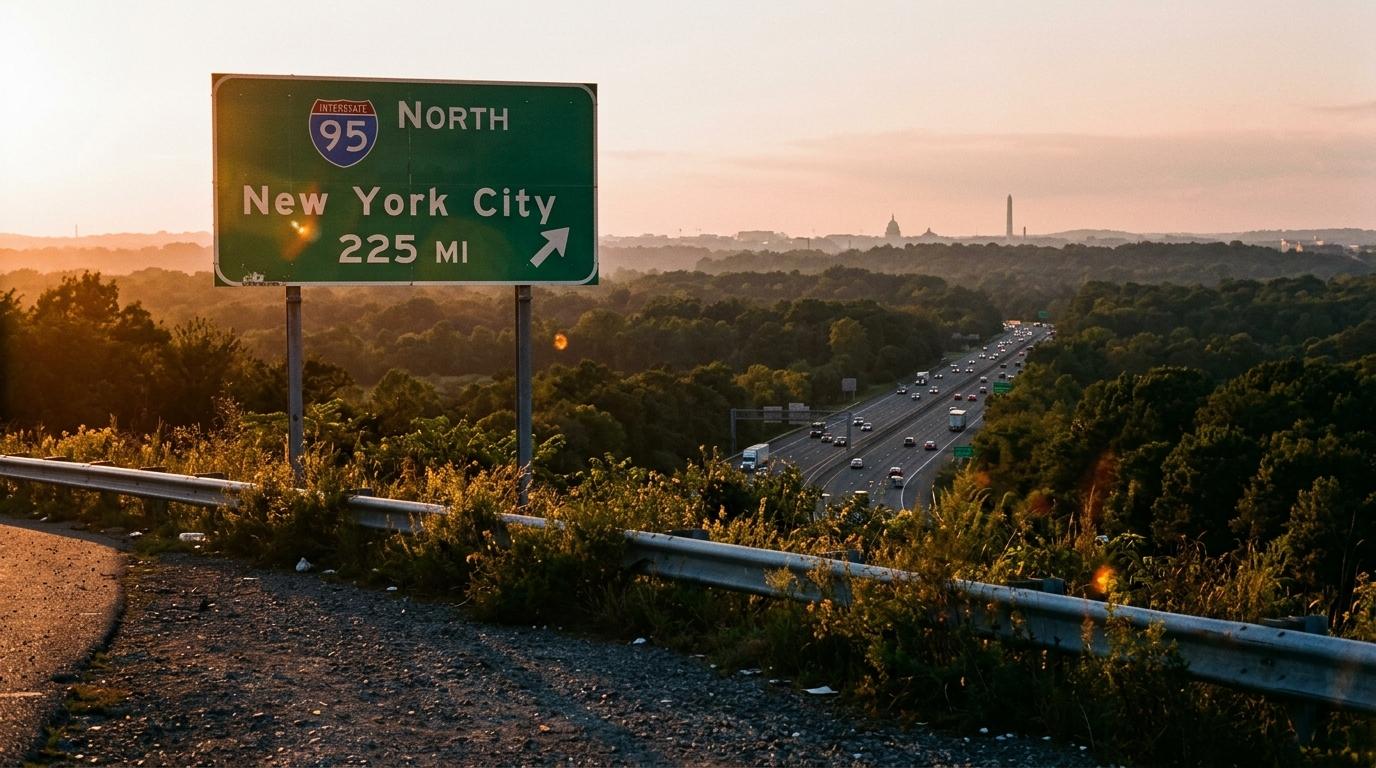
If you're wondering how far is Washington DC from New York City, the short answer is roughly 225 miles by road and about 204 miles in a straight line. That puts the two cities close enough for a long day trip, yet far enough apart that the way you travel changes your day completely.
A fast train can have you at the Capitol in under three hours. A Friday afternoon drive on the New Jersey Turnpike can take twice that. Flying looks quick on paper but often isn't once you count the airport time on both ends.
This guide breaks down the real distance, compares every practical way to make the trip, and helps you pick the option that fits your schedule, budget, and group size.
How Far Is Washington DC From New York City in Miles?
The distance from New York to Washington DC depends on how you measure it and which route you take.
As the crow flies, Midtown Manhattan sits about 204 miles (roughly 328 kilometers) from downtown Washington. That's the number you'll see on most distance calculators, but nobody actually travels that line.
By road, the trip is about 225 to 230 miles, depending on where you start and finish. Most drivers follow the New Jersey Turnpike south, cross the Delaware Memorial Bridge, and continue on I-95 through Delaware and Maryland into the District.
By rail, Amtrak's Northeast Corridor covers roughly 225 miles between New York Penn Station and Washington Union Station. Trains pass through Newark, Trenton, Philadelphia, Wilmington, and Baltimore along the way.
To put it in perspective, Philadelphia sits a little less than halfway down the route, and Baltimore is only about 40 miles short of Washington. The corridor between these cities is one of the most densely traveled stretches in the country, which explains both the excellent transportation options and the heavy traffic.
NYC to Washington DC: Travel Options at a Glance
Each mode has a clear trade-off between speed, cost, and convenience. The times below are typical and assume normal conditions.
|
Travel option |
Typical travel time |
Leaves from |
Arrives at |
Best for |
|
Amtrak Acela |
About 2 hr 45 min to 3 hr |
Penn Station / Moynihan Train Hall |
Union Station |
Business travelers, day trips |
|
Amtrak Northeast Regional |
About 3 hr 15 min to 3 hr 45 min |
Penn Station / Moynihan Train Hall |
Union Station |
Lower train fares, flexible seating |
|
Driving |
About 4 to 5 hr without heavy traffic |
Your door |
Your destination |
Road trips, stops along the way |
|
Bus |
About 4 to 5 hr |
Midtown Manhattan curbside stops or Port Authority |
Union Station or curbside stops |
Tight budgets |
|
Flight |
About 1 hr 15 min in the air |
LGA, JFK, or EWR |
DCA, IAD, or BWI |
Connecting travelers |
|
Private car service |
About 4 to 5 hr |
Your door or airport |
Your door or hotel |
Families, groups, heavy luggage |
The real story is door-to-door time. A one-hour flight rarely beats the train once security lines, boarding, and airport transfers enter the picture.
Taking the Train From New York to Washington DC
For most travelers, the train is the easiest way to get from New York to Washington DC. Amtrak runs frequent daily departures, and both terminals sit right in the middle of their cities. You skip airport security, avoid New Jersey traffic, and can work or nap the whole way.
Acela
Acela is Amtrak's premium service on the Northeast Corridor, with Business and First Class seating only. It makes fewer stops than regular trains and typically reaches Washington in about two hours and 45 minutes to three hours.
Amtrak began rolling out its NextGen Acela trains in August 2025. They can reach 160 mph, offer more seats per departure, and include free Wi-Fi and individual power outlets. That top speed only applies on certain stretches of track, so don't expect a dramatic drop in overall travel time just yet. The original Acela trainsets are being retired as the new fleet expands.
Northeast Regional
The Northeast Regional covers the same route with more stops, adding roughly 30 to 45 minutes to the journey. In exchange, fares are often noticeably lower, especially when booked in advance. Coach seats are roomy compared with airline seats, and there's a Quiet Car on most trains if you want to read or sleep.
Station tips
In New York, Amtrak trains depart from Penn Station, with the Moynihan Train Hall across Eighth Avenue serving as the main Amtrak waiting area. In Washington, you'll arrive at Union Station, a short walk from the U.S. Capitol and connected to the Metro's Red Line.
Train fares change with demand. Weekday mornings, Friday afternoons, and holiday weekends fill up fast, so booking a week or more ahead usually gets you a better price.
Driving From NYC to Washington DC
Driving gives you full control over your schedule, and it can make sense if you're traveling with kids, carrying a lot of gear, or planning stops along the way. Without heavy traffic, expect about four to five hours behind the wheel.
The usual route
From Manhattan, most drivers leave through the Lincoln or Holland Tunnel and pick up the New Jersey Turnpike (I-95) heading south. After crossing the Delaware Memorial Bridge, you'll continue on I-95 through Delaware and into Maryland. Near Baltimore, you can stay on I-95 or switch to the Baltimore-Washington Parkway for the final stretch into the city.
Tolls and costs
This is a toll-heavy drive. You'll pay for the Hudson River crossing, the New Jersey Turnpike, the Delaware Memorial Bridge, the Delaware section of I-95, and Maryland's toll facilities. An E-ZPass transponder saves time and usually costs less than paying by mail. Toll rates change regularly, so check each agency's current rates before you go.
If you're driving back into Manhattan, remember that vehicles entering the Congestion Relief Zone south of 60th Street pay a separate congestion toll during peak hours.
Traffic and parking
The biggest variable is traffic. Friday afternoons, Sunday evenings, and the days around Thanksgiving can turn a four-hour drive into six or more. Common slowdowns include the tunnel approaches, the northern end of the Turnpike, the Baltimore area, and the Capital Beltway.
Parking in central Washington is limited and often expensive. If your hotel doesn't include parking, consider leaving the car at a garage near a Metro station and riding in.
Flying Between New York and Washington DC
Flight time is short, usually around an hour and 15 minutes. Yet for a city-to-city trip, flying is often slower than the train once you add the trip to the airport, security screening, boarding, and the ride from the arrival airport.
Flying makes the most sense when you're already at a New York airport, connecting from another flight, or heading to a part of the Washington region closer to an airport than to Union Station.
Airports on each end
In New York, flights to Washington leave from LaGuardia (LGA), John F. Kennedy (JFK), and Newark Liberty (EWR). LaGuardia typically has the most frequent service on this route. Getting to any of them from Manhattan can take 30 minutes to well over an hour depending on traffic, so it helps to arrange New York airport transfers in advance rather than gambling on a cab line or rideshare surge.
In the Washington area, you can land at three airports:
-
Ronald Reagan Washington National (DCA) is just across the Potomac in Arlington, Virginia, and is the closest to downtown.
-
Washington Dulles International (IAD) is about 26 miles west of the city in Northern Virginia.
-
Baltimore/Washington International (BWI) is in Maryland, roughly between Baltimore and Washington.
DCA is the most convenient for central Washington, though Dulles and BWI can make sense depending on your final destination. If you're landing with luggage, kids, or a tight meeting schedule, booking Washington airport transfers means a driver is waiting when you walk out instead of you navigating Metro transfers or taxi queues.
Taking the Bus
The bus is usually the cheapest way to travel from New York to Washington DC. Several carriers run this route throughout the day, including Greyhound, Megabus, Peter Pan, and FlixBus, along with smaller operators that serve suburbs like Arlington and Bethesda.
Most buses leave from the Port Authority Bus Terminal or curbside stops in Midtown Manhattan. Many arrive at the bus deck inside Washington's Union Station, which puts you right next to the Metro.
Expect about four to five hours on board, and longer when traffic backs up. Buses use the same highways as cars, so the same rush-hour and holiday slowdowns apply. Seats, legroom, and onboard Wi-Fi vary widely by company, so read the fine print on baggage limits before booking.
Which Way to Travel Fits Your Trip?
The right choice depends less on the miles and more on who's traveling and what the day looks like.
Business travelers
Acela is hard to beat. You get a reliable arrival time, space to work, and a station a few minutes from federal offices, law firms, and Capitol Hill. If you have meetings in Northern Virginia instead, a flight into DCA or a private car straight to the office may save time.
Families and groups
Once you're buying four or more train tickets, a private car service or your own vehicle starts to look more reasonable. You leave from your door, load luggage once, and stop whenever someone needs a break. A pre-booked private transfer also removes the stress of driving through Manhattan and finding parking in Washington.
Budget travelers
The bus is almost always the lowest fare. Northeast Regional trains booked well in advance can come surprisingly close, with a smoother ride and fewer traffic delays.
Day trippers
An early Acela or Northeast Regional departure gets you to Union Station by mid-morning. That leaves enough time to visit the National Mall, a Smithsonian museum or two, and the Capitol before catching an evening train back.
Tips for Planning Your New York to Washington DC Travel
A few small decisions can save you hours on this route.
Watch the calendar. The Wednesday before Thanksgiving, the Sunday after, and long holiday weekends are among the busiest travel days on the entire corridor. Trains sell out, buses fill up, and I-95 slows to a crawl.
Leave early or late. If you're driving, starting before 6 a.m. or after 7 p.m. helps you avoid the worst congestion around New York and Baltimore. On the train, midday departures are often cheaper and less crowded than morning trains.
Think about the last mile. Union Station is ideal for Capitol Hill and downtown. For Georgetown, Arlington, or Alexandria, a flight into DCA or a car service directly to your address may get you there faster.
Check events in Washington. Inaugurations, major marches, and large conventions bring road closures and crowded hotels. A quick look at the city's event calendar before you book can prevent surprises.
Book flexible fares when plans may change. Both train and bus tickets come in different fare types with different change rules. Paying a little more for flexibility can be worth it for work trips.
Frequently Asked Questions
Can you do a day trip from New York City to Washington DC?
Yes. With roughly three hours each way on Acela, a day trip is realistic if you leave early and return in the evening. Driving or taking the bus makes a same-day round trip much more tiring, since you could spend eight to ten hours on the road.
What is halfway between New York and Washington DC?
The halfway point falls roughly around Wilmington, Delaware. Philadelphia is a bit closer to New York, while Baltimore sits much nearer to Washington. Both make popular stopovers if you want to break up the trip.
Is it faster to fly or take the train from NYC to Washington DC?
For most city-center trips, the train is faster door to door. A flight is shorter in the air, but airport travel and security usually add two hours or more. The train drops you at Union Station, already in the heart of the city.
Conclusion
At about 225 miles by road, the trip between these two cities is short enough to handle in a morning but long enough that your choice of transportation really matters. The train offers the best balance of speed and comfort for most people. Driving and private car service work well for families and groups, the bus wins on price, and flying fits best when an airport is already part of your plans.
Pick the option that matches your schedule and your group, plan around the busiest travel days, and sort out the ride on each end before you leave. Do that, and the journey becomes one of the easier city-to-city trips on the East Coast.
"We used to drive it every time and lose half the day to traffic. Now we take the early train, have a car meet us at Union Station, and we're at the museums before lunch."


