
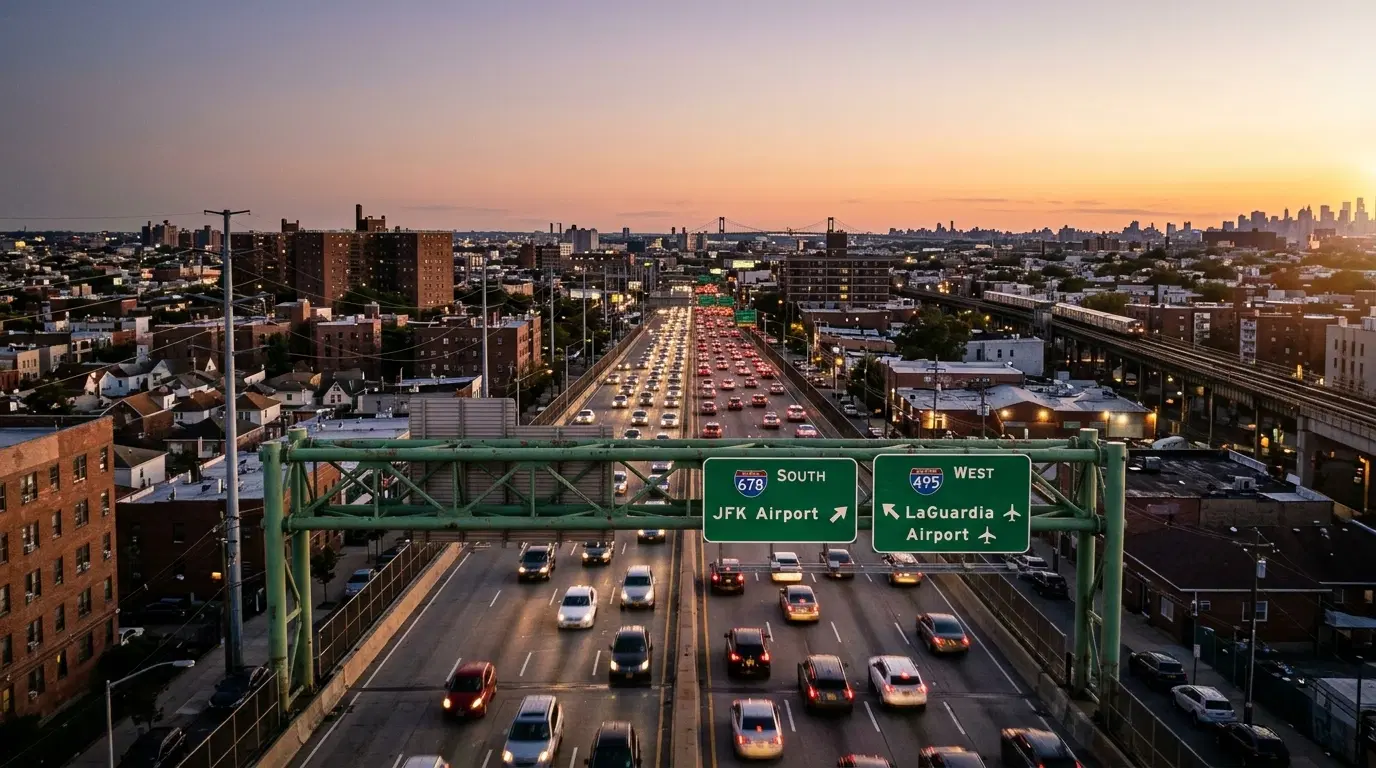
John F. Kennedy International and LaGuardia sit in the same borough, and on a map they look like next-door neighbors. If you're asking how far is JFK airport to LaGuardia, the short answer is roughly 10 miles as the crow flies and 11 to 13 miles by road. The longer answer is that New York traffic, not mileage, decides whether the trip takes 25 minutes or well over an hour.
That gap matters most if you're connecting between flights, meeting someone arriving at the other airport, or switching airports because of a rebooked itinerary. Below you'll find the real distance, realistic travel times by time of day, every practical way to make the JFK to LaGuardia airport trip, and what each option costs.
How Far Is JFK Airport to LaGuardia, Exactly?
The straight-line distance between the two airports is about 9 nautical miles, or a little over 10 statute miles (roughly 17 kilometers). Nobody travels that line, though. Planes don't hop between them, and there's no direct rail link.
The road distance is the number that counts. Depending on which terminal you leave from and which one you're heading to, the JFK to LGA distance usually works out to 11 to 13 miles. JFK's terminals are spread around a large central loop, so leaving from one side of the airport can add a mile or so compared with the other.
The usual driving route
Most drivers take the Van Wyck Expressway (I-678) north out of JFK, then merge onto the Grand Central Parkway heading west, which runs right along LaGuardia's southern edge. Neither road charges a toll, so a direct trip between the airports shouldn't add any bridge or tunnel fees.
The Van Wyck is also the weak point. It's one of the most congested highways in Queens, and a single lane closure or fender-bender can back it up for miles. When that happens, experienced drivers may switch to surface roads such as Woodhaven Boulevard or take a wider loop on other parkways, which adds distance but can save time.
How Long Does It Take to Get From JFK to LaGuardia?
By car, plan on 25 to 35 minutes when roads are clear and 45 to 75 minutes or more when they aren't. Public transit is slower but more predictable, usually landing somewhere between 60 and 90 minutes once you count transfers and waiting time.
Time of day makes the biggest difference for anything on the road:
|
When you travel |
Typical drive time |
What to expect |
|
Late night and early morning |
20 to 30 minutes |
Light traffic; the trip feels as short as the mileage suggests |
|
Weekday midday |
30 to 45 minutes |
Moderate traffic with occasional slowdowns near the airports |
|
Weekday morning rush |
40 to 60+ minutes |
Heavy volume on the Van Wyck and Grand Central |
|
Weekday afternoon and evening rush |
50 to 75+ minutes |
Usually the worst window of the day |
|
Fridays, Sundays, and holiday weekends |
Highly variable |
Airport traffic peaks; leave extra margin |
These ranges are estimates, not guarantees. Weather, construction, and big events in the city can push any of them higher, so check a live traffic map before you set out.
How to Get From JFK to LaGuardia: Your Transportation Options
There's no direct train or dedicated public shuttle between the two airports, so every option is either a car ride or a multi-leg transit trip. Here's how each one works.
Pre-booked private transfer
A private car booked in advance is the most straightforward way to handle JFK to LGA transportation, especially with luggage, kids, or a tight connection. You know the vehicle type and the price before you land, and you don't have to queue at a taxi stand or watch app prices climb during a rush. Larger vehicles are an easy fit for groups who would otherwise need two cabs.
If that sounds like the right fit, you can compare options for JFK Airport transfers ahead of your trip, then simply head out once you've collected your bags.
Yellow taxi
Taxis line up at official stands outside every JFK terminal. The JFK flat fare only applies to trips to and from Manhattan, so a ride to LaGuardia runs on the meter. On top of the metered amount, New York City rules add a surcharge for trips to or from LaGuardia, an access fee for taxi pickups at JFK, and the standard taxes and time-of-day surcharges that apply to every cab ride.
With traffic factored in, the total commonly lands somewhere around $50 to $70 before tip, and it can run higher when you're crawling through rush hour, since the meter keeps charging in slow traffic.
Rideshare apps
Uber and Lyft both operate at JFK and LaGuardia, with pickups at designated areas rather than the curb directly outside arrivals. Prices change with demand, so the fare can be reasonable at midday and noticeably steeper when a wave of international flights lands at once. Walking to the pickup zone also adds a few minutes at some terminals.
Public transit via the subway and Q70 bus
This is the cheapest way to get from JFK to LaGuardia, and it works well for solo travelers with light bags:
-
Take the AirTrain from your JFK terminal to Jamaica Station.
-
Tap in at the AirTrain exit and ride the E train toward Manhattan to Jackson Heights–Roosevelt Avenue.
-
Transfer to the Q70 LaGuardia Link bus, which runs nonstop to LaGuardia's Terminals B and C.
The AirTrain fare is $8.75 when you exit at Jamaica, the subway costs $3, and the Q70 is free to ride. That puts the whole trip at under $12. Expect it to take 60 to 90 minutes door to door.
Public transit via the LIRR and Q70 bus
A slightly faster variation swaps the subway for the Long Island Rail Road. From Jamaica Station, take a westbound LIRR train to Woodside, then catch the Q70 from there to LaGuardia. The train leg is quick, though LIRR fares within the city are higher than the subway, typically $5.25 off-peak and $7.25 at peak times. Add the AirTrain and you're looking at roughly $14 to $16 in total.
One caveat for both transit routes: the Q70 only serves Terminals B and C. If your airline flies from another terminal, build in extra time to get there once you arrive.
Which Option Makes Sense for Your Trip?
The right choice depends less on the distance than on what you're carrying, who's with you, and how much time you have.
Solo traveler with a carry-on and a few hours to spare. Transit is hard to beat on price. The AirTrain, E train, and Q70 combination costs a fraction of a car, and the timing is fairly steady regardless of road traffic.
Family or group with checked bags. A private transfer or a larger pre-booked vehicle usually wins. Hauling suitcases up subway stairs and through two transfers with tired kids is a tough way to spend 90 minutes, and one vehicle for everyone often costs less per person than you'd expect.
Business traveler on a schedule. A car is the obvious pick, and booking ahead removes the guesswork about availability and pricing when you land.
Late-night arrival. Roads are at their emptiest, so any car option will be fast. Transit still runs, since the Q70 operates around the clock, but trains run less often late at night and waits get longer.
Connecting Flights Between JFK and LaGuardia
Switching airports mid-trip is where people get caught out. The drive itself might take 40 minutes, but the full connection includes a lot more than the drive.
Count every step: getting off the plane, clearing passport control and customs if you've arrived internationally, collecting and rechecking your bags, the ground trip itself, and a fresh security screening at LaGuardia before you can reach your gate. Each one can stall on a busy day.
A few habits make the connection far less stressful:
-
Give yourself a generous buffer. For a domestic-to-domestic connection, many travelers aim for at least three hours between landing and departure. After an international arrival, four to five hours is a more comfortable margin.
-
Check your terminals in advance. Knowing exactly where you land at JFK and where you depart at LaGuardia lets you plan pickup points and transit stops before you're on the ground.
-
Avoid the evening rush if you can. A connection that crosses Queens between roughly 4 and 7 p.m. on a weekday deserves extra time.
-
Know your ticket situation. If both flights are on one booking, ask the airline how it handles a missed connection between airports. On separate tickets, a delay is usually your problem to solve, which is another reason to leave plenty of room.
Making the Trip in Reverse: LaGuardia to JFK
The distance is the same in both directions, and so are the transportation options. The transit route simply runs backward: the Q70 from Terminal B or C to Jackson Heights or Woodside, the E train or LIRR to Jamaica, then the AirTrain to your JFK terminal.
The main difference is timing. Southbound traffic on the Van Wyck toward JFK can be just as heavy as the northbound side, particularly in the afternoon when international departures pile up. If you're heading to JFK for a long-haul flight, leave room for its larger terminals and longer security lines. When you need a ride waiting at the curb for that leg, LaGuardia Airport transfers can be arranged before you fly in.
Frequently Asked Questions
Is there a direct shuttle or train from JFK to LaGuardia?
No. There's no direct rail link and no free public shuttle connecting the two airports. Your choices are a car (private transfer, taxi, or rideshare) or a combination of the AirTrain, the subway or LIRR, and the free Q70 bus.
What is the cheapest way to get from JFK to LaGuardia?
Public transit. The AirTrain to Jamaica, the E train to Jackson Heights–Roosevelt Avenue, and the Q70 bus to LaGuardia costs under $12 in total, since the Q70 itself is free. It's the slowest option, though, and it's not ideal with heavy luggage.
Is 3 hours enough time to get from JFK to LaGuardia for a connecting flight?
For a domestic connection with carry-on bags and no rush-hour traffic, three hours is usually workable by car. After an international arrival, or if you have checked bags to collect and recheck, three hours gets tight. Customs and a second security screening can eat up much of that time on their own.
Conclusion
On paper, the trip between New York's two Queens airports is short: about 10 miles in a straight line and 11 to 13 miles on the road. In practice, the clock matters far more than the odometer. A quiet late-night drive can take 25 minutes, while the same route at 5 p.m. on a Friday can stretch past an hour.
Pick your option based on your bags, your group, and your margin. Transit keeps costs low for light travelers with time to spare. A taxi or rideshare works when you need a car on short notice. For connections, families, and anyone who wants the price and pickup settled before landing, a pre-booked transfer takes the most uncertainty out of the day.
"We landed at JFK with two kids and four suitcases, and our next flight left from LaGuardia that evening. Having a car already arranged turned the part of the trip we'd been dreading into the easiest hour of the day."


