
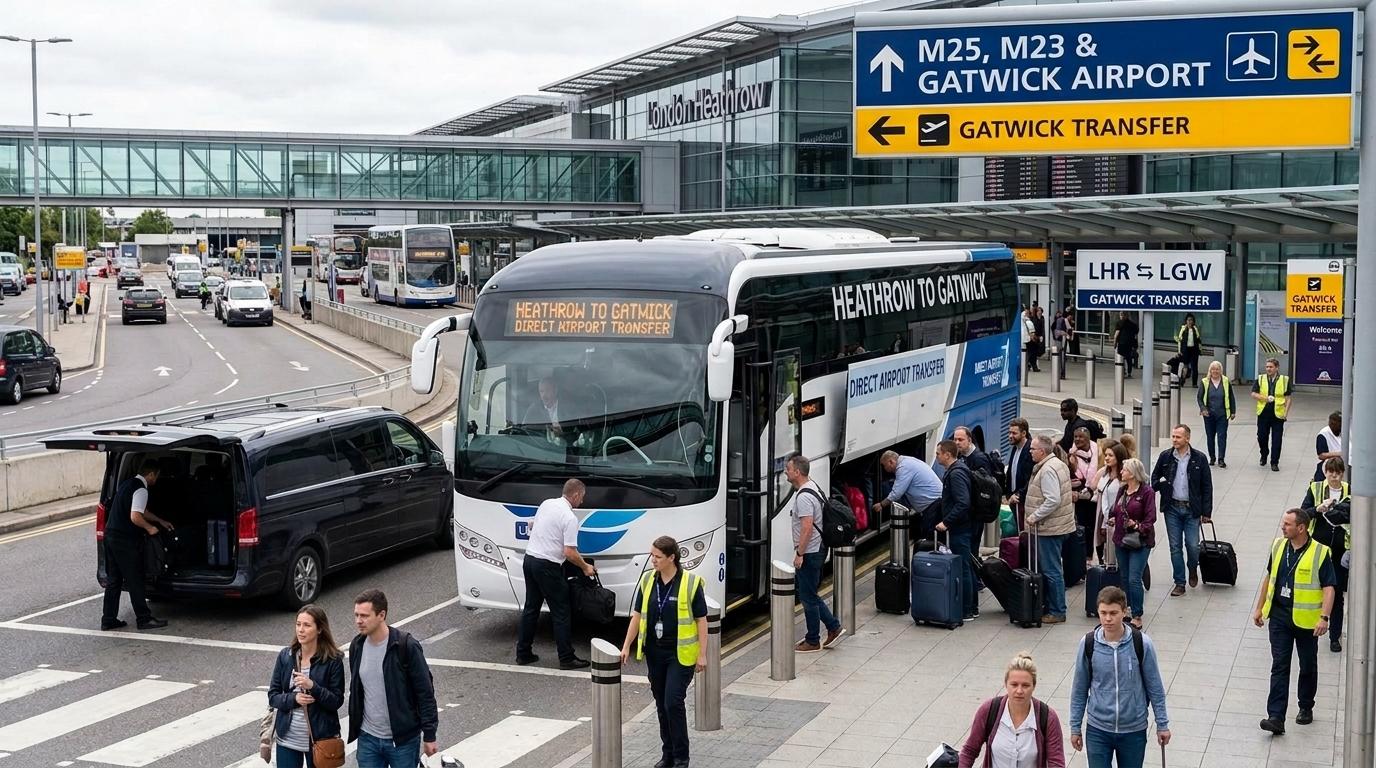
There is no direct train from Heathrow to Gatwick, so the quickest sensible way to make the journey is by road: about 60 to 90 minutes by coach, taxi or private transfer, depending on the M25. Rail is possible, but it means crossing London with your bags and usually takes two hours or more. This guide compares every option for the Heathrow to Gatwick transfer, explains the reverse trip, and shows how much time to leave if you are connecting between two flights.
The two airports are roughly 40 miles apart on opposite sides of London, linked by the M25 and the M23. That one stretch of motorway decides most of what follows. It is why the coach and the car are the best options, and why a delayed first flight can turn a comfortable connection into a missed one.
We had a five-hour gap and two big suitcases, so we booked a car. The driver was waiting at arrivals, and we reached Gatwick with plenty of time to spare.
Heathrow to Gatwick at a glance
Use this table to choose quickly. Journey times are terminal to terminal, and fares are typical ranges seen in October 2026. Check the operator before you travel, because prices for the same journey vary a great deal by time of day and how early you book.
|
Option |
Typical time |
Typical cost |
Luggage |
Risk of delay |
|
Coach |
70 to 90 minutes |
About £13 to £40 per person |
Fine: one large bag plus hand luggage on most services |
Medium (M25 traffic) |
|
Rail via central London |
2 to 2.5 hours |
About £20 to £70 per person |
Poor: several changes, stairs and busy platforms |
Medium to high (three trains) |
|
Black cab |
60 to 90 minutes |
Often £100 or more |
Excellent |
Medium (M25 traffic) |
|
Ride-hailing |
60 to 90 minutes |
Varies widely with demand |
Good |
Medium |
|
Private transfer |
60 to 90 minutes |
About £50 to £150 per vehicle |
Excellent |
Medium, but the driver watches the route |
In short: the coach is the cheapest direct option, a pre-booked private transfer is the least stressful, and rail only makes sense if you are already going into London.
Which option suits which traveller
A solo traveller with one bag and a long gap between flights will usually be happiest on the coach. A couple with two large suitcases and a four-hour gap is better served by a car, because the fixed price and door-to-door route remove the chance of a missed coach. A family of four is almost always better off in a private vehicle: the per-person cost falls quickly as the group grows, while the coach fare is charged per head and every child over a certain age needs a seat.
If you are only passing through London and want to stay a night, rail is a reasonable choice. It lets you break the journey in the city, and the route is the same whichever way you are travelling.
Heathrow to Gatwick by coach
The coach is the standard answer for solo travellers and couples on a budget. Services leave from Heathrow Central bus station, which you reach on foot from Terminals 2 and 3 and by a short free transfer from Terminals 4 and 5. They stop at both Gatwick terminals, North and South.
Pickup points, frequency and journey time
Coaches run through the day, and some services run into the night. Frequency changes with the time of day, from every half hour at busy times to hourly early in the morning and late in the evening. That is far less frequent than a train, so a missed coach costs you more.
The scheduled journey is usually 70 to 90 minutes, but a timetable is a guide, not a promise. The M25 around Heathrow and the stretch near the M23 junction can add 20 to 30 minutes at busy times. On a clear Sunday morning you may arrive early; on a Friday evening you might not.
Before you book, check which Gatwick terminal the coach calls at first. If your flight leaves from the terminal that is the second stop, you will lose a few minutes on the bus.
Booking and luggage
Book ahead if you can. Fares for the same coach vary with the time of day and how early you buy, and the cheapest tickets sell out on busy days. Most services allow one large suitcase plus a piece of hand luggage per person, with extra bags charged or refused. If you are travelling with skis, golf clubs or a pushchair, read the operator's luggage rules first.
The weak spot of the coach
The weakness of the coach is the connection time. If the service you planned to catch is full or cancelled, the next one may be an hour away. A coach will not wait for a late flight, and a ticket for a specific departure may not be valid on the next one. That is the main reason many connecting passengers choose a private transfer instead. If you are comparing other routes into Heathrow, see our guide to the coach to Heathrow.
Heathrow to Gatwick by train
Trains are the least convenient way to cross London between two airports, but they are the only option that does not depend on the M25. They can also be the cheapest if you buy an advance ticket for the Gatwick leg.
Route via central London
The usual route is to take the Elizabeth Line from Heathrow into central London, change at Farringdon, and ride the Thameslink line south to Gatwick Airport station. The Elizabeth Line takes about 35 to 40 minutes to Farringdon, and Thameslink takes about 40 to 50 minutes on from there, so even with perfect connections you are looking at about two hours.
Another option is to take the Heathrow Express to Paddington, cross London by Tube or taxi to Victoria, then take the Gatwick Express or a Southern service. The Heathrow Express is the fastest leg, but you pay a premium fare for it and the change at Victoria means more stairs and more people.
Either way you are making at least two changes in busy stations. Allow two hours at the very least, and closer to two and a half if you are not used to the stations.
Why rail is slow with bags
Platforms, escalators and interchange corridors at Farringdon, Paddington and Victoria are fine with a rucksack, and tiring with two suitcases. Rush hours make the same connections slower and more crowded. If your bags are heavy, or you are travelling with children, rail adds effort and risk for little saving.
Fares add up too. You are paying for a Heathrow rail fare, a central London change and a Gatwick fare, and the combined total often matches the coach or exceeds it. Unless you want to stop in London, the train rarely beats the road.
Taxi and ride-hailing
A black cab can carry you from terminal to terminal, but the meter runs for the whole 60 to 90 minutes and the fare can pass £100 once traffic is included. Hailing a cab at the rank is quick, but you are paying for a long out-of-town journey at a metered rate.
Ride-hailing apps can be cheaper in quiet periods. Prices rise sharply at peak times and during delays, though, and drivers may not know which terminal door you need. You also have no guarantee of a vehicle large enough for your luggage until the driver arrives.
If you are happy to pay for convenience, a taxi is straightforward. If you want to know the price in advance, a pre-booked car is usually the better value.
Private transfer from Heathrow to Gatwick
A private transfer is a pre-booked car or minibus that takes you directly from your Heathrow terminal to your Gatwick terminal. It is not the cheapest option for one person, but it is the one that behaves most predictably.
Fixed price, flight tracking, meet and greet
The price is agreed when you book, so a slow M25 does not change what you pay. Many providers track your flight, so if you land late the driver waits. You can also ask for a meet and greet at arrivals, which saves you hunting for the pickup point, and a driver can help with luggage.
For two or more people, the cost per person often comes close to the coach once you add the time and the risk you avoid. If you are comparing the full range of ways to reach the airport, our Heathrow airport transfer page explains how pre-booked journeys work.
Vehicle choice and groups
A standard saloon suits one or two passengers with a couple of suitcases. An estate or people carrier is better for three or four, and a minibus makes sense for larger groups or for families with strollers and car seats. Ask for child seats when you book, because availability differs between providers.
If you are travelling with sports equipment, oversized bags or a musical instrument, say so when you reserve. A driver can plan for the space, and you avoid being turned away at the kerb.
Terminal-to-terminal drop-off
Tell the provider your exact departure terminal at Gatwick (North or South) when you book. The driver will drop you at the correct departures door, which matters if you are close to check-in cut-off. If you are arriving at Gatwick and heading to Heathrow, name the terminal there too, because Heathrow has four working terminals (2, 3, 4 and 5) and getting dropped at the wrong one can cost you half an hour. For help with moving around once you arrive, see our guide to getting between Heathrow terminals.
Prefer to book a ride in the other direction? Our Gatwick airport transfer page covers journeys from Gatwick.
Gatwick to Heathrow (the reverse trip)
The journey in the opposite direction is almost identical in time and cost. Coaches leave from Gatwick's North and South terminals and arrive at Heathrow Central bus station, from where you walk or take a short transfer to your terminal. Rail works the same way in reverse: Thameslink to Farringdon, then the Elizabeth Line to Heathrow.
Three differences are worth knowing. First, you will often be arriving at Heathrow for a long-haul flight with larger bags, which makes a private car or cab more attractive. Second, check which Heathrow terminal your airline uses before you leave Gatwick: the terminal for a given airline can change, and a coach or rail journey drops you in a different place from a car. Third, the M25 clockwise towards Heathrow can be slower in the evening peak, so leave more margin than you would on the way out.
How much time to allow between flights
If you are connecting between two flights at different airports, you are almost certainly on two separate tickets. That means the second airline has no duty to wait or rebook you if the first flight is late, so build in a generous buffer.
Here is a worked example for a typical hand-luggage-only connection from a short-haul arrival at Heathrow to a departure from Gatwick:
-
Your first flight lands at 10:00.
-
Allow about 45 to 60 minutes to leave the aircraft and get through the terminal and, if you are arriving from outside the Common Travel Area, immigration. You reach the coach stop or car at about 11:00.
-
The road journey takes 70 to 90 minutes with a safety margin for traffic, so you arrive at Gatwick at around 12:30.
-
Airlines usually ask you to be at the airport two hours before a short-haul flight and two to three hours before a long-haul flight. Plan to be at Gatwick at least two hours before departure.
That puts the earliest sensible departure at about 14:30 to 15:00. As a rule, aim for at least five hours between landing at one airport and taking off from the other. Add an hour if you have checked bags or must collect and recheck luggage, and another if you are arriving from outside the UK and need to clear immigration.
Separate tickets versus one booking
On a single booking (one ticket for both flights) the airline's connection rules apply, and the airline has to look after you if a delay causes a missed flight. Even then, a long road transfer between airports is unusual, so check with the airline before you choose this routing. On separate tickets, you carry all the risk: if the first flight is late and you miss the second, you may need to buy a new ticket.
The cheapest way to protect yourself is to leave more time, not to save money on the transfer. A private transfer with flight tracking removes some of the risk on the ground, but it cannot fix a flight that lands late.
What if your flight is delayed
If the first flight is delayed, contact the second airline as soon as you know. Ask whether it can move you to a later departure without a fee. If you are on separate tickets, expect a charge or a new fare, so ask before you assume.
If you have pre-booked a private transfer, tell the provider about the delay. Providers that track flights adjust the pickup time automatically, and many allow a reasonable wait after landing. A coach, by contrast, will not wait: you either catch the next one or pay for a new ticket.
Keep your boarding passes, because some airlines ask for proof of the missed connection. Keep an eye on the M25 as well. If there has been a closure or an incident, a taxi or car with live navigation is better placed to find a different route than a coach that follows a fixed path.
If you are cutting it fine, check in online before you leave the first airport and keep your hand luggage small. Going straight to security at Gatwick can save 30 minutes or more.
Other London airports
Heathrow and Gatwick are not the only airports you may need to link. Travellers moving between London's airports will find these guides useful:
-
Heathrow to Stansted: the route to the north-east, usually the longest transfer.
-
Luton to Heathrow: north of London via the M1 and M25.
-
London City Airport to Heathrow: east to west across the capital.
The pattern is the same across all of them. There is no direct rail link between London's outer airports, the M25 is the connecting road, and a long gap between flights is the best protection you can buy.
FAQs
How far is Heathrow from Gatwick?
The airports are about 40 miles apart by road. The journey takes roughly 60 to 90 minutes without heavy traffic, and longer at peak times or if there is an incident on the M25.
Is there a direct train between Heathrow and Gatwick?
No. You must change at least once in central London, and the usual route takes two hours or more. A road transfer is almost always quicker and simpler, especially with luggage.
What is the cheapest way to get from Heathrow to Gatwick?
The coach is usually the cheapest direct option. Fares depend on the time of day and how early you book, so compare them. For a group of three or four, a private transfer can work out at a similar cost per person.
What is the fastest way to get from Heathrow to Gatwick?
A taxi or private transfer is usually fastest because it goes direct from terminal to terminal at the time you choose. The coach is slightly slower because of its timetable and stops.
How long does a taxi take from Heathrow to Gatwick?
Allow 60 to 90 minutes. The M25 is the main variable: clear roads can get you there in about an hour, while rush hour or an incident can add half an hour or more.
Can I take luggage on the coach between the airports?
Yes, most services allow a large suitcase and a piece of hand luggage per person. Check the operator's limits for extra bags, sports equipment or oversized items before you travel.
How much time should I leave between flights?
Aim for at least five hours between landing at one airport and departing from the other, and more with checked bags or immigration. If your tickets are separate, a longer buffer protects you against delays.
Which Gatwick terminal should I go to?
Go to the terminal printed on your boarding pass or booking confirmation. Gatwick has a North and a South terminal, and a shuttle links them, but using it takes time you may not have, so tell your driver or check the coach stop in advance.
Choosing the Best Way Between Heathrow and Gatwick
Choose the coach if you are travelling alone, have little luggage and plenty of time. Choose rail only if you are already going into London. Choose a pre-booked private transfer if you have a tight connection, heavy bags, children or an early flight, because a fixed price and a driver who tracks your flight remove the biggest risks of the journey.
Whatever you pick, build in time and confirm your terminals. Transpovia can arrange a Heathrow to Gatwick transfer with a fixed price and a driver waiting at arrivals, so the road between the two airports is one less thing to worry about.


