
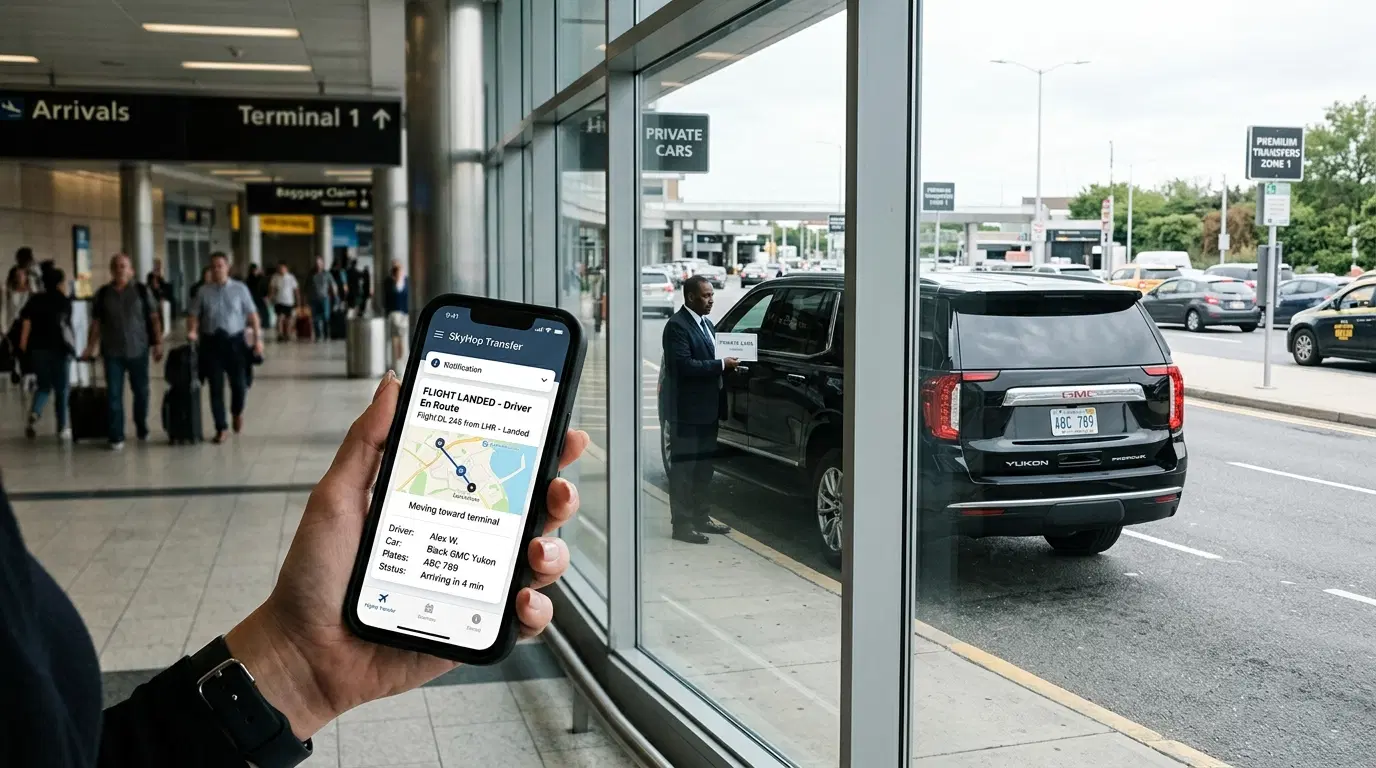
Your flight was due at 3 p.m., but a storm two cities back pushed it to 4:30, and the car you booked for 3 is nowhere in sight — or worse, left without you. The reverse stings too: you land 40 minutes early and stand at the curb while a driver shows up for the old time. Neither problem is your fault, and neither should cost you. A flight tracking airport transfer solves both by tying your pickup to when your plane actually lands, not to a time printed on a booking.
Why a Fixed Pickup Time Fails So Often
A pickup locked to your scheduled arrival is a bet that your flight runs exactly on time — and that bet loses more often than travelers expect. Federal data sets a low bar for "on time": the Bureau of Transportation Statistics counts a flight as on time only if it arrives within 15 minutes of schedule, and canceled or diverted flights are counted as late. Even against that generous definition, roughly one in four U.S. flights failed to arrive on time through 2025.
Early arrivals cause the mirror-image problem. A tailwind, a short taxi to the gate, or light traffic in the air can put you at the carousel well ahead of schedule, waiting on a driver who booked to the printed time. A static pickup time can't bend either way. It assumes the one outcome — a perfectly punctual arrival — that a quarter of flights don't deliver.
What Flight Tracking Actually Does for Your Transfer
Airport transfer flight tracking connects your flight number to live status, so the service works from when your plane will really arrive rather than when the schedule once promised. That single link changes how the pickup is planned.
When you enter your flight number at booking, the provider can follow the flight through its real stages: pushback, time in the air, and the estimated and then actual gate arrival. As those update, the dispatch adjusts, so the driver aims for the moment you'll actually reach the arrivals doors. A flight monitored airport transfer treats the schedule as a starting guess and the live data as the truth. This is why Flight-Tracked Airport Transfers hold up when a plain scheduled booking falls apart — providers such as Transpovia monitor the flight and move the pickup to match, instead of sending a driver to sit on a time that's already wrong.
How Tracking Handles Delays, Early Landings, and Terminal Changes
The value shows up in the four things that most often break an arrival. A delayed flight airport transfer shifts the pickup later automatically, so a two-hour hold doesn't leave you paying for a driver who waited or gave up. An early landing works the same way in reverse, with the driver alerted to come sooner. Here's how a tracked pickup compares with one tied to a fixed time:
|
Situation |
Fixed-time pickup |
Flight-tracked pickup |
|
Flight lands 90 minutes late |
Driver waits and may leave; extra charges likely |
Pickup shifts to the new arrival time |
|
Flight lands 40 minutes early |
You wait at the curb for the old time |
Driver is alerted to arrive sooner |
|
Gate or terminal change |
Driver may be at the wrong building |
Meeting point updates to the new terminal |
|
Flight diverted to another airport |
Booking is often wasted |
Provider sees the change and re-coordinates |
Terminal reassignments and diversions are where tracking quietly saves the day. If your inbound aircraft is switched to a different terminal, or weather sends you to a nearby airport entirely, a provider watching the flight can move the driver rather than leaving them parked at a building you never reached.
What Flight Tracking Can't Do (and Why Wait Time Still Matters)
Tracking is powerful, but it has a clear edge: it sees your plane reach the gate, not you reach the door. Between those two points sits everything tracking can't watch — a slow immigration line, a baggage carousel that takes 40 minutes, a lost bag that sends you to a service desk, or the extra time a traveler with reduced mobility needs.
That's why the best airport pickup flight tracking still pairs with a free wait window and a reachable phone. The tracking gets the driver to the right place at roughly the right time; the wait policy covers the unpredictable stretch after you land. Confirm how long your provider waits before you book, especially for international arrivals and late-night landings, where the gap between gate and curb runs longest. A quick message to the driver when you clear customs bridges anything the data alone can't see.
How to Make Sure Your Transfer Can Track Your Flight
Tracking only works if you hand over details it can follow, so a couple of booking choices decide whether it helps. The most common slip involves code-share flights. The number on your ticket may belong to the airline that sold you the seat, while the aircraft actually flies under a different operating carrier's number — and the operating number is usually what tracking follows. If your booking is a code-share, share the operating carrier and flight number, or provide both to be safe.
Beyond that, give the airline, the arrival date, and the terminal if you know it, and enter the time in the destination's local zone rather than your home one. Keep a phone number that receives messages on arrival, since that's the backup when live data and reality briefly disagree. If you have a tight connection or your itinerary changes before departure, tell the provider so the tracking follows the right final leg. These small steps are what let a service watch the correct flight instead of an outdated one.
When Flight Tracking Matters Most
Every arrival benefits from tracking, but some make it close to essential. Late-night and red-eye landings are the clearest case: when transit has stopped and taxi lines have thinned, a driver who already knows you've landed beats standing outside at 2 a.m. Long-haul international arrivals come next, since immigration and baggage times swing widely and a scheduled pickup can't absorb that.
Tight business schedules lean on it too, because a delayed inbound flight shouldn't cost a same-day meeting. Families traveling with children and anyone coordinating a group appreciate not having to renegotiate a pickup mid-trip after a delay. And the calendar matters: winter storm season across the northern states and summer thunderstorms drive delay rates up, so tracking earns its keep most in the months when flights are least likely to run on time. A tracked service like Transpovia is worth prioritizing whenever the arrival is late, long, or time-sensitive.
FAQs
How does a transfer service know when your flight lands?
It follows your flight number through live status feeds that report departure, time in the air, and estimated and actual gate arrival. The service updates the driver's timing as that data changes, which is why an accurate flight number at booking matters more than the scheduled time you were originally given.
Does flight tracking cost extra on an airport transfer?
It depends on the provider. Many private transfer services include flight tracking as a standard part of the booking, while some premium meet-and-greet add-ons bundle it with extra wait time. Check what's included before you pay, so you know whether tracking and a wait window come with the fare or cost more.
What happens to a flight-tracked transfer if your flight is canceled?
Tracking shows the provider the cancellation, but a canceled flight usually means rebooking the ride for your new arrival rather than an automatic shift. Contact the provider as soon as you rebook your flight, and check the cancellation and change terms in advance so you know whether any charge applies.
Which flight number should you give if you're on a code-share?
Give the operating carrier's flight number — the airline actually flying the aircraft — since that's typically what tracking systems follow. Your ticket may show the marketing airline's number instead, so if you're unsure, provide both. Getting this right is the difference between a service watching your real flight and watching the wrong one.
Before You Book
Enter the correct flight number, use the destination's local arrival time, add your terminal, and keep a phone reachable when you land. Then confirm the wait policy for anything after the gate. With those set, a tracked service such as Transpovia can follow your flight and time the pickup to your real arrival, whether you're early, late, or bang on schedule.


