
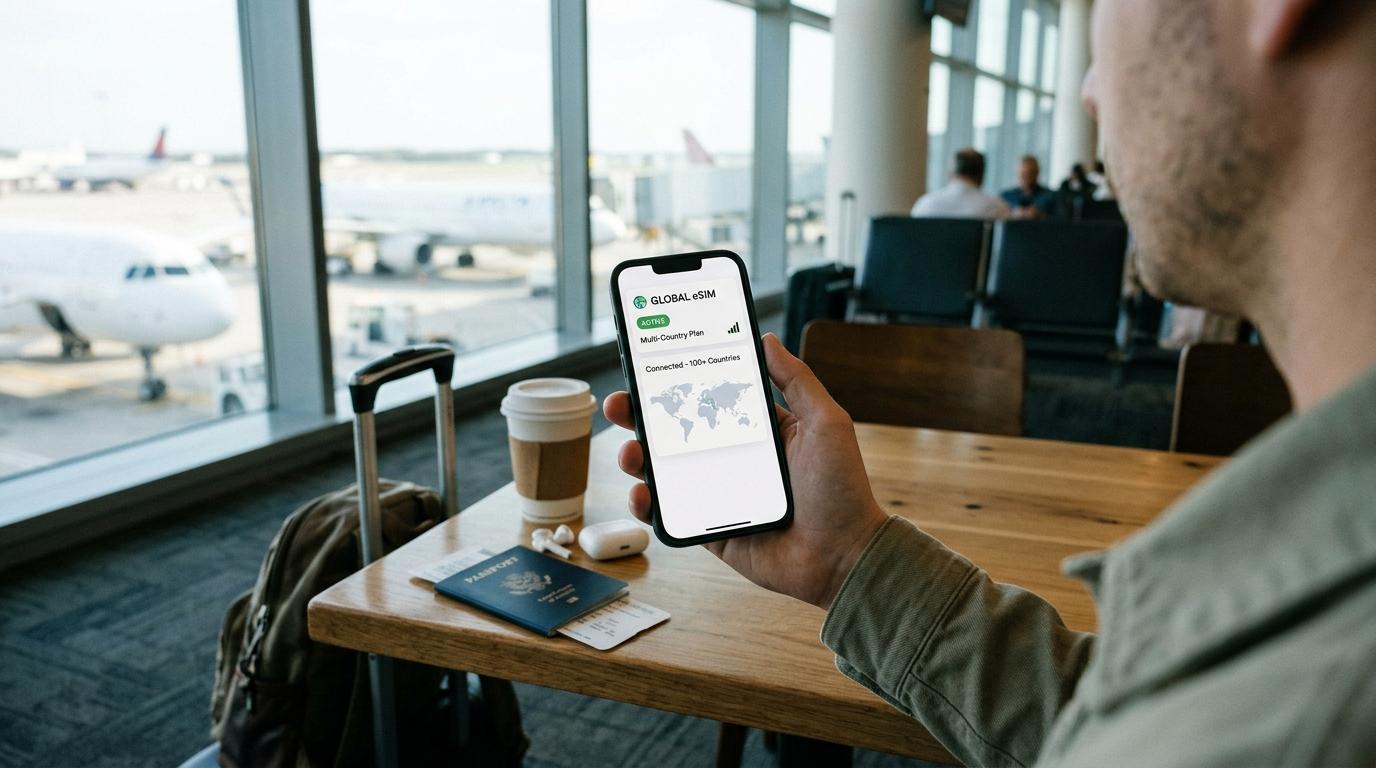
Picking the best eSIM for multi country travel comes down to three things. The first is which countries sit on your route. The second is how much data your group uses each day. The third is how well your phone handles two lines at once. A plan that looks cheap on the checkout page can fall apart at the first border when the country list is wrong or the speed drops after a small daily allowance.
This guide explains how local, regional, and global plans differ, what coverage claims tend to leave out, and how to set up one eSIM that follows you across several countries. It also covers the hours right after landing, when a working data connection matters more than at any other point of the trip.
What an eSIM Does When You Cross Borders
An eSIM is a digital SIM that lives inside your phone and lets you add a mobile data plan without inserting a physical card. On a trip through several countries, one eSIM profile connects to partner networks in each country on the plan, and the phone switches between them on its own when you cross a border. That is the idea behind an international travel eSIM, and it explains why one eSIM for multiple countries works without any card swapping. Providers sell a cross border eSIM under several names, and a multi country eSIM usually means a regional or global plan.
That works differently than the usual alternatives. A local SIM suits a long stay in one place. It also means a new card, a new number, and often a queue at a shop in every country you add. Roaming through your home carrier keeps your number. The daily fees or travel passes bill through your home account, though, and the rules change by country and by carrier. A travel eSIM is prepaid. You know the cost before you leave, and nothing surprising arrives on next month's bill.
Local, Regional, and Global Plans Explained
Providers sell three kinds of plans, and the right one depends on your route more than on price.
A local eSIM covers one country and makes sense when the trip stays in one place. A regional eSIM covers a group of countries, usually one continent or travel zone, for example Europe, Southeast Asia, or Latin America. A global eSIM covers a long list of countries across several continents.
A simple rule works for most itineraries. One country calls for a local plan. Two to five countries in the same region usually suit a regional plan. A route that crosses continents, or one that may change halfway through, suits a global plan. Regional plans often cost less per gigabyte than global ones, while global plans save time when the itinerary stays loose.
Travelers who want to compare options in one place can browse the multi-country eSIM page on Transpovia and match the country list against their own route before paying.
Check the Country List Before You Pay
The plan name rarely tells the full story. A plan labeled "Europe" may include the United Kingdom, Switzerland, Norway, and Turkey, or it may stop at the European Union. Balkan countries, for example Albania, Serbia, and Montenegro, sometimes sit outside the list. Small states in the middle of the continent, for example Andorra, can also fall outside the coverage even when the plan looks generous.
Borders on the map matter less than borders on your actual route. A train ride between Zurich and Milan crosses out of Switzerland, which sits outside the European Union, and a plan that skips it can leave the phone offline for part of the ride. A road trip along the Adriatic coast can touch three or four countries in a single afternoon.
Ferries and cruise ships add another wrinkle. They often use onboard or maritime networks that standard plans do not cover. A plan that works in port can drop out at sea. Travelers who plan to cross water between countries should read that part of the terms with care.
The reliable habit is to read the country list itself and tick off every country on the itinerary by name. The marketing title of the plan is the least useful line on the page.
How Much Data a Multi-Country Trip Needs
Data needs depend on habits more than on the number of countries. Maps, messaging, taxi apps, and email use very little. Video calls, social video, and automatic photo backups use a lot. Provider guidance often puts everyday use for a typical traveler somewhere between 500 MB and 1 GB a day, and heavy users run well past that.
A practical way to size a plan is to count the days of the trip, then think about the busiest day rather than the average one. A travel day with a long train ride, a video call home, and live navigation uses far more than a quiet museum day. Planning for a few heavy days and a buffer for the rest protects you on the day you need a map most.
Three habits stretch any plan further. Downloading offline maps over hotel Wi-Fi removes a large share of mobile data use. Turning off automatic photo upload on mobile data stops a quiet drain in the background. Setting video apps to a lower quality on mobile networks saves more than most people expect.
Top-ups matter too. Some providers let you add data inside their app without installing anything new, and others require a fresh plan. A provider with easy top-ups lowers the risk of guessing wrong.
Unlimited Plans and Fair-Use Slowdowns
The word "unlimited" deserves a closer read. Most unlimited eSIM plans follow a fair use policy, which means speeds drop after a daily high-speed allowance. Providers call that slowdown throttling, and the threshold varies by provider. Some publish it and some do not.
Slower speeds still handle messaging and basic maps without much trouble. They struggle with video calls and streaming. Travelers who work remotely, upload large files, or stream a lot will feel the difference quickly.
Hotspot rules deserve the same attention. Some plans allow unlimited hotspot sharing, some cap it at a small daily amount, and some block it. A traveler who shares a connection with a laptop or a tablet should check that line before buying.
A fixed-data plan can be the better value for light and medium users, since it avoids paying for an allowance that never gets used. Unlimited plans pay off for people who stream, work on the road, or share data with a second device every day.
Phone Compatibility, Unlocking, and Dual SIM Setup
Two conditions have to hold before an eSIM works. The phone needs eSIM support, and the carrier lock on the phone has to be off. Many phones sold in recent years support eSIM, and the settings menu usually shows an option to add a mobile plan or eSIM when the phone qualifies. A phone bought through a carrier payment plan may still be locked, and the carrier can confirm the status.
Most travelers use the eSIM for a second line next to the home number, a setup called dual SIM. Naming the two lines clearly, for example "Home" and "Travel," prevents mix-ups later. The travel line handles mobile data. The home line stays on for calls and texts when the owner wants it to.
Two settings protect against surprise charges. Data roaming needs to be on for the travel eSIM, because that is how it reaches partner networks abroad. Data roaming on the home line should stay off. That way the phone never falls back on an expensive home carrier rate when the travel line struggles. Many phones also offer an option that lets the second line take over mobile data automatically, and switching that off keeps the data on the line you chose.
Installing the eSIM Before You Leave
Most providers deliver a QR code or an app link after purchase. Installation needs a Wi-Fi connection and takes only a few minutes. Doing it at home a day or two before departure beats doing it at the gate, where a slow connection or a delayed email can leave you stuck.
Activation rules differ. Some plans start the validity clock at installation. Others start it the first time the phone connects to a network abroad. A few start on a date chosen at checkout. Reading that line in the terms prevents the unpleasant surprise of a seven-day plan that expires before the trip ends.
Many eSIM profiles install only once. Deleting the profile in the settings menu can remove the plan for good. It pays to leave it in place for the whole trip, even on a day when it sits unused. Keeping the confirmation email with the QR code and the plan details also helps if the support team needs to look up the order.
What Happens at the Border
Once the plan is active, the phone does the work. It scans for the partner network in the new country, connects, and shows the carrier name at the top of the screen. On trains and buses this often happens within a minute or two of crossing. After a flight, it usually happens right when the phone leaves airplane mode.
We rode trains through Vienna, Budapest, and Prague and my phone never asked me for anything. The only sign we had crossed a border was the carrier name at the top of the screen.
Occasionally the phone clings to a weak signal. Near borders, a phone can pick up a tower belonging to the neighboring country and show a strong bar with no usable data. Switching airplane mode on and off for ten seconds usually pushes the phone to rescan. Choosing the network by hand in the mobile settings is the next step when that fails, and the plan details often list the partner networks for each country.
Coverage and speed still depend on the local network. A city center may offer fast 5G while a mountain village drops to 4G or less. A multi-country plan changes the setup, not the geography.
Calls, Texts, and Verification Codes
Most travel eSIMs carry data only. Calls and messages travel through apps, for example WhatsApp, FaceTime, Signal, or Teams, and those apps work normally on a data connection. A WhatsApp account stays tied to the home number, and nothing changes for contacts.
Verification codes need more thought. Banks and some apps send codes by SMS to the home number. With dual SIM, the home line can stay active and receive those texts. Incoming texts abroad can carry roaming terms set by the home carrier, and a quick look at those terms before departure avoids a surprise. Many banks now offer approval inside their own app, and setting that up at home removes the problem for good.
Wi-Fi calling gives another route. A home carrier that supports it lets calls and texts travel over hotel or café Wi-Fi without any roaming charge.
Sharing Data With Family, Couples, and Groups
Plans belong to a single device. The simplest setup for a family is one eSIM per phone, which keeps everyone independent and avoids a dead battery on the one phone doing hotspot duty. Teenagers can run through a shared allowance quickly, and separate plans make it easier to see who uses what.
A couple who stay together all day can share a single plan through hotspot, which can cost less. The trade-off is battery life on the host phone and the hotspot rules the provider sets. Tablets and laptops without a cellular connection depend entirely on hotspot. Travelers who bring them need a plan that allows it.
Group trips gain a lot with a quick check before departure. Each person confirms that the phone supports eSIM, installs the plan at home, and tests it on Wi-Fi to confirm the setup works.
Staying Connected on Arrival Day
Arrival day is where a multi-country plan proves its worth. Immigration lines, baggage claim, and the walk to the pickup area all happen while the phone is hunting for a signal. A connection that starts at the airport lets you message a host, check a gate change, and open a ticket without hunting for Wi-Fi.
It also helps with ground transport. A pre-booked private transfer works best when a driver and a passenger can reach each other. Transpovia is a ground transportation marketplace that connects travelers with airport transfers and private rides, and a working data plan makes it easy to follow pickup instructions, share a flight delay, or message the driver at the meeting point. The same connection helps on the next leg of a multi-country route, when a train station or a new airport comes with unfamiliar signs.
Setting up the eSIM before the flight means none of that waits on airport Wi-Fi.
Common Mistakes With Multi-Country eSIMs
A few errors show up again and again. Buying a regional plan for a route that touches one country outside the region leaves a gap on the very day the traveler needs data most. Leaving data roaming on for the home line exposes the traveler to high carrier rates. Choosing a plan that expires on the second to last day of the trip forces a rushed top-up.
Other mistakes are quieter. Assuming that unlimited means full speed all day leads to disappointment on a video call. Deleting the profile after the first week removes a plan that was still paid for. Forgetting to check the hotspot rules strands a laptop on a travel day.
Each of these takes under a minute to avoid, and each costs far more to fix abroad.
FAQs
Can one eSIM work in several countries?
Yes. A regional or global plan connects to partner networks in every country on its list, and one installation covers the whole route. The plan only works in countries that appear on that list.
What is the difference between a regional and a global eSIM?
A regional eSIM covers countries in one area, for example Europe. A global eSIM covers countries across many continents. Regional plans often cost less for the same data, while global plans suit routes that cross continents or change along the way.
Is a multi-country eSIM cheaper than roaming?
Often it is, although the answer depends on the home carrier and the destinations. Some carriers include roaming in certain regions or sell travel passes at fair rates. Comparing the home carrier's travel pass with a prepaid eSIM for the same days gives the clearest answer.
Do I need to change anything when I cross a border?
Usually nothing. The phone finds the partner network in the new country by itself. A short airplane mode reset helps when the phone stays on a weak signal.
Will my WhatsApp number change?
No. WhatsApp stays tied to the home number. The travel eSIM only provides data, and the app runs over it normally.
Can I use my phone for hotspot sharing?
It depends on the plan. Some plans allow it freely, some cap it, and some block it. The plan description states the rule, and it is worth reading before purchase.
When should I buy and install the eSIM?
A day or two before departure works well. That gives time to install over Wi-Fi, test the profile, and fix any problem with the support team before the trip starts.
What if my phone does not support eSIM?
The phone then needs a physical SIM. Local SIM cards, or a travel SIM with a physical card, are the usual options. A compatible phone also helps, and many newer phones support eSIM.
Choosing the Right Plan for Your Route
The best eSIM for multi country travel is the one whose country list matches every stop on the route, whose data allowance covers the busiest days, and whose rules on hotspot and activation suit the group. Regional plans fit routes inside one area, and global plans fit routes that cross continents. A phone with no carrier lock, a dual SIM setup, and a Wi-Fi test before departure removes most of the stress.
With the connection settled, the rest of the trip gets easier. Travelers who also want a smooth first hour on the ground can book an airport transfer or private ride through Transpovia and keep the driver's details one tap away.


