
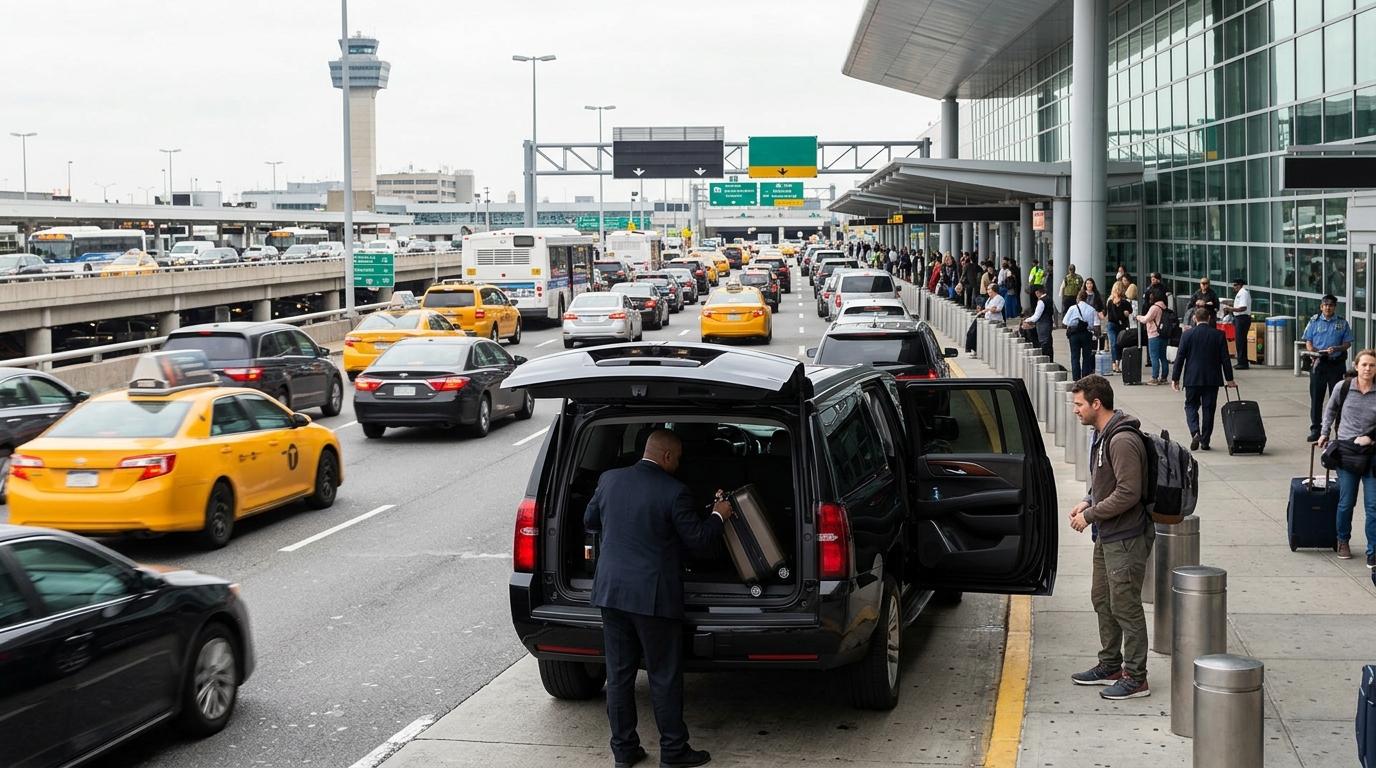
Getting to JFK by car comes down to three decisions: which road you take, what time you hit it, and where the car stops once you arrive. Get those right and the drive is manageable. Get them wrong and the last mile alone can eat an hour.
This guide gives you JFK directions for the drive itself: driving directions to JFK Airport from the areas people most often start in, how traffic tends to behave, what the airport's rebuild means for drivers, and where you can let passengers out or wait for them.
Set Your GPS to the Terminal, Not Just "JFK"
JFK sits in southeast Queens, New York (ZIP code 11430), and it is one of those airports where typing the generic name into a map app can put you on the wrong approach. The airport is a loop of roads with several terminals, and each one has its own entrances and curb. Check the terminal on your booking confirmation, then enter it by name: "JFK Terminal 4" rather than "JFK Airport."
The terminal picture is also changing. JFK is in the middle of a rebuild of roughly $19 billion that includes a new Terminal One and a new Terminal 6, and airlines have been shifting between buildings as phases open. The terminal you used last year may not be the one your flight uses now. Look at your airline's most recent email or app notification instead of trusting memory.
Do this before you leave, not from the driver's seat. Terminal signs come up fast once you are on airport roads, and there is little room to fix a wrong lane. Good JFK airport directions start with the terminal, not the airport.
The Two Roads That Lead to JFK
Almost all car traffic reaches the airport on two highways: the Van Wyck Expressway (I-678) and the Belt Parkway. Both connect to the JFK Expressway, a short road inside the airport complex that branches toward the terminals.
Van Wyck Expressway
The Van Wyck runs north to south through Queens and ends at the airport. It is the usual route from Manhattan, the Bronx and most of Queens, and it is also the road drivers complain about most. Expect slowdowns around the Kew Gardens interchange and again on the final approach. When it flows, it is the most direct way in. When it doesn't, no alternative on your map looks as good as it did a minute earlier.
Belt Parkway
The Belt Parkway runs east to west along the northern side of the airport, linking Brooklyn and Long Island to the JFK Expressway. It suits drivers coming from Brooklyn, Staten Island and Nassau County. It has tight curves, short merges and lane changes close together, so it rewards drivers who stay alert.
Whichever road you choose, follow the signs for "JFK Airport" and then your terminal. Don't rely on exit numbers from older directions, because the airport's road layout has been reworked in recent years.
If handling the Van Wyck yourself doesn't appeal, especially with luggage, children or an early flight, a pre-booked JFK airport transfer through Transpovia puts a driver in charge of the route and the curb while you sit back.
Driving Directions to JFK From Where You're Starting
These are general driving directions to JFK International Airport, not turn-by-turn instructions. Use live navigation on the day for the exact route and any closures.
From Manhattan
Midtown is roughly 16 miles from the airport. Most drivers take the Queens Midtown Tunnel to the Long Island Expressway (I-495), then follow signs for the Van Wyck Expressway south to JFK. From Lower Manhattan, many drivers cross into Brooklyn and use the Belt Parkway east instead. A typical trip runs somewhere between 45 and 75 minutes, and weekday afternoons can push well past that.
From Brooklyn
Take the Brooklyn-Queens Expressway to the Belt Parkway heading east, then follow the JFK signs. Compared with the Van Wyck, this route avoids the Queens interchanges but has its own bottlenecks near the airport exits.
From Long Island
Head west on the Belt Parkway, joining from the Southern State Parkway or Cross Island Parkway as needed. Drivers coming from the east to Terminals 1 and 4 should pay attention here: a permanent roadway configuration took effect in January 2026, and the signs may not match what older guides or apps describe.
From the Bronx, Westchester and New Jersey
From the Bronx and Westchester, the Whitestone Expressway feeds into the Van Wyck south. From New Jersey, the George Washington Bridge leads to the same corridor, while the Verrazzano Bridge from Staten Island connects to the Belt Parkway east. Both bridges are tolled.
Tolls matter throughout the region: most New York crossings are tolled, and many are cashless. If you are in a rental car, check how the rental company handles tolls before you leave the lot.
Where to Drop Off Passengers at JFK
The rules at JFK are stricter than most people expect. According to the Port Authority, terminal curbs are for active drop-offs and pickups only. You cannot park in front of or next to a terminal, and a vehicle left unattended can be towed at the owner's expense. So if you arrive early, or your passenger is still finding their bags, circling the curb is not a plan.
Use the free wait lot at Lefferts Boulevard
The Port Authority runs a free on-airport lot at the Lefferts Boulevard AirTrain station, inside Long Term Parking Lot 9. It works for both drop-offs and pickups. Your passenger takes the AirTrain to any terminal in about eight minutes, at no cost, and you never touch the congested terminal roads. This is the setup commonly called a Kiss & Fly drop off. To find it, search "JFK Lefferts Boulevard AirTrain Station" in your GPS or follow the signs for the "Wait Lot," which you can reach from the Van Wyck or the Belt Parkway close to the airport entrance.
"We left Brooklyn with plenty of time, but the last mile before the terminal took longer than the first fifteen. Next time we're being dropped off at the lot and riding the AirTrain."
Use the Cell Phone Lot when you're collecting someone
If you are waiting to pick up an arriving passenger, the free Cell Phone Lot near the JFK Expressway is less than five minutes from all terminals and is the closest wait lot for Terminals 5, 7 and 8. Search "JFK Cell Phone Lot" or follow the signs as you enter the airport.
When the curb still makes sense
If your passenger has heavy bags, small children or mobility needs, a terminal curb drop-off can be worth the extra traffic. Keep it quick: pull in, unload, leave. For anyone else, the AirTrain from the wait lot is often the lower-stress option.
When Traffic Is Worst and How Much Time to Allow
JFK traffic isn't random, but it is hard to predict to the minute. As a general pattern, early mornings (before about 6:30 a.m.) and evenings after about 8 p.m. are the lightest windows, while weekday afternoons and Friday departures tend to be the slowest. Holiday weekends and summer peaks add more pressure on top.
Overnight work on the Van Wyck is common, too, so driving to JFK Airport late at night or very early isn't always the shortcut it seems. The Port Authority posts advisories about lane closures and detours, and late-night or early-morning drivers sometimes need an extra 10 to 15 minutes. Check live traffic in your map app and look at the airport's current advisories before you set out.
If you plan to drive to JFK during a busy window, remember that the highway is only part of the trip. Airport roads, drop-off queues and security lines all stack up behind it. During the busiest stretches, the Port Authority has advised drivers to arrive at the airport at least three hours before departure. Treat that as a sensible ceiling for international trips and busy dates, and judge shorter domestic flights on the day's conditions.
What the JFK Rebuild Means for Drivers
Construction is the biggest reason older directions to JFK no longer work. A permanent roadway configuration for drivers from Long Island and points east heading to Terminals 1 and 4 took effect in January 2026. A new permanent layout for Terminals 5 and 7 followed in October 2025, and drivers to Terminal 8 use the JFK Expressway. The new Terminal One and Terminal 6 are opening in phases, which can move curbs, signs and pickup areas.
Practical takeaways:
-
Follow the posted signs over memory or an old map.
-
Confirm your airline's terminal the day before you travel.
-
Look at the Port Authority's travel advisories if you're driving overnight or at a peak time.
-
If the terminal roads back up, the Lefferts Boulevard wait lot is the airport's own suggested way out of the queue.
If You're Collecting Someone or Would Rather Not Drive
Not every trip has to involve your own car. Arriving passengers who don't have a ride waiting often head for a cab, and this guide to the JFK taxi lot shows where cabs line up at each terminal. If you're meeting a traveler with lots of luggage, it also helps to agree on a pickup point in advance, since terminal pickup areas can differ from what a returning visitor remembers.
For a drive where you'd rather not handle the Van Wyck at all, pre-booking a private ride is the other realistic option, with a driver who already knows which curb to head for.
FAQs
What is the best route to JFK from Manhattan?
Most drivers use the Queens Midtown Tunnel, join the Long Island Expressway (I-495), then take the Van Wyck Expressway south to the airport. From Lower Manhattan, the Belt Parkway via Brooklyn is a common alternative. Check live traffic before choosing, because the better route changes through the day.
How long does it take to drive to JFK?
From Midtown Manhattan, a typical trip runs roughly 45 to 75 minutes, and weekday afternoons can take longer. Allow extra time for the airport roads and drop-off queues once you arrive.
Is there free drop-off at JFK?
Yes. The Port Authority operates a free wait lot at the Lefferts Boulevard AirTrain station that works for drop-offs and pickups. From there, a free AirTrain ride of about eight minutes takes passengers to the terminals.
Can I park at the terminal curb while my passenger checks in?
No. Terminal curbs are for active pickups and drop-offs only, and unattended vehicles can be towed. If you need to wait, use the wait lot or the Cell Phone Lot.
Should I take the Van Wyck or the Belt Parkway?
It depends on where you're starting. The Van Wyck is more direct from Manhattan, the Bronx and most of Queens. The Belt Parkway works better from Brooklyn and Long Island. Look at live traffic on both before committing.
What address should I enter in my GPS?
Enter your terminal by name, such as "JFK Terminal 4," rather than a general airport address. For waiting, search "JFK Lefferts Boulevard AirTrain Station" or "JFK Cell Phone Lot."
Plan the Last Mile Before the First
The drive to JFK is rarely about distance. It's about timing, the right approach road and knowing where the car can actually stop. Pick your terminal ahead of time, choose a route that suits your starting point, and decide before you leave where passengers will be dropped. A few minutes of planning usually beats an hour of improvising on the Van Wyck.
And if you'd rather arrive without thinking about lanes and curbs, Transpovia lets you compare and book airport transfers in advance, so the route is someone else's job.


