
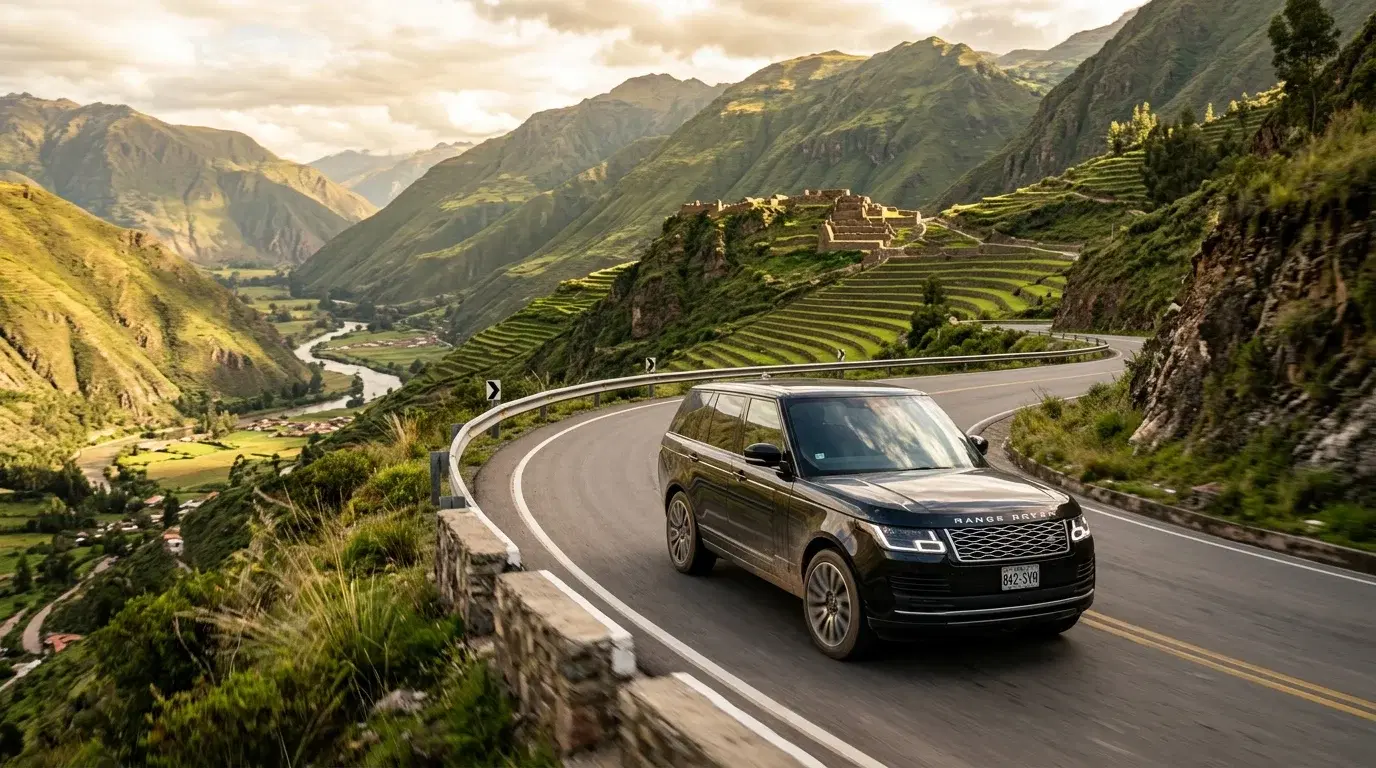
You step off the plane and feel it within a few minutes: the thin air, the slight headache, the sense that walking to baggage claim took more effort than it should. Cusco sits at about 3,400 meters, and the Sacred Valley lies several hundred meters lower. That single fact changes how most people plan their first day. Choosing a Cusco Airport to Sacred Valley transfer isn't only about price or drive time — it's about where your body will sleep tonight and whether you'll have a train to catch tomorrow. Deciding before you fly makes the first day far easier.
Why So Many Travelers Head Straight to the Valley
Sleeping lower helps. Cusco is around 3,400 m, while Pisac sits near 2,970 m, Urubamba near 2,870 m and Ollantaytambo near 2,790 m. That's a drop of 400 to 600 meters — modest on a map, noticeable in how you feel on your second morning.
The reasoning is medical, not marketing. The CDC's high-altitude guidance advises ascending gradually and warns against jumping straight to a high sleeping elevation, since sleeping altitude produces the most strain on the body. Day trips up high with a night lower down are much gentler.
Practical version: land, drive down to the valley, spend two nights there, then come back up to Cusco once you've adjusted.
None of this is a rule. If you've already spent days in Puno or Arequipa, you're acclimatized and the argument disappears. It matters most for travelers flying in from Lima or overseas within a day or two.
Comparing Your Cusco Airport to Sacred Valley Transfer Options
Alejandro Velasco Astete Airport sits inside the city, roughly 3.7 km from the Plaza de Armas. Every route to the valley starts by crossing Cusco, then either climbing over the Chinchero plateau toward Urubamba and Ollantaytambo, or dropping northeast toward Pisac.
|
Option |
Airport to Urubamba |
Typical cost |
Suits |
|
Pre-booked private transfer |
1 hr 30 min |
~$35–80 per vehicle |
Most arrivals, groups, train connections |
|
Taxi arranged at the airport |
1 hr 30 min |
~S/130–180 to Ollantaytambo |
Travelers happy to negotiate on arrival |
|
Colectivo (shared van) |
2 hr 30 min plus |
~S/10–20 plus a taxi into town |
Light packers on a tight budget |
|
Sightseeing transfer with stops |
4–7 hrs |
~$70–100 per vehicle |
Travelers already acclimatized |
The trade-offs are sharper here than on most airport routes.
The colectivo is the one people misunderstand. Shared vans to the valley don't leave from the airport — they leave from streets in Cusco, mainly Calle Pavitos for Urubamba and Ollantaytambo and Calle Puputi for Pisac. So the cheap option is really a taxi into town, a wait for the van to fill, and a second ride out. Vans go when full, usually run from around dawn until early evening, and luggage space is minimal — large cases end up on the roof or in a seat you pay for.
Taxis found at the airport work, but the price is settled by conversation, and quotes climb sharply for valley destinations. Agree the total before the bags go in the trunk.
A pre-booked car costs more than a colectivo and about the same as a negotiated taxi, with the difference being certainty: a fixed price, a driver who knows which lane leads to your hotel, and no bargaining while you're short of breath. Travelers arriving via the capital often make the same call there — a Lima Airport to Miraflores Transfer is chosen for predictability rather than speed.
Which Valley Town Should You Aim For?
Pick the town that matches tomorrow's plan, not the one closest to the airport.
-
Pisac — about an hour from the airport. Closest to Cusco, good for the market and ruins, highest of the three main valley towns.
-
Urubamba — about 1 hour 30 minutes. The valley's practical center, most hotel choice, and a sensible base if you're touring the area for a couple of days.
-
Ollantaytambo — about 1 hour 45 minutes to 2 hours. The town with the train station for Machu Picchu, and the lowest of the three.
If Machu Picchu is on your second or third day, Ollantaytambo saves you a second long drive later. If you're building acclimatization days with day trips to Moray, Maras and Chinchero, Urubamba is more central. Hotels in all three towns are often down narrow lanes or dirt access roads, which is worth flagging when you book — a driver who hasn't been there before may leave you at the plaza rather than the door.
Timing: Weather, Airport Hours, and the Train
Morning flights into Cusco are more reliable than afternoon ones. Cloud builds over the basin through the day, especially in the wet season from roughly November to March, and the airport's position among the mountains means visibility matters. Delays and diversions cluster in the afternoon.
Two timing details have changed recently. Since December 1, the airport operates 22 hours a day, from 4:00 a.m. to 2:00 a.m., after CORPAC agreed the extension with LATAM — so genuinely late arrivals are now possible, and the valley drive after dark is a real scenario rather than a hypothetical. The mountain road is paved but winding, and it isn't the drive to improvise at 1:00 a.m. CORPAC also flagged a runway maintenance program during the first half of 2026, so schedule changes are worth checking close to departure.
If you're heading for a Machu Picchu train the same day you land, be careful. The drive to Ollantaytambo alone runs close to two hours before you add baggage claim and any flight delay. Sleeping in Ollantaytambo the night before an early train removes almost all of that risk. Regional strikes, known locally as paros, can also close roads or the rail line with little notice, which is the strongest argument for keeping a spare day in the plan.
Paying for the Ride, and What to Settle First
Peru uses the sol, and while pre-booked transfers are usually paid by card in advance, most on-the-spot arrangements are cash. There are ATMs at the airport; withdraw modestly and keep small notes, since valley shops and colectivos rarely break large bills.
A few things worth agreeing before the wheels move:
-
The total price, in soles, for the whole ride — not per person, and not "we'll see."
-
Whether the airport parking fee is included. Asking whether the price incluye estacionamiento prevents a small argument at the end.
-
The exact drop-off address, especially for hotels outside the town centers.
Ignore anyone who approaches you inside the terminal offering a ride. The pattern reported at Cusco is familiar: a helpful-looking person steers you past the official desk toward a car parked outside, and the fare grows during the drive. Use the counters inside arrivals, a car your hotel arranges, or an app you open yourself — Uber, Cabify and inDrive all operate in Cusco, though driver availability thins out sharply before 5:00 a.m.
When a Private Transfer Earns Its Price
A private transfer solves a problem that's specific to this route: you're making a two-hour mountain drive on the day your body is least equipped to deal with complications.
The situations where it clearly pays:
-
You're connecting to a train from Ollantaytambo and can't absorb a delay.
-
You're traveling with children or older parents, where a colectivo with roof-strapped luggage isn't realistic.
-
You're a group of three or four, at which point the per-person cost drops below two taxis.
-
Your flight arrives late, or arrives with the wet-season delay that pushes the drive into darkness.
-
Your hotel is one of the many valley properties down an unmarked lane.
Booking ahead through an operator like Transpovia means a driver tracking the flight, a price agreed in writing, and a car that continues past the plaza to your actual door. That last part matters more here than in a city with numbered streets.
Arrange the return leg at the same time, particularly if you're flying out on an early morning departure. Transpovia and similar operators treat a 4:30 a.m. pickup as a normal booking, while apps at that hour depend on who happens to be awake in Urubamba. The reasoning carries across the region; travelers booking a Quito Airport to Historic Center Transfer weigh the same trade-off between cost and certainty.
Should You Sightsee on the Way?
Turning the transfer into a half-day tour is popular, and many drivers offer to stop at Chinchero, Moray and the Maras salt ponds en route. It's good value if you have the energy.
There's a catch nobody mentions. Chinchero sits at roughly 3,760 m — higher than Cusco. A sightseeing stop on arrival day means climbing above the airport before descending, which works against the reason you chose the valley in the first place. If acclimatization is the goal, drive straight down and save those sites for day two, when they make an easy loop from Urubamba. You'll also need the regional tourist ticket for the archaeological sites, sold at official offices and at the site entrances rather than by drivers.
Frequently Asked Questions
How long does it take to get from Cusco Airport to the Sacred Valley?
Around one hour to Pisac, about 90 minutes to Urubamba, and roughly one hour 45 minutes to two hours to Ollantaytambo. Add time for crossing Cusco during morning and evening traffic, and more in heavy rain.
Is it better to stay in the Sacred Valley or Cusco on your first night?
Many travelers arriving from sea level sleep better in the valley, since it sits 400 to 600 meters lower than Cusco. If you've already spent days at altitude elsewhere in Peru, either works — the benefit applies mainly to a fast ascent.
Can you take a bus from Cusco Airport to Ollantaytambo?
Not directly. Shared vans leave from Calle Pavitos in central Cusco, so you'd take a taxi into town first, then a colectivo. Total travel time is around two and a half hours, and luggage space on board is limited.
Will the new Chinchero airport change any of this?
Not yet. The Chinchero project is still under construction and its opening date has moved repeatedly, so plan around the current airport and check for updates before booking flights far ahead.
Before You Land
Decide your first night's altitude before you book the flight, then arrange the ride to match it. Keep soles in small notes, agree the price before you set off, and leave a buffer day around anything involving trains. If you're landing late or connecting onward, a pre-booked car through Transpovia takes the one variable you can't control off the table.
"We flew in from Lima and drove straight down to Urubamba instead of staying in Cusco. Slept properly the first night, and the altitude never became a problem for the rest of the trip." — Couple traveling to Machu Picchu


