
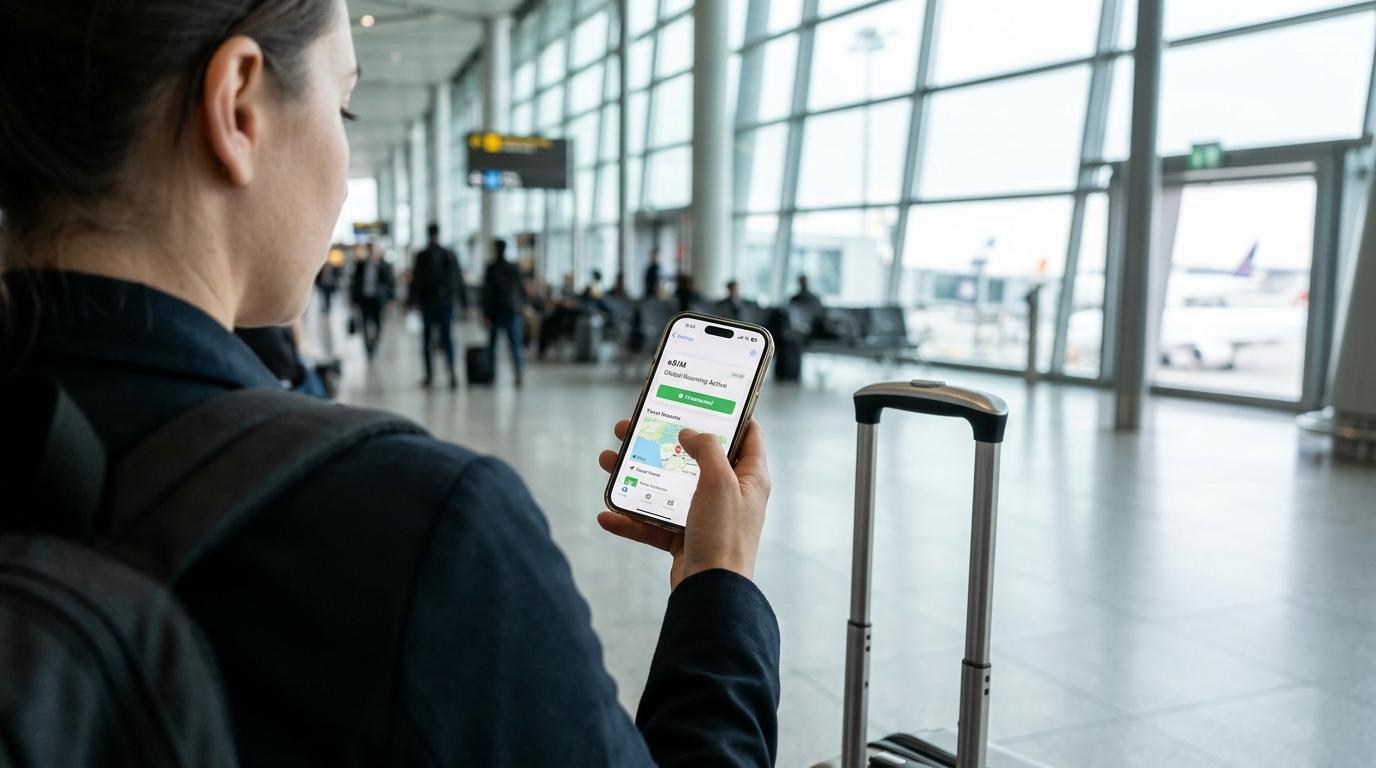
The cheapest eSIM is rarely the plan with the lowest number on the banner. A small plan that runs out on day two costs more in the end than a fair plan that lasts your whole trip. The real goal is the lowest cost for the data you will actually use, in the countries you will actually visit, on a network that actually works. This guide shows you how to compare plans on that basis, where hidden costs tend to hide, and how to build a low cost setup before you board.
You will find a simple method for comparing plans, a breakdown of country, regional, and global options, the traps behind very cheap listings, and a clear way to decide between an eSIM, roaming, and a local SIM. No fixed prices appear here, because plans and exchange rates change often. Check the current terms at checkout before you pay.
What Cheapest Really Means
Price alone tells you very little. Two plans can both say five dollars and offer very different value. One gives a small amount of data for seven days, and the other gives a larger amount for thirty. Compare four things together before you decide.
-
The amount of data in the plan.
-
The number of days the plan stays valid.
-
The countries it covers.
-
The speed and conditions after you use a set amount.
A plan that fits all four for your trip is cheap. A plan that fails one of them is expensive, even at a tiny price.
The Cost Per Gigabyte Method
Divide the price by the number of gigabytes. If a plan costs 10 units of your currency and carries 5 GB, you pay 2 units per gigabyte. Run the same math for each plan on your short list. This single step cuts through most marketing language.
Do not stop there. A low cost per gigabyte on a huge plan means little if you will use a fraction of it. Estimate your use first, then compare plans close to that size.
The Cost Per Day Method
Divide the price by the number of valid days. This helps on long trips and for travelers who stay connected all day. A plan with generous data and a short validity can look cheap per gigabyte and expensive per day. Use both numbers together and your picture gets much clearer.
Estimate Your Data Before You Shop
Buying too much is the most common way to overpay. Buying too little is the second, because a rushed top up usually costs more per gigabyte than a good plan bought in advance.
Maps, messaging, and email use very little data. Video calls, streaming, and cloud backups use a lot. Social media falls in between, and short videos can drain a plan faster than people expect. Most phones show data use per app in the settings menu. Check last month at home. That number is the best guide you have, and it takes one minute.
Then adjust for the trip. A week of sightseeing with offline maps needs less than a week of remote work. If you plan to share data with a laptop, add room for it, and confirm that the plan allows sharing at all.
Where the Savings Begin
The cheapest travel eSIM options tend to share a few traits. You can often influence all of them.
Country Plans for Single Destinations
If you stay in one country, a country plan usually gives the lowest cost for the data. Many travelers see affordable travel eSIM offers listed by country first, and for a single destination that is a sensible place to start. Regional and global plans carry the cost of covering many places, and you pay for coverage you never use.
Regional Plans for Short Multi Country Trips
If your route crosses several nearby countries, a regional plan can cost less than buying separate country plans. Check the country list with care. Two plans with the same regional name can cover different places, and a missing country forces you to buy a second plan.
Global Plans Only When You Need Them
A global plan makes sense when your route spans several continents. For a trip inside one or two regions, it is often the most expensive way to stay connected, because you pay for coverage in places you will never see.
Small Plans and Top Ups
If you are not sure how much data you need, start with a smaller plan and add data later. Check that the provider offers top ups without a new installation, and read how the validity period behaves when you add data. A flexible small plan can cost less than a large plan that sits half empty.
Buying Early and Watching Promotions
Prices and promotions shift each week. Compare a few days before your trip, and do not wait for the airport. Airport wifi is slow, and the pressure to buy right now rarely helps your budget. Read the terms of any discount code, because some apply only to the first purchase or to certain plans.
Cheap Plans and Their Limits
Low prices carry trade offs. Knowing them in advance stops a bargain turning into a headache.
Speed Limits and Fair Use
Many plans slow down after a fixed amount of use per day or in total. An unlimited plan may crawl after a certain point. If you stream or join long calls, a fixed plan with full speed can serve you better. Read the fair use terms in plain language before you buy.
Network Priority
Some low priced plans may receive lower priority on a local network during busy hours. You may notice slower speeds in crowded places, for example stadiums, big stations, and tourist squares. Test your connection when you arrive and keep a backup plan in mind.
No Phone Number
Most travel eSIMs carry data only. Calls and texts run through apps, for example WhatsApp or FaceTime. If you need a local number for deliveries or a ride, check before you buy. Otherwise keep your home SIM active for texts and bank codes.
Hotspot Rules
Some cheap plans block sharing. If you work with a laptop, this one rule can undo the savings, since you may need to buy a second plan. Confirm sharing support first.
Validity Clock
Some plans start counting days when you install the profile, and others start at the first connection. If you install early to feel safe, you might lose days of a plan you paid for. Read the activation rule and install on the right day.
Support and Refunds
Very cheap providers may offer thin support. That is acceptable for a short trip with a simple setup, and it becomes risky when your flight lands at midnight and nothing works. Look for live chat or tickets and read the refund policy for failed installs.
Hidden Costs to Watch
A low sticker price can hide small extras. These are the ones to check.
-
Currency conversion and card fees when the plan is priced in another currency.
-
Extra charges for top ups or for a longer validity.
-
Taxes shown only at the last step of checkout.
-
A second plan needed after a country was missing in the list.
-
Roaming charges on your home line when data roaming stays on by mistake.
That last item catches many travelers. If data roaming is on for your home line, your phone may use it and bill you, even when the eSIM is installed. Switch off data roaming on the home line, and keep it on only for the eSIM line.
eSIM, Roaming, or Local SIM
The cheapest option depends on the trip. Here is a plain comparison.
Home Carrier Roaming
Roaming is the easiest option, and some home plans include it in selected regions. Inside the European Union, many plans include roaming under fair use limits. Outside those areas, daily passes add up quickly. Read your carrier rates before you leave. For a very short trip in a region your plan already covers, roaming may be the cheapest choice.
Local SIM
A local SIM can be the cheapest option for a long stay in one country, and it often brings a local number. It also costs time. You visit a shop, sometimes show an identity document, and carry a number you will drop later. For travelers who cross borders often, that effort repeats at every stop.
Travel eSIM
An eSIM sits in the middle. You buy it online, install it at home, and it works when you land. For trips of a few days to a few weeks, or trips across borders, it often gives the best balance of cost and effort. For long stays in one country, compare it with a local plan.
Check Your Phone First
A cheap plan wastes money if your phone cannot use it. Do these checks before you pay.
First, confirm that your model supports eSIM. Most phones released in recent years do, and the manufacturer support page lists the models.
Second, confirm that your phone is not locked to a carrier. On an iPhone, open Settings, then General, then About, and look for the Carrier Lock line. If it says No SIM restrictions, you can use another provider. If a carrier name appears, contact that carrier and ask for a release before you travel. Android menus differ by brand.
Third, learn how dual SIM works on your phone. You will have your home line and the eSIM active together. Pick the eSIM for mobile data and switch off data roaming on the home line.
Set Up in Six Steps
-
Connect to stable wifi at home.
-
Scan the QR code in your confirmation email or follow the app steps.
-
Label the new line with the destination.
-
Check when the plan starts counting days.
-
After landing, set mobile data to the eSIM line and turn on data roaming for that line only.
-
Open a map app and send a message to confirm that everything works.
Save a screenshot of the QR code and the plan details. Many providers allow only one installation, and a deleted profile can mean a new purchase.
Ways to Use Less Data
The cheapest gigabyte is the one you never use. A few habits protect your plan.
-
Download offline maps, travel documents and essential information over Wi-Fi before you leave.
-
Turn off automatic photo uploads and cloud backups abroad.
-
Limit background refresh for heavy apps.
-
Set your phone to warn you when you approach your data limit.
-
Use hotel wifi for large downloads, and keep eSIM data for banking and anything with a password.
Public wifi saves data, though it is shared with strangers. Avoid logging in to sensitive accounts on it, and use your eSIM for those tasks.
Budget Tips for Common Trips
A Weekend City Break
A small country plan usually covers maps, messages, and a few photos. Buy the smallest plan that fits your habits, and download maps before you leave.
A Two Week Holiday in One Country
A mid size country plan with enough days works well. Estimate your use using last month and add a margin for video and sharing.
A Multi Country Rail Trip
A regional plan can cost less than several country plans. Verify each country on the list, and keep an eye on the activation rule.
A Month of Remote Work
Compare a large eSIM plan with a local plan. Hotspot support and speed rules matter more than the sticker price here.
A Family Trip
Every phone needs its own profile. Buy small plans for the adults who mostly navigate, and a larger plan for the phone that will share data. Sharing drains the host battery. Bring a power bank.
Arrival Day Costs You Can Avoid
A connected phone helps you avoid several costly mistakes on arrival day. You can read pickup instructions, message a driver, and check your booking without buying data at airport prices or hunting for wifi. If you book an airport transfer through a ground transportation marketplace named Transpovia, your confirmation usually arrives by email or app message. Open it on airport wifi while you wait for your bags, and keep your eSIM active at the curb.
I paid very little for my eSIM, and it still got me a map and my driver's message the moment I landed.
Save your booking, the hotel address in the local language, and an offline map to your phone. A weak signal in an arrivals hall is common, and offline copies give you a backup.
FAQs
What is the cheapest eSIM for a short trip?
The cheapest plan is the smallest plan that covers your days, your countries, and your usual data use. Compare cost per gigabyte and cost per day, and check hotspot and speed rules before you buy.
Is an eSIM cheaper than roaming?
Often it is, especially outside regions where your home plan already includes roaming. For a very short trip in a covered region, roaming can cost less. Check your carrier rates before you leave.
Is an unlimited eSIM worth the money?
It can be, if you use a lot of data and the fair use terms suit you. Many unlimited plans slow down after a set amount. Read the terms. A fixed plan at full speed can work out cheaper for lighter use.
Can I buy a cheap eSIM after I land?
You can, though airport wifi is often slow, and you may overpay under time pressure. Install your plan at home a few days before departure.
Will a cheap eSIM work on any phone?
Only on phones that support eSIM and are not locked to a carrier. Check both before you pay.
Do cheap eSIMs include a phone number?
Most do not. They carry data only, and calls run through apps. Keep your home SIM active if you need texts or bank codes.
Can I top up a cheap plan?
Many providers allow it through an app or a web page. Check this before you buy, and confirm if the top up extends the validity or keeps the original end date.
Conclusion
The cheapest eSIM is the one that matches your trip. Estimate your data, list your countries, check your phone, and compare plans by cost per gigabyte and cost per day. Read the fair use terms, the hotspot rules, and the activation rule before you pay, and switch off data roaming on your home line.
A low cost plan is one piece of a smooth arrival. When you book an airport transfer or a private ride with Transpovia, add your eSIM to the same checklist, and you will land connected, organized, and in control of your budget.


