
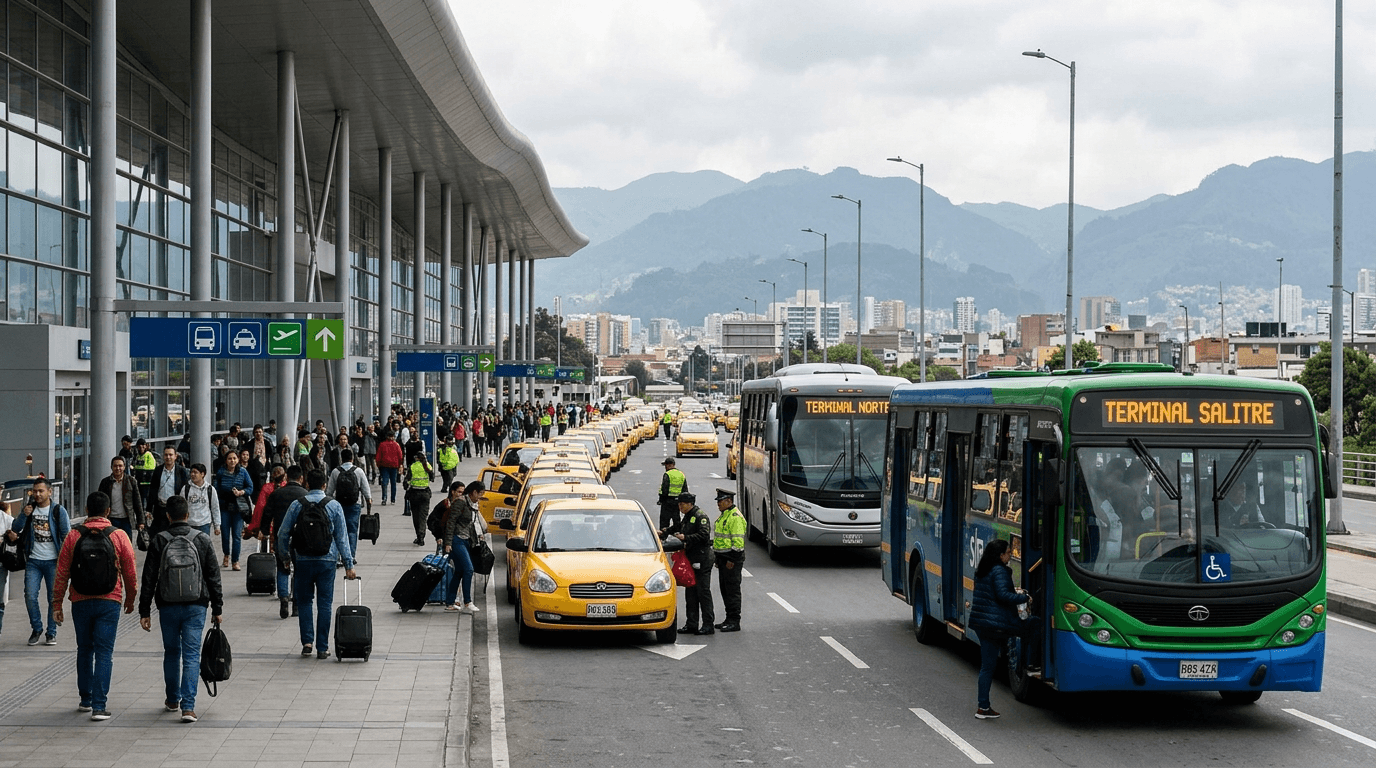
Bogota airport to bus terminal rides look short on a map. After a long flight, with heavy bags and a ticket for a specific departure, they feel much longer. El Dorado Airport sits in the west of the city, and the central bus terminal at Salitre is close by. The northern terminal on Autopista Norte is a different story, with a far longer drive through busy roads. This guide covers how far each terminal is, how long the ride usually takes, what taxis charge in 2026, how TransMilenio works when you carry luggage, and when a booked private car saves real stress. It also covers the trip in reverse, bus terminal to airport, for anyone flying out after a road trip through Colombia.
Which bus terminal should you head to?
Bogotá has three official bus terminals, and the right one depends on where your bus goes. Terminal Salitre is the central station in the west of the city, near Ciudad Salitre. Long distance buses to Medellín, Cartagena, Barranquilla and Sogamoso depart here. It is the busiest of the three, and it gets packed around long weekends and the end of the year.
Terminal del Norte, also called Terminal Satélite del Norte, stands on Autopista Norte at Calle 193. It opened in 2017 and handles buses heading north, including routes to Boyacá, Santander, the Caribbean coast and nearby towns including Zipaquirá and Villa de Leyva. The operator lists round the clock service there, though each bus company sets its own departure times. Terminal Sur serves the south and rarely comes up in an airport trip, which is why this guide skips it.
Check your ticket before you leave the airport. Bus companies print the terminal on the booking, and a wrong guess means another long ride across the city. If you bought online, look for the words Terminal Salitre or Terminal Norte near the departure time. If the ticket shows only a company name, a short message to the company clears it up in minutes.
How far is each terminal by road?
Terminal Salitre is the closer one. The road distance runs between 7 and 9 km depending on the route, and a taxi can cover it in about ten minutes when Avenida El Dorado is clear. On a weekday evening the same ride can take far longer. Keep a generous buffer between your landing time and your bus time. For international arrivals, passport control and baggage claim can easily eat the first hour.
Terminal del Norte lies roughly 21 to 27 km away by road, again depending on the route. Without traffic the drive takes around 40 minutes. With the usual crowding on Autopista Norte near Calle 193, expect more, and never plan a tight connection. If you can pick the bus time yourself, choose a departure that leaves at least two hours between your arrival and the bus.
El Dorado has two passenger buildings. Terminal 1 is the main one, and Puente Aéreo is a smaller second terminal about one kilometer to the west. Tell your driver which building you left, because pickup points differ.
Many travelers book a car before landing. A driver waiting at arrivals removes the first decision of the trip, and the page for Bogotá El Dorado Airport Transportation – private transfer shows how that kind of booking works for the airport.
Taking a taxi to Terminal Salitre
Taxi Imperial runs the official airport taxi service. Look for the stands outside the arrivals doors and ignore anyone who approaches you inside the building. Since August 2024 the airport has used a system where the fare is calculated before the ride starts, which cuts down on arguments at the end.
Bogotá's 2026 taxi decree sets a minimum fare of 8,000 COP. A surcharge of 8,000 COP applies to any ride heading to or leaving the airport, and premium taxis charge 8,600 COP. A night surcharge of 3,800 COP applies between 8 pm and 5 am, and the same amount applies on Sundays and holidays. The meter adds the distance on top. These numbers change each year. Ask the stand attendant or the driver to confirm the total before you set off.
We landed after dark, found the driver at arrivals and reached the terminal with time to buy water and sit down. Nobody rushed us once.
Give the driver the full name, Terminal de Transporte Salitre, and the address, Diagonal 23 número 69-55. Drivers know the building well, and the address clears up any doubt. Ride apps also work in Bogotá, and pickup rules at the airport change. Read the meeting point in the app before you walk out.
Reaching Terminal Salitre on TransMilenio and SITP
TransMilenio costs 3,550 COP per ride in 2026. That fare has applied since January 14 and covers TransMilenio, TransMiZonal and TransMiCable. You need a TuLlave card, and the city points travelers to a card counter at entrance 4 on the first floor of Terminal 1.
The dual route K86 and M86 stops in front of entrances 1 and 8, at stops marked Bus satélite aeroportuario. It follows Calle 26 toward Portal El Dorado and several trunk stations. A second route, feeder 16-14 Airport, goes straight to Portal El Dorado. Service starts before 5 am on weekdays and ends around 10 pm on weekdays and Saturdays, with different hours on Sundays and holidays. Check the current hours on the day you travel.
On the Salitre side, feeder route K301 La Felicidad connects the terminal with Normandía and Avenida Rojas stations on the El Dorado trunk line. The city runs it on weekdays starting early in the morning. Another option is to ride the airport line to El Tiempo station and walk the last about 950 meters over the pedestrian bridge. With rolling suitcases that walk is tiring, and in rain it is worse.
Count on about an hour for the whole trip by public transport, waits included. TransMilenio is by far the cheapest option. Crowds are real, though, especially at rush hour, and bags take up space that other riders want. If you carry two large suitcases or travel with children, a taxi or a booked car is the calmer choice. The SITP route P500 also leaves the airport, and it heads north to El Chicó, which means it does not help for Salitre.
Getting to Terminal del Norte
The northern terminal is far enough away that public transport turns into a puzzle. TransMilenio has a trunk station called Terminal on Autopista Norte, at Avenida Carrera 45 with Calle 192, and the city says the terminal is a short walk once you leave that station. To reach it, you would start at the airport and ride the airport route to Portal El Dorado and then continue across the city on trunk lines, with transfers that depend on the hour and your starting stop. Plan the connections on the TransMilenio map before you start, and expect a long trip with luggage.
A taxi covers the distance more simply. You pay the meter plus the airport surcharge, and the ride takes about 40 minutes with light traffic and longer when Autopista Norte clogs. Ask the driver to enter the terminal area at Calle 193 instead of stopping on the avenue, since the terminal was built to move buses off the road edge and the loading zone is inside.
For a northern departure, a pre booked private ride is usually the sensible pick. You skip the stand, the fare is agreed in advance, and a driver who tracks your flight knows when you land. That matters when the bus company will not hold a seat for a late traveler.
What if you land late and leave by bus the next morning?
Some travelers arrive after the last comfortable bus of the day. In that case it is smarter to rest in town than to wait in a terminal overnight. Buy the bus ticket online before you travel, sleep in a hotel near your terminal or in a central district, and take a short taxi in the morning.
La Candelaria is a favorite base for the first night in Bogotá, with its old streets, museums and cafés. The guide to a Bogotá Airport to La Candelaria transfer explains how the ride works and what to expect on arrival. Terminal Salitre is a short taxi ride across town in the morning, and the early hours are usually quiet on the roads.
If your hotel offers a late check in, tell them your arrival time. If your bus leaves very early, ask them to order a taxi the night before. A hotel taxi call is more dependable than a street hail at dawn.
Bogota bus terminal to airport
Travelers often forget the way back. The ride between Terminal Salitre and the airport covers the same 7 to 9 km, and the 8,000 COP airport surcharge applies in both directions. A taxi can do it in about ten minutes when the road is open, and TransMilenio takes closer to an hour with waits. If your flight is international, leave much earlier than the distance suggests, since check in and security queues can run long.
At Terminal Salitre, the taxi line forms outside the arrivals side, where all arriving buses unload. Walk to the official stand, and avoid anyone offering a ride in the corridors. Give the driver your airline and terminal. If your flight departs at Puente Aéreo, mention it.
Practical tips for both directions
Allow extra time on Fridays, Sundays and public holidays. Roads fill with people leaving or returning to the city, and the terminals are crowded too. Carry some cash in Colombian pesos, even if you plan to pay by card, since small purchases and some taxis work better with cash.
At Terminal Salitre, buses that serve towns around Bogotá, including Villavicencio, depart at module 4, while arriving passengers walk into module 5. Knowing which end of the building you need saves walking with heavy bags. Ticket counters sit in the main hall, and the company names appear above each window.
Travelers with children should check the paperwork rules. Colombia asks for a travel authorization when minors ride a bus without a parent. Ask your bus company which form it expects before you arrive at the terminal.
Keep your bag within sight at all times, both at the airport and in the terminal. Do not leave phones on café tables, and keep your passport in a front pocket while you wait for a bus. These habits take a few seconds and prevent most problems.
Readers who also want the city routes into the airport can follow the guide on How to get to El Dorado Airport, which helps when you spend a night in town before flying.
Last, check the weather. Bogotá rain arrives fast and floods streets near the airport corridor. A heavy shower can slow traffic to a crawl. On a rainy afternoon add a longer margin.
FAQs
What is the distance between El Dorado Airport and Terminal Salitre?
The road distance is about 7 to 9 km depending on the route. A taxi can cover it in roughly ten minutes when traffic is light.
What is the distance between El Dorado Airport and Terminal del Norte?
Expect about 21 to 27 km by road. The drive takes around 40 minutes without traffic and noticeably more at rush hour.
Is there a direct bus between the airport and Terminal Salitre?
Public transport usually needs a connection. Riders take the airport route toward Portal El Dorado, then continue by trunk line or feeder, or walk part of the way after leaving El Tiempo station.
How much does TransMilenio cost in 2026?
The fare is 3,550 COP per ride since January 14, 2026. You also need a TuLlave card, sold at a counter on the first floor of Terminal 1.
How much is the airport taxi surcharge?
It is 8,000 COP for a regular taxi in 2026, and 8,600 COP for premium taxis. It applies in both directions and sits on top of the meter reading.
Which terminal serves buses to Zipaquirá and Villa de Leyva?
Terminal del Norte on Autopista Norte at Calle 193 handles most northern routes. Confirm the terminal on your ticket, because each bus company sets its own rules.
Choose the ride that fits your bags and your bus time
For Salitre, the cheapest way is TransMilenio and the quickest is a taxi, with a booked car in between on comfort. For Norte, distance and traffic make a taxi or a private ride the practical choice. Always check the terminal on your ticket, leave a wide buffer, and give the driver the exact name of the terminal.
When your bus leaves early or your flight lands late, Transpovia lets you arrange a private ride with local transport providers before you travel, and a driver is ready at arrivals while you collect your bags.


