
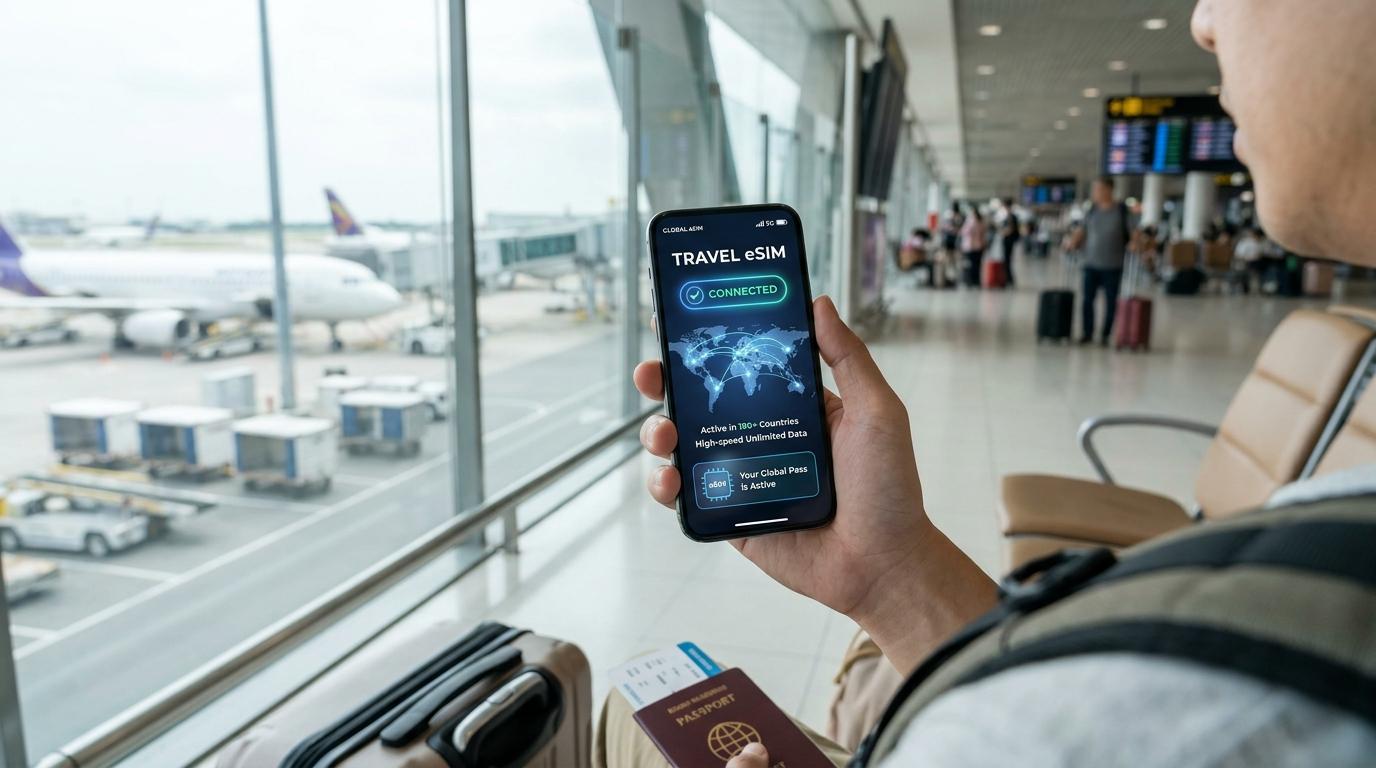
The best travel eSIM is the one that covers every country on your route, gives you enough data for the way you use your phone, and installs before you leave home. Price matters too. A cheap plan that fails at the border costs more than a fair plan that works. This guide shows you how to judge plans, which details travelers overlook, and how to set everything up in ten minutes.
You will find a clear comparison of country, regional and global plans, a plain explanation of data limits and fair use rules, a setup walkthrough, and answers to the questions people ask most before they buy.
What a Travel eSIM Does and Why Travelers Switch
An eSIM is a digital SIM that lives inside your phone. No plastic card, no tiny tray, no hunting for a shop counter at arrivals. You buy a plan online, scan a QR code or tap an install button in an app, and your phone adds a second mobile line for data.
Your home number stays active on the original SIM. That detail matters more than most people expect. Banks, airlines and messaging apps still text your usual number for login codes, and you can keep receiving them while the eSIM handles your data.
Travelers switch for three practical reasons. First, roaming charges on many home plans climb quickly, and a single hour of maps and video calls can wipe out a day of budget. Second, a travel eSIM gives you a connection the moment you land, which lets you open your ride app, message family and check your booking confirmations while you walk to the exit. Third, you can compare plans in advance instead of accepting whatever the airport kiosk offers at a crowded counter.
If you want to see the best travel eSIM plans in one place, Transpovia has an eSIM page that sits next to its airport transfer service. That way you can sort out your data and your airport ride at the same time, before you pack.
Check Your Phone Before You Compare Anything
Every comparison article skips this step, and it causes more failed purchases than any other mistake. Not every phone supports eSIM, and a phone locked to a carrier may refuse a new profile.
Open your phone settings and look for a section about mobile data or cellular plans. If you see an option to add an eSIM or add a cellular plan, your phone supports it. You can also check the model name on the manufacturer website. Recent iPhones, recent Google Pixel phones and many Samsung Galaxy models support eSIM, though older and budget models often do not.
Then confirm your phone is unlocked. If you still pay off the device through your carrier, call or message them and ask directly. A locked phone may accept the eSIM profile and still refuse to connect abroad.
Apple also notes that iPhones with a SIM tray can run a physical SIM and an eSIM together on a trip. Some newer iPhones go further. With iOS 26, a travel eSIM can switch off on its own when you return home, which keeps your phone tidy after the trip ends.
Country, Regional and Global Plans
The type of plan shapes both your price and your coverage, and you should decide this before you look at brands.
Country Plans
A country plan works in one destination. If you spend two weeks in Japan or Mexico, this is usually the most sensible choice. You pay for exactly the coverage you need, and the price per gigabyte is often lower than on wider plans.
Regional Plans
A regional plan covers a group of countries, for example Europe, Southeast Asia or the Caribbean. Pick this when your route crosses borders. A rail trip through Spain, France and Italy needs one plan, not three installs. Check the country list carefully, because regional bundles do not always include every neighboring country. Switzerland, the United Kingdom and Turkey are common gaps in European bundles, and you should look for them by name.
Global Plans
A global plan covers dozens or even more than a hundred countries on a single profile. Airalo, for example, offers a global plan that its own materials say covers 138 countries. Global plans suit people who change continents often, for example a business traveler who flies to three regions in a month. They usually cost more per gigabyte than regional plans, which means a global plan makes little sense for a single holiday in one place.
A simple rule works well. One country means a country plan. Several neighboring countries mean a regional plan. Several continents in one trip, or frequent travel to unpredictable places, means a global plan.
How Much Data Do You Need?
Most people buy too little or far too much. Think about what you actually do on a normal travel day.
Maps, messaging apps and email use very little data. Photo uploads, general browsing and social media scrolling use a moderate amount. Video calls, streaming shows and downloading large files use a lot. If you leave a phone on automatic photo backup, your data can vanish while you sleep.
A light user who relies on maps and chat during a short city break can often live on a small plan. A couple sharing one connection through a hotspot needs more. A remote worker who joins video meetings needs a lot more, and probably wants an unlimited plan or a large bucket with an easy top up.
Two habits stretch any plan. Download offline maps and essential travel information on hotel Wi-Fi the night before. Turn off automatic app updates and cloud photo backup while you travel. Both take under a minute and can cut your usage sharply.
If you are unsure, pick a plan one step larger than you think you need. Running out in a foreign city while you hunt for a driver at night is a worse problem than paying a little extra for spare capacity.
Data Only Plans and Plans With Calls and Texts
Most travel eSIMs give data only. For most travelers that is enough. WhatsApp, FaceTime, Messenger and similar apps make voice and video calls over the data connection, and your home SIM can still receive texts for verification codes.
Some providers offer plans with a local or virtual phone number, calls and text messages. These cost more, and they help if you need to ring a hotel desk, a local clinic or a driver who does not use messaging apps. They also help if your trip involves business calls to landlines.
Ask yourself one question. Who needs to reach you by regular phone call while you are away? If the answer is nobody, a data plan wins on price every time.
Unlimited Plans and What Fair Use Really Means
Unlimited promises freedom, and for heavy users it can deliver. Providers for example Holafly focus on unlimited plans, and many other brands now sell them too. Read the fine print, though. Many unlimited plans apply a fair use policy. After you use a set amount in a day, your speed drops to a slower level or the provider restricts certain activity.
Hotspot rules vary too. Some plans allow you to share your connection with a laptop or a travel partner. Others block it. If you work on a laptop at cafes, check the hotspot policy before you pay, because it can decide the whole purchase.
For a short trip with moderate use, a fixed data plan often costs less than an unlimited one. For a long trip with daily video calls, unlimited plans can save money and stress.
How to Compare Travel eSIM Providers
Brand names change quickly, and rankings online shift every month. A better approach is to compare the same list of details across any provider you consider.
Coverage and Network Quality
Look at which local networks the plan uses in your destination. Providers partner with different carriers in each country, and quality varies between cities and rural areas. If you will drive through the countryside or hike, coverage maps and traveler reviews for that exact place carry real weight.
Validity and Start Date
Plans expire after a set number of days. Some start counting when you install the eSIM. Others start when the phone first connects to a network in the destination. This detail changes when you can safely install, and you should read it closely. If the clock starts at install, wait for the day you leave.
Top Ups
Running low on data is common on longer trips. Some providers let you add data to the same eSIM, and a few let you top up even after your data has run out. Ubigi does this, according to a review in Gourmet Traveller. Others make you buy and install a new profile. A smooth top up spares you a stressful moment in a foreign terminal.
Usage Based Billing
A few services, for example Roamless, charge for the data you actually use rather than selling a fixed bundle. This suits travelers who find it hard to predict their needs, and it makes budgeting less exact.
Support and Refunds
Check that customer support answers in a language you speak and offers live chat. Look for a clear refund or replacement policy if installation fails. A support team that replies within minutes beats a slightly lower price.
The Cheapest Travel eSIM Without Bad Surprises
Everyone searches for the cheapest travel eSIM, and the honest answer depends on your trip. The lowest price per gigabyte usually belongs to country plans and large buckets. The lowest total price usually belongs to a small plan that matches a short trip.
Watch for three traps. The first is a very cheap plan with a short validity window that expires before your trip ends. The second is a low price for a country list that excludes a stop on your route. The third is a plan with a headline price that rises once you add the data you need.
Compare total cost for your whole trip, not the number on the front page. Add up your days, estimate your data, and pick the plan that covers both with a small margin.
The Right eSIM for Each Type of Traveler
A weekend city break. A small country plan is enough. Pick the shortest validity that covers your dates.
A two week holiday in one country. A mid sized country plan with a top up option gives flexibility. Add a little extra if you plan to use ride apps and maps all day.
A multi country rail or road trip. A regional plan makes sense. Check each country on your route in the coverage list.
A family trip. One adult can buy a larger plan and share a hotspot, if the plan allows it. Check how many devices can connect at once. Teenagers with their own phones may need their own eSIMs, because streaming adds up fast.
A business traveler. Choose a plan with reliable networks, a clear hotspot policy and fast support. An unlimited or large plan removes worry on days full of calls.
A long stay or digital nomad. Look for monthly plans, easy renewals and good network partners. Switching to a local SIM may become cheaper after the first weeks, and you should compare once you arrive.
How to Install and Activate Your eSIM
The process takes about ten minutes. Do it at home on stable Wi-Fi, not in a crowded arrivals hall.
-
Buy your plan and wait for the confirmation email or in app message.
-
Open your phone settings and choose the option to add an eSIM or cellular plan.
-
Scan the QR code, or follow the app prompt to install the profile.
-
Label the new line with something clear, for example Travel Data.
-
Leave the eSIM switched off before you land if the validity starts at install.
-
After landing, turn on the eSIM line and enable data roaming for that line only.
-
Set your home SIM to not use mobile data, which avoids roaming charges on your normal plan.
Screenshot your QR code and confirmation email before you leave. If a phone reset or an app problem hits you abroad, those saved details can rescue the whole setup.
Using Your Connection at the Airport
A working data connection at arrival makes the first hour of your trip calmer. You can open your maps, send a message to your host and check your flight status without hunting for open Wi-Fi.
It also makes your ride easier. If you booked a private airport transfer, your driver may send a message with pickup details, and you can reply right away. Transpovia is a ground transportation marketplace for airport transfers and private rides, and many travelers book a transfer before they fly and rely on their data connection to keep in touch with the driver when they land.
Landing in a new country at midnight was far less stressful with data already working. I messaged our driver while still on the plane and he was waiting when we walked out.
Mistakes That Cause Most Travel eSIM Problems
Most failures trace back to a short list of errors.
-
Buying for the wrong country or region and discovering the mistake after landing.
-
Installing the eSIM without a stable connection, which can block a full profile download.
-
Forgetting to turn on data roaming for the travel line. Many eSIM plans need it enabled.
-
Leaving the home SIM allowed to use mobile data, which can create roaming charges.
-
Deleting the eSIM profile by accident. Some eSIMs cannot be reinstalled with the same QR code.
-
Waiting for the departure gate to buy. Airport Wi-Fi can be weak and slow.
If your phone shows no signal after landing, restart it first. Then check that the right line is selected for data, that roaming is on, and that the network selection is set to automatic. If that fails, contact the provider support through live chat and share your order number.
FAQs
What is the best travel eSIM for most people?
The best travel eSIM depends on your destination, trip length and data habits. For one country, a country plan with strong local network partners works well. For several countries, a regional plan keeps things simple. For frequent flying across continents, a global plan saves time.
Is a travel eSIM cheaper than roaming?
In many cases yes, because roaming rates on home plans can be high. Your own carrier may offer daily travel passes, though, and you should compare the daily price with an eSIM for your trip length. Check your carrier terms before you decide.
Can I keep my home number while using a travel eSIM?
Yes, on most phones. Your home SIM stays active for calls and texts, and the travel eSIM handles data. Turn off mobile data on the home SIM to avoid roaming charges.
What is the best eSIM for international travel across several continents?
A global plan fits this case best. Compare the country list, the validity and the price per gigabyte, and confirm that every destination on your route appears on the list.
How much data do I need for a week abroad?
Light use with maps and messaging needs little. Regular social media, music and photo sharing needs a moderate plan. Daily video calls or streaming needs a large or unlimited plan. Download offline maps and turn off automatic backups to stretch what you have.
Can I share my eSIM data with other people?
Only if the plan allows hotspot sharing. Some providers allow it freely, some limit it and some block it. Check the plan terms before you buy.
What happens if my eSIM does not work after I land?
Restart your phone, select the travel line for mobile data, turn on data roaming for that line and set network selection to automatic. If it still fails, contact the provider support and share your order details.
When should I buy a travel eSIM?
Buy it a few days before you leave and install it at home on Wi-Fi. Then activate it on arrival, following the start rules of your plan.
Conclusion
Picking the best travel eSIM comes down to five checks. Confirm your phone supports eSIM and is unlocked. Match the plan type to your route. Estimate your data honestly. Read the validity, hotspot and top up rules. Compare total trip cost instead of headline price.
Install the plan at home, save your QR code, and keep your home SIM for calls and codes. Then you land with a working connection, ready to message your driver, open your maps and start your trip without stress. When you plan your next flight, book your airport transfer with Transpovia too, and arrive with both your data and your ride sorted.


