
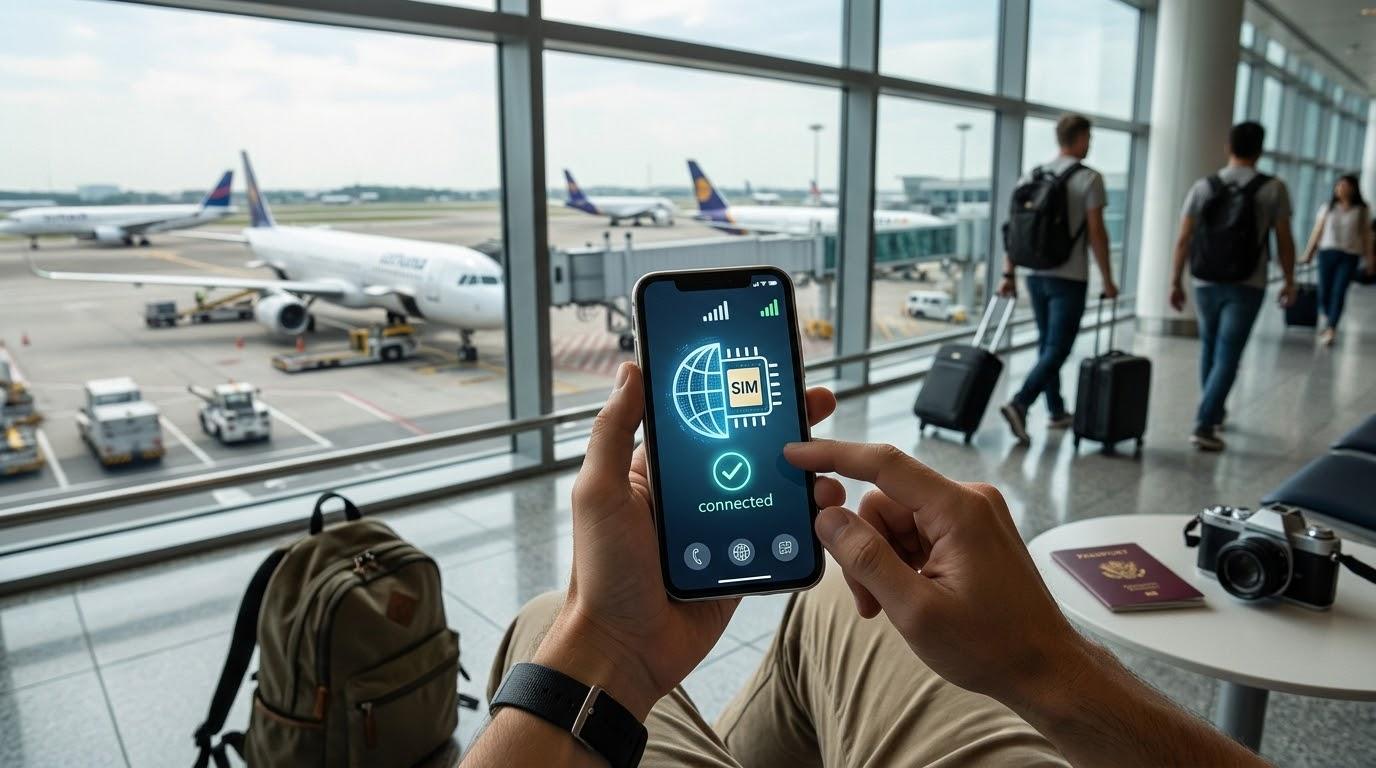
The best global eSIM is not the one with the biggest country count on the banner. It is the one that covers every stop on your route, gives you enough data for the full trip and works with your phone. Plenty of plans use labels including global, worldwide and international for very different products. This guide shows you how to read those labels, build a country list, size your data and decide when one global plan beats several smaller ones.
What global really means on an eSIM plan
A global eSIM is a travel data plan that works in many countries with one install. You scan one QR code at home, and your phone connects to local networks when you land in new places. You do not buy a new plan at each border, and you do not hunt for a shop in a new language.
The word global stretches a long way. Country counts on global plans range widely, between about 50 and well over 150, depending on the provider. Some plans cover most of Europe, North America and Asia and leave out parts of Africa, the Middle East or small island nations. Others list nearly everywhere and limit data to a small fixed amount. A plan with 130 countries on the banner can still miss the one you need.
Make the list of covered countries the main fact on the page. Read the names, not the number. If your route includes a smaller destination, for example an island or a mountain nation, look for it by name before you pay.
You can compare global eSIM plans on the Transpovia eSIM page before you travel and match each plan to your country list. Look at the data amount, validity, hotspot policy and coverage notes side by side.
Global, regional or country plans
Three plan types cover most trips, and each wins in a different situation.
Country plans
A country plan covers one destination. It usually offers the best price per gigabyte, and it often gives access to the strongest local networks. It fits a week in a single country or a long stay.
Regional plans
A regional plan covers a group of countries, for example most of Europe or a set of Asian nations. If your trip stays in one region, a regional plan often beats a global plan on value because the provider spends less on far away networks.
Global plans
A global plan covers countries across several continents. It costs more per gigabyte than a country plan. You pay for flexibility. It pays off when you visit three or more countries on different continents, when your route may change on the road or when you travel often for work.
A practical rule helps here. If every stop sits in one region, start with a regional plan. If your stops span continents, or you do not know your next stop, a global plan saves time and stress.
Build your route list first
Before you compare anything, write down every country you may enter, including layovers. People forget airport stops, and a long layover in a country that sits outside your plan can leave you without data when you need it.
For each country on the list, check three things on the plan page. Is the country named. Is the network type listed, for example 4G or 5G. Are there any special notes for that country, for example lower speeds or a smaller data cap.
Keep this list in your notes. It becomes your checklist for comparing plans and for contacting support if something fails.
Fixed data, unlimited and pay per use
Global plans come in three pricing styles, and they suit different habits.
Fixed data plans. You buy a set number of gigabytes for a set number of days. This is the most common style for global plans. It gives you a clear budget and no daily throttling. You need to estimate your use with care, because top ups can cost more than the first purchase.
Unlimited style plans. Some global plans offer unlimited data with a fair use rule. You get a daily amount of fast data, and speed drops after that. These plans are rarer on the global level than on country plans, and the daily amount can be small. Check the speed after the limit and the countries where unlimited applies, since some providers offer true unlimited only in selected places.
Pay per use plans. A few providers charge for the data you actually use, with no fixed bundle. This suits people with unpredictable needs. It also needs close watching, because costs rise when you stream or share your connection.
How much data a world trip needs
Many travelers use about 0.5 to 1 GB per day on maps, messaging, photos and social apps. That gives you a simple formula. Multiply the number of days by your daily use, then add a safety margin of around 20 to 30 percent for surprise days. A 14 day trip at 0.75 GB a day needs about 10.5 GB, which means a 15 GB plan leaves room.
Heavy habits change the math. Video calls, streaming and hotspot use can multiply your daily use several times. If you work on a laptop using your phone connection, plan for a much larger bundle or an unlimited style plan with a clear hotspot rule.
Light users save money by downloading maps, travel documents and essential information on hotel Wi-Fi. Offline maps alone can cut daily use by a large share.
Validity and when the clock starts
Global plans come with a validity period, often lasting a week up to a few months. Two details matter. The first is the length. Pick a validity that matches the full span of your trip, since a plan that expires on day 20 of a 25 day trip leaves you stuck. The second is the start rule. Some plans start counting when you install the eSIM, and others when you first connect to a supported network. The second rule is friendlier when you install days before you fly.
Ask about top ups. A plan that allows an extension through the same eSIM profile spares you a second install, which is useful if you run out of data on a quiet mountain road with weak WiFi.
Hotspot, calls and your home number
Most global eSIMs carry data only. You will not get a local phone number, and you cannot make regular calls on the plan. Messaging apps and video call apps use data and cover most conversations.
Keep your home SIM active in the second slot. Banks and some apps still send codes by text to your regular number. Set the home line for calls and texts, set the eSIM to carry your data and turn off data roaming on the home line to avoid charges.
Hotspot rules vary. Some global plans allow tethering with no extra cap, others limit it and some block it. If you share your connection with a laptop or a partner's phone, read the policy before you buy.
Where global plans have gaps
Global plans work through partner networks in each country, and quality varies. In big cities and tourist areas, you will usually see strong 4G or 5G. In rural areas, mountains and small islands, speeds can drop or coverage can end.
Some countries are left out of global plans altogether, often because of local rules or high network costs. This is why reading the country list matters more than trusting the headline.
Public WiFi in airports and hotels may look cheaper than a plan, and it carries privacy risks. A personal data connection avoids logging into banking apps on shared networks. If you use hotel WiFi often, a VPN adds a layer of protection.
A global base plus a local top up
Long trips often work best with a mix. Use a global plan for your base to give you coverage the moment you land. Then add a country or regional plan for places where you stay several weeks. Local data costs less per gigabyte, and local networks often perform better.
This approach suits round the world travelers, digital nomads and people who split a trip between fast moving weeks and slow stays. You keep a working connection at every border while you save money in the places where you stay longest.
Choosing by traveler type
The one week multi country holiday
A global or regional plan with a modest fixed bundle will do. Make sure every country is named.
The backpacker
Look for long validity, top up options and a price that suits a tight budget. A global base with local top ups usually works best.
The business traveler
Look for reliable speed, hotspot support and good customer service. Time zones make support hours important, and you should check how the provider handles chat and email.
The family
Count devices. Some families buy a plan per adult phone, and others share one plan through hotspot. If you share, check the cap and the battery impact on the host phone.
The frequent flyer
If you cross borders often, a plan that you can reuse and top up saves repeated installs. Check how long the profile stays valid after the data runs out.
Compatibility and installation
Your phone must support eSIM and be network unlocked. Recent iPhones, Samsung Galaxy phones and Google Pixel phones support eSIM, though models sold in some countries may only take a physical SIM. You can check in the settings under mobile data or SIM, or ask your carrier.
Install at home with stable WiFi. Scan the QR code, give the line a clear name for example Travel Data and set it to carry your data. Keep data roaming off on the eSIM before you land, unless the provider says otherwise. Save a screenshot of the QR code and the support contact in your photos.
Three sample routes and what each one needs
Two weeks in Western Europe with a few days in Morocco
A regional European plan handles most of this trip well. Morocco may sit outside that region. Compare one global plan that names every country with a regional plan plus a small country plan for the last leg. Count the total data and the number of installs, then pick the option that leaves you less to manage.
A month across Southeast Asia
You cross borders by bus, train and boat, and the signal often drops between cities. A regional Asian plan that names each country usually beats a global plan on value. If one border town sits outside the list, buy a small local plan for that stop.
Four months around the world
A global plan makes a strong base here. It connects you at every landing without any shopping. Add a local plan for the longest stays, for example a full month in one city, where local data costs less and local networks run faster.
Small habits that stretch your data
A fixed bundle lasts much longer when you give a little thought to how your phone uses it.
-
Turn off video autoplay in social apps.
-
Download offline maps for each city while you still have hotel WiFi.
-
Set app updates to run on WiFi only.
-
Pause cloud photo backup while you travel.
-
Open your phone settings each evening and look at which apps used the most data.
-
Limit background refresh for apps you do not need on the road.
These steps cost nothing, and they can turn a tight bundle into a comfortable one. They also protect you on days when you land in a country with weaker coverage and need every megabyte for maps and messages.
What to do when the network does not appear
Even a well chosen plan can stumble on arrival. Run through the same short routine each time before you write to support. Check that the eSIM line is on and chosen for mobile data. Check that data roaming is switched on for the eSIM line. Restart the phone and wait a minute. Open the network list in your settings and pick a supported network by hand if the phone does not choose one. If nothing works, send the support team a screenshot of your plan page and the country you are in. A clear message gets a faster answer than a vague one.
Common mistakes
-
Trusting the country count and not reading the country list.
-
Forgetting layover countries.
-
Buying a global plan for a trip that stays in one region.
-
Underestimating data for a long trip.
-
Leaving data roaming on for the home SIM.
-
Ignoring the validity start rule.
-
Installing the eSIM at the airport with no WiFi.
-
Deleting the profile before checking if it can be topped up.
The first hour after you land
Your first hour in a new country sets the tone. You need to message your host, confirm your address, open train tickets and find your driver. With working data the moment you leave the plane, all of this takes less effort.
If you book a private transfer, keep the confirmation and the driver contact in an offline note. Transpovia is a ground transportation marketplace that brings together airport transfers and private rides. A phone that works on arrival makes the meeting point easier to find, especially in large terminals.
"We changed countries four times in three weeks and never had to think about SIM cards once."
FAQs
What is the best global eSIM for a trip across several continents?
The best choice is the plan that names every country on your route, offers enough data for your full trip and allows the hotspot use you need. Compare plans using your own country list.
Does a global eSIM work in every country?
No. Global plans cover many countries, though the number varies widely and some places are excluded. Always check the country list by name.
Is a global eSIM cheaper than several local plans?
Not always. Local and regional plans often cost less per gigabyte. A global plan wins on convenience and flexibility, especially when your route spans continents or may change.
How much data should I buy for a world trip?
Multiply your days by your daily use, which is often 0.5 to 1 GB, then add 20 to 30 percent. Add more if you stream, make video calls or use hotspot.
Can I top up a global eSIM during the trip?
Many providers allow top ups through the same profile. Check this before you buy, since it spares you a reinstall.
Will I keep my regular number for calls and texts?
Yes, if your home SIM stays active in the second slot. Turn off data roaming on that line to avoid charges.
Is a global eSIM safe to use on public networks?
A personal data connection is generally safer than open public WiFi. For extra protection, use a VPN on shared networks.
Conclusion
The best global eSIM matches your route, your data habits and your phone. Write down every country, including layovers. Estimate your data with a safety margin, check the validity rule and read the hotspot policy. When your route stays in one region, a regional plan may serve you better, and for long stays a local top up can save money.
Once your connection is sorted, plan your arrival. If you want a driver waiting after you land, look at the airport transfer options on Transpovia and book your ride before you fly.


