
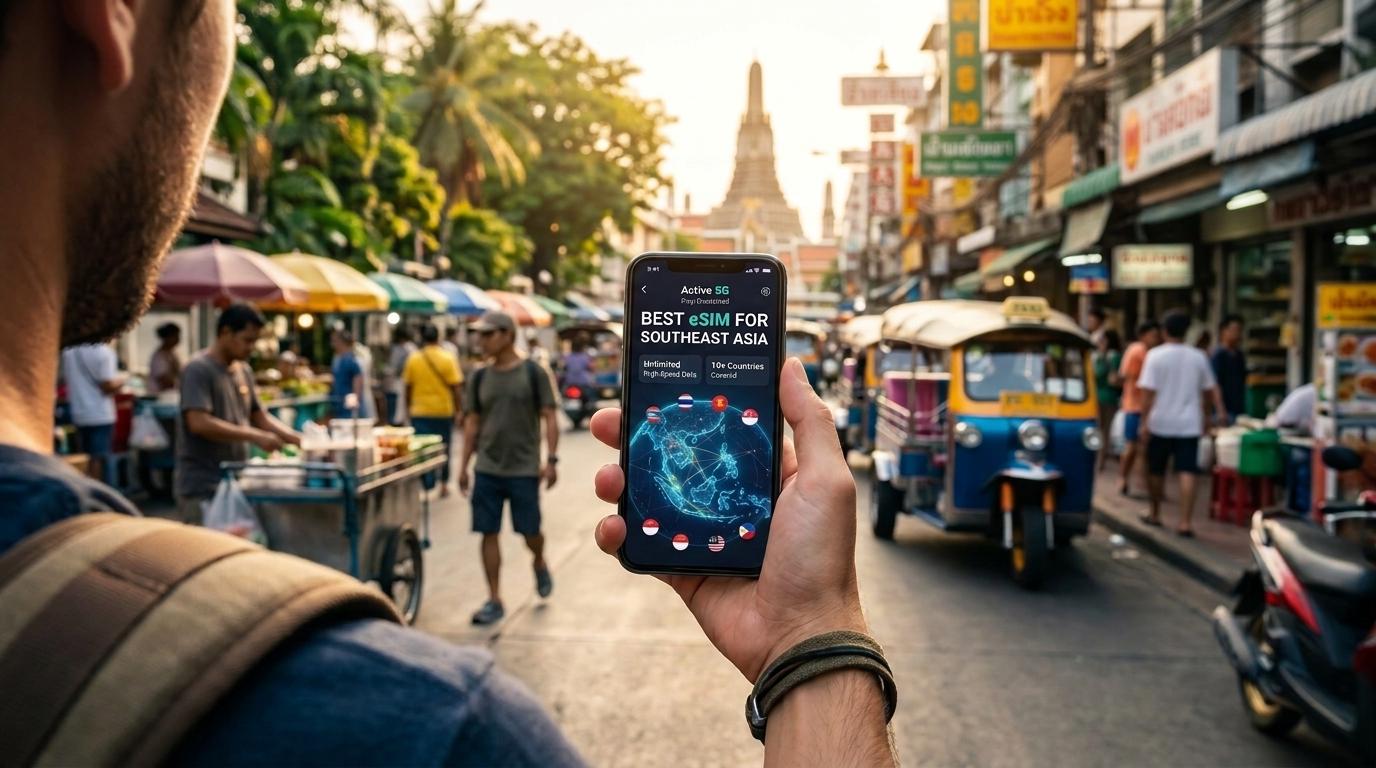
The best eSIM for Southeast Asia is a regional plan that covers every country on your route, starts its clock when you first connect, and gives you enough data for maps, ride apps and messages. One profile spares you a new SIM at every border, and it lets you land in Bangkok, Hanoi or Denpasar with data already working. The right choice still shifts with your trip length, your route and your phone. This guide explains what to compare, how regional and single country plans differ, how coverage behaves in each country, and the small setup details that decide if your data works on day one.
What Makes an eSIM a Good Fit for Southeast Asia
An eSIM is a digital SIM profile that you install with a QR code or an app instead of a plastic card. Travel eSIMs carry mobile data only. Calls and texts then run through apps, for example WhatsApp, Line, Zalo or Grab chat.
Plans that look identical on a product page often behave differently once you are on the road. These six points mark the difference between a plan that works and one that frustrates you.
-
Country list. Regional plans differ more than the marketing suggests. Most include Thailand, Vietnam, Indonesia, Malaysia and Singapore. Cambodia, Laos, the Philippines and Brunei appear on some lists and not on others, and Myanmar is often missing. Reading the full country list before you pay takes two minutes and prevents the most common surprise.
-
Shared data pool. A regional plan gives you one balance that you spend in any covered country, which suits a route where daily use stays similar.
-
Validity clock. Some plans start counting the day you install, and others wait for the first connection to a local network. The second type lets you install at home without losing days.
-
Hotspot rules. Many plans allow tethering, and a few block it or cap it. Anyone who plans to work on a laptop should confirm this first.
-
Local network partners. An eSIM connects to local operators. Your coverage therefore matches the partner network in each country and not the brand on the checkout page.
-
Support and refund terms. A live chat that answers in your language matters most at an airport at midnight.
Regional eSIM or Single Country Plan
A regional eSIM covers several countries with one profile and one data balance. A single country eSIM covers one destination, usually with more data for the price. Regional plans win when a route crosses three or more borders, when you want one QR code for the whole trip, or when the whole trip lasts under about a month. Country plans win when you spend two weeks or more in one place, because the cost per gigabyte tends to drop and some local plans add a real phone number.
Many travelers mix the two. They use a regional plan while they move, then switch to a local plan once they settle in Chiang Mai, Canggu or Da Nang for a long stay. Transpovia, a ground transportation marketplace for airport transfers and private rides, also lists a Southeast Asia travel eSIM for guests who want data ready before the first pickup.
A multi country Southeast Asia eSIM also suits families and groups better than most people expect. One person can buy and install each profile, and everyone avoids the scramble for local SIM counters after a long flight. Backpackers gain the most. A typical route through Bangkok, Chiang Mai, Luang Prabang, Hanoi and Siem Reap would otherwise need several separate SIMs.
eSIM, Local SIM, Roaming or Hotel WiFi
Four options compete for the same job, and each has a clear strength.
Home carrier roaming needs no setup. Daily passes vary widely between carriers, and the cost climbs fast on a route that lasts several weeks. A local physical SIM often gives the best data per dollar in one country, though it means a shop visit, usually a passport, and a fresh SIM at every border. A travel eSIM sits between the two, with a quick install and fair pricing across borders. Hotel and cafe WiFi helps with big downloads and rarely helps on a street corner at night when a ride app has to find you.
Most travelers end up using WiFi for heavy tasks and the eSIM for everything that happens while they move.
Which Traveler Needs What
Backpackers do best with a regional plan, a modest data allowance and a top up option, since their route often changes on a whim. Families do well with a plan that allows hotspot sharing, because one phone can then cover a tablet or a second adult's phone in a pinch. Remote workers need a larger allowance, clear fair use terms and a local plan once they settle in one city. Short city breakers who visit one country for a week usually do better with a single country eSIM than a regional bundle.
Coverage Country by Country
Networks across the region keep improving, though quality still shifts between islands, valleys and highways. These notes describe typical patterns, and a plan's own coverage map has the final word.
Thailand
Thailand has strong 4G across cities and popular islands, with 5G in central Bangkok and other busy urban areas. Networks can slow during Songkran and Yi Peng, when crowds fill the same cell towers, and overnight trains often lose signal outside towns. Arrivals at Suvarnabhumi who want a physical tourist SIM often face a queue, which is one more reason to land with an eSIM ready.
Vietnam
Vietnam offers strong 4G in Hanoi, Ho Chi Minh City, Da Nang and Hoi An, with good service on Phu Quoc. Ha Long Bay cruises have little signal, trekking routes near Sapa are unreliable, and sleeper buses cross dead zones. Airport counters can be slow, and a profile installed at home saves time. Mobifone and Viettel are the networks that travel eSIMs most often use.
Indonesia
Southern and central Bali are well covered, while the rural north and east are weaker. Nusa Penida and Nusa Lembongan have improved, the Gili Islands can feel slow, and Komodo is remote. Telkomsel is widely seen to be the most reliable network in the country. The IMEI registration rule mainly concerns local Indonesian SIMs and stays beyond 90 days, which means a short trip rarely runs into it.
Malaysia and Singapore
Kuala Lumpur and Penang perform well, while the Cameron Highlands and Borneo's jungle interior are thin. Singapore offers near total 4G coverage, with signal in the tunnels on most MRT lines, and Singtel has a name for speed.
The Philippines
Manila, Cebu and Boracay connect well, and remote stretches of Palawan drop out. Globe and Smart share the country, with Smart often stronger on outer islands. The Philippines is absent on some regional country lists, which makes a quick check before purchase worthwhile.
Cambodia, Laos and Myanmar
Phnom Penh and Siem Reap have solid 4G, and Sihanoukville is inconsistent. Laos is the weakest link in the region. Vientiane and Luang Prabang work fine, while mountain and rural areas may offer 3G or nothing. Myanmar works in the main cities, and some providers have dropped it. Travelers heading there should confirm it appears on the plan.
How Much Data to Buy
Habits drive usage, and a rough guide still helps. Maps, messaging and light browsing usually use around 1 GB a day. Regular social video and photo uploads push that toward 2 GB, and video calls or hotspot work for a laptop can pass 3 GB. These figures are estimates, and your phone's usage screen for the past month gives a better baseline than any table.
Adding two or three spare days to the validity period protects against delayed flights and slow first days. Unlimited plans sound ideal, and many slow down after a daily or total threshold. The fair use terms matter more than the word unlimited. A fixed plan with a top up option often costs less for light users.
Speed deserves a brief word too. 5G access depends on both the plan and the phone, and most travelers find 4G fast enough for maps, video calls and uploads. Dense cities handle the load well, and remote areas matter far more than peak speed.
Phone Compatibility and Setup Before You Fly
The phone must be unlocked. Most iPhones since the XS, Google Pixel phones since the Pixel 3, and Samsung Galaxy S20 and newer models support eSIM. Phones sold in mainland China often lack eSIM support. A phone locked to a home carrier will refuse a foreign profile. Travelers with financed phones should ask the carrier to unlock it before departure.
Most travelers install the eSIM at home on stable WiFi, label it clearly, for example Southeast Asia, and keep its data switched off before landing. After touchdown they turn on the eSIM line, enable data roaming for that line only, and select it for mobile data. Plans that start the clock at first connection begin counting at that moment. If the signal does not appear within a few minutes, restarting the phone or choosing a local network by hand usually fixes it.
I installed it at the kitchen table the night before, and when we landed in Phuket my phone just worked. Nobody had to hunt for a SIM stand with two tired kids.
Installing early also exposes problems while WiFi is still available. On many plans the QR code installs only once. Deleting the profile can then mean paying for a new one.
Keeping Your Home Number for Bank Codes and Calls
Dual SIM lets the eSIM carry data while the home SIM stays on standby for calls and texts. Banks and apps often send one time codes by SMS to the home number, and losing that line can lock you out of a payment in Ho Chi Minh City. Turning data roaming off on the home line keeps roaming charges away, and WiFi calling can handle voice if the home carrier offers it. Travelers should also ask their carrier about charges for incoming texts abroad, since policies differ between plans.
Border Crossings, Ferries and Night Buses
The strength of a regional eSIM shows at land borders. Phones usually pick up the next country's partner network within minutes of crossing, and toggling airplane mode or choosing a network manually helps when they lag. Overland routes, for example Thailand to Cambodia or Vietnam to Laos, pass through patches with weak signal. Offline maps and saved tickets take the stress out of those stretches.
Ferries between islands and long mountain roads in Laos can cut data for hours. A plan that lists Laos matters on a Hanoi to Luang Prabang route, since some regional plans skip it.
Arrival Forms, Airport Pickups and the First Hour
Several countries ask foreign visitors to complete a digital arrival form before landing. Thailand requires the Thailand Digital Arrival Card within three days before arrival. Malaysia asks for the Malaysia Digital Arrival Card in the same window, and Singapore has the SG Arrival Card with a similar three day window. The Philippines uses eTravel, and Indonesia uses the All Indonesia system. Rules change. The official government sites always have the latest word.
Passengers fill these in at home on regular WiFi, and the eSIM then covers what comes after landing, for example translation, maps and messages with a driver. Ride apps need data, Grab and Gojek among them, and some ask for an SMS code that lands on the home line, which is one more reason to keep dual SIM active.
A pre booked airport transfer works best when the traveler can read driver messages the moment the plane lands. That holds for a Transpovia booking and for any other.
Mobile Data Instead of Public WiFi
Airport, hotel and cafe networks are open to many strangers at once, and banking or booking on them carries a risk that private mobile data avoids. An eSIM connection runs through a local mobile operator, which makes it a safer default for payments, ticket purchases and logins. A VPN adds another layer for travelers who handle sensitive work. Public WiFi still earns its place for large downloads, and a sensible habit is to keep money tasks on the eSIM.
Mistakes That Waste Data and Money
-
Buying a country plan for a multi country route. Data stops at the border, and a new purchase at a bus station costs time.
-
Skipping the country list. A plan that leaves out Laos or the Philippines looks identical to one that includes them.
-
Leaving the home line on for mobile data. This can trigger roaming charges that dwarf the cost of any eSIM.
-
Testing too late. Problems show up faster at home than in a midnight arrival hall.
-
Ignoring tethering limits. A laptop can drain a small plan in an afternoon.
FAQs
Is a regional eSIM better than buying a local SIM in each country?
For a route with three or more countries, a regional eSIM usually saves time and often money. A local SIM can still win in a single country on a long stay, since it may give more data and a local number.
Which countries does a Southeast Asia eSIM usually cover?
Most plans include Thailand, Vietnam, Indonesia, Malaysia and Singapore. Cambodia, Laos, the Philippines and Brunei vary by plan, and Myanmar is often excluded. The country list on the plan page settles it.
How much data do I need for two weeks in Southeast Asia?
Light users often manage on about 1 GB a day, and regular social video or hotspot use can push the figure to 2 or 3 GB. Add a few spare days of validity for delays.
Can I keep WhatsApp and my home number?
Yes. WhatsApp keeps working on the eSIM data connection with the same number, and a dual SIM phone can keep the home line active for calls and bank codes.
Does an eSIM work on trains, buses and islands?
It works wherever the partner networks reach. Overnight trains, sleeper buses, mountain roads and remote islands can lose signal, and offline maps help in those stretches.
When should I buy and install my Southeast Asia eSIM?
A day or two before departure works well. That leaves time to test the installation on home WiFi and fix any device issues before the flight.
Can I share my eSIM data with a laptop?
Many plans allow it, and some limit or block it. The plan terms say which applies, and heavy laptop use can drain a small allowance quickly.
Conclusion
The best eSIM for Southeast Asia matches your actual route. Count the countries, confirm that each one appears on the list, estimate your daily data, and pick a validity window with a few spare days. An unlocked phone with an early install and the eSIM chosen for data covers most of the rest.
Good connectivity also makes the ground journey easier. A traveler can read a driver's message at the airport and find a hotel after dark without hunting for WiFi. Transpovia helps travelers line up airport transfers and private rides in the region, and a connected phone makes any of those pickups smoother.


