
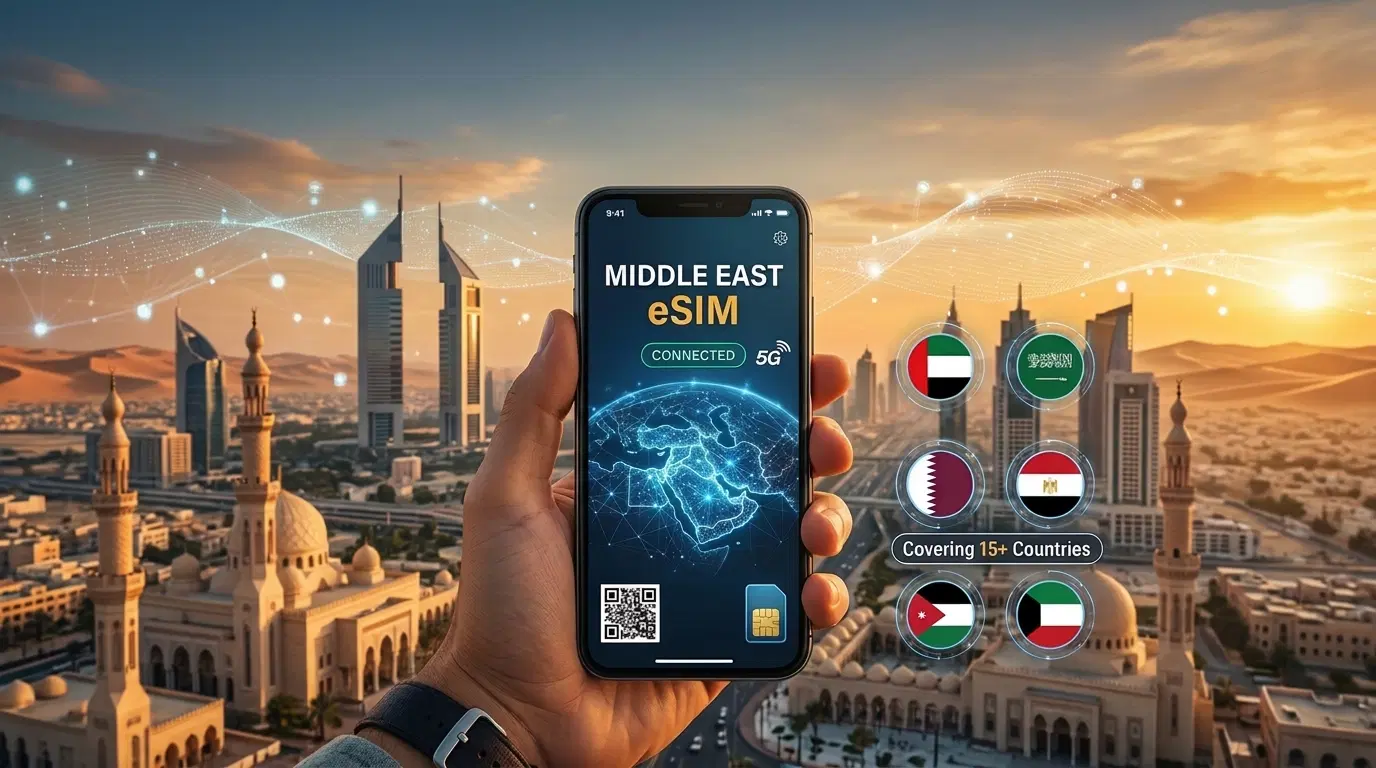
The best eSIM for Middle East travel is the plan that lists every country on your route, runs on strong local networks, and gives you enough data for maps, messages, and ride requests. Price matters less than those three points. A cheap plan that skips Oman or drops out near the Saudi border costs far more in stress than a slightly dearer plan that covers the whole itinerary.
This guide explains how to judge a plan before you pay. It covers what providers mean by "Middle East," when a regional plan beats a country plan, how coverage and fair use limits work, and why WhatsApp calls behave differently in Dubai than they do at home. It also walks through setup, pilgrim trips, business travel, and the first hour after landing.
What "Middle East" Means on an eSIM Plan
No standard list exists. Each provider draws its own map, and plans cover anywhere between five and eighteen countries. One plan may cover the UAE, Saudi Arabia, Jordan, Israel, and Turkey. Another adds Kuwait, Oman, Qatar, and Bahrain. A few reach Egypt, Morocco, or the Caucasus. Some well known plans leave Egypt out completely, which surprises travelers who assumed Cairo came with the package.
The Gulf has its own shorthand. A Gulf region eSIM usually means the six Gulf Cooperation Council countries, which are the UAE, Saudi Arabia, Qatar, Kuwait, Bahrain, and Oman. That grouping suits a trip that links Dubai, Doha, and Muscat. The Levant sits in a different bundle, where Jordan and Israel are the usual members. An itinerary that mixes Amman and Riyadh therefore needs a closer look at the fine print.
The label on the product page is marketing. The country list underneath is the only part that counts. Before paying, a traveler should write down every country on the route and every layover where leaving the airport is possible, then compare that list with the plan. A Middle East travel eSIM that matches the route on paper behaves the way you expect once you land, and comparing its country list with your itinerary takes only a few minutes.
Regional eSIM or Country eSIM
Both types work well. The right pick depends on how many borders the trip crosses and how long you stay in each place.
When a Regional Plan Makes Sense
A regional Middle East eSIM earns its place when the trip crosses borders. A week might start in Dubai, continue by road to Muscat, and end in Doha. One profile and one data balance follow you through each crossing, and the phone picks up a partner network on its own. No counter queue, no passport check at a kiosk, and no second QR code in an arrivals hall slow the trip down.
Regional plans also help travelers who change their minds. A family that adds Jordan to a Dubai holiday at the last minute does not need to buy anything new, provided Jordan sits on the list. The trade-off is cost. A multi country Middle East eSIM often carries a higher price per gigabyte than a single country plan, and some versions come with smaller allowances or shorter validity.
When a Country Plan Wins
A traveler who spends ten days in the UAE and nowhere else usually gets more data for the money out of a country plan. Some providers also reserve their largest or unlimited tiers for single country products. That fits a beach holiday, a conference week in Riyadh, or a long stay in Doha.
Modern phones store several eSIM profiles, which makes mixing possible. A traveler might install a country plan for the main destination and keep a small regional plan for a side trip. The one rule is to switch the active data line before a border crossing, because the phone will not guess which profile you meant.
Coverage Checks That Matter Before You Buy
Providers rarely run their own towers. They buy access on local carriers, and the quality of those carriers decides how the plan feels in practice.
Network Partners and 5G
Product pages should name the network partners for every country. In the UAE the local networks are e& and du. Saudi Arabia has STC, Mobily, and Zain, and Qatar has Ooredoo and Vodafone Qatar. Plans that switch automatically among several partners tend to hold a signal better in hotels, malls, and underground car parks. A plan tied to a single partner can be excellent or poor, which depends on where you stand.
Fast 5G concentrates in large cities. Riyadh, Jeddah, Dubai, Abu Dhabi, and Doha have strong coverage, while desert roads and mountain areas can slow down or drop out. In Saudi Arabia, 4G reaches almost every populated area, though the empty desert stays thin. Offline maps matter on any route that leaves a city, because a working eSIM cannot create a signal where no tower exists.
Fair Use Limits and Hotspot Rules
"Unlimited" rarely means unlimited. Many plans run at full speed up to a set amount and then slow down sharply. Others cap the daily allowance. A traveler who streams video or tethers a laptop should read the fair use policy before buying, since a throttled connection in the middle of a video call helps nobody.
Hotspot rules vary too. Some plans allow sharing with other devices, some restrict it, and a few block it. Families and remote workers who share one connection across a phone, a tablet, and a laptop need to confirm that line in the plan details.
Calls, WhatsApp, and VoIP Rules in the Gulf
Most travelers run into this issue only after landing. Voice over internet protocol, or VoIP, gets different treatment across the region, and the rules shape which eSIM habits make sense.
The UAE is the strictest. On local networks, WhatsApp voice and video calls and FaceTime calls fail to connect for residents and visitors alike. Text messages, photos, and voice notes work normally. Hotel Wi-Fi follows the same restrictions in most cases, which leaves the call stuck on its connecting screen.
Qatar sits in the middle, with restrictions that vary and appear to change over time. Oman is inconsistent. Kuwait and Bahrain generally allow internet calling, and most current guides say the same for Saudi Arabia, where VoIP restrictions ended in 2017. That list is only a snapshot, because regulators adjust their positions without much notice.
A travel eSIM changes the picture in a useful way. Many providers route traffic through a gateway outside the country, and the call filtering happens inside local networks. For that reason WhatsApp calls often work on a travel eSIM in places where a local SIM blocks them. Often is not always, and no provider can promise it. Travelers who must reach family or clients by voice need a backup, for example Botim, a licensed calling app in the UAE, or an agreement to make text messages the main channel.
Rules around VPNs carry legal limits in the UAE, which makes a VPN a last resort at best. Business travelers who depend on video meetings should test their meeting platform on the eSIM before an important call, because some platforms struggle on local networks.
One more habit matters. Most travel eSIMs are data only eSIM products with no phone number. Your home SIM stays in the phone for calls and for the text message codes that banks and apps send, while the eSIM handles data. That split protects the number your accounts rely on.
How Much Data to Buy
Guessing high wastes money, and guessing low sends you hunting for a top-up in the middle of a desert drive. Sorting your habits into three groups makes the choice easier.
Light use covers maps, chat, ride apps, and email. It uses little data, and hotel and mall Wi-Fi absorb much of the rest. Medium use adds photo uploads, regular messaging, and a few short video clips each day. Heavy use means video calls, long video sessions, or sharing the connection with a laptop. Many provider guides suggest roughly 3 to 10 GB for a week of moderate use, and that range gives a reasonable starting point for most holidays.
Validity matters equally. A plan that expires after seven days leaves nothing for a trip that stretches to nine. Providers that allow top-ups in the app save the trouble of buying a fresh profile. Some plans start the clock when the eSIM first connects to a local network, and others start it at installation, which makes the terms worth reading before you scan the code at home.
Compatibility and Setup Before You Fly
Your phone has to meet two conditions for an eSIM to work. The device must support eSIM, and the original carrier must have released it for use on other networks. Both facts appear in the phone settings or on the carrier's website, and a quick check takes a minute.
The best time to install is at home on stable Wi-Fi. Providers send a QR code or an app link, and the phone walks you through the steps. A clear label for the new line, for example "Middle East data," makes it easy to spot later in the settings. After that, choose which line handles mobile data and switch on data roaming for the eSIM line only. Data roaming on the home SIM should stay off, because an overlooked setting there can trigger roaming charges that defeat the purpose.
The original email and a screenshot of the QR code are worth saving, though many profiles cannot reinstall once you delete them. Removing the eSIM during the trip, even when it looks idle, often means losing it for good. On arrival, the plan normally connects on its own once the phone finds a partner network, and a short restart helps when it does not.
Special Cases for Pilgrims, Business Travelers, and Families
Different trips stress an eSIM in different ways, and a few situations deserve their own attention.
Pilgrims Visiting Saudi Arabia
Saudi authorities have enabled international pilgrims to activate eSIM cards digitally through provider apps on arrival, which removes the need to queue for a physical card. Physical tourist SIMs still require passport registration. A pilgrim who moves among Makkah, Madinah, and Jeddah does better with a plan that covers the whole kingdom, since one profile then serves every stop. Cities and highways have strong 4G, and the main pilgrimage cities have 5G in many areas.
Business Travelers
Conference trips and short client visits need reliability more than low cost. A plan with generous hotspot rules, clear fair use terms, and an easy top-up process saves time. The home SIM stays active for verification codes and calls, and the eSIM carries the laptop through a hotspot when hotel Wi-Fi fails.
I installed the eSIM on my kitchen Wi-Fi the night before. By the time we reached the baggage belt in Dubai, my maps and my driver's message were both loading.
Families and Groups
Every phone needs its own eSIM profile, and a Wi-Fi only tablet cannot hold one. Families often buy one larger plan with hotspot sharing, which keeps a tablet online for children. That setup drains the host phone's battery faster, which makes a power bank part of the packing list.
Your First Hour After Landing
The first hour sets the tone for the whole trip. Phones with working data can switch off airplane mode and open a map right at the gate. They can also message a hotel, confirm a pickup time, or share a flight number with a driver before immigration queues begin.
Ground transport belongs in that plan. Transpovia is a ground transportation marketplace where travelers arrange airport transfers and private rides ahead of a trip, and keeping the confirmation on a phone that already has data removes a common source of arrival stress. DXB in Dubai, DOH in Doha, RUH in Riyadh, and JED in Jeddah all handle enormous traffic, and a driver who can reach you by message finds you faster than one who relies on public Wi-Fi.
Mistakes That Cost Travelers Time
Three errors show up again and again. The first is trusting the plan name over the country list, which leads to a surprise in Egypt or Oman. The second is buying an unlimited plan without reading the throttling terms and then discovering a crawl speed on day three. The third is expecting WhatsApp calls to work everywhere, which ends in a surprise at a Dubai hotel desk.
A smaller mistake hides in timing. Some travelers wait to buy a plan at the airport and then struggle with weak public Wi-Fi to download the profile. Buying and installing before departure takes a few minutes and removes the problem completely.
FAQs
What is the best eSIM for Middle East travel?
The best eSIM for Middle East travel is one whose country list matches your route, which uses reliable local network partners and offers enough data and validity for your trip length. Regional plans suit multi country trips, and country plans suit a single destination.
Does a regional eSIM work in every Middle East country?
No. Each provider defines the region differently, and country lists range between five and eighteen. Egypt, Turkey, Israel, and Morocco appear in some plans and not in others, which makes a comparison with your itinerary essential before buying.
Can I make WhatsApp calls in Dubai with an eSIM?
WhatsApp calls fail on local UAE networks, while messages, photos, and voice notes work. Many travel eSIMs route data outside the country, and calls often connect, though no provider guarantees it. A licensed app, for example Botim, offers a legal backup.
Do Middle East travel eSIMs include a phone number?
Most do not. They provide data only, which means you keep your home SIM for calls and text message codes. A smaller group of providers sells plans with a number or call minutes, and those cost more.
How much data do I need for a week?
Many guides suggest 3 to 10 GB for a week of moderate use that includes maps, messages, and some web use. Video calls, long video sessions, and hotspot sharing push that figure higher, and hotel Wi-Fi pulls it lower.
Can I install an eSIM after I land?
You can, though installing before departure works better. The profile download needs a stable internet connection, and airport Wi-Fi can be slow or restricted. Installing at home and switching on data roaming on arrival avoids the problem.
Is an eSIM cheaper than roaming with my home carrier?
Usually, though the gap depends on your carrier. Comparing the daily roaming pass or per gigabyte rate with the eSIM price for your trip length, and counting how many days you will use data, gives a clear answer.
Choosing With Confidence Before You Fly
A good Middle East eSIM comes down to a short list of checks. The country list has to match the route, the network partners need confirming, the fair use terms deserve a read, and the calling plan for the UAE and Qatar needs a decision. Installation at home, an active home SIM for verification codes, and offline maps for drives outside cities complete the preparation.
Once the phone is ready, the ground plan deserves the same care. Travelers who want a driver waiting after a long flight can arrange an airport transfer or private ride with Transpovia before they leave, then land with data, directions, and a confirmed pickup already in hand.


