
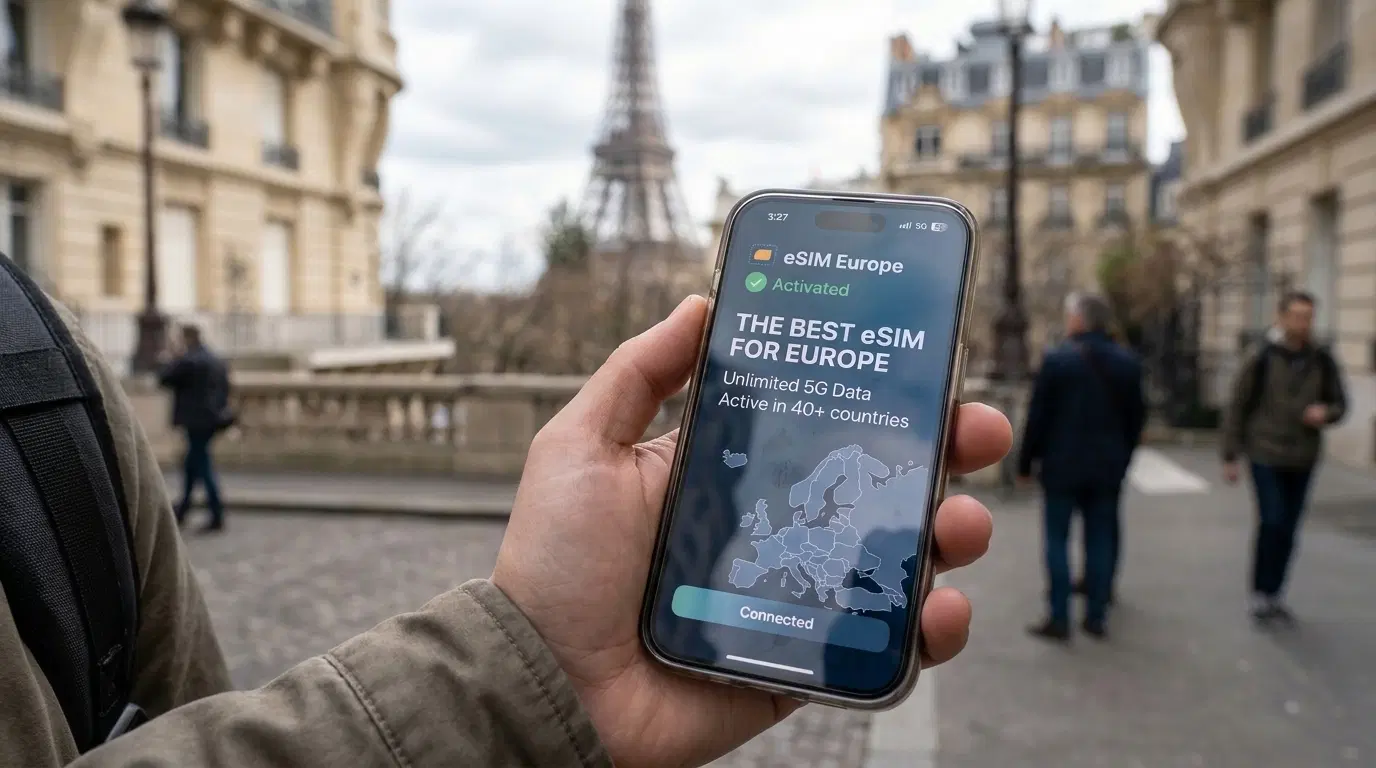
The best eSIM for Europe is a regional plan that covers every country on your route, carries enough data for the length of your trip and installs on your phone before you leave home. That single choice replaces the pile of local SIM cards, roaming day passes and café WiFi hunts that used to follow a trip across several borders. Not every plan covers the same countries, though, and the differences hide in the fine print rather than on the front page. This guide explains how a multi country eSIM works in Europe, which destinations plans often leave out, how much data you actually need and how to set everything up for a phone that connects the moment you land.
What Makes an eSIM the Best Choice for Europe?
An eSIM is a digital SIM profile that you install on your phone with a QR code, which removes the plastic card entirely. A European eSIM plan is a prepaid data profile that connects to local mobile networks in many countries. The best one matches your route, your data habits and your phone model.
Europe packs dozens of countries into a small area, and a rail trip across Paris, Amsterdam and Berlin crosses two borders in a single day. A local SIM card works well in one country and turns awkward in the next, and some countries ask for ID registration at the shop counter. Roaming on a home plan keeps things simple, although the daily pass fees add up across a long itinerary.
A multi country eSIM removes those steps. You buy online, install the profile at home and let the plan activate when you land. Three factors decide how well it performs in practice. Coverage comes first, then data allowance and validity, then phone compatibility.
How a Multi Country eSIM Works Across Borders
A regional eSIM runs on agreements between the provider and local mobile networks. When you land in a new country, your phone joins one of those partner networks on its own, and your data balance carries over. You never swap profiles or change settings at the border, although the phone may sit on a weak signal for a few minutes while it searches.
Two details are worth knowing before you pay. Most travel eSIMs carry data only, which means no local phone number and no regular calls. WhatsApp, FaceTime and similar apps still work normally over data. The validity period also behaves differently between plans. Some plans start counting days when you first connect abroad, and others start when you install the profile. Reading the activation rule on the product page prevents wasted days.
Travelers who book ground transport through Transpovia can also browse a Europe travel eSIM on the same site, which keeps the ride and the data sorted before departure. Having both arranged ahead means the first hour in a new country needs far less improvising.
Which Countries a European eSIM Plan Covers
Most regional plans list between about 28 and 42 countries, and the exact list changes by product. A plan that advertises 40 countries on its front page can still leave out the one stop on your route.
Countries nearly every plan includes
Spain, France, Italy, Portugal, Germany, the Netherlands, Belgium, Austria, Greece and most other EU members appear on almost every list. Ireland and the Nordic countries usually sit there too.
Countries that deserve a second look
-
United Kingdom and Switzerland. Both sit outside the EU, and several plans leave out one or both.
-
Türkiye. Some plans exclude it and others include it, which calls for an explicit check.
-
Western Balkans. Albania, Bosnia and Herzegovina, Kosovo, Montenegro, North Macedonia and Serbia often need a separate look. Kosovo is the country plans skip most often.
-
Iceland, Monaco and Andorra. These appear on some lists and not on others.
-
Islands and territories. Madeira, the Canary Islands and Guernsey sometimes count separately in the total, which inflates the headline number.
The simplest habit that prevents trouble is to write down every country you will enter, short transit stops included, and match that list against the plan's country page and its terms.
Do You Need an eSIM or Is Your Home Plan Enough?
The answer depends on the country that issued your home plan.
Residents of the EU and EEA
The EU's Roam Like at Home rules let customers of EU and EEA operators use their normal plan in other member countries at no extra charge, within fair use limits. Iceland, Liechtenstein and Norway fall under the same rules, and Ukraine and Moldova joined on January 1, 2026. The data allowance abroad can be smaller than the one at home, and the rules do not reach the UK or Switzerland. A travel eSIM therefore matters mainly on trips that leave the zone or last a long time.
Visitors Based in the United States, Canada and Other Regions
The EU roaming rules do not cover visitors who hold plans issued outside Europe. Their home carriers set their own international terms, and most sell a daily pass or a travel add on that costs more the longer the trip runs. Comparing the total home plan cost for the whole trip against a regional eSIM Europe plan takes five minutes and often settles the question.
Residents of the UK
UK operators no longer have to offer free roaming in the EU since January 1, 2021. Some providers charge for it and others include it voluntarily, which makes an eSIM a common choice for UK travelers heading to the continent.
Regional eSIM, Country eSIM or Global eSIM?
A regional plan covers a block of countries under one profile and one data balance. That fits any trip with two or more stops.
A country eSIM often costs less per GB for a stay in one place, although it forces a new purchase and a new installation at each border. It works well for someone who spends two weeks in Portugal and nowhere else.
A global eSIM covers most of the world, which helps when the trip continues to Asia or North America after Europe. It can cost more per GB for the same European use, which makes it a fit mainly for routes that go beyond the continent.
How to Choose the Right Plan
Match the data to your habits
Maps, messaging, ride apps and booking sites use little data. Video calls, large file downloads and hotspot sharing use a lot. A useful rule of thumb is that a plan around 10 GB suits light users who lean on hotel WiFi for a month, while heavier users often look for 30 GB or more.
Read the fine print on unlimited plans
Unlimited plans usually carry a daily fast data cap, after which speeds drop. They suit people who stream, work online or share a connection with others. Light users pay for capacity they never touch.
Choose validity with a buffer
A delayed flight or an extra night in Lisbon can push a trip past its planned end date. Picking a validity period one or two days longer than the itinerary costs little and avoids a mid trip top up.
Check hotspot and calling rules
Hotspot rules vary, and some plans limit sharing to a small daily amount that a laptop burns through quickly. Data only plans cannot place regular calls. A few plans include a local number and call minutes, often with a shorter validity. On a dual SIM phone, your home SIM can stay active for incoming calls and texts while the eSIM handles data.
Compare price per GB
The headline price tells you less than the price per GB does. Some resellers add a currency markup at checkout, and the terms page is usually where caps and country exclusions appear.
Which eSIM Fits Which Traveler?
A weekend city break
A small data plan with a short validity is enough for maps, messaging and ride apps. Paying for a month of data on a three day trip wastes money.
Two weeks across three or four countries
A mid size regional plan covers most travelers here. The country list matters more than the data size, and the list should match every stop, short ones included.
A month or longer, or remote work
Larger or unlimited plans make sense, with attention to hotspot terms and fair use limits. Anyone who works on a laptop should confirm that the plan permits tethering before buying.
Families and groups
Two options work. One shared plan with hotspot allowed keeps costs down, and one profile per person avoids a single point of failure when the host phone runs low on battery.
A rail pass or road trip route
Long train rides and drives through the Alps or other mountain areas cross patches with no signal on any network. A plan with broad country coverage keeps the connection steady at borders, and offline maps cover the quiet stretches in between. Switzerland and the UK deserve a direct check on this kind of route, since they sit outside the EU and often fall outside a plan's list.
Business travel with calls
Data only plans handle WhatsApp and video calls well. A plan with a local number suits people who need ordinary calls, and the home SIM can stay active for the main number.
When a Local SIM Still Makes Sense
A local SIM wins in a few situations. Someone who stays in one country for several months, needs a local number for bank codes or deliveries and plans to top up every month may prefer a local contract. Some countries also ask for ID registration, which adds time at the shop counter. For trips of a few weeks across several countries, a travel eSIM usually removes more hassle than it adds, and it keeps your home number reachable through the second SIM slot.
Phone Compatibility and Setup
An eSIM needs an unlocked phone that supports it. That includes the iPhone XS and later and many recent Android models. US versions of the iPhone 14 and later have no physical SIM tray, which makes eSIM the only route for those phones. The About page in the phone's settings usually shows an EID number when the phone has eSIM support.
After purchase, the provider sends a QR code by email or inside its app. You scan it in the cellular or SIM settings, give the line a name and wait a few minutes while the profile installs. Doing this at home on a stable WiFi connection beats trying it in a busy terminal.
Buying a few days ahead leaves room to fix problems before the trip. Support teams answer questions while you still have time, and a profile that sits on the phone does not use up validity on plans that start at first connection. The activation rule on the product page tells you which kind of plan you hold.
Before landing, choose the eSIM for mobile data and turn data roaming on for that line. Keeping roaming off on the home line prevents surprise charges on a second network.
Staying Connected at Airports, Train Stations and Border Crossings
A connected phone matters most in the first hour after landing. A private driver or a ride booking may send pickup details, a meeting point or a delay notice, and those messages only help when the phone is online. Airport WiFi can be slow or crowded, and a plan that is already active removes that gamble. Public WiFi in stations and cafés also stays open to anyone nearby, which is one more reason to keep banking and booking apps on your own data connection.
I turned off airplane mode at the gate, and by the time I reached baggage claim my driver's message was already waiting. That alone made the eSIM worth it.
Trains bring their own quirks. Tunnels and remote stretches cause short signal drops, which makes downloading offline maps and tickets before a long rail day wise. At land borders, the phone sometimes stays on a weaker network for a few minutes. A short wait, an airplane mode toggle and a check that the travel eSIM is the selected data line fix most cases.
Ferries need extra care. Offshore service is unreliable, and maritime networks can fall outside EU roaming protections. Keeping roaming disabled on the home line at sea avoids expensive surprises.
Common eSIM Problems and Fixes
Signal bars with no internet. Data roaming usually needs to be on for the eSIM line. The APN setting should match the provider's instructions, and an airplane mode toggle often refreshes the connection.
The profile will not install. The installation needs a stable WiFi connection. Many QR codes work only once, which means deleting a profile before using it can force a new purchase.
No service in one country. The plan may not list that country even when the product page seems to promise broad coverage. Checking the country list again and contacting the provider settles it.
Slow speeds. Unlimited plans can throttle after a daily cap, and a 5G label does not guarantee 5G everywhere because providers rely on local partner networks. Remote areas, for example islands and mountain valleys, may simply lack coverage on the local network.
FAQs
What is the best eSIM for Europe?
No single plan wins for everyone. The best eSIM for Europe is the regional plan whose country list covers every stop on your route, with data and validity sized to your trip. Light users can pick a small plan, and heavy users or groups sharing a hotspot should look at larger or unlimited options.
Does one eSIM work in every European country?
No. Most regional plans cover roughly 28 to 42 countries, and gaps often include the UK, Switzerland, Türkiye, the Western Balkans, Iceland, Monaco or Andorra. A country count on the front page does not prove that a specific destination has coverage, and the country list deserves a direct check.
Can I install a Europe eSIM before I leave home?
Yes, and that is the recommended approach. You scan the QR code on a stable WiFi connection, and the profile waits on your phone. Depending on the plan, the validity either starts at installation or at your first connection abroad, and the activation rule is worth reading.
Will my regular phone number still work?
Yes on a dual SIM phone. The eSIM carries data while your home SIM stays active for calls and texts. Keeping data roaming off on the home line prevents extra charges, and WhatsApp and similar apps work over the eSIM data.
Is an eSIM cheaper than roaming?
It often is on longer or multi country trips, although the answer depends on your home carrier. Adding up the home plan's travel pass for every day of the trip and comparing it with the total price of a regional plan gives a clear answer.
Do I need a travel eSIM if I live in the EU?
Possibly not. The EU roaming rules let EU and EEA residents use their normal plan across member countries within fair use limits. A travel eSIM becomes useful for the UK, Switzerland and other countries outside the zone, and for trips where the home roaming data allowance is small.
Does an eSIM work on trains and ferries?
On trains, yes, with short drops in tunnels and remote stretches. On ferries, service offshore is unreliable, and maritime networks can sit outside EU roaming protections. Downloading maps, tickets and entertainment beforehand covers the gaps.
Pick a Plan That Matches Your Route
The best eSIM for Europe comes down to three checks. The country list has to include every stop, the data and validity have to fit the trip, and the phone has to support eSIM and arrive unlocked. A plan that passes all three keeps you online at every border, without a single SIM swap.
Once the data side works, the arrival is the next piece worth planning. Booking an airport transfer through Transpovia before you fly means a ride is already waiting while your eSIM connects, and the first hour in a new city starts calmly.


