
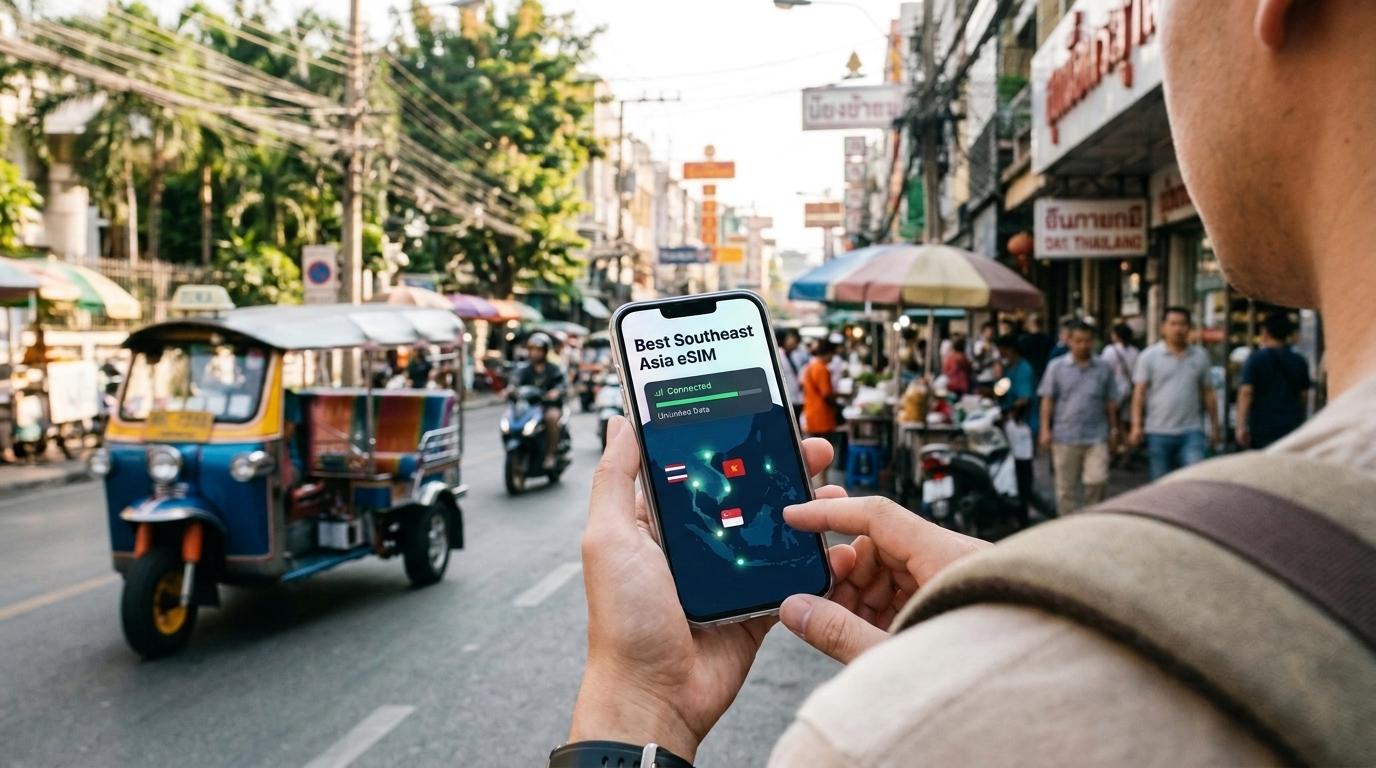
The best eSIM for Asia is a regional plan that lists every country on your route, gives you enough data for the days you travel, and installs on your phone before you leave home. Those three points decide almost everything, and this guide walks through each one in plain terms. A traveler who gets them right lands in Bangkok, Tokyo, or Singapore with working data and no hunt for a phone kiosk at midnight.
Asia makes this choice harder than a single destination does. A two week trip can cross three borders, and every country has its own networks, SIM rules, and prices. Buying a local SIM at each stop eats time at arrivals, and home roaming charges climb fast. A multi country eSIM Asia plan removes most of that hassle. The sections below explain how to pick one that fits your actual route rather than a broad promise on a product page.
How One eSIM Works Across Several Asian Countries
An eSIM is a digital SIM profile stored inside your phone, which means there is no plastic card to swap or lose. A regional eSIM Asia plan bundles agreements with local mobile networks across a group of countries. When your flight lands in a country on the list, your phone joins a partner network there and keeps drawing on the same data balance you bought at home.
You scan one QR code or tap one install link, and the profile stays in your phone settings through the end of the plan. Most travelers switch it on before takeoff and leave it alone for the whole trip. Your regular number stays on your main SIM, which matters for bank codes and calls with family.
The word "regional" deserves attention. A regional plan covers a defined list of countries, and that list changes between providers. Published Asia plans range between roughly 15 countries and 30 or more, which is a wide gap when your route includes smaller stops. Reading the list takes two minutes and prevents the most common complaint travelers have.
Regional Plan or Country Plans, Which Fits Your Route
The right choice depends on how many borders you cross. Travelers who stay in one country usually pay less with a plan built for that country. Japan, South Korea, and Thailand all have strong single country options, and a short trip to any of them rarely needs a plan that covers thirty destinations.
Travelers who move through several countries get more value out of a regional plan. A route that links Bangkok, Hanoi, and Siem Reap shows the point well, and a trip that joins Tokyo with Seoul shows it too. Three country plans mean three purchases, three installs, and three activation dates to track. One Asia travel eSIM removes that bookkeeping, and the Asia travel eSIM page on Transpovia gives you a place to compare plans before you fly. Transpovia is best known for its marketplace for airport transfers and private rides, and the eSIM option sits beside those services for travelers who prefer to sort out data and arrival logistics in one sitting.
A simple test helps here. Count the countries where you will sleep, then count the countries you will only cross by train or plane. A total of three or more points toward a regional plan almost every time. A total of two with long stays calls for a comparison of both options on price per gigabyte.
Check the Country List Before You Pay
Every regional plan publishes a coverage list, and mismatches hide there. Some plans include most of Southeast Asia and leave out Japan. Others cover Japan and South Korea and skip Cambodia or Laos. A few reach Central Asia with countries including Kazakhstan and Uzbekistan, which most Asian plans leave out entirely.
Travelers do best when they list every country on the itinerary, along with layovers that include a planned trip outside the airport, and then compare that list with the plan page name by name. Some places deserve extra attention because plans treat them inconsistently.
-
Mainland China, Hong Kong, and Macau, which many providers split into separate categories
-
India, Pakistan, and Bangladesh, which often sit outside regional bundles
-
Taiwan, which some plans include and others sell separately
-
Indonesia, where Bali visitors should confirm the plan names the country directly
-
Island destinations in the Philippines and the Maldives, which vary widely
An Asian eSIM plan that covers fifteen countries beats a plan that lists thirty and misses the one country you need. Coverage on paper means little before your own route appears in it.
How Much Data You Actually Need
Data planning goes wrong in two ways. Some travelers buy too little and run dry in the third country, and others buy a huge allowance and waste most of it. A realistic estimate starts with how you use your phone on an ordinary travel day.
Navigation, chat, ride apps, and translation use modest data. Photo backups, video calls, and large file downloads use a lot of data. Many travelers find that one to two gigabytes per day covers navigation, chat, and social posts comfortably, and people who stream or work online need considerably more. A traveler who works remotely in Chiang Mai or Da Nang for several weeks sits in a different category than a tourist who spends the days on temple visits, and the plan size should reflect that. Multiply your daily estimate by the number of trip days, then add a buffer of about twenty percent for the days that go differently than planned.
Validity matters equally with size. A plan with 20 GB over 30 days fits a month of slow travel, while the same 20 GB over 7 days makes little sense for most people. Travelers should check how long the plan stays active after installation and when the clock starts. Some plans begin counting at installation, and others begin on first connection to a network. The second type gives you freedom to install at home without wasting days.
Unlimited Plans and Fair Use Limits
Unlimited eSIM plans tempt heavy users, and they deserve a careful read. Many unlimited plans cap high speed use each day and slow your connection after that cap, often to a speed that handles messages and struggles with video. Hotspot sharing may also be limited or blocked. A capped plan with a generous daily allowance can serve you better than an unlimited plan that slows down every afternoon.
Network Quality, Speed, and Coverage Beyond the Cities
An eSIM never creates coverage. It only gives you access to local networks, and that explains why speeds vary. Seoul, Tokyo, Singapore, Bangkok, and Kuala Lumpur offer fast mobile service on the networks that most travel eSIMs use, and big cities across the region follow that pattern. Rural areas, islands, and mountain regions can look very different.
Plans usually list the network partners in each country. A traveler who plans a trek in northern Vietnam or a remote island stay in Indonesia gains by knowing which carrier serves that area. Guesthouse owners and local guides often know which network holds up best in their region, and one question at check-in saves guesswork later.
Fifth generation service appears on some plans and not on others. Many travelers never notice the difference in ordinary use, since maps and messaging run well on fourth generation speeds. Video work and large uploads are the main situations where it matters.
Calls, Texts, and Keeping Your Own Number
Most travel eSIMs carry data only. That works well for modern travel, because WhatsApp, FaceTime, Line, and similar apps handle calls and messages over data. Hotels, restaurants, and drivers across much of Asia use messaging apps for bookings and pickups, and data alone covers most of those needs.
Your home number still matters. Banks and online accounts send verification codes by text, and those codes go to your regular SIM. Many travelers keep the main SIM active with data roaming switched off and use the eSIM for all data. This setup lets text codes arrive without roaming fees on mobile data, though results depend on your home carrier, and a quick call to the carrier before departure clears up any doubt.
A few plans include a local phone number or a small voice allowance. Those plans cost more and suit business travelers and anyone who arranges local services by phone.
Phone Compatibility and Setup
Not every phone supports eSIM, and not every phone that does can use a travel plan. Your phone must support eSIM and must be carrier unlocked. A phone locked to a home carrier will refuse a profile of another provider. The settings menu on most recent iPhone and Android models shows eSIM support, and the carrier lock status appears in the same area.
Most travelers install the profile at home on a stable Wi-Fi connection, and the process takes a few minutes. After installation, a short label for the new line helps, and the line should handle mobile data only. The main SIM stays the default for calls and texts. Data roaming must be switched on for the eSIM line because the plan relies on partner networks, and this step catches many first time users off guard.
Early installation works well, though the activation rules matter. When a plan starts counting at installation, a profile set up two weeks before departure burns days you never use. Plans that start on first connection avoid that waste.
What Happens When the QR Code Fails
QR codes work once on most plans. A screenshot of the confirmation page and a copy of the backup install details protect you, since deleting the eSIM off your phone often cancels it for good. A few minutes with the support page before departure beats troubleshooting in an airport queue with low battery.
Country Notes for Common Asia Routes
Route details change the plan you should choose, and a few patterns come up often.
Thailand, Vietnam, Cambodia, and Laos. This classic Southeast Asia loop suits regional plans well. Border crossings happen overland, and the connection moves with you. Cambodia and Laos deserve a careful check because they appear less often on coverage lists than Thailand and Vietnam.
Japan and South Korea. Both countries have excellent mobile networks and strong country plans. A traveler who visits only these two can choose a plan built for them or a broader Asia plan that includes both. Price and total days settle the question.
Singapore, Malaysia, and Indonesia. Short hops by plane or ferry put several countries into one week. A regional plan saves repeated setup, and Bali visitors should confirm that Indonesia appears by name.
Mainland China. Rules here differ across the region. Some travel eSIMs handle mainland China separately, and the way a plan routes data affects access to services including Google and WhatsApp. Travelers who head there should read the plan details closely and choose a provider that addresses it directly.
India and South Asia. Tourist SIM purchases in these countries often involve paperwork, which makes an eSIM attractive, though many regional plans leave them out. The country list shows quickly if a plan works there.
Common Mistakes That Cost Travelers Money
Most eSIM problems trace back to a short list of errors. Buying a plan without reading the country list ranks first. Starting the validity clock too early ranks second. Forgetting to switch on data roaming for the eSIM line ranks third, and it leaves many people with a plan that appears installed and never connects.
Other mistakes cost less and still frustrate. Deleting the profile before the trip ends removes the remaining data. Automatic app updates can burn a small allowance in a day, and hotel Wi-Fi handles big downloads better. A hotspot shared with three friends consumes data much faster than one phone alone, and a plan that allows hotspot use may still limit it.
Connect Your Data Plan With Your Arrival
Data and transport work best when you plan them together. A working eSIM lets you open a booking confirmation, message a driver, share a live location with family, and check flight status the moment you land. Airport Wi-Fi in busy hubs often disappoints, and a connected phone avoids the scramble.
Landed in Bangkok at midnight and my phone was already online before I reached the baggage belt. I found my driver without asking anyone for Wi-Fi.
That kind of smooth arrival comes out of small choices made at home. A transfer booked in advance, a confirmation saved on the phone, an eSIM installed the night before departure, and screenshots of both for offline access cover nearly everything. Transpovia connects travelers with airport transfers and private rides in many destinations, and travelers who book a ride ahead spend less energy on arrival logistics, which leaves more room to enjoy the first evening.
FAQs
What is the best eSIM for Asia for a multi country trip?
The best eSIM for Asia is a regional plan whose coverage list includes every country on your route and whose data allowance matches your trip length. Coverage lists, validity rules, and fair use limits deserve a look before price. A plan with fewer countries that matches your route beats a plan with more countries that misses one of your stops.
Does one eSIM really work in every Asian country?
No single plan covers every country in Asia. Regional plans cover a defined group, commonly between 15 and 30 or more countries, and the list varies by provider. The named countries deserve a check before purchase, especially for China, India, Central Asia, and smaller island destinations.
Is an eSIM cheaper than a local SIM in Asia?
For a single country and a long stay, a local SIM can cost less. For short trips or routes across several countries, an eSIM usually wins on convenience and total cost because it removes shop visits, ID checks, and repeated purchases. Price per gigabyte and the days you need make the comparison fair.
Can I use my phone number and eSIM at the same time?
Yes, on a dual SIM phone. Your main SIM keeps your number for calls and text codes, and the eSIM handles mobile data. Choosing the eSIM for the data line and turning off data roaming on the main SIM avoids roaming charges.
When should I install an Asia eSIM?
A day or two before departure works well, at home on Wi-Fi. The plan terms say if counting starts on installation or on first connection. When it starts on first connection, early installation costs you nothing.
Can I share data off an Asia eSIM through a hotspot?
Many plans allow it, and some limit or block it. The plan terms answer this question before you rely on it for a laptop or for friends. Hotspot use drains data quickly, and a larger allowance helps when you share.
What if my phone does not support eSIM?
Older phones and some budget models lack eSIM support, and carrier locked phones cannot install travel profiles. A physical travel SIM or a local SIM bought on arrival works in those cases. Your phone settings or your carrier can confirm eSIM support and carrier lock status before you travel.
Final Thoughts on Choosing an eSIM for Asia
The right plan comes down to three checks. The country list should match your route, the data should fit your travel days, and your phone should be unlocked and ready. Travelers who handle those points once at home avoid nearly every common problem on the road.
Pair that preparation with a booked airport transfer and your first hour in a new country gets much easier. Transpovia helps travelers arrange airport transfers and private transportation across many destinations, and a ride arranged in advance means you can step out of arrivals with a working connection and a clear idea of where to go.


