
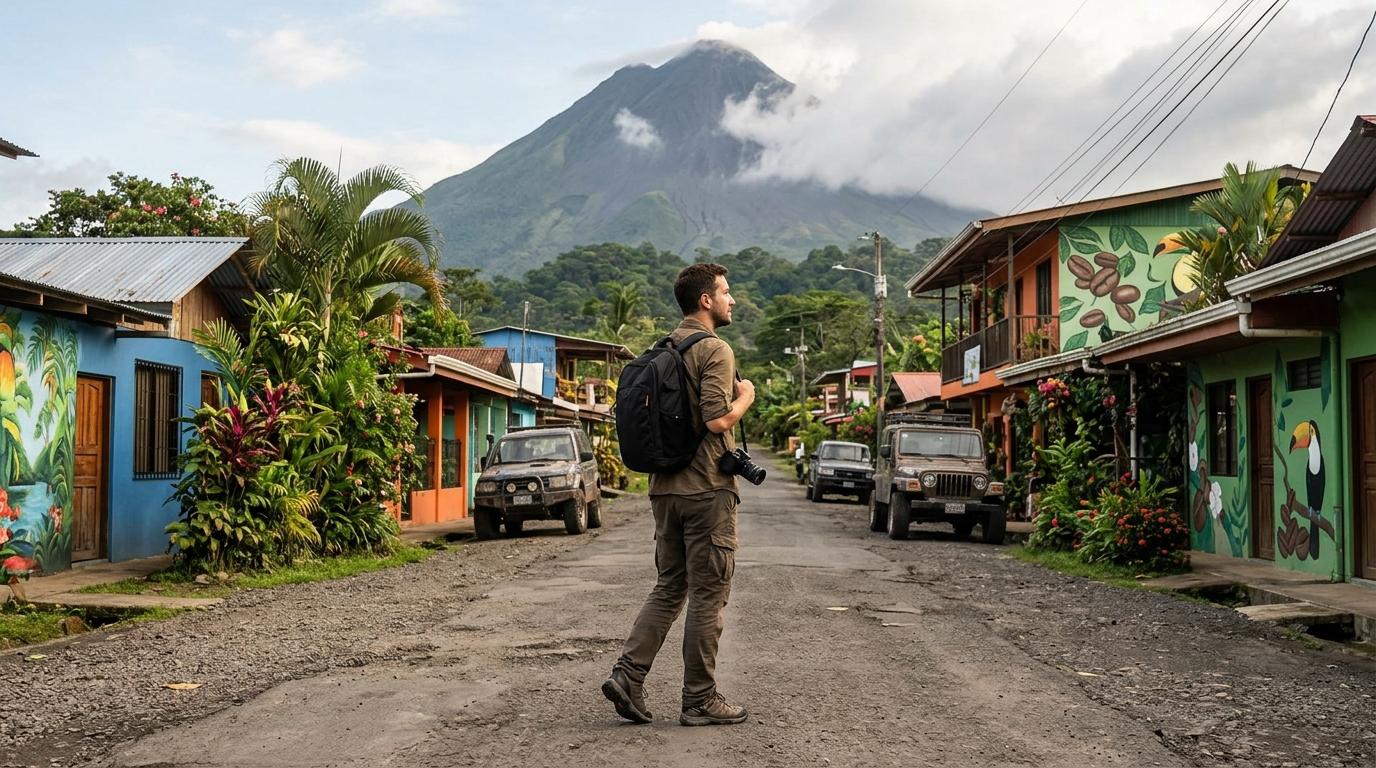
Traveling alone in Costa Rica is easier than most first-timers expect. The country is compact, the main travel routes are well worn, and the places travelers love most are built around hostels, group tours, and shared tables at the end of a long day. The hard part is deciding where to go. This guide covers the best cities for solo travel Costa Rica has to offer, from volcano towns and cloud forest villages to surf beaches on two coasts, with notes on who each place suits, how long it takes to reach from the airport, and what to expect when you arrive with no one else to plan around.
Most of these destinations are small towns rather than cities in the strict sense, and that works in your favor. Small places are walkable and easy to figure out on day one. They are also full of other independent travelers doing exactly what you're doing, which makes it far easier to find company for a hike or a sunset when you want it.
What Makes a Costa Rica Town Good for Traveling Alone
A great solo destination isn't just a pretty one. When you're on your own, a few practical things matter more than they would on a couples' trip or a family vacation. Every town in this guide was chosen with these in mind:
-
A walkable center. You can reach restaurants, tour offices, and a pharmacy on foot, without depending on rides for every errand.
-
Built-in ways to meet people. Group tours, surf schools, outdoor fitness classes, Spanish lessons, and social hostels give you company without forcing it.
-
Activities that work for one. Guided hikes, ziplining, hot springs, and nature walks are just as good alone. Many tours price per person, so there's no single supplement to worry about.
-
A steady tourism track record. Established destinations have more English speakers, more reviewed accommodation, and tourist police presence in the busiest areas.
-
Reasonable access from an international airport. Long, complicated travel days are more tiring and more stressful without a partner to share the load.
If this is your first trip alone, give extra weight to the first and last points. A town that's easy to reach and easy to walk will make your first few days far smoother.
Best Cities for Solo Travel Costa Rica at a Glance
For most visitors, these seven are the best cities to travel alone in Costa Rica, covering the main circuit from the Arenal area to both coasts. Drive times are approximate and change with traffic, weather, and time of day.
|
Destination |
Best for |
Main airport |
Approx. drive from airport |
|
La Fortuna |
First trips, volcano views, adventure tours |
SJO |
2.5 to 3 hours |
|
Monteverde |
Cloud forest hikes, cooler weather, quiet evenings |
SJO or LIR |
About 3 to 3.5 hours |
|
Manuel Antonio and Quepos |
Beach days with easy wildlife watching |
SJO |
About 3 hours |
|
Tamarindo |
Beach activities and beginner surfing |
LIR |
About 1 hour |
|
Santa Teresa |
Surfing, outdoor classes, and longer stays |
SJO or Tambor |
4.5 to 5 hours from SJO with the ferry; under 1 hour from Tambor |
|
Puerto Viejo de Talamanca |
Caribbean culture, cycling, budget stays |
SJO |
About 4 to 4.5 hours |
|
San José |
Arrival nights, museums, city food |
SJO |
30 to 45 minutes |
If you want to look beyond this list, Transpovia's overview of the cities in Costa Rica served by its airports and cruise ports is a useful way to see which destinations sit closest to each arrival point before you lock in flights.
La Fortuna: Among the Best Cities for First Time Solo Travelers
If you only pick one base for a first trip, make it La Fortuna. The town sits at the foot of Arenal Volcano, and almost everything a solo traveler needs is packed into a few blocks around the central park and church: tour desks, sodas (small local restaurants), supermarkets, and a wide range of hostels and guesthouses.
The activity list is long and works well alone. You can hike the lava trails in Arenal Volcano National Park, climb down the several hundred steps to La Fortuna Waterfall, cross the hanging bridges above the rainforest canopy, or spend an evening in one of the hot springs along the road toward the volcano. Guided night walks are a favorite for solo visitors because groups are small and conversation comes naturally when everyone is hunting for frogs and sleeping birds.
Solo tips for La Fortuna
Book your first tour for the morning after you arrive. It gives the day a structure and puts you in a group right away. Many hotels and hostels also arrange shared outings to the hot springs in the evening, which is an easy way to meet people without trying. If you plan to continue to Monteverde, ask about the combined boat and road crossing over Lake Arenal, which shortens the journey and doubles as a scenic outing.
Monteverde: Cloud Forest Calm With an Easy Social Scene
Monteverde feels different from the rest of the country. It's higher, cooler, and often wrapped in mist, so pack a fleece and a rain jacket even in the dry season. Most travelers stay in Santa Elena, the small town that serves as the area's hub, where hostels, cafes, and tour offices line a handful of streets.
The main draw is the cloud forest itself. The Monteverde Cloud Forest Biological Preserve and the Santa Elena Reserve both have well-marked trails, and hiring a naturalist guide for a morning walk makes a big difference if you want to spot quetzals, sloths, or tiny orchids you'd walk straight past on your own. Ziplines, hanging bridges, and coffee and chocolate farm tours fill the afternoons, and guided nature walks after dark are popular here too.
Monteverde is a strong pick if you want a slower pace and early nights rather than a busy entertainment scene. It's also one of the places travelers often mention when they talk about the safest cities for solo travel in Costa Rica, thanks to its small size and community feel. The tradeoff is access: the final stretch up the mountain is steep and winding, which is why many visitors would rather leave the driving to someone else.
Manuel Antonio and Quepos: Rainforest That Runs Into the Beach
Manuel Antonio delivers the classic Costa Rica picture in one place: monkeys in the trees, sloths overhead, and white-sand coves inside a national park. It's an easy destination for solo travelers who want wildlife without long hikes, and the beaches outside the park, like Playa Espadilla, are good spots to relax, take a surf lesson, or join a guided coastal sightseeing trip.
Two things are worth knowing before you go. Manuel Antonio National Park is closed on Tuesdays, and entry tickets are sold online only, so book ahead, especially in the dry season. A guided walk is worth it here; guides carry spotting scopes and find animals most visitors miss.
Where to stay alone
The hill road between Quepos and the park entrance holds most of the hotels and restaurants, with hostels mixed in. Quepos itself is a working town with a marina, cheaper groceries, and a more local feel. Staying near the top of the hill gives you views but means relying on the public bus or rides to reach the beach, so check how far your accommodation is from the park before booking.
Tamarindo: A Beach Destination in Guanacaste
Tamarindo is one of the easiest solo travel destinations to settle into on Costa Rica's Pacific side. Surf schools line the main beach, which has gentle, consistent waves for beginners, and group lessons are a natural way to meet people on your first morning. Visitors can spend their days exploring the coastline, enjoying local restaurants, browsing shops, and watching the sunset from the beach.
Its location is a major plus. Guanacaste Airport (LIR) in Liberia is roughly an hour away, so you can land and be on the beach the same afternoon. That makes Tamarindo a strong first or last stop, especially if you fly into LIR and want to skip the longer drives from the capital.
The flip side of its popularity is that Tamarindo is busier and more developed than other beach towns. If you want quieter sand, nearby Playa Langosta and Playa Grande are within easy reach for a day trip, while the town itself remains your base for food, tours, and beach activities.
Santa Teresa: Surf, Outdoor Activities, and a Slower Rhythm
On the southern tip of the Nicoya Peninsula, Santa Teresa draws surfers, outdoor enthusiasts, and remote workers who often stay for weeks instead of days. The town stretches along a single dusty main road parallel to the beach, with cafes, co-working spaces, and studios offering daily fitness and wellness classes. That routine-driven lifestyle makes it simple to see the same faces every day, which is how friendships form fast here.
The surf is better suited to intermediate riders than total beginners, though lessons are widely available. Nearby Montezuma, with its waterfall and natural scenery, makes a good day trip, as do the beaches around Malpaís.
Getting there
Santa Teresa takes more effort to reach than other destinations on this list. From San José, the overland route includes the ferry from Puntarenas to Paquera, and the full trip usually runs four and a half to five hours. Travelers short on time often fly into Tambor, a small domestic airstrip less than an hour's drive away. The road into town can be rough and dusty, so a driver who knows it is worth more here than almost anywhere else.
Puerto Viejo de Talamanca: Caribbean Culture for Independent Travelers
Puerto Viejo shows a completely different side of Costa Rica. The Caribbean coast has its own Afro-Caribbean heritage, food, and traditions, and you'll notice it right away in dishes like rice and beans cooked in coconut milk and the distinctive architecture and local crafts. The town is relaxed, affordable, and full of backpackers and long-term travelers.
Renting a bicycle is the best way to get around. A flat coastal road connects Puerto Viejo with Playa Cocles, Punta Uva, and Manzanillo, so you can beach-hop at your own pace. Cahuita National Park, a short drive north, has an easy coastal trail with good odds of seeing sloths and monkeys, and the Jaguar Rescue Center is a popular half-day visit.
Puerto Viejo suits travelers who are comfortable with a looser, more laid-back atmosphere. Keep an eye on your belongings, avoid walking unlit stretches of road alone late at night, and choose accommodation with good recent reviews about security. The drive from SJO is long, so many people make it a destination for at least four or five nights rather than a quick stop.
San José: Worth a Night, Not Necessarily a Week
Most international flights land at Juan Santamaría International Airport (SJO), which is actually in Alajuela, about 30 to 45 minutes from central San José. Many solo travelers skip the capital entirely, but one night can be a smart buffer after a late arrival or before an early flight.
If you do stay, base yourself in a well-reviewed neighborhood such as Barrio Escalante, known for its restaurants and food options, or the Sabana area near the city's large park. During the day, the National Theater, the Pre-Columbian Gold Museum, and the Central Market give you a quick feel for the city and its food.
San José is where you need the most street awareness. Petty theft is more common in busy downtown areas and bus terminals, so keep your phone out of sight, avoid walking alone at night, and use a pre-arranged ride rather than flagging down unofficial taxis. Staying near the airport in Alajuela is another sensible option if your connection is tight.
Staying Safe as a Solo Traveler in Costa Rica
Costa Rica is one of the most visited countries in Central America, and most solo trips go smoothly. Still, the U.S. Department of State rates it Level 2, "Exercise Increased Caution," mainly because petty crime is common. In practice, that means theft of unattended bags, phones snatched in crowded places, and break-ins at rental cars parked at trailheads and beaches.
A few habits cover most of the risk:
-
Never leave belongings unattended on the beach, even for a quick swim. Bring only what you need and use a waterproof pouch for your phone.
-
Respect the ocean. Rip currents are a serious hazard on many Pacific and Caribbean beaches, and many lack lifeguards. Swim where locals swim and ask about conditions.
-
Arrange rides in advance after dark. Avoid unmarked taxis, especially from the airport or late at night.
-
Share your plans. Send your itinerary and accommodation details to someone at home and check in when you change towns.
-
Keep valuables out of parked cars. If you rent a vehicle, assume anything visible can be taken.
Women traveling alone generally report feeling comfortable in the towns covered here, though the usual precautions apply: trust your instincts about people and places, keep your belongings secure, and choose accommodation with strong recent reviews. Costa Rica's emergency number is 911.
Getting Between Destinations When You're Traveling Alone
Transport is where solo trips in Costa Rica are won or lost. Distances look short on a map, but mountain roads, river crossings, and afternoon rain stretch travel times, and there's no travel partner to navigate, watch the bags, or take a turn at the wheel. Here's how the main options compare for someone on their own.
|
Option |
Works well for |
Watch out for |
|
Public bus |
Tight budgets and flexible schedules |
Long trips, transfers between San José terminals, keeping an eye on luggage |
|
Shared shuttle |
Popular routes at set times |
Fixed departures, multiple hotel stops, little flexibility with flight delays |
|
Rental car |
Remote areas and spontaneous detours |
Driving alone on unfamiliar mountain roads, theft from parked cars, extra insurance costs |
|
Private transfer |
Airport arrivals, long transfer days, night arrivals |
A higher fare than the bus, so it pays to plan which legs need it most |
Why a private transfer makes sense on a solo trip
For arrivals and longer legs, a private car with a professional driver removes most of the stress. You're met at the terminal, the price is agreed before you travel, and you go straight to your hotel's door instead of guessing which bus stop is closest. That matters most after a late flight, when you're tired, carrying everything you own, and least alert to scams.
Pre-booked airport transportation from Juan Santamaría is the simplest way to start a trip to La Fortuna, Monteverde, or Manuel Antonio. Transpovia offers private transfers at fixed prices with flight tracking, so if your plane lands late, your driver adjusts instead of leaving. A private car also lets you ask for a stop along the way, whether that's a coffee break, a supermarket run, or the crocodile viewpoint at the Tárcoles River bridge on the drive to the Central Pacific.
A practical approach for many solo travelers is to mix and match: book private transfers for airport days and the longest or trickiest routes, then use local buses, bikes, or walking once you're settled in town.
Sample Solo Routes Through Costa Rica
These routes link the towns above in a logical order, with enough time in each place to join a tour or two and actually meet people.
One week: volcano and beach
-
Days 1 to 3: Fly into SJO and head straight to La Fortuna for hiking, the waterfall, and hot springs.
-
Days 4 to 5: Cross to Monteverde for the cloud forest and a guided nature walk after dark.
-
Days 6 to 7: Continue to Tamarindo for a surf lesson and beach time, then fly home from LIR.
Ten days: the Pacific loop
-
Days 1 to 3: SJO to La Fortuna.
-
Days 4 to 5: Monteverde.
-
Days 6 to 8: Manuel Antonio, with a guided morning in the national park.
-
Days 9 to 10: Back toward SJO, with an optional night in Alajuela before your flight.
Two weeks: both coasts
-
Days 1 to 3: La Fortuna.
-
Days 4 to 5: Monteverde.
-
Days 6 to 8: Manuel Antonio.
-
Days 9 to 13: Puerto Viejo de Talamanca, broken up with a night in San José if the drive feels too long in one go.
-
Day 14: Return to SJO for your flight home.
Flying into one airport and out of the other, such as arriving at SJO and departing from LIR, saves you from backtracking and can free up extra time on the ground.
Frequently Asked Questions
Is Costa Rica good for first-time solo travelers?
Yes. Costa Rica is one of the easiest countries in Latin America for a first solo trip. Tourism infrastructure is well developed, English is widely spoken in tourist areas, and group tours make it simple to meet people. La Fortuna and Tamarindo are especially beginner-friendly because both are compact, walkable, and close to plenty of activities.
What is the safest city for solo travel in Costa Rica?
Small, tourism-focused towns such as Monteverde and La Fortuna are generally considered among the most comfortable for solo travelers. No destination is risk-free, though. Petty theft happens across the country, so the habits you bring matter as much as the place you choose.
How should I get from the airport to my first destination?
For most solo travelers, a pre-booked private transfer is the easiest option, particularly after a long or late flight. You skip the search for a bus terminal or taxi, travel at a price agreed in advance, and arrive directly at your accommodation. Shared shuttles and public buses cost less but run on fixed schedules and take longer.
Conclusion
The best cities for solo travel Costa Rica offers each answer a different kind of trip. La Fortuna is the easy, all-round starting point. Monteverde brings quiet trails and cool air. Manuel Antonio puts wildlife and beaches side by side, Tamarindo and Santa Teresa offer opportunities for surfing and outdoor activities by the ocean, and Puerto Viejo shows you a Caribbean side many visitors never see.
Whichever combination you choose, give each stop enough time to settle in, book a tour early to meet people, and plan your longest travel days carefully. Taking the guesswork out of airport arrivals and long transfers with a private driver means you spend your energy on the places themselves, which is the whole point of traveling alone.
"I landed after dark not speaking much Spanish, and having a driver waiting with my name on a sign made the whole trip feel manageable from the first hour."


