
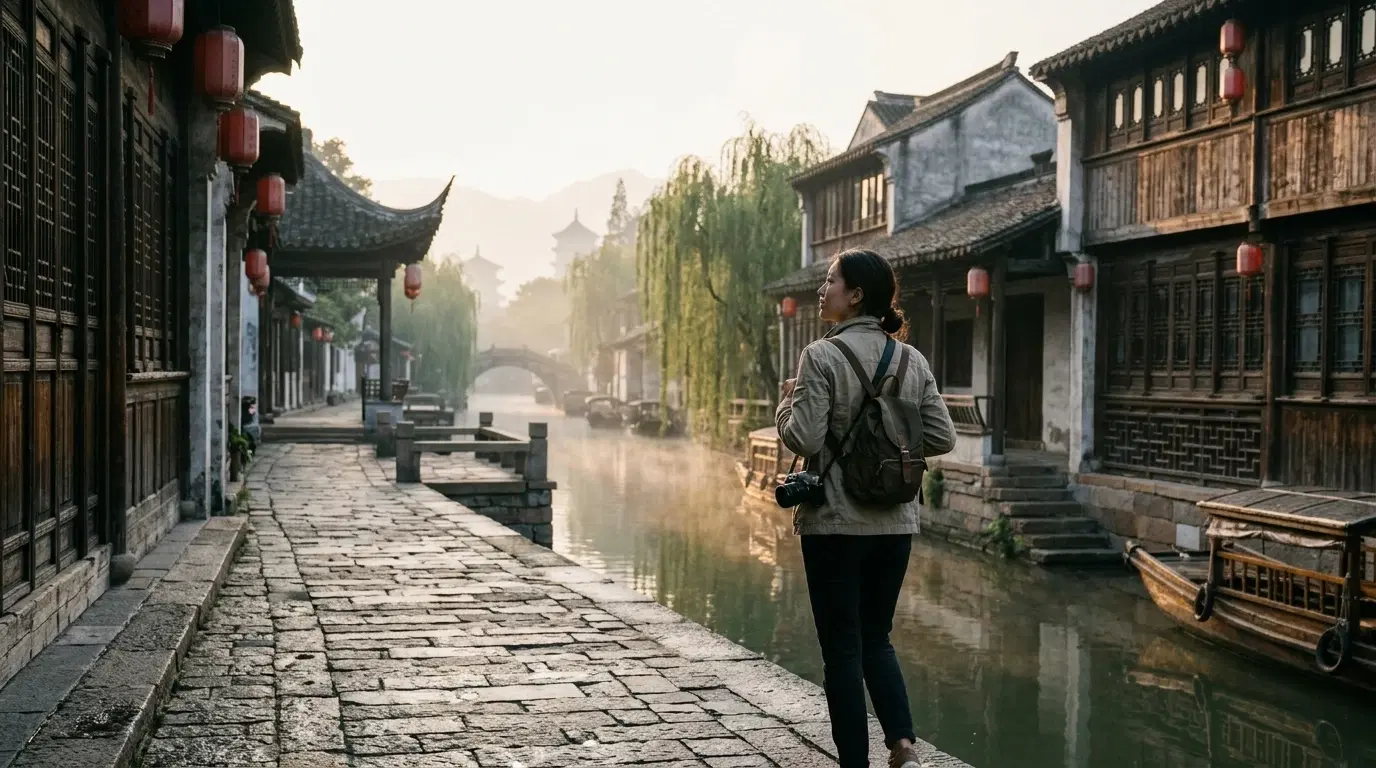
China can feel intimidating to plan alone. The cities are huge, the language barrier is real, and the apps that run daily life work differently from what you use at home. Many travelers are surprised once they arrive, though. Big Chinese cities are some of the easiest places in Asia to explore on your own. Metro systems are clean and signposted in English, high-speed trains link major hubs in a few hours, and walking around at night rarely feels risky. This guide covers the best cities for solo travel China has right now, what each one does well, and the practical details that make a first trip alone go smoothly. That includes the part most guides skip: getting from a very large airport to your hotel after a long flight.
Why China Works Well for Traveling Alone
Solo travel works best in places where you can move around independently, eat well without a reservation, and feel comfortable walking back to your hotel after dark. China's major cities do well on all three.
Street food stalls, noodle shops, and food courts make eating alone normal. In most of these places nobody will look twice at a table for one. Public transit is affordable and frequent. Petty crime exists, but violent crime against visitors is uncommon, and busy streets, security staff, and CCTV are everywhere in central districts. For many people, that combination makes China one of the safest regions for a first trip alone, as long as you prepare for the practical gaps covered later in this guide.
The other advantage is variety. You can pair a futuristic skyline with ancient city walls, or spicy hot pot with Cantonese dim sum, often linked by a single train ride.
The 7 Best Cities for Solo Travel China Has to Offer
China has dozens of large cities, but these seven offer the right mix of sights, food, transport, and ease for travelers on their own. You can compare more cities in China as you build out a longer route.
Shanghai: The Easiest Introduction
Shanghai is often the best city for first-time solo travelers in China. English signage is common, the metro network is one of the largest in the world, and the city is used to international visitors.
Spend an evening on the Bund looking across at the Pudong skyline, then lose a morning in the leafy lanes of the former French Concession, where cafés, boutiques, and old villas line the streets. Yu Garden and the surrounding old town show a more traditional side, though it gets crowded on weekends. Shanghai is also a good base for day trips to water towns like Zhujiajiao.
Shanghai has two airports. Pudong handles most long-haul international flights and sits well east of downtown. Hongqiao is closer to the city and also connects to a major high-speed rail station. Knowing which one you're using matters when you plan your arrival.
Beijing: History on a Grand Scale
Beijing is the place for imperial history. The Forbidden City, the Temple of Heaven, and the Summer Palace are all within reach by metro, and the Great Wall is an easy day trip. Mutianyu is a popular section for independent visitors because it's less crowded than Badaling and has a cable car.
The hutongs, the old alleyway neighborhoods around Houhai and Nanluoguxiang, are ideal for a solo wander, especially by rented bike. Beijing duck is worth ordering even alone; many restaurants sell half portions.
The city is spread out, so plan your days by district. Beijing also has two international airports, Capital in the northeast and Daxing far to the south. Mixing them up can cost you hours.
Chengdu: Relaxed, Friendly, and Built Around Food
If you want a slower pace, Chengdu is one of the best cities to travel alone in China. The city has a reputation for teahouse culture, and spending an afternoon in People's Park with a cup of tea while locals relax and chat is a very local experience.
The Chengdu Research Base of Giant Panda Breeding is the main draw for many visitors. Arrive early in the morning, when the pandas are most active. The food scene is another big reason to come. Sichuan hot pot, mapo tofu, and dan dan noodles are everywhere, and many hot pot restaurants now offer individual pots, which is perfect when you're on your own.
The main international hub is Tianfu International Airport, which sits a long way southeast of the city center. After a long-haul flight, booking private airport transportation in advance saves you from figuring out metro transfers or explaining your hotel address to a taxi driver while jet-lagged.
Hangzhou: Scenery and Calm
Hangzhou feels like a breath of fresh air after Shanghai, and it's only about an hour away by high-speed train. West Lake is the centerpiece, with walking and cycling paths, causeways, temples, and pagodas around its shoreline.
Head into the hills to the tea villages around Longjing, where green tea grows on terraced slopes and you can sit for tea with a view. Lingyin Temple is one of the most significant Buddhist sites in the region. Hangzhou is a good choice for solo travelers who want to recharge without giving up good food and easy logistics.
Xi'an: Ancient Capital, Lively Streets
Xi'an was the starting point of the Silk Road and one of China's ancient capitals. Most people come for the Terracotta Army, which sits outside the city and deserves at least half a day.
Inside the city, you can rent a bike and ride along the top of the old city wall, which forms a full loop of roughly 14 kilometers. Evenings are best spent in the Muslim Quarter, where you can graze on roujiamo (often called a Chinese burger), lamb skewers, and hand-pulled noodles. Food stalls make it easy to try a little of everything alone.
Xi'an's airport sits northwest of the city in neighboring Xianyang, and the Terracotta Army is to the east, so plan your transfers with distance in mind.
Guangzhou: Cantonese Food and Real City Life
Guangzhou is less polished for tourists than Shanghai, which is part of its appeal. This is the heartland of Cantonese cuisine, and a dim sum breakfast at a busy teahouse is a must. Ordering a few small plates works well solo.
Shamian Island offers shaded streets and colonial-era architecture, while the Canton Tower and the Pearl River waterfront light up at night. Guangzhou is also a major trade city, so you'll see business travelers alongside tourists, and the transit system is extensive.
Shenzhen: Modern, Clean, and Close to Hong Kong
Shenzhen grew from a small town into a tech giant within a few decades, and it shows in the wide boulevards, parks, and modern architecture. It's one of the cleanest and most orderly cities in the country, which many solo travelers appreciate.
Tech fans can browse the Huaqiangbei electronics markets, while OCT Loft offers galleries and cafés in converted factory buildings. Shenzhen's location next to Hong Kong also makes it a natural start or finish for a wider regional trip.
Matching the City to Your Travel Style
Not every city suits every traveler. A quick way to choose:
For your first solo trip to China: Shanghai, then Hangzhou by train. Both are well signposted and easy to navigate.
For history lovers: Beijing and Xi'an. Together they cover imperial palaces, the Great Wall, and the Terracotta Army.
For food-focused travelers: Chengdu for spice, Guangzhou for Cantonese cooking, and Xi'an for street food.
For a relaxed pace: Chengdu and Hangzhou, where teahouses and lakeside walks set the rhythm.
For a modern, low-hassle city: Shenzhen, especially if you're combining China with Hong Kong.
Many solo travelers link two or three of these cities by high-speed rail. Shanghai to Hangzhou, Beijing to Xi'an, and Guangzhou to Shenzhen are all common pairings.
Arriving Alone: Why Your Airport Transfer Matters
The airport is where many solo trips to China feel hardest. Several of the airports in this guide are far from the city center, signs for the right taxi line or metro line can be confusing, and many taxi drivers don't speak English. After 12 or more hours of flying, managing luggage, a dead phone battery, and an unfamiliar payment system on your own can turn into a rough first hour.
A pre-booked private transfer solves most of this. A driver meets you in arrivals with your name on a sign, the price is fixed before you land, and you don't have to show anyone your hotel's address in Chinese characters. This is especially helpful in three situations:
Late-night arrivals. Metro lines in most Chinese cities stop running before midnight, so a late landing can leave you with fewer options.
Distant airports. Beijing Daxing, Shanghai Pudong, and Chengdu Tianfu all involve a long ride into town. Sitting in a private car beats navigating transfers with bags.
Cruise arrivals. Travelers arriving by ship in Shanghai or at the port in Tianjin often need a ride straight to a hotel, a train station, or an airport.
Platforms like Transpovia let you book a private airport transfer with an upfront fare and a professional driver before you leave home, which is one less thing to sort out when you land somewhere new by yourself.
Practical Tips for Solo Travelers in China
Set Up Mobile Payments Before You Go
China runs on Alipay and WeChat Pay. Both now let international visitors link foreign credit or debit cards, and setting them up before departure saves a lot of hassle. Carry some cash as a backup, since a few smaller vendors may still prefer it.
Sort Out Your Connectivity
Many Western apps and services, including Google, WhatsApp, and Instagram, are blocked on Chinese networks. A travel eSIM that routes data internationally is the simplest way for many visitors to stay connected. Download offline maps and a translation app with camera translation before arrival as well.
Use High-Speed Rail Between Cities
China's high-speed rail network is fast and comfortable, and it's often easier than flying for routes under five or six hours. You book tickets with your passport, and you'll need it again to enter the station, so keep it handy.
Check Your Visa Options Carefully
Entry rules have changed several times in recent years. Many nationalities can now visit visa-free for short stays, while others, including US citizens, may qualify for a 240-hour (10-day) visa-free transit if they continue on to a third country or region. Each option has specific conditions, so confirm the current rules for your passport before booking flights.
Save Your Addresses in Chinese
Keep your hotel name and address in Chinese characters on your phone. It helps with taxis, ride-hailing pickups, and asking for directions.
Staying Safe as a Solo Traveler in China
Large Chinese cities are generally considered among the safest cities for solo travel in Asia, but a few habits still help.
Watch out for the well-known "tea ceremony" or "art student" scam in tourist areas of Shanghai and Beijing. Friendly strangers invite you for tea or to see an exhibition, and you end up with a huge bill. Politely decline invitations from people who approach you on the street.
Keep your phone secure in crowded areas like metro stations and night markets. Use official taxi lines or booked rides rather than drivers who approach you inside the terminal. Share your itinerary with someone at home, and save the address of your country's embassy or consulate.
Traffic is a bigger risk than crime for many visitors. Electric scooters move quickly and quietly, often on sidewalks, so stay alert when crossing streets.
Frequently Asked Questions
What is the best city in China for a first solo trip?
Shanghai is usually the easiest starting point. It has extensive English signage, a large metro network, plenty of international-friendly hotels, and quick train links to Hangzhou and nearby water towns. Once you feel comfortable, add a city like Xi'an or Chengdu.
Is China safe for women traveling alone?
Major Chinese cities are generally regarded as safe for women traveling solo, and walking in central areas at night is common. Standard precautions still apply: avoid unlicensed taxis, be wary of overly friendly strangers in tourist zones, and arrange trusted transport for late-night arrivals.
How many days do I need for a solo trip to China?
Ten days to two weeks lets you see two or three cities without rushing, for example Beijing, Xi'an, and Shanghai, or Chengdu and Guangzhou. If you're using the 240-hour visa-free transit, plan around the 10-day limit and check which regions you're allowed to visit.
Conclusion
Traveling alone in China rewards a bit of upfront planning. Pick cities that match your interests, whether that's Shanghai's skyline, Beijing's palaces, Chengdu's pandas and hot pot, or the calm around West Lake in Hangzhou. Set up payments and connectivity before you fly, use high-speed rail between hubs, and stay alert to the common tourist scams.
Above all, don't leave your arrival to chance. Several of China's main airports sit far from the cities they serve, and a pre-arranged private transfer turns what could be the most stressful hour of the trip into an easy start. With that handled, you're free to focus on the part that makes solo travel worth it: exploring at your own pace.
"I landed in Chengdu close to midnight with no idea how I'd explain my hotel address. Seeing a driver holding a sign with my name made the whole trip feel easier from the start."


